Jimutavahana's Sacrifice
A famed prince lays down his life for a stranger; then the stranger, already saved, runs back to reclaim his own death. Which one showed the greater courage?
The compassionate prince Jimutavahana offers his own body to Garuda to spare a serpent-youth, Shankhachuda, marked to die that day. But Shankhachuda, rescued and safe, follows the trail of blood up the mountain and begs to take his place back. Which of the two showed the greater fortitude? You judge first, then the king does.
The Burning Ground
Down came the corpse from the tree, onto the king's shoulder for a count he no longer kept. As he walked, the Vetala stirred and began a tale of two lives offered on a single mountain.
The Prince Who Gave Everything Away
Jimutavahana was a prince of the sky-faring Vidyadharas, famed across three worlds for his compassion. He had given away even his family's wishing-tree, the tree that grants every desire, handing it to the poor of the world rather than keep its wealth for himself.
Wandering one day near the sea with a companion, he came upon a shore heaped with the bones of serpents, and learned the terrible arrangement that had made them. Long ago the divine eagle Garuda had made war on the serpent race and would have destroyed it utterly. To save his people, the serpent king Vasuki struck a bargain: each day one serpent would come to the shore and offer itself to Garuda, so that all the rest might live. Day after day, a single life for the many.
Jimutavahana wandered on, and heard weeping, and found a young serpent-youth named Shankhachuda with his aged mother. Shankhachuda was that day's victim. His mother wept over him, saying, my son, whom I bore with a hundred pangs, must I lose you now. The prince's heart could not bear it. Quietly he resolved to take the serpent's place. He sent the two away, wrapped himself in the red cloth of the victim, and climbed the execution rock.
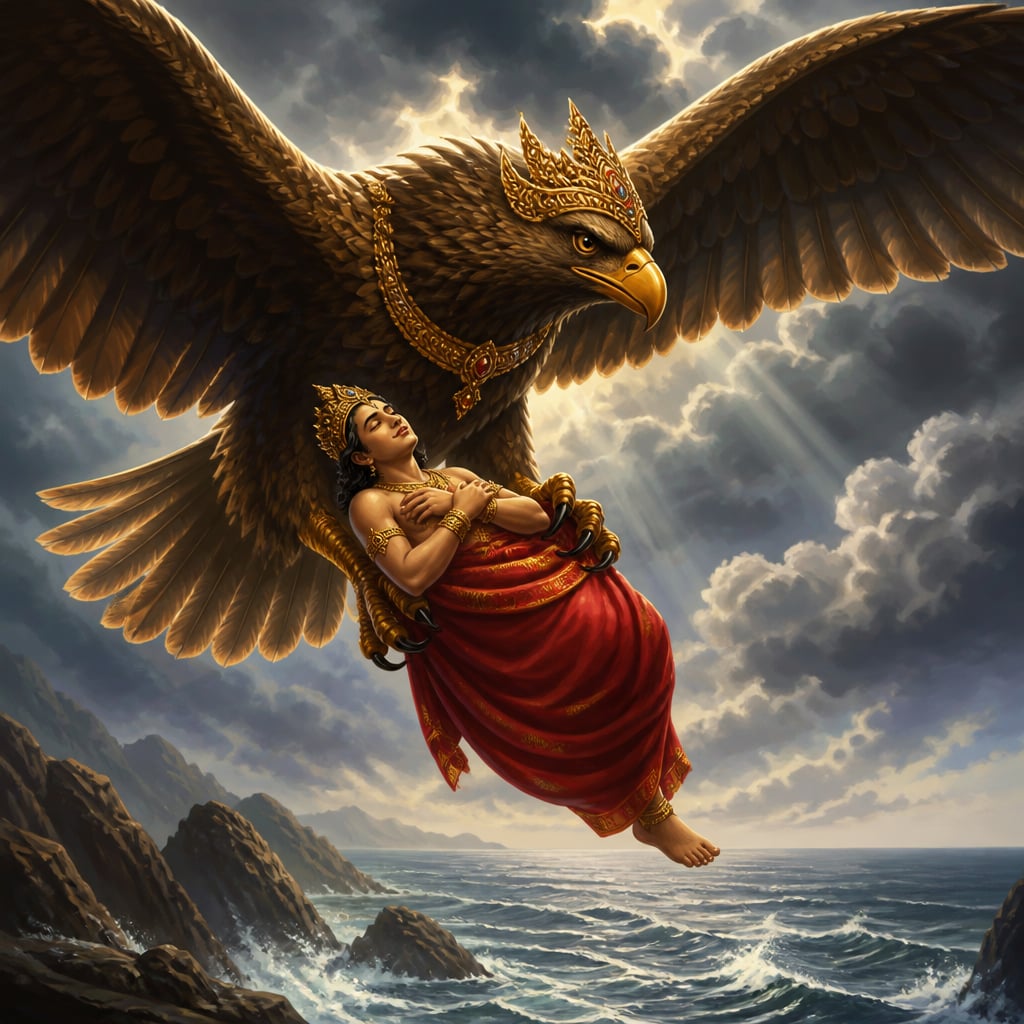
Shankhachuda protested. Who saves a common stone, he said, by throwing away a gem? But the prince would not be moved. When Garuda came, the wind of his wings bending the trees, the great eagle seized the prince and bore him up to a mountain peak to devour him. And there a strange thing happened: the prince lay joyful and unafraid, so calm under that terrible beak that even Garuda paused, astonished, and asked who he was.

Meanwhile Shankhachuda came back from his prayers and found the rock stained with blood, and understood at once what had been done for him. He did not bless his luck and slip away to safety. He ran. He followed the trail of blood up the mountain, far and steep, until he reached Garuda, and he cried out: stop. I am the serpent meant for you. Set him down. Take me.

The goddess Gauri, moved by all she saw, sprinkled the prince with nectar and raised him whole, and made him emperor over the Vidyadharas. And Garuda, ashamed to his core, vowed never again to devour a serpent, and the serpents dead on that shore rose living from their bones.
The Betaal's Riddle
"So, king," said the Vetala. "Two beings offered their lives on that mountain. The prince Jimutavahana, who lay down for a stranger. And the serpent Shankhachuda, who, already saved, ran back to give his life after all. Which of the two showed the greater fortitude?
Answer, if you know. You know the rules."
You Be the Judge
Hold the story here, before the king answers. One is a prince famed through three worlds for laying down everything he owns. The other is an ordinary serpent-youth who had been rescued, who could simply have lived. Whose courage, when you truly weigh it, stood the higher?
Vikram's Verdict
"The serpent, Shankhachuda," said Vikramaditya. "And I know how that sounds, to rank a frightened serpent-youth above a prince the three worlds sing of. Hear me out.
"Jimutavahana is a wonder, but his sacrifice is not a surprise. He has been this person for many lives. Giving himself away is simply what he is; compassion is his nature, worn smooth by a hundred births. For him to lie down on that rock was the easiest hard thing in the world, because it was already who he was.
"Now weigh Shankhachuda. He was the one marked to die, and then he was spared, carried out of death's reach by another's gift. He had his life back in his hands. Every instinct a living creature owns was telling him to keep it, to go home to his mother, to breathe. And instead he turned and ran back up that mountain, chasing the eagle, to climb again onto the death he had just escaped. That is the harder thing by far. To offer your life once, caught in the grip of a moment, is great. To be given it back, and then to go and offer it a second time, against every pull to live, is greater. The prince conquered a stranger's death. The serpent conquered his own will to survive. That is the higher fortitude."
As the last word left him, the corpse was already gone, back to its branch.
The Dharma
This verdict overturns something we do almost without thinking. We give our highest praise to those for whom goodness looks effortless: the born saint, the natural genius, the one who seems made of virtue. There is a real wonder in such people. But the king points to a harder and more honest truth. Goodness that comes easily, however lovely to watch, asks little of the one who has it. The goodness that counts for most is the kind wrung out of a reluctant heart.
Jimutavahana was the born saint. Compassion was his svabhava, his very nature, worn smooth over a hundred lives, so lying down on that rock cost him almost nothing; it was simply what he was. Shankhachuda was an ordinary creature who wanted to live, and doing the right thing once took everything he had. That is the whole difference. The prince gave from a full and easy hand; the serpent gave from a heart that shook. This is dhairya, fortitude, seen for what it truly is: not the grand gesture of a natural hero, but the steadiness of an ordinary soul who does the hard thing the one time it is asked of him.
In Your World
Think about who you actually admire, and how much of it is deserved. We praise the naturally gifted student who never had to open a book, and overlook the struggling one who fought for every mark. We celebrate the rich man's easy gift and miss the poor woman who gave what she could not spare. Effortless virtue draws the applause, and the harder, costlier kind goes unremarked.
Learn to look, as the king looked, at what a thing cost the one who did it. When you weigh your own goodness, be honest about how much of it is simply easy for you, temperament dressed up as virtue, and how much is a real choice made against a real pull. And when you weigh others, save your deepest respect for the ones doing the quiet, hard, unapplauded thing when nothing in them wants to. One hard act from an ordinary person can be worth more than a lifetime of easy goodness.
Reflection
- You judged the two before the king spoke. Did you crown the famous self-sacrificer, or the ordinary one who did the harder thing against his own nature?
- Whose small, hard-won goodness in your life have you overlooked because someone more naturally gifted stood beside them?
- Where have you done good easily, and taken credit as though it cost you, when the real credit belongs to those for whom the same thing costs everything?