Who Can Cross?
Measuring the Vanaras' Powers
With Lanka's location known, the challenge becomes clear: who can leap 100 yojanas across the ocean? Each vanara states his maximum distance, Angada 80 yojanas, Jambavan 70 in his prime, but none can reach 100. Only one has the power, if only he knew it.
The New Challenge
Hope has returned, but with it comes a new problem. Sampati has given them the location. Lanka lies one hundred yojanas across the ocean. Sita waits there in a garden of ashoka trees. The mission is clear: someone must cross the ocean, find Sita, confirm her presence, and return with news.
But one hundred yojanas is an impossible distance. No vanara has ever leaped so far. The greatest athletes among them might manage forty or fifty yojanas on a good day. But one hundred? It seems beyond the realm of possibility.
Jambavan, ever practical, takes charge. "Let us not despair before we have measured ourselves. Each of us carries power in our muscles, energy in our souls. Let us hear what each can do. Perhaps among all of us, there is one who can make this leap." The vanaras gather in a circle on the shore. One by one, they begin to state their capabilities.
The Count of Powers
The first vanaras step forward. A young warrior speaks first: "I believe I can leap twenty yojanas. Perhaps twenty-five if the wind favors me." Twenty yojanas, impressive for an ordinary vanara, but far short of one hundred. Then another: "Thirty yojanas. That is my limit." Then another, and another. The numbers grow: forty, forty-five, fifty. But fifty is still only half the distance.
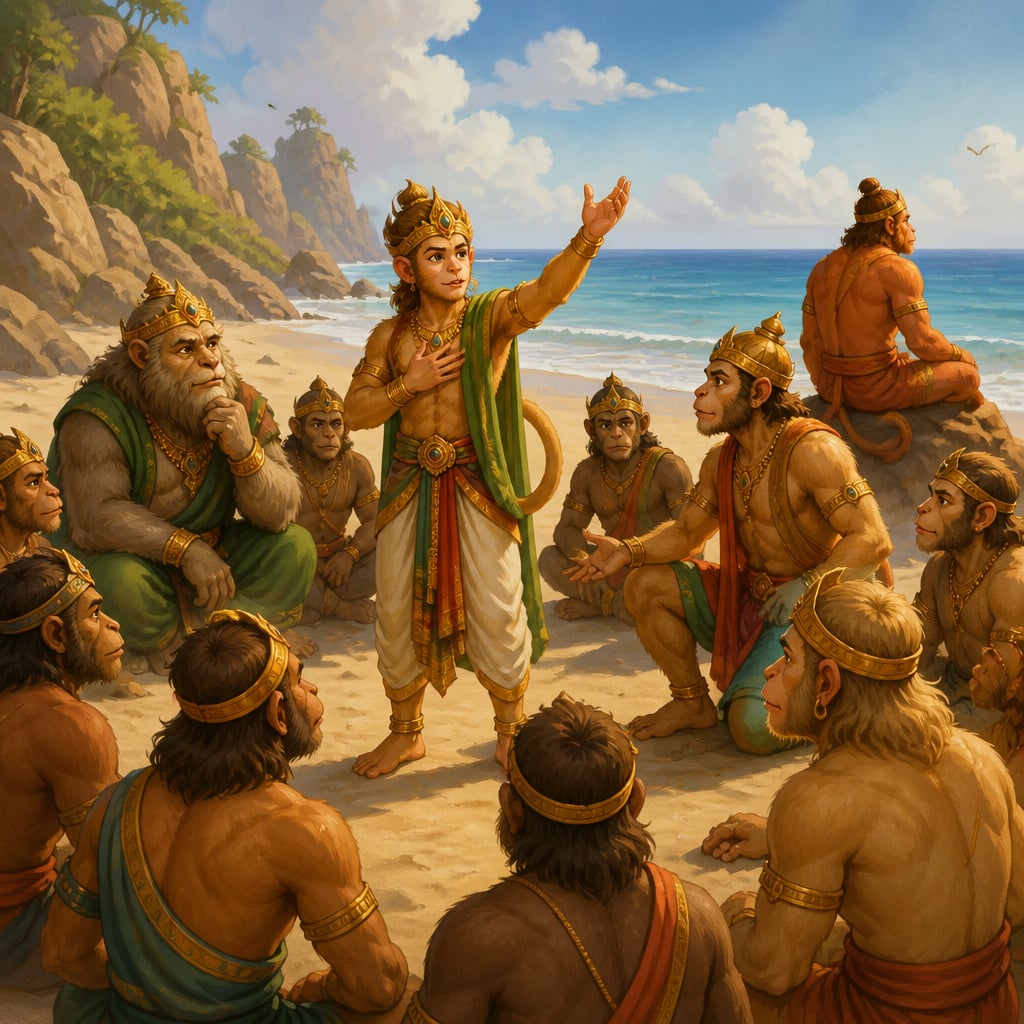
Nila, son of the fire god Agni, steps forward with more confidence. "I have fire in my blood. I can leap far and fast. I believe sixty yojanas is within my power." Sixty! The vanaras murmur with hope. Perhaps there is someone who can do more? But Nila shakes his head. "Sixty is my honest estimate. To claim more would be to lie. And even sixty would leave me stranded forty yojanas from Lanka, falling into the sea."
Angada, the crown prince, steps forward. As Vali's son, he carries the blood of the mightiest vanara who ever lived. If anyone should be able to make this leap, surely it is him. "I have assessed my power carefully," Angada says. "I believe I can leap eighty yojanas." Eighty! The closest yet to the target. But Angada continues, his face grave. "Eighty yojanas is my outward limit. But the mission requires not just reaching Lanka, it requires returning with news. If I leap eighty yojanas to reach the island, I will have nothing left for the return journey. I would be stranded, unable to complete the mission." The hope fades. Eighty is not enough.
Jambavan speaks next, but not to boast, to remember. "In my youth, I was mighty beyond description. I once circled the earth in Vishnu's service when he took the form of Vamana. I leaped mountains and oceans without tiring. In those days, I could have crossed this ocean and returned before sunset. One hundred yojanas would have been a morning's exercise. But those days are gone. My age has caught up with me. Today, I might manage fifty or sixty yojanas, enough to die heroically in the middle of the ocean, but not enough to complete the mission."
The assessment is complete. The best among them, Angada, can leap eighty yojanas. But one hundred is required for the outward journey alone. With the return trip, the true need is two hundred yojanas of leaping power. No one has come close. The cruel irony sinks in. They are tantalizingly close to success, the goal is visible, the destination known, but the final gap cannot be crossed.
The Silent One
Throughout the assessment, one vanara has said nothing.

Hanuman sits apart from the others, staring at the ocean. He has not offered his estimate. He has not joined the discussion. He seems lost in thought, or perhaps lost in something deeper.
Jambavan notices this silence. And as he watches Hanuman, a memory stirs. An ancient memory. A piece of knowledge he has carried for ages, waiting for the right moment to use it.
The son of the wind god...
The child who flew toward the sun...
The curse that made him forget...
Jambavan's eyes widen. Could it be? Could the answer have been sitting among them all along, silent and unknowing?
The Question
Jambavan walks toward Hanuman, and the other vanaras turn to watch. There is something in the ancient bear's manner, a purposefulness, an intensity, that catches everyone's attention.
"Hanuman," Jambavan says, his voice carrying across the shore. "Son of Kesari and Anjana. Child of the wind god Vayu."
Hanuman looks up, puzzled by this formal address.
"Why have you said nothing? We have heard from warriors young and old, weak and strong. But you, the mightiest among us, have remained silent."
Hanuman blinks in confusion.
"Mightiest? No, Jambavan. I am a humble servant of Sugriva. My strength is ordinary. I did not speak because I have nothing special to offer."
Jambavan shakes his head slowly.
"That is where you are wrong, son of the wind. That is where you are very, very wrong."
The Hidden Truth
The other vanaras exchange confused glances. Hanuman is strong, certainly. He is devoted, brave, intelligent. But the mightiest? That seems like an exaggeration.
But Jambavan knows something they don't. Something that Hanuman himself has forgotten.
Long ago, when Hanuman was a child, he possessed powers beyond imagination. He could fly. He could change his size at will. He could challenge the sun itself.
But that power was taken from him, not destroyed, but hidden. A curse made him forget his own capabilities. And for all these years, Hanuman has lived as an ordinary vanara, unaware of the sleeping giant within him.
"There is more to you than you know," Jambavan says quietly. "And it is time for you to remember."
Hanuman stares at the ancient bear, something stirring in the depths of his consciousness. A distant memory. A flash of light. The heat of the sun on his face...
What has he forgotten?
On the Edge of Discovery
This is the moment everything hangs upon. The vanaras have the knowledge but lack the power. Or do they?
The power exists. It has always existed. It sits among them in the form of a humble vanara who believes himself ordinary, a servant who doesn't know he is a prince of the wind, a seeker who doesn't know he carries the strength of storms.
Jambavan holds the key to awakening this power. With the right words, with the right reminder, Hanuman can become what he truly is.
The ocean waits. Lanka waits. Sita waits.
And Hanuman is about to remember.
Thus ends the tale of Who Can Cross, where powers are measured, limits are reached, and one silent vanara holds the hidden answer to an impossible question.
Living traditions
The scene of vanaras honestly stating their capabilities is studied in management as a model of transparent team assessment. The principle that the silent one may hold the greatest power challenges assumptions about who speaks and who leads. Jambavan's wisdom in recognizing dormant potential resonates with modern coaching and mentorship. The moment prefigures Hanuman's transformation, which itself has inspired countless individuals facing seemingly impossible challenges to discover their own hidden capabilities.
- Honest Capability Assessment: The vanaras' practice of honestly declaring their capabilities before the mission reflects the dharmic principle of truthfulness (satya) in self-assessment, a value that continues in professional settings
- Mentorship and Potential Recognition: Jambavan's role in seeing Hanuman's hidden potential models the guru's function of recognizing and calling forth capabilities that the student doesn't yet see
- Rameshwaram: The traditional site from which Hanuman leaped to Lanka. The Ramanathaswamy Temple and Ram Setu point connect pilgrims to this pivotal moment when the vanaras debated who could cross.
- Jambavan Cave Temple: A cave associated with Jambavan, the ancient bear king who awakened Hanuman's memory. Pilgrims visit to honor his wisdom and to seek mentors who can see their hidden potential.
- Gandhamadana Parvatham: The hill from which Hanuman is traditionally believed to have launched his leap to Lanka. A temple with Hanuman's footprints marks the site.
Reflection
- Have you ever underestimated your own abilities? What helped you recognize what you were truly capable of?
- Why did Hanuman remain silent while others discussed their abilities? What does his silence reveal about the relationship between self-knowledge and true capability?
- What does it mean to have power you don't know you possess? How does Hanuman's forgotten potential reflect larger questions about hidden capacities within us?