Tara's Grief and Wisdom

The Queen Who Accepted Destiny

When Queen Tara learns of Vali's death, she rushes to his body with their son Angada. Her lamentation is among the most moving passages in the Ramayana - a wife's grief for a husband who ignored her warnings and died for his pride. Yet within her sorrow lies wisdom: she accepts what cannot be undone and becomes a voice for reconciliation and moving forward.

The Arrival

The sound of Vali's fall echoes through Kishkindha. Within the mountain palace, Queen Tara feels a cold certainty even before the messenger arrives.

"Your warning," she whispers to herself. "He did not heed your warning."

When the news comes - that Vali is fallen, struck by an arrow, lying on the battlefield - Tara does not cry out. She does not collapse. She rises, takes her son Angada's hand, and walks toward the gates.

Angada, barely more than a youth, asks through tears: "Mother, is father...?"

"Come," is all Tara says. "We must go to him."

The palace vanaras part before her. They see in her face something that commands reverence even in chaos - a dignity that tragedy cannot destroy. She walks through Kishkindha's gates, past the spot where her husband fell, toward where his body now lies surrounded by vanaras and the human strangers who have changed everything.

Sugriva sees her approaching and looks away. Whatever triumph he might feel is poisoned by the sight of his brother's widow and fatherless nephew. Rama watches with compassion. He knows what it is to lose - he has lost his father, his throne, his wife. He does not look away from suffering he helped cause.


The Lamentation

Tara kneels beside Vali's body. For a long moment, she is silent, her hand on his still face. Then the grief pours out.
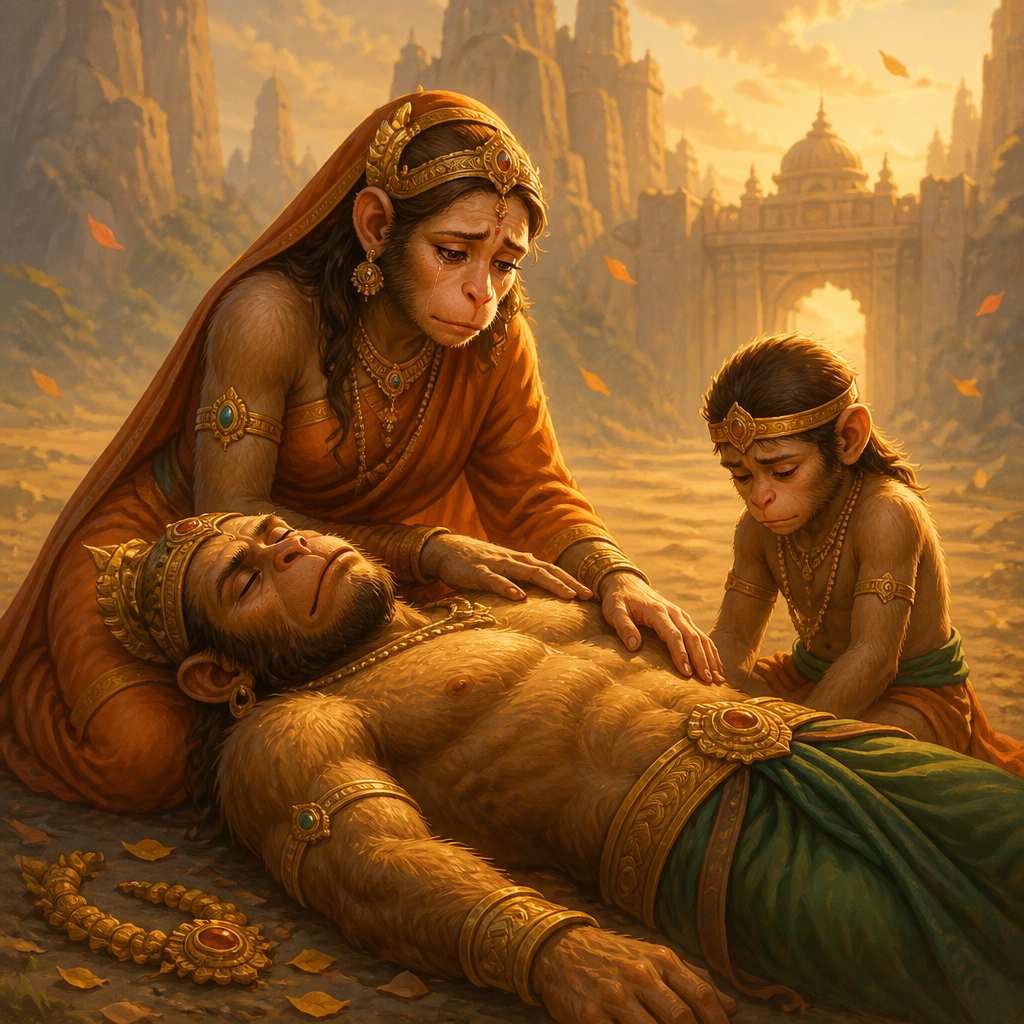
Tara kneels beside the body of Vali with Angada at her side and the broken golden garland between them.

"O king of the vanaras, hero of a hundred battles, how can you lie here in the dust? You who feared nothing - did you not fear this? You who conquered all enemies - how could you fall to a hidden arrow?"

Her voice rises, carrying across the battlefield.

"I warned you, my lord. I begged you not to go. I told you something had changed, that Sugriva would not challenge without new strength behind him. But you would not listen. Your pride was dearer to you than my counsel."

She strokes his face, her tears falling on his still features.

"Was I such a poor wife that my words meant nothing? Did my years of devotion earn no weight against your certainty? You trusted your boon, you trusted your strength, but you would not trust your wife. And now you are gone, and I am left to mourn not just your death but your stubbornness that caused it."

But even in accusation, love persists.

"Yet how can I blame you, my lord? You were what you were - proud, fierce, magnificent. I did not marry a cautious man. I married a king who answered every challenge, who feared no enemy, who blazed through life like a fire. That same fire has burned out now, and the world is colder for its absence."

She turns to Angada.

"Look at your father, my son. Remember him as he was - not this silent form, but the king who held you on his knee, who taught you to fight, who loved you even when his rage consumed all else. He was not perfect. No one is. But he was your father, and he loved you."

Angada kneels beside his mother, tears streaming down his young face.


Confronting Rama

Tara rises and turns to face Rama. The gathered vanaras hold their breath - what will this grieving queen say to her husband's killer?

Her voice is steady.

"You are Rama. I know who you are - dharma's avatar, as they say. You have killed my husband from hiding, while he fought another. I will not debate whether this was just - my lord has already debated this with you, and in the end he accepted your arguments."

She pauses.

"But I will ask you this: was there no other way? Could you not have spoken to him first, tried to make peace between the brothers before resorting to arrows? My husband was proud, yes, but he was not deaf to reason when reason was sincerely offered."

Rama's answer is gentle.

"Perhaps, Queen Tara. Perhaps if I had approached him, he might have listened. But consider: you yourself warned him, and he did not listen. You, who had his love and trust, could not reach him. Would a stranger have succeeded where a wife failed?"

The truth of this strikes Tara. She bows her head.

"You are right. His pride was a wall that even I could not breach. Perhaps... perhaps only death could break it. In his final moments, my lord asked Sugriva's forgiveness and offered his own. Perhaps your arrow gave him what years of living could not - clarity."


The Wisdom Emerges

Something shifts in Tara. The raw grief begins to transform into something else - not acceptance in the sense of approval, but acceptance in the sense of recognizing what cannot be changed.

"What is done is done," she says, her voice taking on a new quality. "My husband is gone. No tears will bring him back. No rage will undo the arrow. The question now is: what happens next?"

She looks at Sugriva - the brother-in-law who was once almost a brother, then an enemy, now about to become king.

"Sugriva, you will rule Kishkindha. My husband's kingdom becomes yours. I will not fight this - it was perhaps always meant to be so, though the path was cruel. But I ask one thing: treat Angada well. He is your brother's son, your own blood. Do not punish him for his father's deeds."

Sugriva, moved by her dignity, responds immediately.

"Tara, Angada will be as my own son. More - he will be my heir until I have a son of my own. Vali's line will not end. His legacy will continue through Angada. I swear this before Rama and all these witnesses."

Tara considers her own future. As Vali's widow, she has options - some traditions expect her to withdraw from worldly life, others to follow her husband in death. But Tara is practical as well as grieving.

"I will stay," she declares. "Not from lack of love for my husband, but from duty to my son and to Kishkindha. This kingdom needs wisdom in the days ahead. The transition will be difficult. If I can serve by advising, by helping, by smoothing what might otherwise be rough - then that is my dharma now."

Rama speaks: "Queen Tara, your wisdom does you honor. Kishkindha is fortunate that you choose to remain. A kingdom that has lost a king needs a queen's steadiness more than ever."


The Funeral and Looking Forward

The vanaras prepare Vali for his final rites. As a king and a son of Indra, he receives full royal honors. The pyre is built of sandalwood. Sacred mantras are chanted.

Tara lights Vali's funeral pyre at dusk

Tara lights the flame - a wife's final duty to her husband. She watches the fire consume what was once the mightiest vanara in the world.

"Go to the heavens, my lord," she whispers. "Go to your father Indra's realm. Leave behind your anger, your pride, your grievances. Take only the love that was real between us. I will care for our son. I will honor your memory. And when my time comes, perhaps we will meet again in some better world."

The flames rise, carrying Vali's spirit upward. As the funeral concludes, the reality of the new situation settles in. Vali is gone. Sugriva is king. Kishkindha must adjust to this transformation.

Tara takes Angada's hand again.

"Come, my son. We have mourned as we should. Now we must live as we must. Your uncle will need advisors. You will need to learn kingship, for you are now crown prince. The path ahead is not what we expected, but it is the path we have."

Angada looks back at the fading pyre.

"Mother, do you forgive them? Uncle Sugriva? Prince Rama?"

Tara's answer comes slowly.

"Forgiveness is not a single act, my son. It is a practice. Today I accept what has happened. Tomorrow I will try not to let anger consume me. The day after, I will look for good in those who harmed us. Forgiveness is a journey, not a destination. We are at its beginning."

She leads her son back toward the palace - a palace that belongs to others now, but where her wisdom will still have a place.

Living traditions

Tara's approach to grief - full expression followed by acceptance and constructive engagement - parallels modern therapeutic models like Acceptance and Commitment Therapy (ACT). Indian psychologists cite her as an indigenous example of healthy grief processing. Her decision to remain as advisor rather than withdraw models resilient adaptation to changed circumstances. Women's leadership programs reference Tara's diplomatic skills in navigating the transition from one regime to another.

Reflection

More in Kishkindha Kanda

All lessons in Kishkindha Kanda · The Ramayana course