The Great Assembly

Gathering of the Vanara Hosts

With his pledge renewed, Sugriva summons vanara leaders from every direction. The mightiest warriors and wisest counselors gather in Kishkindha to plan the systematic search for Sita across all lands.

The King's Command

The monsoon has passed. The skies have cleared. And Sugriva, reminded forcefully of his promise by Lakshmana's fiery words, finally acts. Standing at the highest point of Kishkindha, he raises his voice in a call that echoes across mountains and valleys, a summons to every vanara who owes allegiance to the throne.

"Let messengers go forth," he commands. "To every mountain where our people dwell, to every forest where vanaras roam, to every corner of the earth where our kind has made their home. Summon them all. The King of Kishkindha requires their service."

The messengers depart like golden streaks against the blue sky, vanaras swift as thought itself, racing in all directions. They carry Sugriva's words to distant lands: Come. The king commands. A great task awaits.

The Gathering Begins

Within days, the response begins. From the peaks of Mount Mahendra in the east come the vanaras who have watched the sun rise over ocean waters. From the heights of the Vindhya range arrive the fierce warriors who guard the central forests. From distant Meru, where eternal snows cap the mountains, descend vanaras who have never felt tropical heat.

They come in hundreds, then thousands, then millions beyond counting.
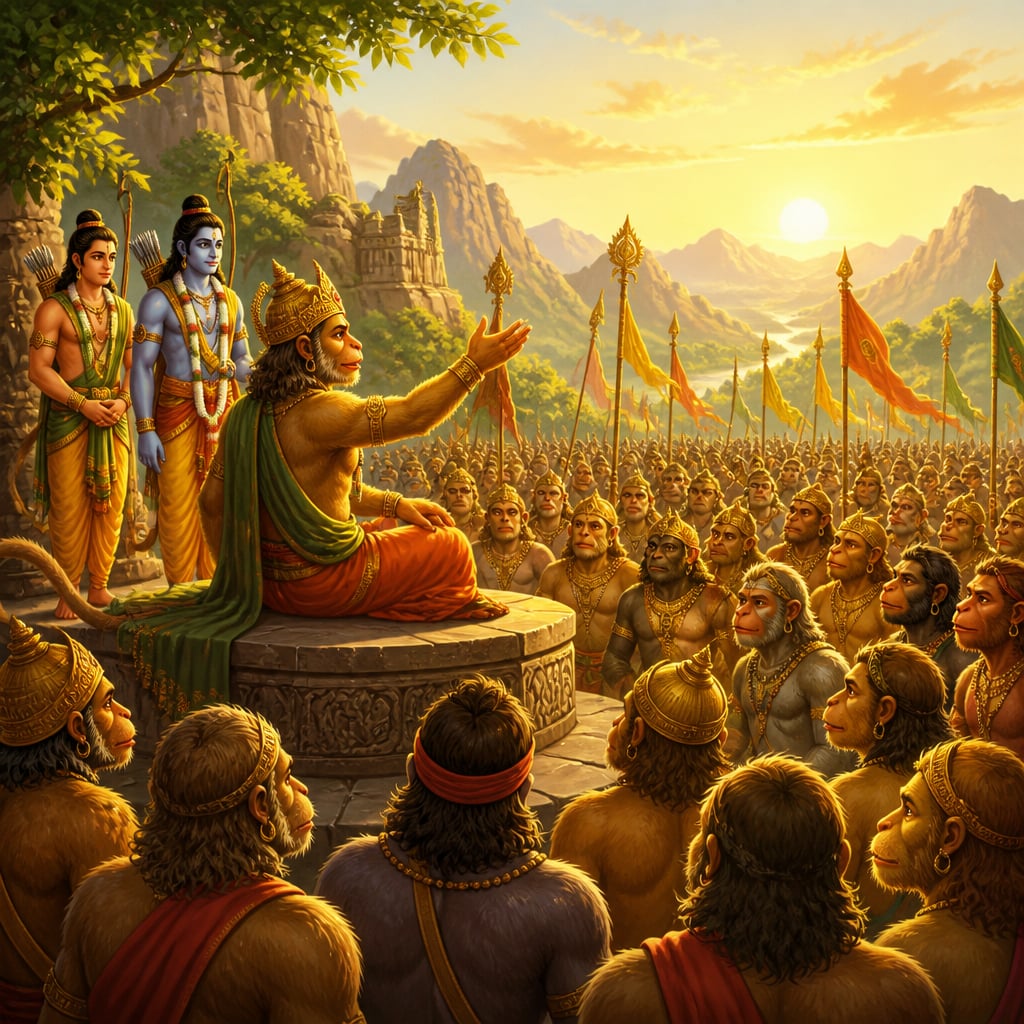
Sugriva addresses a vast host of vanara warriors arrayed across a mountain plateau outside Kishkindha.

"Koti upon koti," the court scribes attempt to record. "Ten million upon ten million." But the numbers soon exceed any count. The forests around Kishkindha fill with vanara camps. The trees bend under the weight of warriors finding perches. The very mountains seem to breathe with the presence of countless beings.

Rama watches this gathering with wonder. He has seen armies before, the forces of Ayodhya, trained and disciplined. But this is something different. This is a force of nature, a living flood of golden-furred warriors arriving from every direction.

"How many are there?" Lakshmana asks, attempting to estimate the numbers.

Sugriva smiles with a king's pride. "Enough," he says simply. "Enough to search every corner of the world. Enough to challenge any enemy. Enough to fulfill my promise to your brother."

The Leaders Arrive

Among the countless warriors, certain figures stand out. These are the vanara chiefs, leaders of clans, commanders of hosts, beings of legendary power who have earned their positions through strength, wisdom, or divine origin.

Nila, son of the fire god Agni himself, arrives with an army from the western forests. His fur seems to glow with inner flame, and where he walks, flowers bloom from the heat he radiates. He is young among the chiefs but fierce beyond measure.

Nala, master builder and engineer, comes from the southern reaches. His mind works differently from other vanaras, where they see chaos, he sees patterns; where they see obstacles, he sees solutions. His skills will prove crucial in ways none yet imagine.

Gavaya, massive and powerful, leads the mountain vanaras who dwell in the highest peaks. These are the strongest of their kind, accustomed to thin air and harsh conditions, unafraid of any physical challenge.

Sharabha, swift and cunning, commands the forest scouts who know every hidden path and secret trail. His warriors can track a bird through the sky or a fish through water.

And then there are the three who will matter most:

Jambavan, the ancient bear king, older than memory itself. Some say he witnessed the churning of the cosmic ocean. Some say he walked the earth before the mountains rose. His wisdom runs deeper than rivers, and his strength, though hidden beneath aged fur, remains legendary.

Angada, prince of Kishkindha, son of the slain Vali. Young and burning with complicated emotions, grief for his father, loyalty to his uncle, uncertainty about his place, he carries the weight of succession on shoulders still growing into their strength.

And Hanuman. The son of the wind. The humble servant who does not yet know the depths of his own power. He stands slightly apart from the other chiefs, watching Rama with an intensity that borders on worship.

The Court of War

Sugriva calls a formal assembly. The great cave-palace of Kishkindha, carved by ancient waters and expanded by generations of vanaras, fills with the mightiest warriors of their race. Rama and Lakshmana sit in places of honor, human princes amid a sea of vanara nobility.

"Brothers," Sugriva addresses the gathering. "You know why you have been summoned. A great wrong has been committed. The wife of Lord Rama, he who saved my life and restored my kingdom, has been stolen by the demon Ravana. We are pledged to find her and bring word of her location. This is our sacred duty."

The vanaras listen in silence. They have heard of Rama, of course, news travels quickly among their kind. They know he is an avatar of something greater than human, though they may not understand exactly what. They know he slew Vali, ending a reign that had grown tyrannical. They know Sugriva owes him everything.

But more than political calculation moves them. There is something about Rama's presence, a quality that draws loyalty as naturally as flowers turn toward the sun. The vanara chiefs find themselves wanting to serve him, eager to undertake this quest, though they cannot fully explain why.

"Where do we search?" asks Nila, ever practical.

"Everywhere," Sugriva answers. "We will divide our forces among the four directions. Each division will search its assigned realm thoroughly, leaving no mountain unclimbed, no forest unexplored, no cave uninvestigated. Somewhere in this world, Ravana has hidden Janaki. We will find her."

Rama's Hope

After the formal assembly, Rama speaks privately with Sugriva.

"I am grateful," he says, "for this display of your power and your commitment. I had not imagined the vanara nation was so vast."

Sugriva nods. "We are spread across the world, prince. Our ancestors traveled far, establishing communities in every land that would have them. Some dwell in tropical forests, others in mountain heights, still others in places humans have never seen. All owe allegiance to the throne of Kishkindha, and all have answered my summons."

"The demon who took Sita is powerful," Rama says carefully. "Ravana is no ordinary rakshasa. He rules Lanka, an island fortress of terrible strength. His armies are vast, his magic formidable. Finding Sita is only the first step. Reaching her, rescuing her, will be far harder."

"One step at a time," Sugriva counsels. "First we find. Then we plan. The vanaras have faced mighty enemies before. We do not fear rakshasas."

Hanuman, listening nearby, speaks quietly: "We do not fear anything, Lord, when we serve a righteous cause."

Rama turns to look at the vanara who has spoken. Something passes between them, a recognition, a connection, a bond that transcends the moment. Rama sees in Hanuman's eyes a devotion so pure it almost burns.

"I believe you," Rama says simply. And in those three words lies the seed of everything that will follow.

The Night Before Departure

As the sun sets over Kishkindha, the assembled host prepares for the mission ahead. Vanaras sharpen their claws, test their strength, discuss strategies with their commanders. The atmosphere mixes military precision with something almost festive, the excitement of a great undertaking.

Rama walks among them, accompanied by Lakshmana. Wherever he goes, vanaras fall silent, bow their heads, reach out to touch his shadow as if it carried blessing. Word has spread of who he is, of what he represents. These are not merely monkeys playing at war. These are beings who sense the divine and respond to it.

"They love you," Lakshmana observes.

"They love what I represent," Rama corrects gently. "Dharma. The hope that righteousness can prevail. They have lived under Vali's increasingly harsh rule for years. They have seen that might does not always make right. Now they see a chance to serve something greater than power, and they respond."

"But will it be enough?" Lakshmana asks. "Millions of vanaras against the armies of Lanka?"

Rama looks out at the gathered host, firelight reflecting off countless golden-furred forms. "Sita is not rescued by numbers," he says. "She is rescued by devotion. By courage. By the willingness to attempt the impossible. Among all these millions, I believe there is one who will reach her. One whose devotion is pure enough to accomplish what armies cannot."

Hanuman sits apart from the host, gazing up at the stars

His eyes find Hanuman in the crowd, sitting slightly apart, gazing up at the stars with an expression of peaceful certainty.

"Him?" Lakshmana follows his brother's gaze. "The son of the wind?"

"Perhaps," Rama says. "We shall see. Tomorrow, the search begins."

Living traditions

The vanara assembly's model of gathering diverse leaders under shared purpose influences modern organizational theory. Indian corporations and institutions reference the sabha tradition in their governance. The geographic knowledge displayed in the Ramayana's description of vanara homelands demonstrates ancient India's cartographic awareness. The decimal 'koti' system used to count vanaras reflects mathematical sophistication that predated most world number systems. Modern large-scale coordination efforts - from disaster relief to space missions - echo the logistics of Sugriva's mobilization.

Reflection

More in Kishkindha Kanda

All lessons in Kishkindha Kanda · The Ramayana course