Hanuman Grows
Transformation of the Mighty Vanara
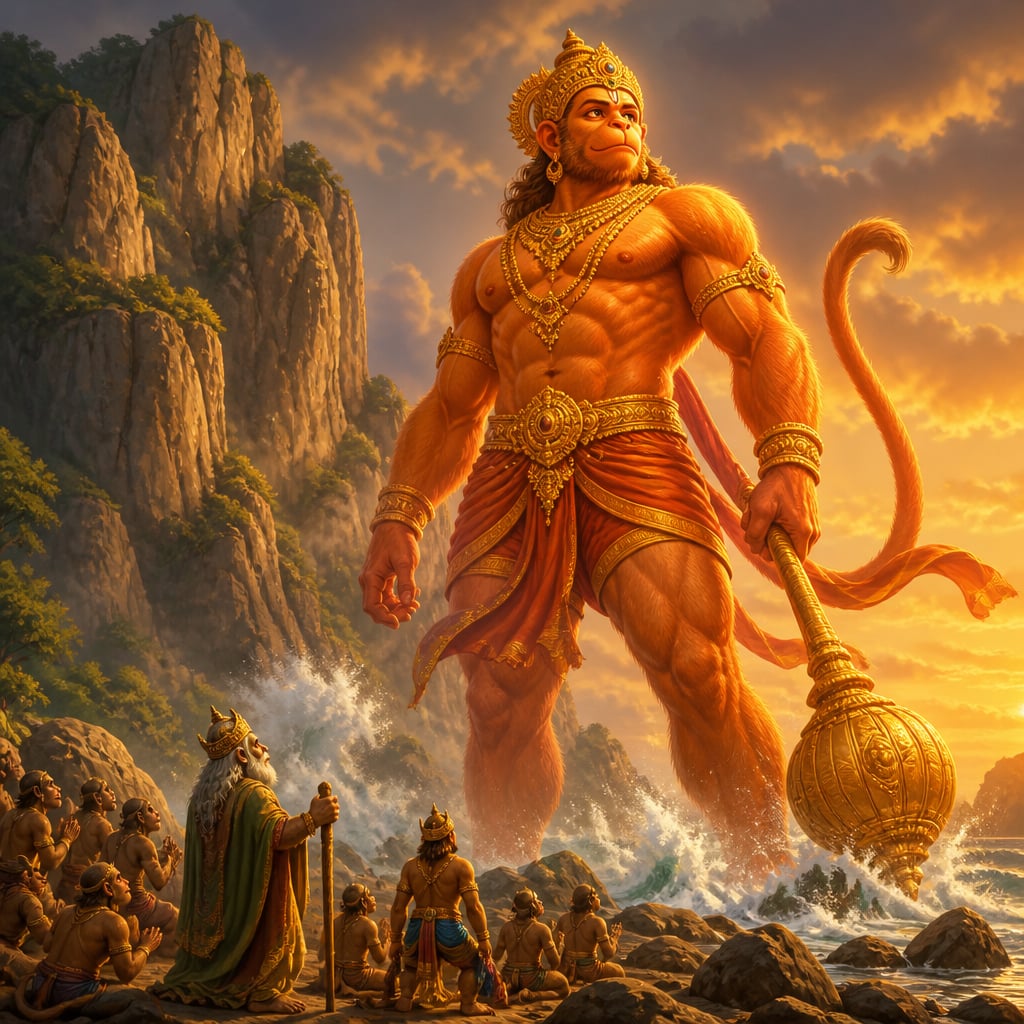
As Hanuman remembers his divine powers, his body begins to grow. The humble vanara expands to mountainous size, his golden form blazing like the rising sun. The other vanaras watch in amazement as Hanuman's true form is revealed.
The Transformation Begins
The vanaras have stopped breathing. Hanuman stands before them, the same Hanuman they have known for years, the quiet servant of Sugriva, the humble messenger who never boasted of his strength. But something is happening to him.
As Jambavan's words settle into his consciousness, as the memories of his childhood flood back, Hanuman's body begins to change. It starts slowly, a straightening of the spine, a squaring of the shoulders, a lifting of the chin. Then it accelerates.
Hanuman's body begins to expand. Not metaphorically, not symbolically, literally. His muscles swell. His frame stretches. His form grows larger and larger with each passing moment. "By the gods..." one vanara whispers. "He's growing... he's actually growing!" The vanaras step back as Hanuman rises above them. One foot tall. Two feet. Four. Eight. Sixteen. He grows past the height of the tallest vanara. He grows past the height of trees. He grows until his head blocks out the sun and his shadow covers the entire assembly.
Mountain-Like Form
When the growth finally slows, Hanuman stands before them like a mountain made flesh. His golden fur blazes like fire in the sunlight. His eyes burn with an inner flame, not anger, but purpose. His tail, massive now, curls behind him like a second mountain range.
The vanaras crane their necks to look up at him, and many fall to their knees in awe. "This is... this is what was hidden within you?" Angada gasps. "All this time?" Hanuman's voice, when he speaks, is like thunder rolling across the sky. "This is who I was before I forgot. This is who I have always been. This is who I am."
Something happens among the vanaras, a shift from astonishment to reverence. They have just witnessed a miracle. The ordinary has revealed itself to be divine. They begin to praise Hanuman, and their praise seems to fuel his growth even more. "Victory to Hanuman!" they cry. "Victory to the son of Vayu! Greatest of vanaras! Mightiest of warriors! He will cross the ocean! He will find Mother Sita!" Each cry of praise adds energy to Hanuman's form. He doesn't just grow in size, he grows in radiance. His entire body begins to glow, blazing like the sun itself. Jambavan watches with quiet satisfaction. The awakening is complete.
Hanuman's Declaration
The transformed Hanuman surveys the ocean before him. One hundred yojanas of water that seemed impossible just moments ago now appears... manageable.
He speaks, and his voice carries across the shore, across the waves, perhaps across the ocean itself.
"I am Hanuman, son of Vayu, the Wind God. In prowess, I am equal to Indra, king of heaven. In speed, I match my father himself."
This is not boasting. This is statement of fact. Hanuman is not claiming powers he doesn't have, he is finally acknowledging powers he always had.
"I will leap to Lanka. I will find the daughter of Janaka. I will bring news to Lord Rama. And nothing, nothing in the three worlds, will stop me."
The Inner Transformation
The physical growth is spectacular, but the inner transformation is even more profound. Hanuman has lived his whole life believing himself ordinary. Every day, he walked among warriors, served kings, and never suspected he was mightier than all of them combined. The curse had made him forget not just his powers but his very nature.
Now that curse is broken. Hanuman knows who he is. And knowing changes everything. His movements become more confident. His stance more commanding. His eyes, which once looked down in humble service, now look straight ahead with fierce determination. This is what awakening looks like. Not just remembering facts about yourself, but becoming who you truly are.
As Hanuman prepares for his leap, the last traces of doubt fall away from him. The old Hanuman would have worried: What if I fail? What if I fall into the ocean? What if Ravana is too powerful? The awakened Hanuman has no room for such thoughts. His mind is filled with one thing only: the mission. Find Sita. Bring news to Rama. Fulfill the promise. Doubt requires belief in limitation. And Hanuman no longer believes he has limits.
But there is something else that powers his transformation, something beyond remembered abilities and restored confidence. It is purpose. Hanuman is not growing large just because he can. He is growing large because he must. Mother Sita waits across the ocean. Lord Rama grieves in Kishkindha. The dharma of the universe is out of balance. Hanuman's power awakens not for his own glory but for service to something greater. This is the deepest teaching of his transformation: Power finds its fullest expression when directed toward righteous purpose.
At the Summit
Hanuman turns toward Mount Mahendra, the great peak that rises from the southern shore. From its summit, he will launch himself toward Lanka. He begins to climb, or rather, he begins to stride. Each step covers vast distances. The mountain that would take ordinary creatures hours to climb, he ascends in moments.
The vanaras follow at a distance, watching in wonder as their champion prepares for the impossible leap. "Do you think he can really do it?" one young vanara asks Jambavan. "I know he can," the old bear replies. "I have always known. I was just waiting for him to know it too."

Hanuman reaches the peak of Mount Mahendra and stands at its highest point. The ocean spreads before him, vast and gleaming in the sunlight. Somewhere beyond that water, invisible but certain, lies Lanka. He closes his eyes for a moment. In his mind, he sees Rama's face, the gentle prince who trusted him with his ring, who believed in him before he believed in himself. "For you, my lord," Hanuman whispers. "Everything I do is for you."
This moment, Hanuman standing at the edge of Mount Mahendra, the ocean roaring below, Lanka waiting beyond, is one of the most iconic images in all of Hindu literature. A humble servant has become a cosmic hero. A forgotten power has been remembered. An impossible task is about to be attempted.
The vanaras on the shore below hold their breath. The waves seem to pause. Even the wind, Hanuman's father, seems to still in anticipation. Hanuman crouches, gathering his strength. His muscles coil like springs. His tail raises for balance. His eyes fix on the distant horizon. The leap is coming.
Thus ends the tale of Hanuman Grows, where the hidden becomes visible, where the humble reveals its divinity, and where a servant becomes equal to the gods.
Living traditions
Hanuman's physical transformation inspires personal development philosophies worldwide. The image of inner potential manifesting outwardly resonates with modern concepts of self-actualization. Wrestlers and athletes invoke Hanuman before competitions, seeing him as the embodiment of strength awakened through devotion. The transformation scene is frequently depicted in Ramlila performances, where actors use staging techniques to show Hanuman's growth. The message that true confidence and true capability rise together influences leadership training and coaching methodologies.
- Hanuman's Transformation in Art and Iconography: The image of Hanuman growing to enormous size is one of the most depicted scenes in Hindu art. Temple sculptures, paintings, and modern images show him expanding from humble form to cosmic proportions
- Mahima Siddhi in Yoga Tradition: The power to expand one's body (mahima) demonstrated by Hanuman is one of the ashta-siddhis (eight supernatural powers) described in yogic texts like the Yoga Sutras
- Sankat Mochan Temple: One of the most revered Hanuman temples where devotees witness his mighty form and seek his strength for their own challenges. The temple evokes Hanuman's transformation from humble to mighty.
- Hanuman Dhara: A hillside temple with a natural waterfall, associated with Hanuman's power and devotion. The climb to reach it evokes the effort required for transformation.
- Panchamukhi Hanuman Temples: Temples depicting Hanuman's five-faced form (Panchamukhi) represent his cosmic expansion and divine powers. These forms emerged during his transformation.
Reflection
- Have you ever experienced a moment when you suddenly felt capable of something that previously seemed impossible? What triggered that shift?
- Why did the vanaras' praise help Hanuman grow 'even more'? What role does recognition play in unlocking potential?
- Is there a difference between arrogance and justified confidence? When Hanuman declares himself equal to Indra, is this pride or truth-telling? How can we distinguish them?