The Four Directions

Assigning the Great Search

Sugriva divides his vanara army into four great divisions, sending each to one of the cardinal directions. He describes in detail the lands, mountains, rivers, and peoples each party will encounter, revealing the ancient Indian understanding of world geography.

The World Awaits

With millions of vanaras assembled and ready, Sugriva faces his greatest challenge as king, not in battle, but in strategy. Finding one person hidden somewhere in the vast world requires more than strength. It requires knowledge, planning, and organization.

Sugriva rises from his throne, his voice carrying across the assembled multitudes.

"Listen well, mighty vanaras! The search for Mother Sita cannot be left to chance. We must cover every corner of the earth, every forest, every mountain, every island, every cave. No place must remain unsearched!"

He divides his army into four great divisions, one for each cardinal direction. Each division numbers in the hundreds of thousands. Each will have its own leader, its own route, its own challenges.
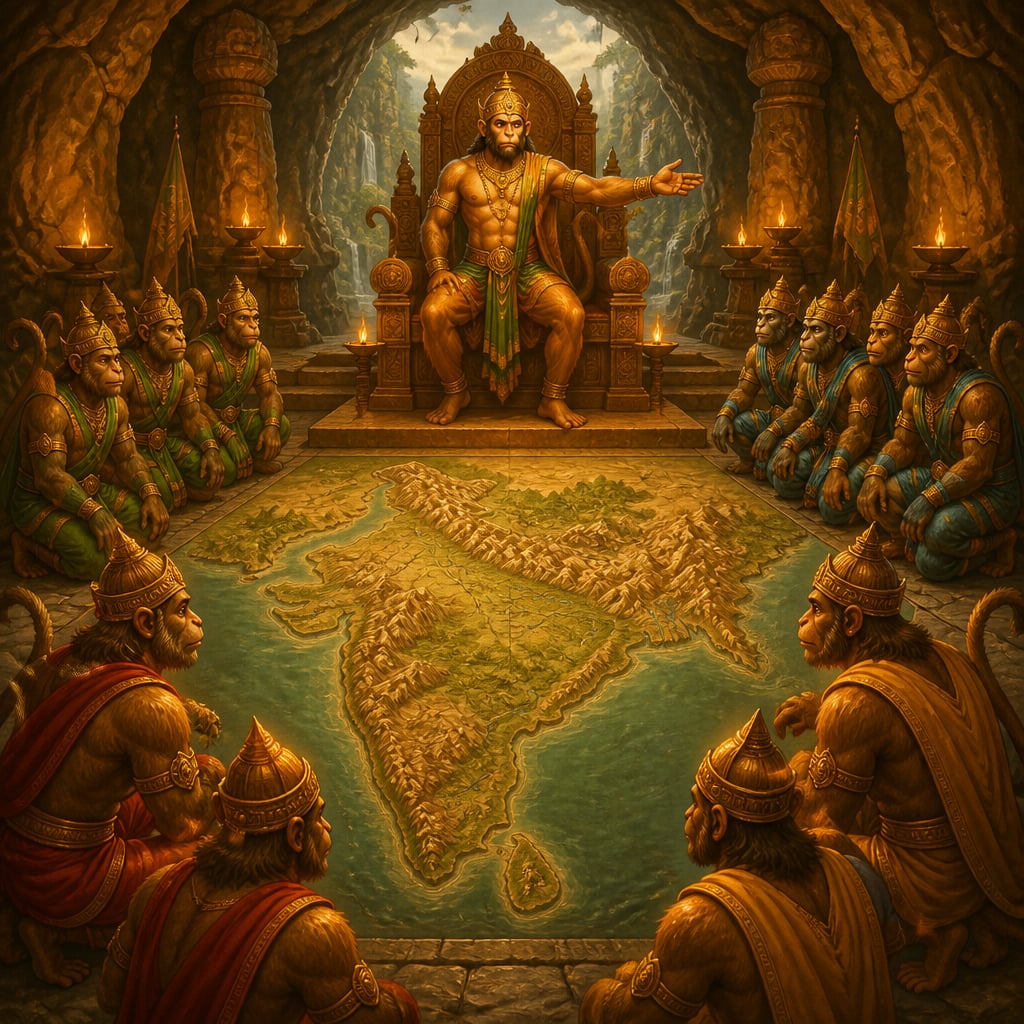
Sugriva on his dais directs four divisions of vanara captains kneeling around a great map of Bharatavarsha.


The Three Directions

Sugriva first addresses the eastern division, led by the mighty sons of Vinata. "Go toward the rising sun! You will find lands where silk is woven, where great rivers flow, where mountains touch the clouds. Search the kingdoms of the Videhas, cross the Ganges, explore the lands where the sun first kisses the earth each morning." He describes in remarkable detail the geography they will encounter, the Shalmali trees as tall as mountains, the silver peaks where medicinal herbs grow, the ocean where islands rise like jewels from the water. The eastern party bows and prepares for departure.

To the west, Sugriva sends a division led by Sushena, his own father-in-law and a vanara of great wisdom. "Father Sushena, you will lead the search toward the setting sun. You will cross the Sindhu river, traverse the lands of many kingdoms, and reach the western ocean where the sun sinks each evening." Sugriva's descriptions reveal an ancient understanding of lands beyond India, regions that would later be known as Persia, Arabia, and beyond. Sushena accepts the mission with dignity.

For the northern direction, Sugriva chooses Shatabali, son of a divine being, whose strength can withstand the coldest climates. "The north is harsh and unforgiving. You will face mountains of ice, winds that cut like swords, lands where the sun barely shines for months. But even there, Ravana may have hidden his captive." Sugriva describes the Himalayan ranges, the lands beyond them, the mysterious regions where strange peoples live. The northern party understands their journey will be the most physically demanding.


The Southern Hope

Finally, Sugriva turns to the southern division, and his voice changes. There is something special in his tone, something that suggests he believes the answer lies in this direction.

"The south... this is where Ravana's Lanka lies. This is where, I believe, Mother Sita is held. The southern party must be our strongest, our wisest, our most determined."

He places Angada, Vali's son and the crown prince, as the nominal leader. But alongside Angada, he sends his most capable warriors, Hanuman, Jambavan, Nila, and dozens of other mighty vanaras.

"You will cross the Vindhya mountains, traverse the Dandaka forest, reach the southern ocean. And somewhere across that ocean lies Lanka, the golden city of Ravana, surrounded by the sea, guarded by rakshasas."

Sugriva provides the most detailed description for this direction, naming mountains, rivers, forests, and peoples. He speaks of the Mahendra mountain at the southern tip, from where the ocean can be seen stretching to infinity.

"When you reach the ocean, you will face your greatest challenge. Lanka lies a hundred yojanas across the water. How you will cross... that I cannot say. But if anyone can find a way, it is you."


The Sacred Deadline

Before dismissing the parties, Sugriva issues a stern command that shocks the assembly.

"I give you one month. One month to search, to find, to return with news. Search thoroughly everything in your assigned direction. But beyond a month, you must not stay."

His voice turns cold, almost threatening.

"Whoever remains beyond a month without returning shall face death at my hands. This is not cruelty, this is necessity. Rama has waited long enough. Sita has suffered long enough. We cannot allow endless wandering and excuse-making."

The vanaras understand. The deadline creates urgency. Without it, search parties might wander for years, losing focus, losing hope. The threat of punishment ensures they will either succeed or return to report honestly.

Rama watches this display of leadership with appreciation. Sugriva is proving himself a capable king, firm when necessary, detailed in his planning, wise in his strategy.

What strikes everyone is the depth of Sugriva's geographical knowledge. How does a vanara king know so much about distant lands, foreign peoples, remote mountains? The answer lies in Sugriva's years of exile. When he fled from Vali, he traveled far and wide, always seeking a safe refuge. He climbed mountains, crossed rivers, explored forests and shores. His suffering became his education. "I have seen much of this world while running for my life," Sugriva admits to Rama. "Every place I describe, I have either visited or heard about from those who live there. Let my pain serve your purpose, let my knowledge guide those who search for your beloved." This is the alchemy of suffering, what seemed like meaningless pain transforms into invaluable wisdom.


The Departure

One by one, the four great divisions bow before Rama, touch his feet, and depart. The eastern party moves like a golden wave toward the rising sun. The western party marches like a determined army toward distant shores. The northern party climbs toward the white peaks that scrape the sky.

The southern party marches into the Vindhya foothills

And the southern party, bearing the weight of everyone's hopes, heads toward the Vindhya mountains, toward Dandaka, toward the sea, toward destiny.

Rama watches them go, his heart heavy with longing and light with hope.

"Sugriva has done everything a king could do," Lakshmana observes. "Now we must wait and trust."

Rama nods but says nothing. His eyes remain fixed on the southern horizon, as if he can see through the miles to where Sita waits, as if his love itself might guide the searchers to her.

Why does Sugriva divide his forces by direction rather than sending them all together? When everyone goes the same way, they cover the same ground. When forces are divided strategically, they cover the entire world simultaneously. The four directions represent completeness, the totality of space, the entirety of possibility. But there is another lesson here. Sugriva knows the south is most likely to hold the answer, yet he doesn't abandon the other directions. True wisdom means following your instinct while remaining open to being wrong. It means betting on your best guess while not abandoning other possibilities.


As Night Falls

As the search parties disappear into the distance, Sugriva returns to his duties as king. But Rama remains on the mountain terrace, watching the southern party until they vanish from sight.

Lakshmana brings him food, but Rama barely eats.

"Brother, you must maintain your strength. The waiting is hard, but you must endure."

"I know, Lakshmana. But somewhere out there, Sita waits alone. Every moment feels like eternity. How many more eternities must pass before I hold her again?"

The moon rises, casting silver light over Kishkindha. Somewhere in the south, hundreds of thousands of vanaras march through the night, carrying Rama's hope on their shoulders.

The search has truly begun.

And in a golden palace across the ocean, Sita looks up at the same moon, not knowing that an army moves toward her, not knowing that her rescue draws nearer with each passing hour.

Thus ends the tale of The Four Directions, where a wise king's knowledge becomes the map that guides hope toward its destination.

Living traditions

The geographical knowledge Sugriva displays has been studied by historians as evidence of ancient India's awareness of world geography, with descriptions matching regions from Southeast Asia to the Mediterranean. Modern disaster response and search-and-rescue operations use similar principles of dividing large areas into manageable sectors with clear boundaries and deadlines. Project management methodologies echo Sugriva's approach: divide the overwhelming whole into achievable parts, assign clear ownership, set firm deadlines, and provide thorough briefings.

Reflection

More in Kishkindha Kanda

All lessons in Kishkindha Kanda ยท The Ramayana course