Vali's Last Words
The Dying King's Challenge
Mortally wounded, Vali does not accept death in silence. He confronts Rama with devastating questions: Why kill me from hiding? What crime did I commit against you? How can dharma's avatar act like a hunter? Rama's response explores the complex relationship between different levels of dharma - and reveals truths that shake simple notions of right and wrong.
The Fallen King
Vali lies on the ground, Rama's arrow protruding from his chest. The golden garland that once ensured his victory now gleams uselessly. His lifeblood drains into the earth of Kishkindha.
But this is no ordinary warrior accepting death. Vali raises himself on one arm and turns his gaze toward the trees where Rama emerges. His eyes burn with a fire that even mortality cannot extinguish.
"Come," he says, his voice still commanding despite the wound. "Come and look at what you have done. Face the one you have killed."
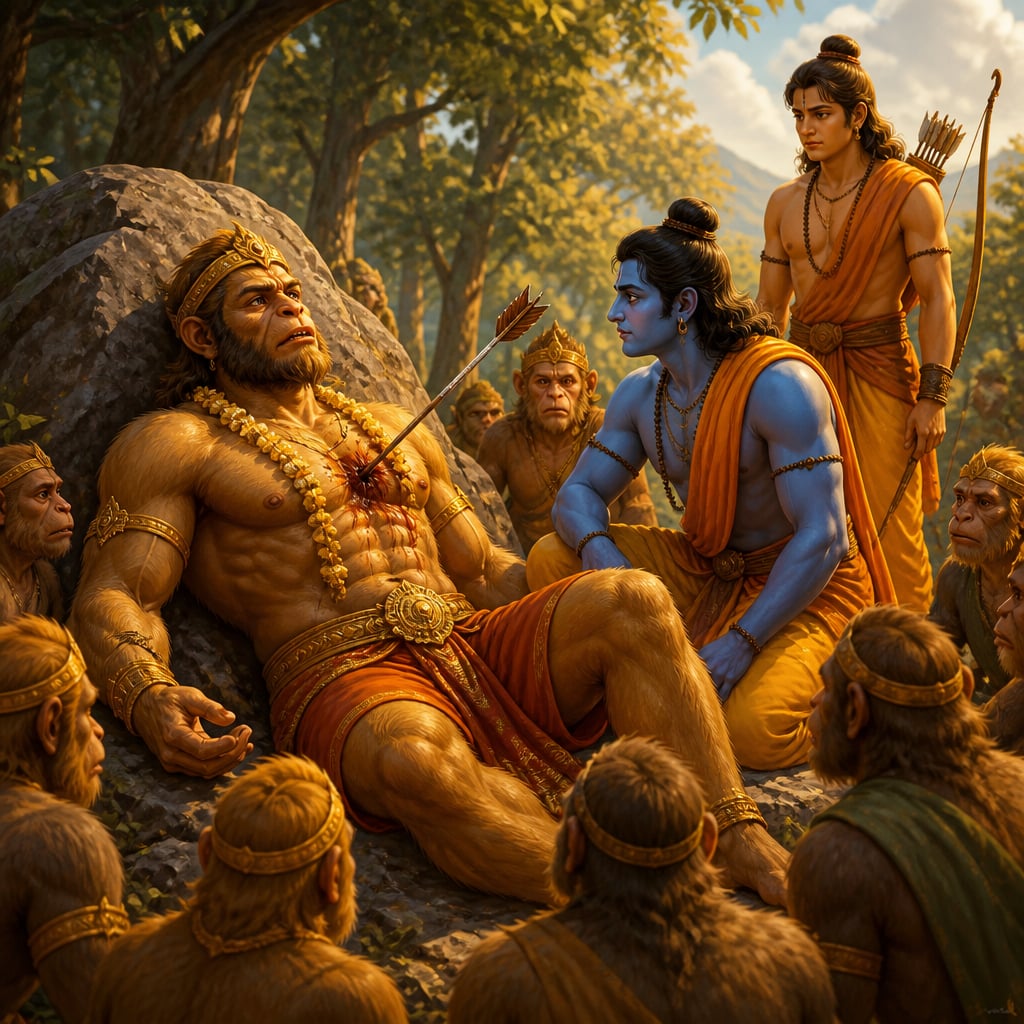
Rama approaches. He does not hide or look away. Whatever this dying king has to say, he will hear it.
Vali's Accusations
Vali's words come in measured fury, each one aimed like an arrow.
"You are Rama, prince of Ayodhya, son of Dasharatha. You are called dharmatma, one whose soul is dharma itself. Men sing of your righteousness. Sages praise your virtue. The world calls you an avatar of Vishnu, descended to uphold cosmic order. Then tell me, O righteous one, by what dharma have you done this?"
He builds his case systematically: "I never wronged you. We never met before this moment. I have not injured your kingdom, your family, or your person. What crime against you justifies my death?"
"I was engaged in combat with another when you struck. The warrior's code demands that combatants fight one enemy at a time. You violated this sacred principle."
"You shot from concealment. You did not face me openly. Hunters hide in trees to kill deer, is that what you are? A hunter? Is Vali nothing more than game to be stalked and shot?"
Vali's voice rises with something like triumph even as his life fades. "You cannot answer! There is no answer! You are not dharma's avatar but a murderer hiding behind dharma's name. When you face judgment after death, what will you say to Yama? How will you justify killing an innocent king through treachery?"
The vanaras watching shift uncomfortably. Even Sugriva, who has every reason to celebrate Vali's death, seems troubled by his brother's words. Have they allied with a false avatar? Has Rama's righteousness been a mask all along?
Rama's Defense
Rama waits until Vali has finished. Then he speaks, calmly, deliberately.
"You speak well, Vali. Your words have logic. But they also have blindness."
He addresses each charge: "You say you never wronged me personally. But dharma is not only personal. You wronged Sugriva, who is now under my protection. When you stole his wife, you committed a sin that cries out for punishment. A king's duty is to punish such sins."
"You invoke the warrior's code. But that code applies to those bound by kshatriya dharma. Are you a man bound by human codes, or a vanara of the forest? Kings hunt in forests, they do not challenge prey to single combat."
"I did not hide from cowardice but from necessity. Your boon makes fair combat impossible. To use stratagem against invincibility is not cowardice but necessity."
Rama kneels beside the dying vanara. "You speak of dharma, but you forgot dharma when you stole Sugriva's wife. You speak of justice, but you denied justice when you refused to hear his explanation. Now you invoke these principles? Where were they in your reign?"
Vali's Transformation
Something shifts in Vali's eyes. The rage begins to fade, replaced by recognition, perhaps regret.
"Perhaps I did wrong," he says slowly. "Perhaps my anger at Sugriva was excessive. Perhaps I should have listened. But Rama, was death the only answer? Could you not have tried to reconcile us first?"
Rama's voice gentles. "I wish I could have. But would you have listened? Your own wife Tara warned you that Sugriva had new allies. You dismissed her counsel and charged out anyway. If you would not hear your loving wife, would you have heard a stranger?"
Vali has no answer. The truth lands more painfully than the arrow.
"I did not kill you from hatred," Rama continues. "Your boon made other approaches impossible. Your pride made negotiation unlikely. Your death was the only path to justice for Sugriva, peace for Kishkindha, and, I believe, liberation for your own soul from the anger that consumed you."
The Promise
Rama makes solemn vows to the dying king, promises that will bind him and his allies.

"Your son Angada will not suffer for your death. I will ensure Sugriva treats him as his own son, indeed, as his heir and crown prince of Kishkindha. Your wife Tara will be honored and protected as the dowager queen. Your kingdom will be ruled justly, its people cared for. Your ministers will retain their positions. And you, you will depart this world absolved of your sins by dying at the hands of an avatar."
This last statement carries deep significance. In Hindu theology, death at divine hands can grant liberation, moksha through contact with divinity. The demons Rama kills, the opponents who fall to his arrows, tradition holds they receive spiritual merit through that contact. Rama offers Vali not just defeat but salvation, not just death but release from the cycle of karma that his actions had worsened.
The Departure
Vali lies back, his resistance fading. When he speaks again, his voice carries something unexpected: gratitude.
"You have conquered me in words as your arrow conquered me in body. I see now that my pride blinded me. I see that my rage against Sugriva was unjust. I see that this death, which seemed like murder, may be mercy."
He reaches out and touches Rama's feet, the gesture of ultimate respect.
"Forgive me for my accusations. Take care of my son. And tell Sugriva... tell him I was wrong. Tell him I forgive him, and I ask his forgiveness in return."
With these words, the great Vali, son of Indra, invincible warrior, king of Kishkindha, closes his eyes. His spirit departs, released from a body that had become a prison of pride and rage.
Rama stands slowly. "Let him be honored in death as he should have been honored in life. He was a king and a warrior. He was wrong, but he was not evil. His end was tragedy, not triumph."
A chapter has ended. A new one, with Sugriva as king, is about to begin.
Living traditions
The Rama-Vali debate is studied in Indian law schools and philosophy departments as a foundational case in contextual ethics. Justice V.R. Krishna Iyer and other jurists have referenced this episode in legal judgments. The concept of ātatāyī (aggressor who forfeits normal protections) influences discussions of self-defense and just war theory. Family counselors cite Vali's deathbed reconciliation as illustrating how crises can create opportunities for healing long-standing rifts.
- Antya-kāla Rituals: The practice of seeking and offering forgiveness at the time of death, as Vali did, continues in Hindu tradition. Dying persons often call family members to resolve conflicts and seek mutual kṣamā (forgiveness)
- Vali Samadhi (Vali's Memorial): Traditional site marking where Vali fell after being struck by Rama's arrow. Pilgrims visit to reflect on the dharmic complexities of the episode and Vali's final transformation.
- Pampa Sarovar: The sacred lake near which annual rituals commemorating Vali's death and funeral are performed. The site connects to both the opening and climactic events of the Kishkindha narrative.
- Kodandarama Temple: Marks the site of Vali's death and contains sculptures depicting the dialogue between dying Vali and Rama. The temple name 'Kodanda' refers to Rama's bow.
Reflection
- Are there relationships in your life where reconciliation is possible but delayed? What would it take to seek or offer forgiveness before it's too late?
- Vali's final transformation - from accuser to one seeking forgiveness - happened in his dying moments. What enabled this transformation? What does this suggest about the conditions necessary for genuine self-reflection?
- Rama argues that different rules apply to different beings based on their nature and context. What is the relationship between svadharma (one's own duty) and universal ethical principles? How do we prevent this framework from being abused?