The Challenge

Sugriva Confronts Vali

The moment has arrived. Sugriva stands before Kishkindha's gates and roars a challenge to his brother. Vali emerges, enraged, and the brothers fight. But the first encounter brings unexpected failure - Rama does not shoot. The brothers look identical in combat, and the arrow cannot find its mark. A second attempt, with a distinguishing garland, will prove fateful.

The Seven Sala Trees

Before the challenge can begin, Sugriva needs one final assurance. He has seen Rama kick Dundubhi's skeleton, a display of strength. But Vali's golden garland drains the power of anyone who faces him. Can Rama's arrows truly pierce such divine protection?

Sugriva leads Rama to a grove where seven massive sala trees stand in a line, ancient giants, their trunks broader than temple pillars, their wood so dense that axes shatter against it. These are the same trees that Vali once struck in a display of power, leaving his mark upon them.

"My lord," Sugriva says hesitantly, "I have seen you throw Dundubhi's bones. But throwing is not shooting. Vali has been struck by weapons before, they bounce off him like twigs. If your arrow cannot pierce his divine protection, we are both dead."

Rama understands. An ally needs confidence. Without words, he raises his bow and nocks a single arrow, one of the divine shafts from Vishwamitra's arsenal. He draws the string to his ear, aims at the first sala tree, and releases.
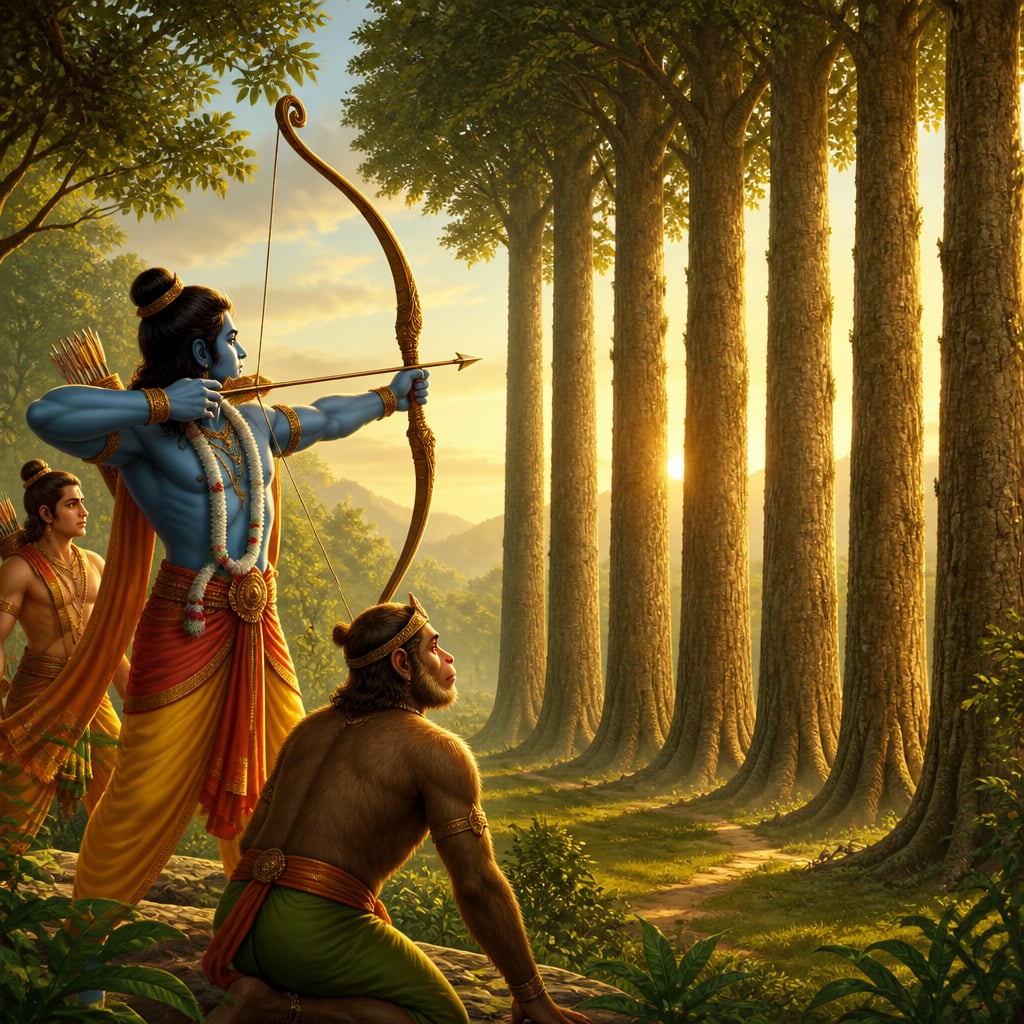
Rama draws his bow and takes aim at a line of seven enormous sala trees to prove his power to Sugriva.

The arrow flies. It strikes the first tree, and passes through. Then the second. The third. The fourth. The fifth. The sixth. The seventh. All seven massive trunks, pierced in a single line. The arrow continues into the earth, strikes a boulder beneath, rebounds upward, and returns to Rama's quiver.

The vanaras stare in stunned silence. Even Hanuman, who has seen divine feats before, cannot quite believe his eyes.

Sugriva falls to his knees. "Forgive my doubt, Lord. An arrow that pierces seven sala trees... such an arrow will find Vali's heart, golden garland or no."

Rama helps him rise. "Faith is strengthened by demonstration. Now you have seen. Now you believe. Now, let us end your brother's tyranny."


The Challenge

Dawn breaks over Kishkindha, painting the mountain city in shades of gold and crimson. Rama, Lakshmana, Hanuman, and a small band of loyal vanaras have taken positions in the same grove of sala trees near the city's main gates, the grove now marked forever by Rama's divine archery. The plan has been discussed, refined, and agreed upon: Sugriva will challenge Vali to single combat, drawing the tyrant out of his fortress. Rama will wait hidden among the trees, arrow nocked, ready to strike.

Sugriva hesitates at the tree line, looking toward the city that was once his home. Years of exile, years of fear, years of watching his wife live in another's palace, all of it has led to this moment.

"He is still my brother," he whispers. "Even now, after everything, part of me hopes he will see reason. Part of me hopes we can speak rather than fight."

Rama places a hand on the vanara's shoulder. "I understand. Brotherhood is not easily erased. But he has made his choice, years of cruelty, of refusing to listen, of persecuting you for a crime you did not commit. You are not killing a brother today. You are freeing him from the adharma that has consumed him, just as you are freeing yourself from unjust exile."

Sugriva nods slowly, finding strength in these words. He steps forward from the concealment of trees and walks toward Kishkindha's towering gates. There, in the open space before the entrance, he throws back his head and releases a simhanada, a lion's roar that echoes off the surrounding mountains, carrying into every corner of the city.

"VALI! Your brother stands at your gates! Come and face me if you dare! Face the one you wrongly exiled, the one you persecuted, the one whose wife you stole! Come prove your strength against mine, or be known forever as a coward who fears his own blood!"

In his throne room, Vali hears the challenge. His eyes widen with surprise, then narrow with rage. His wife Tara, wisest of the vanara women, places a restraining hand on his arm.

"My lord, wait. Something is different. Sugriva has hidden from you for years. Why would he suddenly challenge you openly unless something has changed? He may have found powerful allies. Please, be cautious. Send scouts. Learn what gives him this new confidence."

But Vali's pride will not hear caution. "Allies? What ally would side with that exile? My boon makes me invincible, no force in all the worlds can defeat me in combat. Sugriva has simply grown tired of cowering and seeks a quick death. I shall grant his wish."

He shrugs off Tara's hand and storms toward the gate, golden garland gleaming around his neck.


The First Combat

Vali emerges from Kishkindha's gates like a force of nature, muscles rippling, divine boon radiating power. He sees Sugriva waiting in the open and laughs with contempt.

"So, traitor, you finally face me. No mountain to hide behind now. No sage's curse to protect you. Just you and me, as it should have been years ago. Today I will finish what I started."

Sugriva does not respond with words. He has nothing left to say to this creature wearing his brother's face. Instead, he launches himself at Vali, and the brothers collide with an impact that shakes the earth.

From the grove of sala trees, Rama watches through the branches, arrow nocked against bowstring, waiting for the perfect moment, when the combatants separate, when Vali's chest is exposed, when the shot is clear.

But that moment does not come cleanly.

The brothers are nearly identical in size and coloring. Both have golden-brown fur. Both move with the same fighting techniques, learned from the same teachers in their youth. They grapple, separate, strike, grapple again, a blur of motion where one cannot be distinguished from the other.

Rama raises his bow. Draws the string. But which figure is which? From this angle, in this chaos of combat, he cannot tell.

"I cannot shoot," he whispers urgently to Lakshmana. "They look exactly the same. If I guess wrong, I kill our ally."

Meanwhile, Vali's boon takes its terrible effect. As the brothers fight face to face, half of Sugriva's strength drains away, flowing into Vali. The golden garland pulses with power. Sugriva grows weaker with every passing moment; Vali grows stronger.

The outcome becomes inevitable. Vali beats Sugriva with blow after crushing blow. Finally, he seizes his brother and throws him to the ground, raising his fist for a killing strike.

"Die, traitor. Die knowing you never had a chance."

But Sugriva, summoning reserves of desperate energy, rolls aside at the last moment and flees, running for the tree line, for any shelter from his victorious brother.

Vali pursues briefly, then stops. Why chase? The coward will return to his mountain prison, and nothing will have changed. "Run, Sugriva!" he bellows. "Run and hide! When you find courage again, I will be waiting!"


The Solution

In the grove, Sugriva collapses, battered, bleeding, barely conscious. His eyes find Rama's face, and in them is accusation.

"You did not shoot," he gasps through broken lips. "You promised. You swore an oath by fire. You did not shoot."

Rama's face is pained. "I could not distinguish you from Vali. You look alike, you move alike, you fight alike. Shooting blindly risked killing you while trying to save you. I could not take that chance."

"Then our alliance is worthless," Sugriva says bitterly. "I risked everything, challenged my brother, suffered this beating, came within inches of death, for nothing."

Rama kneels beside the wounded vanara. His voice is steady, patient, certain.

"It is not for nothing. We have learned what we needed to learn. Now we know the problem, and we can solve it."

He reaches up and removes a garland of flowering gajapushpi vines from a nearby tree, bright blossoms, unmistakable even at a distance. He places the garland around Sugriva's neck.

"Wear this when you challenge him again. It will mark you clearly. I will know exactly which brother to strike. This time, I will not fail you."


Tara's Warning

In Kishkindha, Vali returns to his throne room in triumph, savoring his easy victory. But Tara watches him with troubled, knowing eyes.

"You drove him off," she says. "But he came in the first place. After years of hiding, he suddenly found courage. Something gave him that courage, and that something is still out there."

"Nothing has changed," Vali dismisses. "Sugriva simply tired of cowering."

Tara pleads with Vali, who turns away dismissive

"My lord, I have heard rumors from our scouts." Tara's voice grows urgent. "Two human princes have been seen in the forest near Rishyamuka, warriors of tremendous power, armed with divine weapons. Some say one of them is an avatar of Vishnu himself. If Sugriva challenges again, do not answer. Send warriors to investigate first. I beg you."

Vali laughs at her fears. "Rumors! Human princes? What could humans do against me? My boon guarantees that no one who faces me in combat can defeat me. No brother, no ally, no god in heaven can overcome the gift my father Indra gave me. Let Sugriva bring whoever he wishes, I will destroy them all."

Tara bows her head, seeing that further argument is useless. She has done what she can. The rest lies with fate, and fate, she fears, is not on her husband's side.


The Second Challenge

Days pass. Sugriva's vanara body heals with supernatural speed. Soon he stands ready, the bright garland of flowers around his neck, its blossoms unmistakable.

Rama nocks an arrow, a divine shaft from Vishwamitra's arsenal, capable of piercing any armor. His hands are steady. His aim is true. But his mind turns over the moral complexity of what he is about to do.

Shooting from concealment. Attacking a combatant already engaged with another. Killing without face-to-face confrontation. These actions violate the kshatriya warrior code that Rama has followed his entire life.

But dharma, he has decided, requires this violation. Vali's boon makes fair combat impossible, anyone who faces him loses half their strength. Vali is a tyrant who stole his brother's wife and throne. And Sugriva's alliance is essential for rescuing Sita, which is Rama's highest duty.

The calculus is complex. Sages will debate it for ages to come. But Rama has made his decision.

"Go," he says to Sugriva. "This time, I will not fail you. This time, it ends."

Sugriva walks again to Kishkindha's gates. Again he releases his lion's roar. Again he challenges his brother to single combat.

And again, despite Tara's warnings, despite her tears, despite her pleading, Vali emerges to answer.


The Arrow

Sugriva and Vali wrestling, marked by the flowering garland

The brothers clash once more. Vali fights with the absolute confidence of a warrior who has never lost; Sugriva fights with the desperate courage of a man betting everything on his ally's arrow.

From the trees, Rama watches. This time, the bright garland of flowers makes Sugriva unmistakable, a beacon of color against Vali's unmarked form.

The brothers grapple, separate. For one clear moment, Vali's broad chest is exposed, the golden garland of his boon gleaming in the sunlight.

Rama releases.

The arrow flies with divine speed, crossing the distance between grove and combatants in a single heartbeat. It strikes Vali in the chest, piercing through muscle and bone, embedding deep.

The mighty vanara king staggers. He looks down at the feathered shaft protruding from his body, this wound that should be impossible, this attack that came from nowhere. His eyes turn toward the grove, toward the source of this arrow.

And then he falls.

But the story is far from over. Vali has strength left for words, words that will challenge Rama's own dharma, words that will force the prince to justify his actions, words that will echo through the ages in every retelling of this tale.

The arrow has struck. The tyrant falls. But the judgment, of Vali on Rama, and of history on both, has only just begun.

Living traditions

The Vali vadha episode remains one of the most debated ethical cases in Indian philosophy, studied in courses on dharma and situational ethics. The phrase 'shooting from behind a tree' has entered Indian discourse as a metaphor for controversial but pragmatic decisions. Kathakali dancers in Kerala perform the Vali-Sugriva combat as one of the most elaborate sequences in their repertoire, keeping this martial tradition alive through performing arts.

Reflection

More in Kishkindha Kanda

All lessons in Kishkindha Kanda ยท The Ramayana course