Jambavan's Reminder
Awakening Hanuman's Memory
Jambavan reveals Hanuman's forgotten history, his divine birth as son of the Wind God, his childhood flight toward the sun, and the curse that made him forget his powers. With each word, Hanuman begins to remember who he truly is and what he can do.
The Bear Who Remembers
Jambavan stands before Hanuman, and something ancient stirs in his eyes. The old bear has lived through ages that most creatures cannot imagine. He has seen gods walk the earth. He has witnessed the turning of cosmic cycles. And he remembers things that others have forgotten.
"Hanuman," he says, his voice carrying the weight of centuries. "Do you know who you are?"
Hanuman looks puzzled. "I am Hanuman, son of Kesari and Anjana. A servant of King Sugriva. I am nothing special, Jambavan. You know this."
"No," Jambavan replies. "That is not who you are. That is who you have been taught to believe you are. There is a difference."
The other vanaras gather close. Even the ocean seems to quiet, its waves softening as if to listen. "You are not merely the son of Kesari, Hanuman. You are the son of Vayu, the Wind God himself. The lord of all that moves through air blessed your mother Anjana, and from that blessing, you were born."
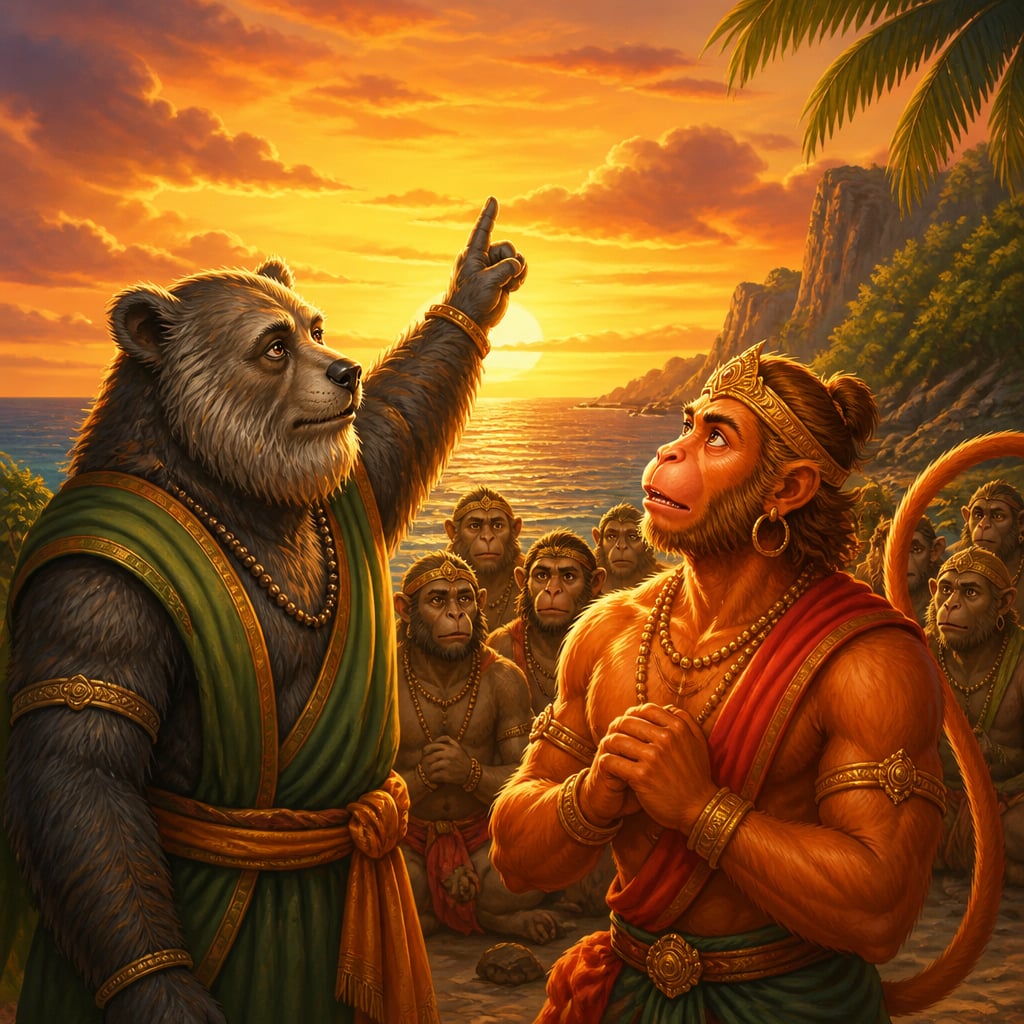
Hanuman's eyes widen. "I... I have heard this story. My mother told me. But it seemed like a legend, a family myth..."
"It is no myth," Jambavan says firmly. "It is truth. And that truth explains everything about your power, the power you have forgotten."
The Child Who Flew
Jambavan's voice takes on a storytelling quality as he reaches back into the distant past.
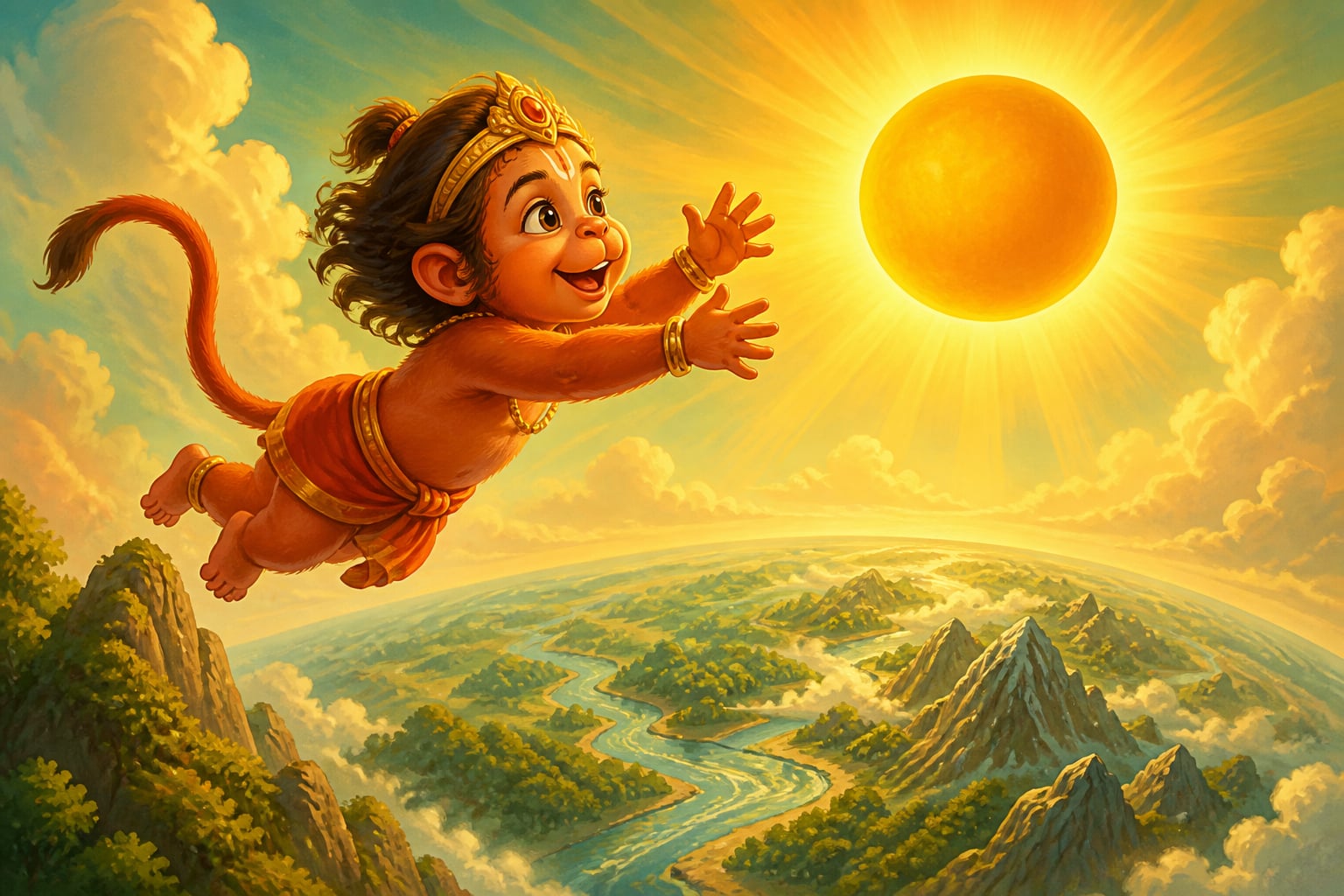
"When you were just a baby, Hanuman, you were already extraordinary. One morning, you woke before dawn and saw the sun rising. Its red disc looked to you like a ripe mango, the most beautiful fruit you had ever seen. So you flew toward it. A baby, flying toward the sun, determined to pluck it from the sky and eat it."
"That's... that's impossible," Hanuman whispers. "A child cannot fly to the sun."
"You did," Jambavan says simply. "You flew three thousand yojanas, three thousand, up into the heavens. Not one hundred. Not five hundred. Three thousand." The number hangs in the air. Three thousand yojanas. The ocean to Lanka is only one hundred.
"You flew so high that you alarmed the gods themselves. Indra, king of heaven, threw his thunderbolt, the vajra, at you. It struck your chin, and you fell from the sky, unconscious." Hanuman unconsciously touches his chin. There is a mark there, a mark he has carried all his life without knowing why. "That is how you got your name," Jambavan says. "Hanuman, one with a disfigured chin. The vajra's strike left its mark on you."
The Curse and the Blessing
Jambavan's voice grows more serious. "When you fell, your father Vayu was enraged. He withdrew all wind from the universe. Creatures began to suffocate. Fires stopped burning. The world was dying. The gods panicked. To appease Vayu, they blessed you with their divine powers. Listen carefully, and remember what each god gave you:"
"Brahma, the Creator, granted you immunity from his Brahmastra, the ultimate weapon, and freedom from fear in battle. Indra, king of heaven and your very attacker, was so moved by Vayu's grief that he blessed you with the vajra's protection, his thunderbolt shall never kill you, only leave its mark upon your chin. Varuna, lord of waters, gave you immunity from drowning and from his celestial noose. Yama, god of death, blessed you with freedom from disease and declared that death itself would wait upon your will. Agni, the fire god, swore that flames would never burn you. Surya, the sun god whom you tried to grasp as a fruit, granted you a fraction of his brilliance and perfect health. And your father Vayu himself gave you his greatest gift, speed equal to thought itself."
"Beyond these, you possess the ashta-siddhis, the eight supernatural powers. Anima lets you shrink to the size of an atom. Mahima lets you grow vast as a mountain. Laghima makes you light as air. Garima makes you immovably heavy. Prapti allows you to reach anywhere instantly. Prakamya gives you irresistible will. Ishitva grants lordship over creation. Vashitva gives control over all beings. All these powers sleep within you, forgotten but not destroyed."
Hanuman listens, tears forming in his eyes as memories long buried begin to surface.
"But some sages, the rishis whose meditation you had disturbed in your playful childhood, placed a curse upon you. Not to harm you, but to protect the world from powers too great for a child to control. The curse was this: You would forget your own strength until someone reminded you of it at the moment when it was truly needed."
Jambavan pauses, letting the weight of his words settle. "That moment, Hanuman, is now." He gestures toward the ocean. "One hundred yojanas separate us from Lanka. One hundred yojanas stand between Rama's grief and Rama's joy. You, who flew three thousand yojanas as a baby, can you not cross one hundred as a grown vanara? You, who challenged the sun, can you not challenge this mere stretch of water?"
The Memories Return
As Jambavan speaks, something begins to happen inside Hanuman.
It starts as a tingling, a warmth spreading through his chest. Then images begin to flood his mind:
- The sunrise. The red fruit in the sky. The joy of flight.
- The wind beneath him, supporting him, loving him.
- His father's voice, teaching him to ride the currents of air.
- The endless blue above, the green earth below, and he, flying between them.
"I... I remember," Hanuman gasps. "I remember flying. I remember... I remember everything."
The curse is breaking. The forgotten is becoming remembered. The sleeping power is waking.
The Awakening
Jambavan sees the recognition dawning in Hanuman's eyes, and his voice rises with passion. "Then why do you sit here, son of the wind? Why do you doubt yourself when you carry the power of storms in your blood? You are not just a vanara. You are the child of Vayu, blessed by every god, protected by dharma itself. The ocean is nothing to you. Lanka is nothing to you. Ravana is nothing to you!"
"Arise, Hanuman! Arise, tiger among vanaras! Cross the ocean that terrifies others. Find Sita who waits for rescue. Fulfill the promise you made to Rama when you wore his ring!"
Hanuman rises to his feet, and something in his posture has changed. He stands taller. His shoulders are broader. His eyes blaze with a fire that wasn't there before. "Yes," he says, his voice deeper, stronger. "Yes. I remember now. I know what I can do."
The other vanaras watch in stunned silence. This is Hanuman, the same Hanuman who walked among them for years, who served Sugriva quietly, who never boasted or showed off. And yet... is it the same Hanuman? He seems transformed. Larger. More powerful. More present.
"How is this possible?" Angada whispers to Jambavan. "He was like us. He was ordinary."
"He was never ordinary," Jambavan replies quietly. "He only believed he was. And believing makes all the difference."
Ready to Transform
This is one of the deepest lessons of the Ramayana: We can possess power we don't know we have. We can carry strength we've forgotten. We can be capable of feats we believe impossible.
Hanuman's "curse" was, in a way, a mercy. It prevented him from misusing his powers when he was immature. It kept him humble, learning, growing. But when the moment came, when the need was real and righteous, the curse could be lifted. All it took was someone who remembered the truth. Someone who could say: "You are more than you think you are. Remember who you really are."
Hanuman looks at the ocean. For the first time, it doesn't seem impossible. It seems... achievable. It seems almost small.
"I will cross this ocean," he says, not as a question but as a statement. "I will find Mother Sita. I will return with news for Lord Rama. And if Ravana tries to stop me, if all the rakshasas in Lanka stand in my way, they will learn what the son of Vayu can do."
The vanaras cheer, but their cheers fade as they realize something is happening. Hanuman is changing. Growing. His body is expanding, his form stretching toward the sky. The transformation has begun.
Thus ends the tale of Jambavan's Reminder, where an ancient bear unlocks a forgotten truth, where a humble servant remembers he is a divine hero, and where the power to accomplish the impossible awakens at last.
Living traditions
Jambavan's awakening of Hanuman is cited in leadership training as an example of transformational mentorship. The psychological insight that identity shapes capability resonates with modern coaching: believing yourself capable is the first step to becoming capable. The ashta-siddhis are referenced in yoga traditions as the fruits of advanced practice. Hanuman Chalisa remains one of the most recited prayers in Hinduism, with millions believing it provides access to the divine protection Hanuman received. The scene's message - that we may possess forgotten powers awaiting awakening - inspires people facing impossible-seeming challenges.
- Guru's Awakening Speech: Jambavan's speech to Hanuman models the transformative power of a guru's words to awaken dormant capabilities. This tradition of 'shakti-pata' (transmission of spiritual energy through words) continues in initiation ceremonies
- Hanuman Chalisa Recitation: The famous prayer references the divine boons Jambavan recounted: 'Ashta siddhi nau nidhi ke daata' (giver of eight siddhis and nine treasures). Daily recitation invokes these powers
- Hanuman Dhara: A natural water stream on a hillside associated with Hanuman. The climb and darshan evoke the awakening of dormant powers through devotion and effort.
- Hanuman Garhi: A major Hanuman temple where devotees seek the strength and courage that awakened in Hanuman when he remembered his true nature.
- Ashta Siddhi Temples: Temples dedicated to the eight supernatural powers (siddhis) that Hanuman possesses. Devotees seek blessings for specific abilities.
Reflection
- Has anyone ever believed in you when you didn't believe in yourself? How did their words affect you? What did they see that you couldn't?
- Why did Hanuman need someone else to remind him of his powers? Why couldn't he remember on his own? What does this suggest about the nature of self-knowledge?
- The story suggests we may have 'forgotten' capabilities within us. What does this mean philosophically? How does identity shape capability?