Despair at the Ocean

The Search Party's Crisis

The southern search party emerges from Svayamprabha's cave to find that a month has passed. Facing certain death for exceeding Sugriva's deadline, the vanaras reach the southern ocean's shore. Angada contemplates rebellion while despair grips the group.

At the Edge of the World

The vanaras stand at the shore, staring at the endless expanse of water before them. The southern ocean, Samudra, the gathering of all waters, stretches to the horizon and beyond. Waves crash against the rocky shore with a sound like thunder. The wind carries the smell of salt and the cry of seabirds.

For a long moment, no one speaks. Then Angada voices what everyone is thinking. "This is it. The edge of the world. And beyond... nothing we can reach."

They have traveled so far. Crossed mountains. Searched forests. Survived the darkness of Maya's cave. And now, at the very end of their journey, they face an obstacle that no amount of courage can overcome. A hundred yojanas of open water separate them from Lanka. A hundred yojanas, roughly eight hundred miles, of churning sea, filled with monsters and magic.

No vanara can swim that far. No vanara can fly that distance. The ocean is not a wall they can climb or an enemy they can fight. It simply is, vast, indifferent, impassable.

Angada sinks to the ground, his head in his hands. "The month has passed," he whispers. "Sugriva's deadline is gone. Whether we find Sita or not, we are already condemned. We are already dead."
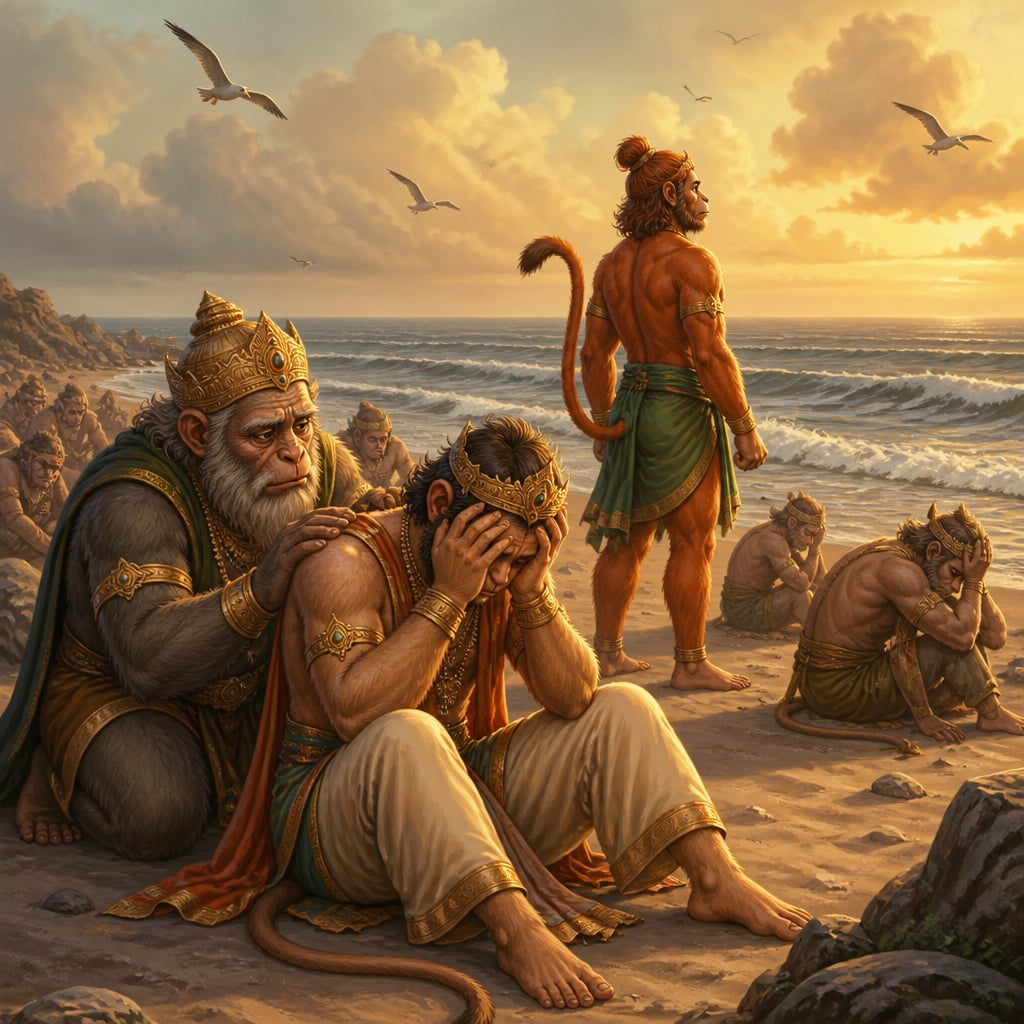
Angada sits collapsed on the southern shore with Hanuman gazing at the ocean and Jambavan kneeling beside him.


Despair and Rebellion

The vanaras gather on the shore, speaking of their fate. Some are angry. Some are sad. Some are simply numb. Jambavan, the ancient bear, tries to maintain order. "Brothers, let us not blame each other. We did our best. Sometimes our best is not enough, but that does not diminish its worth." But fine words won't save them from Sugriva's punishment. They are trapped between an impassable ocean and an unforgivable king.

As the debate continues, something dark begins to grow in Angada's heart. "Why should we return at all?" he suddenly declares. "Why should we go back to face Sugriva's punishment? He killed my father! He took everything from me! And now he would take my life as well? Let us stay here. Let us make our home on this shore. Sugriva is not all-powerful. His reach does not extend this far. We can live free, rather than die as failed servants of a cruel king."

Hanuman steps forward. "Prince, I understand your pain. But think carefully. If we abandon our mission, we abandon not just Sugriva, we abandon Rama. We abandon Mother Sita. We abandon dharma itself." Angada laughs bitterly. "Dharma? What has dharma done for us?"

Other vanaras take a different position: praya, the ritual fast unto death. "We should sit here facing south," one elder suggests. "We should refuse food and water until our lives end. At least we will die with some dignity, having tried our best." The mood shifts toward this dark resolution. One by one, vanaras begin to sit facing the water, preparing to begin the fast that will end their lives.


Hanuman's Silence

Amidst all the despair and debate, one vanara remains strangely quiet.

Hanuman sits apart from the others, his eyes fixed on the distant horizon. He is not arguing with Angada or joining those preparing for death. He is simply... thinking.

Or perhaps listening.

There is something in the wind, a whisper, a memory, a stirring of something long forgotten. Hanuman cannot quite grasp it, but he feels it. A sense that this is not the end. A certainty that something more is coming.

He looks down at his hand, at Rama's ring still safely on his finger. He made a promise. He said he would find Sita or die trying. And he has not tried everything yet.

But what else can he do? The ocean is there, vast and impossible. He cannot walk on water. He cannot...

Can he?

A strange thought flickers in his mind, but it vanishes before he can grasp it. Something about wings. Something about his father. Something about a curse and a blessing.

Hanuman shakes his head. Now is not the time for half-remembered dreams. His companions need him to be present, to help them face this moment.

But the thought remains, just below the surface. Waiting.


Remembering Jatayu

As the vanaras sit in their despair, they begin to speak of death. And in speaking of death, they remember Jatayu, the great vulture who died trying to save Sita from Ravana.

"At least Jatayu died fighting," one vanara says. "He faced Ravana himself, knowing he couldn't win. That is how a warrior should die."

"Rama spoke of him with such love," another adds. "He performed Jatayu's funeral rites as if for his own father. What greater honor could a bird receive?"

"If only we could die as nobly. Instead, we sit here, neither fighting nor fleeing, simply... fading."

The name of Jatayu passes from mouth to mouth, carried on the ocean breeze. The great vulture, friend of Dasharatha, defender of Sita, hero of the skies.

Sampati the wingless vulture watches from a cliff cave

They do not know that someone is listening.

From a cave on the cliff above, a pair of ancient eyes watches them. Ears that once heard the whispers of the wind god now strain to catch every word.

Jatayu? My brother?

A wingless vulture, old beyond measure, begins to move.


The Darkness Before Dawn

This is the lowest point of the search. The vanaras have traveled thousands of miles, faced countless dangers, and now sit on the shore of an impassable sea, preparing to die.

But consider: they have not failed. Not yet. They have reached the southern ocean, the very boundary they were told to search. They have narrowed down Sita's location to one place: Lanka, across the water. They have come closer than any searcher from any other direction.

Their despair comes not from lack of achievement but from lack of imagination. They cannot conceive of any way to cross the ocean, so they assume there is no way. This is how despair works. It doesn't just steal our hope, it steals our vision. We become unable to see possibilities that are right in front of us.

As the sun sets over the southern sea, painting the sky in shades of orange and red, the vanaras sit in their grief. Angada has fallen silent, his rebellion dissipating into exhaustion. Jambavan sits with closed eyes. Hanuman continues his strange vigil, eyes on the horizon, waiting for something he cannot name.

The ocean rolls on, indifferent to their suffering. But it also carries a secret. Somewhere across those waves, in a garden of ashoka trees, Sita waits. She does not know that help is near. She does not know that an army of vanaras sits just a hundred yojanas away, separated from her by nothing but water.

The answer to their despair is already watching them from the cliffs above. One more piece needs to fall into place, one revelation that will transform despair into hope. And that revelation is about to arrive.

Thus ends the tale of Despair at the Ocean, where the search party faces its darkest hour, not knowing that dawn is about to break.

Living traditions

The vanaras' despair at the ocean's edge resonates with anyone facing seemingly impossible obstacles. Modern psychology recognizes the 'darkest before dawn' phenomenon they experienced - breakthrough often follows the moment when hope seems most lost. The site at Kanyakumari draws millions of pilgrims who find inspiration in knowing that the vanaras' moment of despair preceded their greatest triumph. The transformation of praya into Gandhian nonviolent resistance shows how ancient practices evolve while retaining their moral core.

Reflection

More in Kishkindha Kanda

All lessons in Kishkindha Kanda ยท The Ramayana course