Sūrya-Siddhānta: The Text That Travelled
The Sanskrit astronomy text whose numbers still set the New Year in Myanmar, and whose family still runs calendars across Southeast Asia
In 1838 a Burmese monk repaired his country's calendar with numbers from a Sanskrit book. Meet the Sūrya Siddhānta: a text framed as the Sun's own teaching, packed with periods you can check against modern values, revised over the centuries, and carried across the Bay of Bengal into the calendars of Myanmar, Thailand, Cambodia and Laos.
Water, and a Monk's Arithmetic
Every April, the streets of Yangon and Mandalay turn into one long water fight. For the days of Thingyan, the Burmese New Year, people drench each other from buckets, hoses and silver bowls. Music blares from the stages, and the smell of wet, hot dust hangs over the city. The water washes the old year away. But the moment the old year ends is not chosen by anyone in the crowd. It is computed.
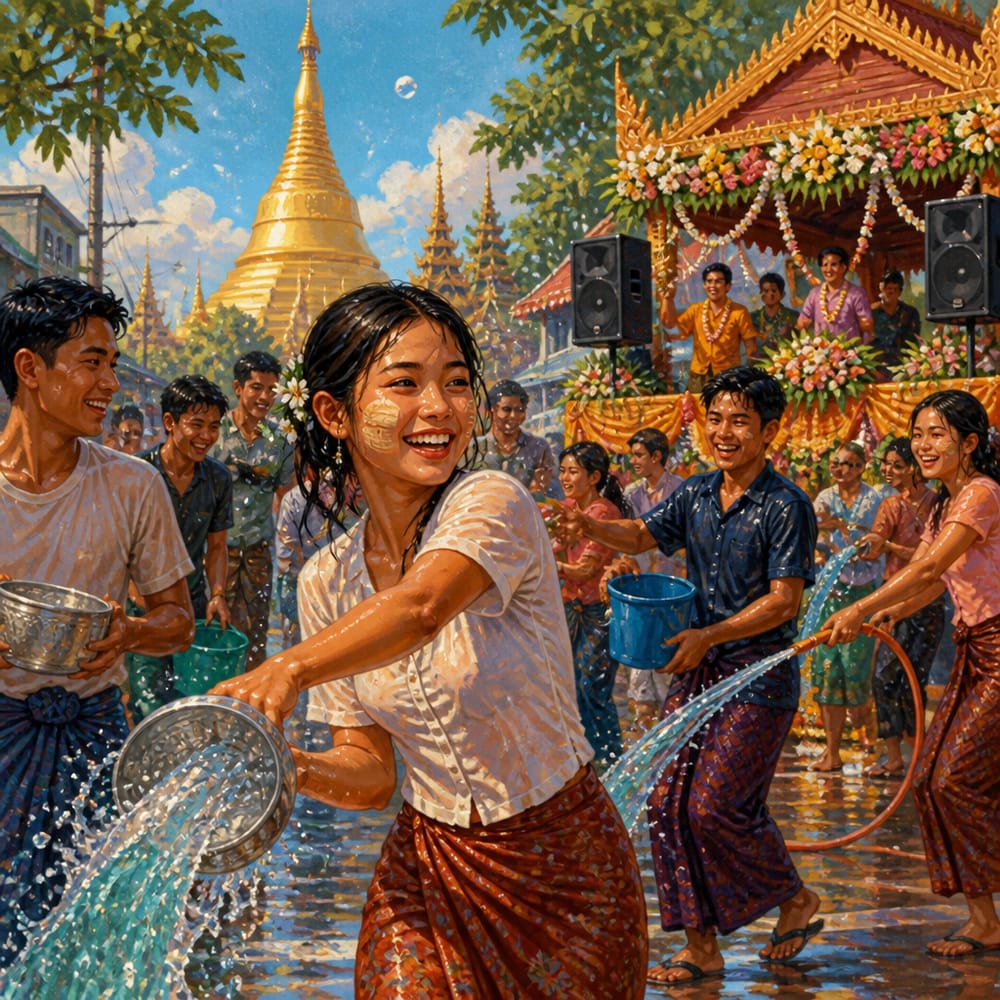
In the Burmese year 1200, the year the rest of the world called 1838, a Buddhist monk named Nyaunggan Sayadaw proposed a repair to that computation. Burma's calendar had a slow problem. Its lunar months, kept in line by an old 19-year cycle of extra months, were drifting away from the solar year the calendar was built on. Left alone, the gap would keep growing, and the Moon's festivals would slide away from the Sun's New Year.
His repair was called Thandeikta. Its year length of 365.2587565 days came from a Sanskrit book the Burmese called the Thuriya Theiddanta. In India it is the Sūrya Siddhānta, "the treatise of the Sun". How did an Indian astronomy text end up timing a Burmese water festival? And why were its numbers good enough to stay in use for more than a thousand years?
A Book the Sun Is Said to Have Taught
The Sūrya Siddhānta opens with a story, and the story should be read as a story. The legend goes that near the end of the first and best age, the Kṛta Yuga, a great asura named Maya wanted to learn the science of the stars. So he worshipped the Sun with hard austerities.
अल्पावशिष्टे तु कृते मयो नाम महासुरः। रहस्यं परमं पुण्यं जिज्ञासुर्ज्ञानमुत्तमम्॥ वेदाङ्गमग्र्यमखिलं ज्योतिषां गतिकारणम्। आराधयन् विवस्वन्तं तपस्तेपे सुदुश्चरम्॥
alpāvaśiṣṭe tu kṛte mayo nāma mahāsuraḥ rahasyaṃ paramaṃ puṇyaṃ jijñāsur jñānam uttamam vedāṅgam agryam akhilaṃ jyotiṣāṃ gati-kāraṇam ārādhayan vivasvantaṃ tapas tepe suduścaram
When little of the Kṛta age remained, a great asura named Maya, longing for the highest, purest, secret knowledge, the foremost limb of the Veda, the cause of the motions of the stars, worshipped the Sun and performed very hard austerities.
Sūrya Siddhānta 1.2-3