Kerala-Paramparā: The Observers of Kerala
Parameśvara to Jyeṣṭhadeva, the school that tested the tables against the sky
Between 1400 and 1600 a line of teachers on the Kerala coast kept watching, correcting, and proving. Meet the astronomers of the school better known for its calculus.
A Sliver of Moon at Tṛkkaṇṭiyūr
On a clear night in the early 1590s, in the village of Tṛkkaṇṭiyūr near Tirur on the Kerala coast, an astronomer named Acyuta Piṣāraṭi was checking the Moon against his numbers. The monsoon had passed. The air still smelled of wet earth, and the coconut palms stood black against a sky full of stars. Beside him lay a bundle of palm leaves, his working notes, and an iron stylus for scratching figures into them by lamplight.
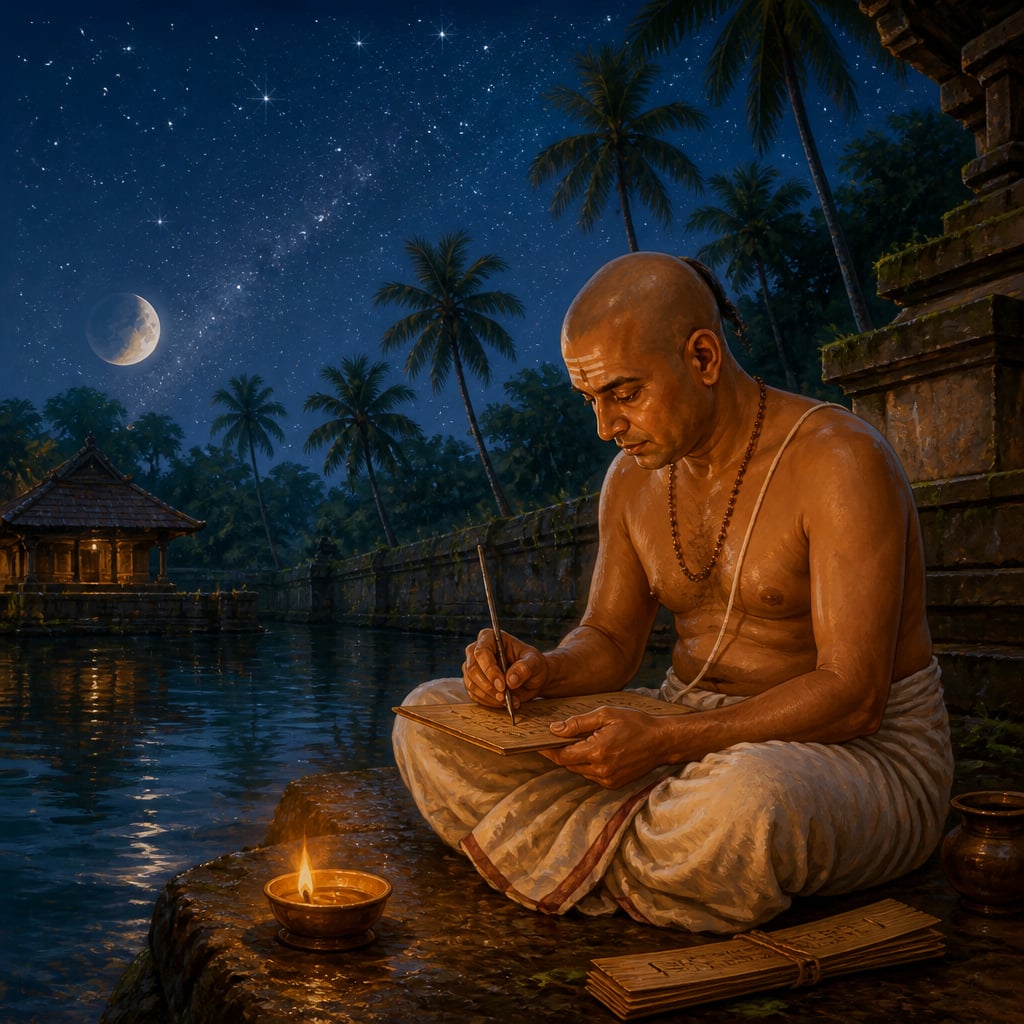
We do not have a diary of that exact night. But we know the place, the tools and the problem. His numbers came from a long line of teachers, and they told him where the Moon should stand among the stars. The sky mostly agreed. On some nights, though, there was a small gap, never more than about a quarter of the Moon's own width.
Most people would call that close enough. In Acyuta's school, an error nobody could explain was a question, not a nuisance. What he found in that sliver of sky would place a Kerala astronomer beside the best observers in Europe. And it would take a twentieth-century scholar, digging through old palm-leaf bundles, to tell the world about it.
A School That Checked Its Own Answers
Acyuta was one link in a chain that historians call the Kerala school. It began with Mādhava of Saṅgamagrāma (c. 1340 to 1425), whose infinite series belong to the Indian Mathematics course. This lesson follows the other half of the school's work: the sky.
For about two hundred and fifty years, the work passed from teacher to student in a small stretch of country around the Nila river:
- Parameśvara (c. 1380 to 1460) watched eclipses for more than fifty years and reset the old tables in his Dṛggaṇita of 1431, as we saw in Lesson 1.7.
- Nīlakaṇṭha Somayājī (1444 to 1544) rebuilt the planetary model in his Tantrasaṅgraha of 1501, the subject of Lesson 2.7.
- Jyeṣṭhadeva (c. 1500 to c. 1575) wrote the Yuktibhāṣā around 1530, a book of proofs written in Malayalam, the spoken language of Kerala, rather than in Sanskrit.
- Acyuta Piṣāraṭi (c. 1550 to 1621), Jyeṣṭhadeva's student, carried the work to the end of the century.