Bhū-Gola: The Round Earth That Rests on Nothing
Siddhānta cosmology, Mount Meru, and how the astronomers reconciled them
The siddhāntas describe a round Earth hanging in space, held by its own power. The Purāṇas describe Mount Meru and ring-shaped continents. See how Lalla and Bhāskara held both, and answer the question 'did ancient Hindus think the Earth was flat?'
The Chapter on Wrong Ideas
In the eighth century, probably in the Lāṭa country of south Gujarat, an astronomer named Lalla sat down to write a chapter that could cost him friends. He came from a family of sky-watchers. His father Trivikrama and his grandfather Śāmba had worked at the same craft. Every evening he could watch the Sun sink red in the west and, every morning, climb back out of the east.
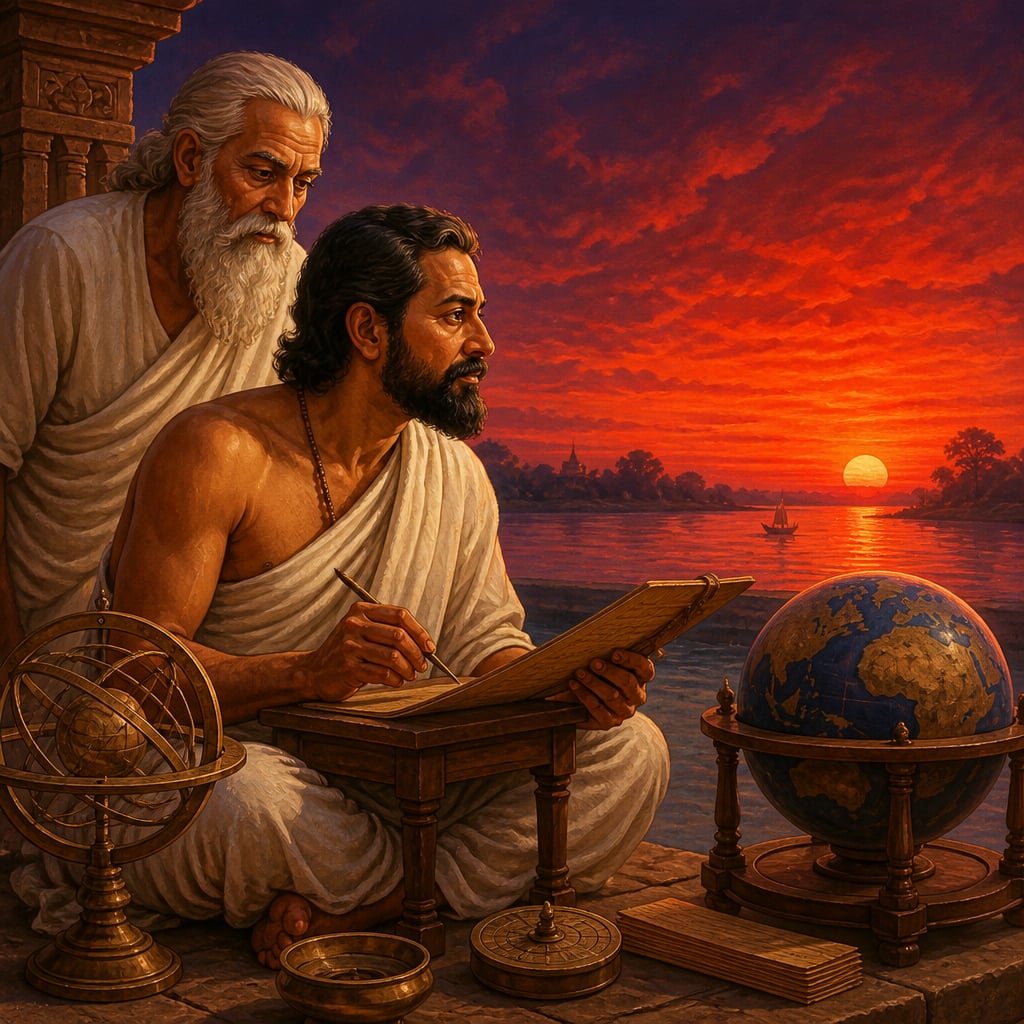
Lalla's big textbook was the Śiṣyadhīvṛddhida, "the book that grows the student's mind". It already held nineteen chapters of hard numbers: where each planet stands, when an eclipse begins, how long a shadow falls at noon. The twentieth chapter was different. He called it Mithyājñāna, "wrong knowledge".
In it he listed ideas that many people believed about the world, and took them apart one by one. His record of the rival views survives in his own words: "Some say that the earth is immense; others that it is perfectly flat like a mirror." Other voices said that night falls because the Sun slips behind Meru, the golden world-mountain of the Purāṇas, and the mountain's darkness covers the land.
These were not village rumours. They came wrapped in the language of respected texts. Lalla had to answer them without throwing away a tradition he also belonged to. How did he manage it? And what did India's astronomers really believe about the shape of the Earth?
A Ball Hanging in the Middle of Space
Lalla was not inventing a new idea. He was defending one his school already held. Around 499 CE, Āryabhaṭa had set it down in a single verse.
वृत्तभपञ्जरमध्ये कक्ष्यापरिवेष्टितः खमध्यगतः। मृज्जलशिखिवायुमयो भूगोलः सर्वतो वृत्तः॥
vṛtta-bha-pañjara-madhye kakṣyā-pariveṣṭitaḥ kha-madhya-gataḥ mṛj-jala-śikhi-vāyu-mayo bhūgolaḥ sarvato vṛttaḥ
In the middle of the round cage of stars, ringed by the orbits of the planets, standing at the centre of space, made of earth, water, fire and air, is the Earth-ball, round on every side.
Āryabhaṭīya, Golapāda 6