Ayana-Calana: Precession and the Drifting Saṅkrānti
Why Makar Saṅkrānti falls around 14 January, three weeks after the solstice
The sky slowly slides against the seasons. Follow Bhāskara, Muñjāla and the Sūrya Siddhānta as they notice and measure precession (ayana-calana), and learn why the star-based (nirayana) and season-based (sāyana) zodiacs now sit a little over 24 degrees apart, which is why Makar Saṅkrānti no longer falls on the solstice.
The Question Bhāskara Asked Himself
It was the year 1150, in a town of scholars near the Sahyādri hills of the Deccan. A thirty-six-year-old astronomer named Bhāskara was finishing the last part of his great book, the Siddhānta Śiromaṇi. The chapter in front of him taught students to build a model of the sky out of bamboo hoops tied into a sphere. One hoop stood for the equator. A second, tilted hoop stood for the Sun's yearly path.
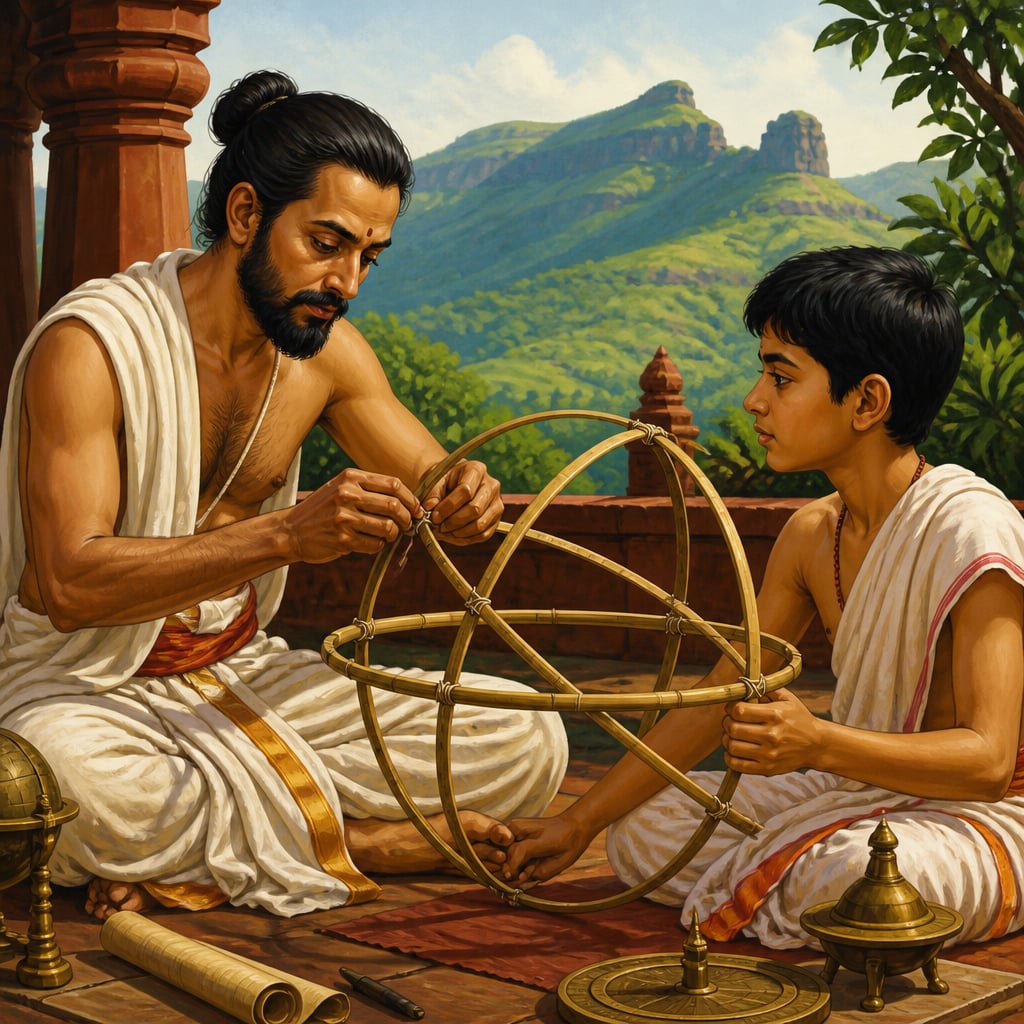
Where those two hoops cross, the Sun stands at an equinox. Bhāskara had just written two short verses saying that this crossing point is not fixed. It creeps slowly backward, year after year, and it drags the seasons along with it.
Then, in his own prose commentary, he wrote down the hardest objection anyone could raise. If this motion is real, why did Brahmagupta, the master whose work he had built his life on, never mention it?
It was a real risk. If the old masters were right, Bhāskara was wrong. If Bhāskara was right, the almanacs of the land were quietly slipping. His answer is one of the most confident sentences in Indian science. It also explains why a festival you celebrate every January falls where it does.
A Sky That Slides
The Earth spins like a top, and like a top it wobbles. Its axis traces a slow circle in the sky, taking about 26,000 years to go round once. As it wobbles, the two points where the equator crosses the Sun's path (the equinoxes) slide backward against the stars by about 50 seconds of arc a year. That is one degree in roughly 72 years.
Indian astronomers called this ayana-calana, "the moving of the ayana", the turning points of the Sun's year. In one human lifetime the drift adds up to about one degree, the width of two full Moons side by side. You cannot see it in a night. You can only see it in records kept across centuries, which is how Hipparchus found it in Greece around 130 BCE, as we saw in lesson 1.7.