Yantra-Paramparā: The Tradition of Astronomical Instruments
Nine instruments of wood, water and copper, and the tenth that Bhāskara called the only true one
In 1150 CE Bhāskara listed nine astronomical instruments, from a stick in the ground to a sinking copper bowl, and then named the mind as the one true instrument. Learn why every siddhānta that computed the sky also needed a chapter on measuring it, how Lalla's twelve instruments and Bhāskara's nine kept the tables honest, how a measuring tool differs from a model like the Greek Antikythera mechanism, and how the same method runs on to the radio dishes of the GMRT near Pune.
The Tenth Instrument
In 1150 CE, somewhere in the Deccan, a thirty-six-year-old astronomer named Bhāskara was writing the chapter on instruments for his great book, the Siddhānta Śiromaṇi. We know his age because he wrote it down: the book says he was born in the Śaka year 1036 (1114 CE) and composed it at thirty-six.
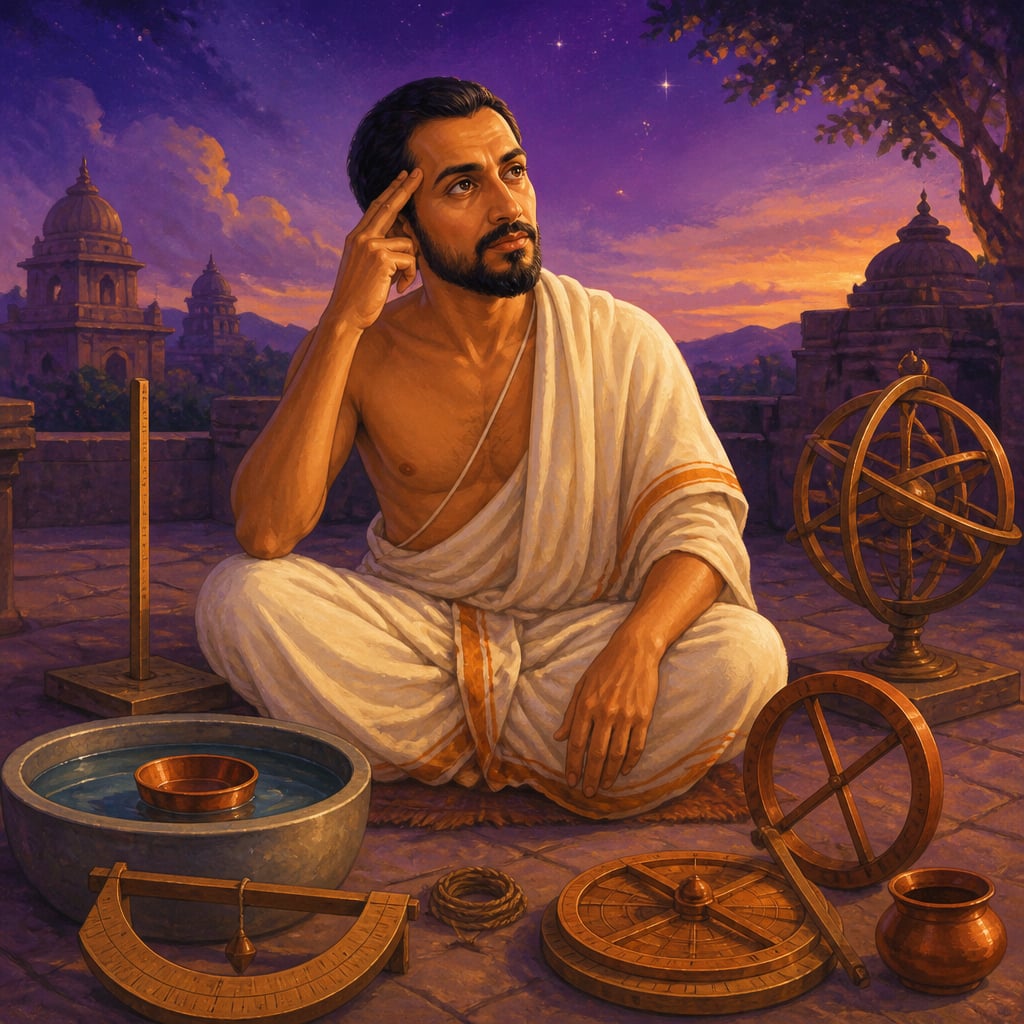
The chapter opens with a problem. The parts of the day that have passed, Bhāskara writes, cannot be known without instruments. A table can tell you where the Sun should be. Only a device can tell you where it is. The stakes were real. A calendar computed from old numbers slowly slides away from the sky, and an eclipse predicted for the wrong hour is a public failure. So he promised to describe "a few instruments, clearly and briefly".
Then he made a list. It is a list of plain things. A sphere of hoops, a ring, a staff, a stick set in the ground. A copper bowl that sinks in water. A wheel, a half-wheel, a quarter-wheel, and a flat marked board. Nine instruments of wood, metal and water, the kind an astronomer could build with a carpenter and a coppersmith.
And then, in the same verse, he added a tenth. It has no wood, no water and no metal.
गोलो नाडीवलयं यष्टिः शङ्कुर्घटी चक्रम्। चापं तुर्यं फलकं धीरेकं पारमार्थिकं यन्त्रम्॥
golo nāḍīvalayaṃ yaṣṭiḥ śaṅkur ghaṭī cakram cāpaṃ turyaṃ phalakaṃ dhīr ekaṃ pāramārthikaṃ yantram
The sphere, the ring, the staff, the gnomon, the water-bowl, the circle, the half-circle, the quarter-circle, the board: and the mind, the one true instrument.
Siddhānta Śiromaṇi, Golādhyāya, Yantrādhyāya 2
Why would a man who had just listed nine tools of measurement end by saying that none of them is the real one? The answer runs through the whole story of Indian astronomical instruments. This chapter follows that story, from a stick in the ground to a field of radio dishes near Pune.