Sāmanta Candraśekhara: The Last Naked-Eye Master
The Odisha astronomer who corrected the siddhāntas with bamboo and wood
Without a telescope or English, Sāmanta Candraśekhara (1835-1904) spent decades observing from Khandapara and wrote the Siddhānta Darpaṇa, correcting the old values by his own measurement.
Two Planets and a Stick
One evening in the early 1890s, a science teacher in his early thirties named Jogesh Chandra Ray met an old astronomer he had heard a great deal about. Ray taught at Ravenshaw College in Cuttack. Some of his friends doubted that the thin, quiet man from the hills could do any real astronomy at all. They decided to test him.
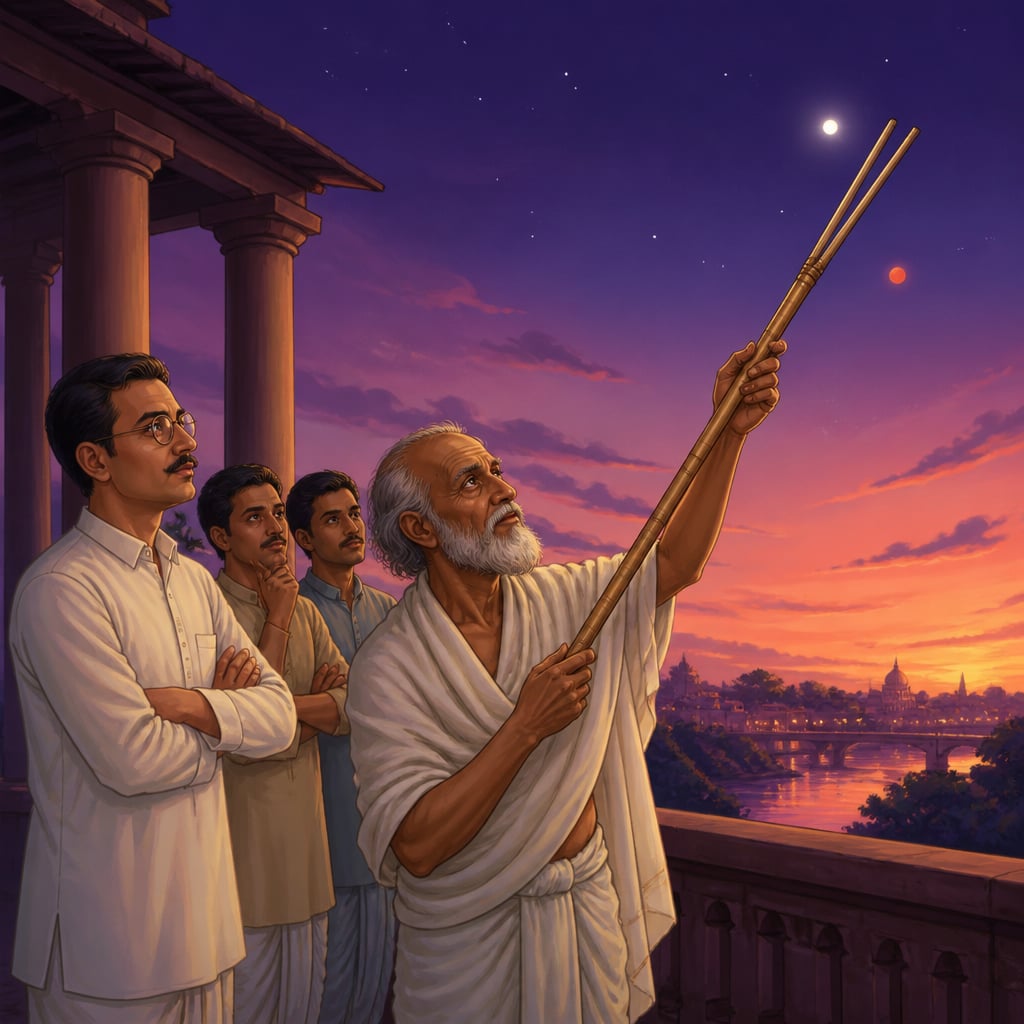
Mars and Venus were shining low in the western sky, about six degrees apart. The friends asked Sāmanta Candraśekhara to show, with any instrument he could make on the spot, how far apart the two planets really were.
He paused for a moment. Then he took a stick 42 finger-widths long and fixed a small cross-piece, four and a half finger-widths wide, to one end. He did the sums in his head, because he knew his tables of sines by heart. Within a few minutes the instrument was ready. Ray counted what followed as proof of the skill that long practice had given him. He wrote that it was "a real pleasure to see him handling his Manayantra with a precision marvellous to behold."
That same evening, Candraśekhara looked through a telescope for the first time in his life. He was well past fifty. For almost forty years he had measured the sky with bamboo and wood. How much can a man find with sticks and his own two eyes? This lesson is his answer.
A Prince Without a Teacher
Candraśekhara was born in 1835 (Śaka 1757) at Khandapara, a small hill kingdom some 50 or 60 miles west of Cuttack, in today's Nayagarh district of Odisha. He belonged to its ruling family. In Odisha he is still best known by a pet name, Pathani Samanta. His parents gave it because their first two children had died as babies, and an odd name was meant to protect him.