Nava-Paramparā: From Madras Observatory to Chandrayaan
The lineage continues in modern Indian astronomy
The tradition did not end with the last siddhānta. Follow it through the Madras Observatory, Saha, Chandrasekhar and Vainu Bappu to India landing on the Moon.
The Star That Came Back
Picture Madras on the night of 16 January 1867. In the observatory at Nungambakkam, a man bends to the eyepiece of the meridian circle, a telescope that swings only north and south along the line of noon. A small lamp lights the brass reading scale. A log book lies open beside him. His name is Chintamani Ragoonatha Charry, and in the observatory's books his title is First Native Assistant. (His name is also spelt Chary.)
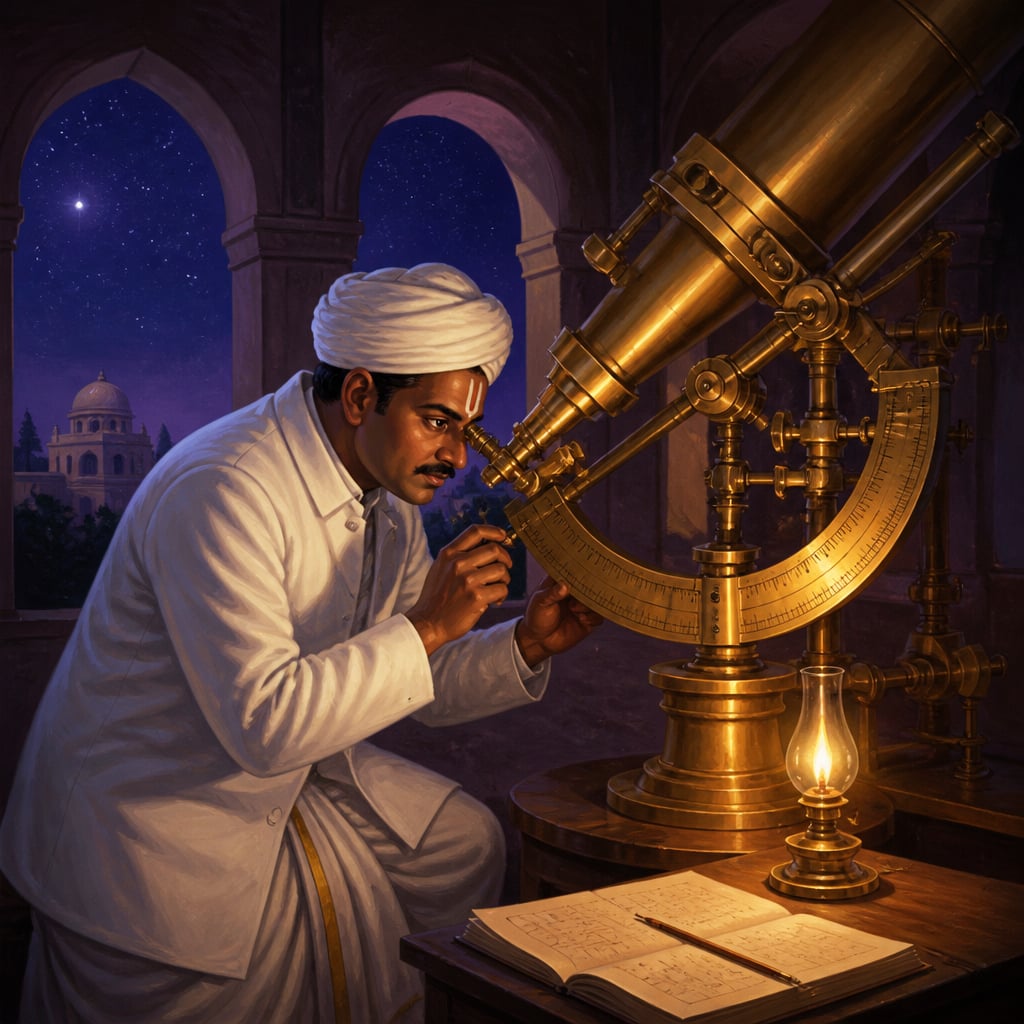
He is looking low in the south, into the small constellation Reticulum, the Net. From Madras it never climbs more than about fourteen degrees above the horizon. In February 1864 his colleague T. Moottooswamy Pillai had logged a faint star there with this same telescope, a steady point of light far too dim for the naked eye. In January 1866, when the observers pointed the telescope at the same spot, the dark field showed nothing at all.
Stars do not simply leave. Either the 1864 entry was a mistake, or the star itself had changed. If it was a mistake, the careful record of an Indian assistant would be quietly struck out. Tonight Charry is looking for an answer.
An Observatory in Madras
The Madras Observatory began in 1786 as a private observatory of iron and timber, set up by William Petrie, an officer of the East India Company. In 1792 the Company took it over and rebuilt it at Nungambakkam. A granite pillar of about ten tons was raised to carry its main instrument.
That pillar still stands, in the grounds of the Regional Meteorological Centre in Chennai. It carries inscriptions in English, Tamil, Telugu and Urdu. The Tamil line gives the year twice: 1792 by the English calendar, and 4893 by the Kali Yuga. That is the era from which the siddhāntas had counted days for well over a thousand years. Old and new ways of counting time stood on one stone.