Jai Singh: The Astronomer-King and His Jantar Mantars
Five observatories in stone, built to correct the tables
Explore Sawai Jai Singh II and the five Jantar Mantars he built across north India, from the 27-metre Samrāṭ Yantra to the Jaya Prakāśa, and why he built in stone.
The Tables Were Wrong
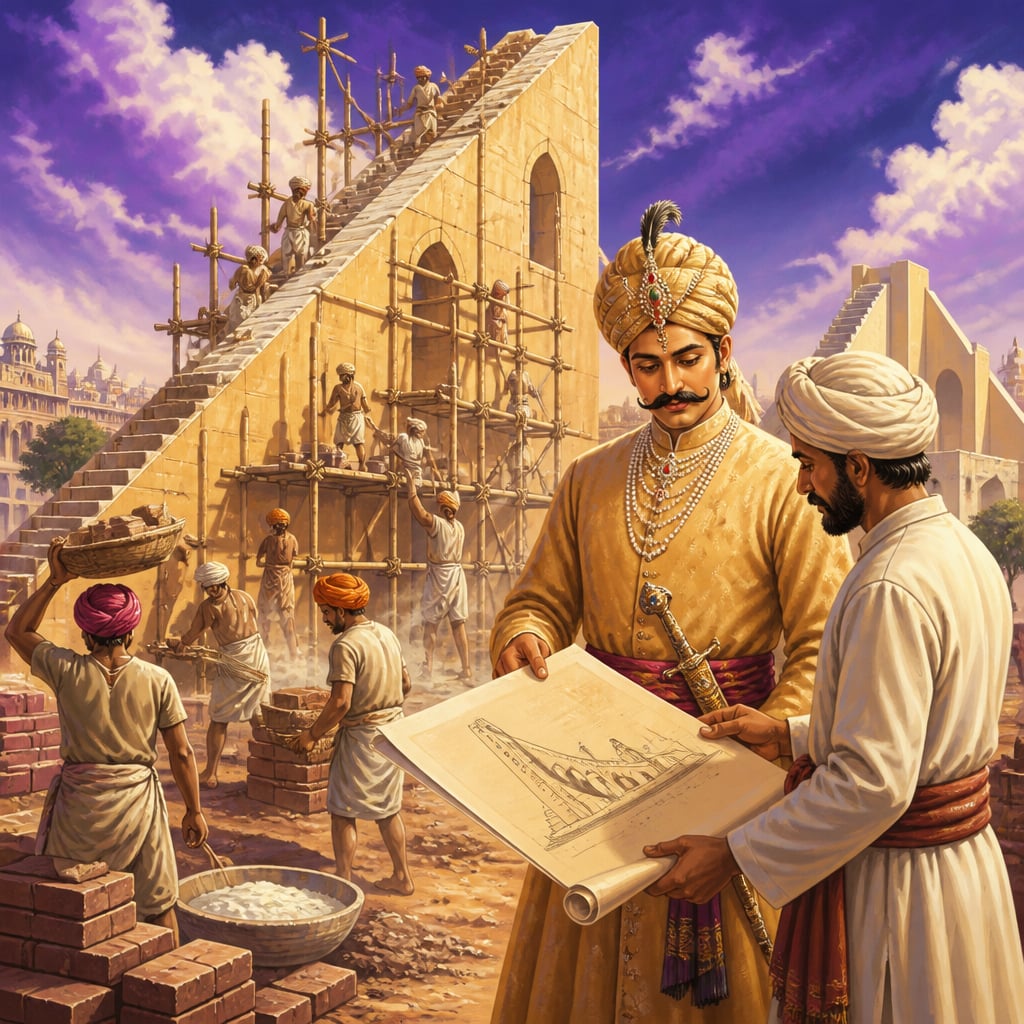
Picture Delhi in the mid-1720s, on open ground a short ride south-west of the walls of Shahjahanabad. Workmen carry bricks and baskets of lime mortar. A wedge of masonry is slowly rising, taller than any house in the lane. The man who ordered it is not a mason or a priest. He is a Rajput king in his thirties, Sawai Jai Singh II of Amber.
Jai Singh had a problem that no army could fix. The astronomical tables used at the Mughal court, including the famous tables of Ulugh Beg of Samarkand, no longer matched the sky. When he checked their predicted positions of the Sun, Moon and planets against what he saw, the numbers were often far off. Tables like these were used to time eclipses, keep calendars and choose the hours for great events. If the tables were wrong, all of that was quietly wrong too.
So he decided to measure the sky himself, and to build instruments so big that they could not lie. Could stone do what brass had failed to do? That is the question behind five observatories that still stand in north India.
A King Who Counted Stars
Jai Singh was born on 3 November 1688 and became ruler of Amber in 1699, at the age of eleven. He spent his life as a general and governor in the service of the Mughal emperors. Yet his great passion was mathematics and the heavens.
He gathered scholars from every tradition he could reach. His chief pandit, Jagannātha Samrāṭ, translated Euclid's Elements into Sanskrit and, around 1732, produced a Sanskrit version of Ptolemy's Almagest from its Arabic form. Persian and Arabic tables sat beside Sanskrit siddhāntas (astronomical treatises). In 1727 he sent a Jesuit, Father Manuel de Figueredo, to Portugal to fetch books and instruments. The mission returned in 1730 with the new 1727 edition of the tables of the French astronomer Philippe de La Hire.