Gola-Yantra: Armillary Spheres and Celestial Models
How a turning cage of rings let astronomers hold the sky in their hands, and make it keep time
Around 499 CE Āryabhaṭa asked for a wooden sphere that turns by itself, in step with the sky. Learn how the gola-yantra (armillary sphere) turned the sky's invisible circles into rings you can touch, how Bhāskara II used it to show why the rules of astronomy work, how Zhang Heng in China drove a sphere with water, and how the modern planetarium puts you inside the model.
A Ball of Wood That Keeps Time
Around 499 CE, in the city of Kusumapura near modern Patna, a twenty-three-year-old astronomer named Āryabhaṭa was finishing the last part of his book. He called that part the Golapāda, the section on the sphere. Most of its verses deal with the sky itself: the round Earth, the Moon's shadow, the eclipses. But in the middle of them sits a verse that reads like an order to a workshop.
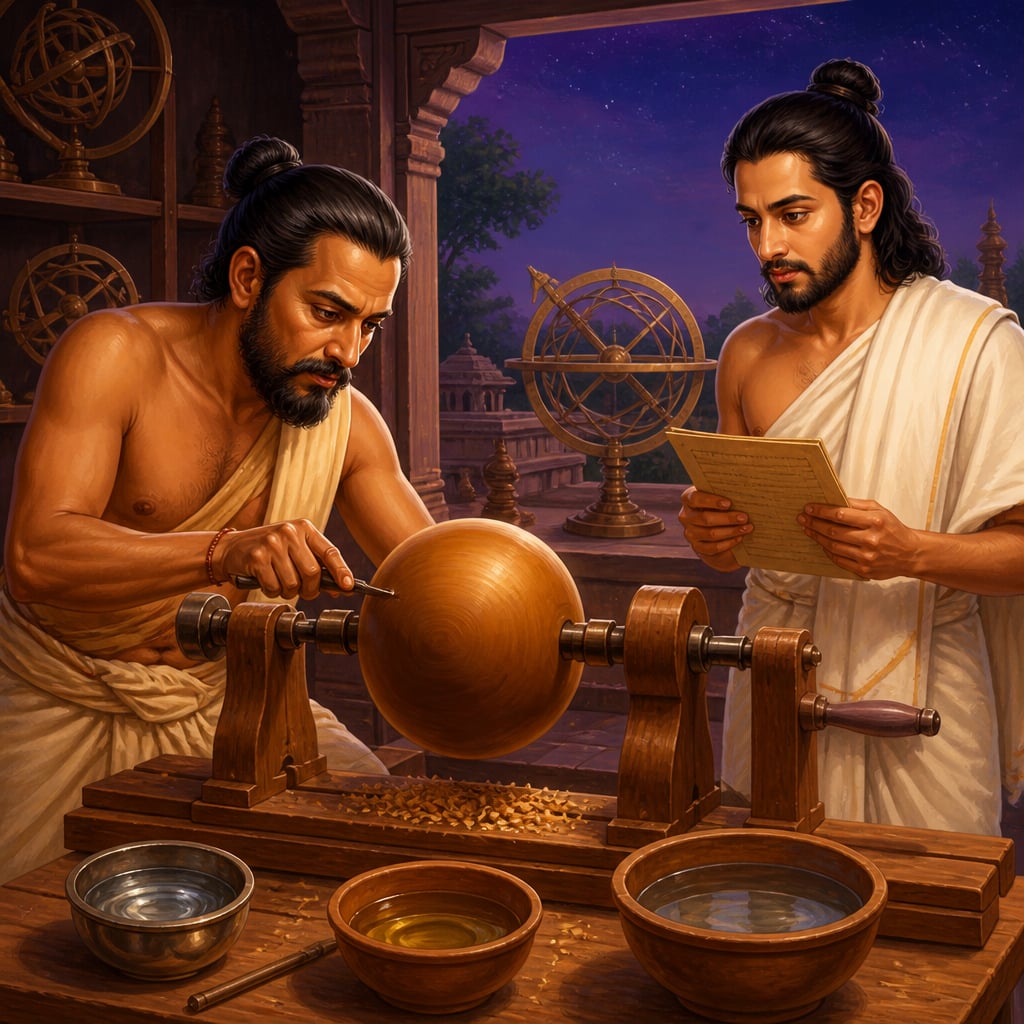
Make a ball of wood, it says. Make it perfectly round, even in weight all over, and light. Then set it turning with mercury, oil and water, so that it keeps pace with time.
काष्ठमयं समवृत्तं समन्ततः समगुरुं लघुं गोलम्। पारदतैलजलैस्तं भ्रमयेत् स्वधिया च कालसमम्॥
kāṣṭhamayaṃ samavṛttaṃ samantataḥ samaguruṃ laghuṃ golam pārada-taila-jalais taṃ bhramayet svadhiyā ca kālasamam
A sphere of wood, perfectly round, even in weight all over and light: let it be turned with mercury, oil and water, by one's own skill, in step with time.
Āryabhaṭīya, Golapāda 22
Picture what he is asking for. A smooth wooden globe, marked with the circles of the heavens. Below it, water dripping, oil sliding, a heavy silver bead of mercury rolling. And the globe turning so slowly that one full turn takes a whole day and night, exactly as the real sky does.
That last demand is the hard part. A model that turns too fast or too slow shows a false sky. And Āryabhaṭa gives no drawing, no gears, no measurements. He says only svadhiyā: by your own intelligence. How do you make a wooden ball keep time with the stars? Indian astronomers worked on that question for centuries, and its answer still turns above the heads of schoolchildren in planetarium domes across India.