Vāra-Horā: Week and Hour Systems
The hidden astronomical rule that sets the order of the days of the week
Why does the week run Sun, Moon, Mars, Mercury, Jupiter, Venus, Saturn, an order that matches neither distance nor brightness? Learn the elegant planetary-hour rule, stated by Āryabhaṭa, that generates the sequence of weekdays, and how the same seven-planet week is shared across the world and survives, unbroken, as the global 7-day week.
The Strangest Order in the Calendar
Line up the seven planets of the ancients by their distance, slowest and farthest first: Saturn, Jupiter, Mars, the Sun, Venus, Mercury, the Moon. Now line up the days of the week by their planet-lords: the Sun's day, the Moon's day, Mars's day, Mercury's day, Jupiter's day, Venus's day, Saturn's day. Sunday, Monday, Tuesday, and so on.
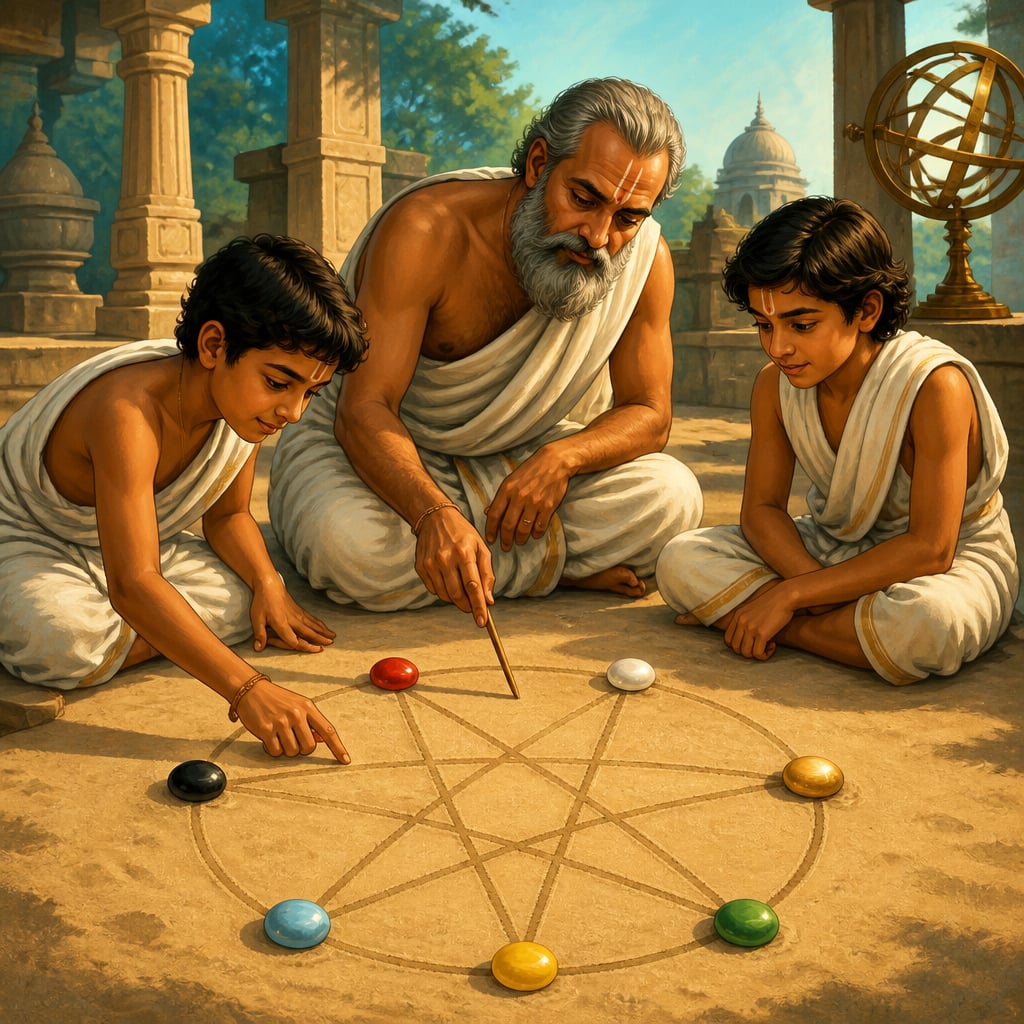
The two orders do not match. The weekday order is not by distance, not by speed, not by brightness, not by any obvious sequence. Sunday jumps to Monday, the Sun to the Moon, then leaps to Mars, then to Mercury. It looks almost random. And yet the very same strange order shows up across the world, in Sanskrit and in Latin, in Hindi and in English. Some hidden rule is generating it. That rule is one of the most elegant small pieces of astronomy in the whole calendar, and Āryabhaṭa states it in a single verse. This lesson uncovers it.
The Planetary Hours
The secret is the horā, the hour. The ancients divided the full day-and-night, the ahorātra, into twenty-four hours, and assigned each hour a planetary ruler. The rulers cycle through the seven planets in the order of their distance, slowest first: Saturn, Jupiter, Mars, Sun, Venus, Mercury, Moon, then Saturn again, round and round through all twenty-four hours.
The day is named for the planet that rules its very first hour, the hour at sunrise. That planet is the dinapati, the lord of the day, and it gives the day its name, its vāra.
Now do the arithmetic that generates the week. A day has twenty-four hours. Seven planets cycle through them. Twenty-four divided by seven leaves a remainder of three. So if today's first hour is ruled by one planet, then after twenty-four hours, tomorrow's first hour is ruled by the planet three steps further along the cycle. Step three along from the Sun, and you land on the Moon. Step three along from the Moon, and you land on Mars. From Mars, three steps to Mercury. The famous, jumbled weekday order is simply the distance-order of the planets, jumped three at a time.