Pañcāṅga: The Five-Limbed Calendar
Tithi, vāra, nakṣatra, yoga and karaṇa: why Diwali moves every year, and why two almanacs can disagree
The pañcāṅga describes every day by five measurements of the real Sun and Moon. Learn the three new limbs, nakṣatra, yoga and karaṇa, see why Diwali lands about 11 days earlier each year until an extra month pulls it back, and find out why a dṛk almanac and a vākya almanac can name different days for the same festival.
The Handbook on the Konkan Coast
In 1520, in the village of Nandigrāma on the Konkan coast, an astronomer named Gaṇeśa Daivajña fixed the starting day for a new set of tables. Picture the work as astronomers of his time did it: sums worked out on a board dusted with fine sand, the figures rubbed away with a palm and written again, old hand-copied tables stacked beside him, the sea a short walk from the door.
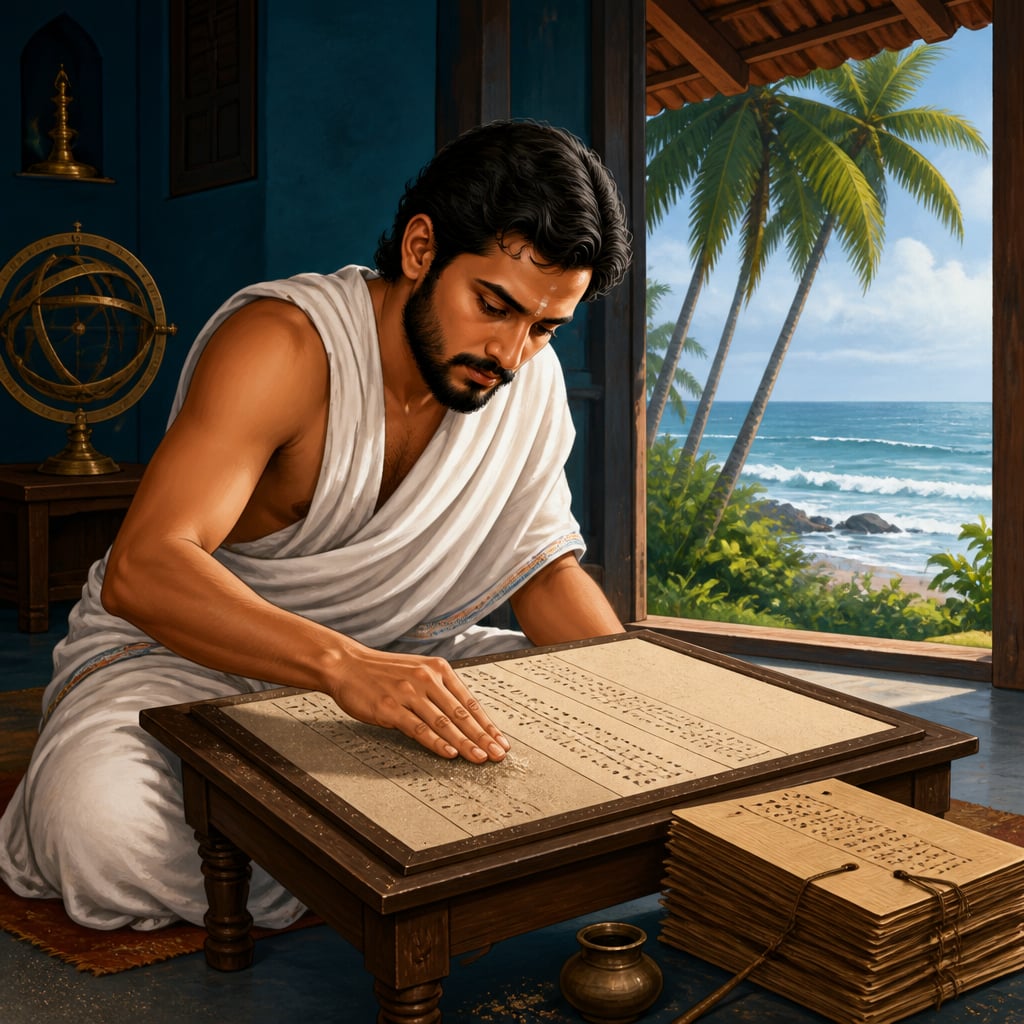
His problem was practical. Every year, in every town, someone had to work out the calendar for the coming year. A wrong answer meant a fast kept on the wrong day, or a wedding fixed on a day the family would never have chosen. The full methods of the great siddhāntas needed long tables of sines and pages of arithmetic. Most almanac-makers did not have the time or the training.
Gaṇeśa's answer was a handbook called the Grahalāghava, "the easy way to the planets". It did away with sine tables altogether and replaced them with simple arithmetic rules. It worked. For centuries, almanac-makers in Maharashtra, Gujarat and beyond computed their calendars from it. But that long success hid a slow problem, and the same problem explains why two almanacs today can print two different dates for Diwali.
Five Limbs, One Day
What Gaṇeśa's readers were building was a pañcāṅga, literally "five limbs". It is the Indian almanac, and it describes every day by five separate measurements of the sky. You have already met two of them in this chapter. The other three are new.
| Limb | What it measures | How many |
|---|---|---|
| Tithi | the Moon pulling 12 degrees ahead of the Sun | 30 in a lunar month |
| Vāra | the weekday, sunrise to sunrise | 7 |
| Nakṣatra | the Moon's place among 27 star-divisions | 27 |
| Yoga | the Sun's and Moon's positions added together | 27 |
| Karaṇa | half of a tithi | 11 names, 60 slots a month |