Vedāṅga Jyotiṣa: Astronomy Before the Siddhāntas
The earliest astronomical text of India composed by Lagadha
Explore Lagadha's Vedāṅga Jyotiṣa, whose sky dates to around 1400 to 1200 BCE: the foundational text that kept the Vedic calendar by pure arithmetic, long before the geometric Siddhāntas.
The Little Book That Kept Time
Picture the little book in a scholar's hands: a bare forty-odd verses on palm-leaf, terse and unadorned, no hymn and no story, only numbers and rules. This is the Vedāṅga Jyotiṣa, and the man the tradition calls Lagadha built it to do one thing better than anyone before him. To keep time.
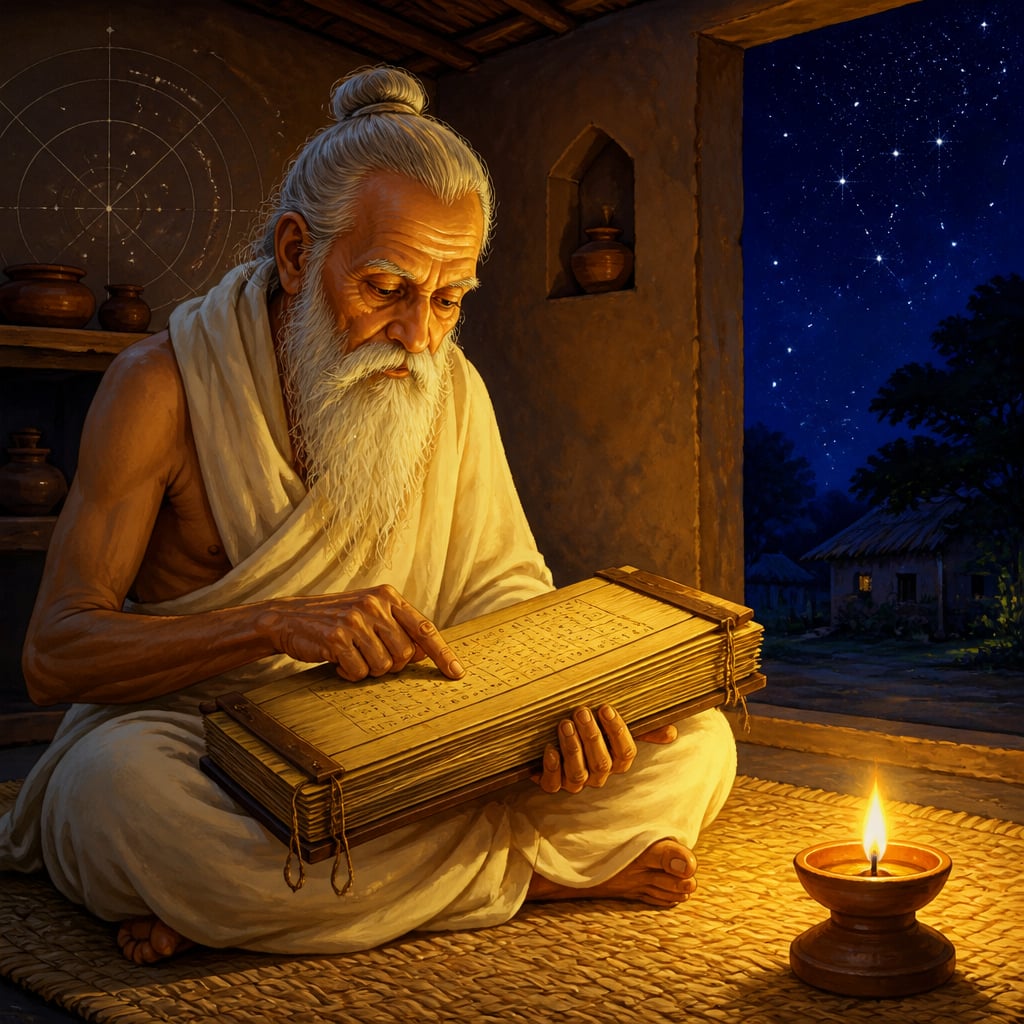
What it could not do is worth saying plainly, because it measures how far Indian astronomy would travel. Lagadha could not calculate an eclipse. He could not tell you where Jupiter would stand next spring, or the exact minute the moon would rise. The trigonometry and the geometric models of the sky that would do all that lay almost two thousand years ahead, in the age of the great Siddhāntas. What Lagadha had was arithmetic. And with arithmetic alone he solved the one problem the Veda most needed solved: when.
This is the oldest astronomical text of India that we can still read, and it stands at the very start of a scientific tradition that would run, unbroken, for three thousand years. To feel the heights the Siddhāntas would reach, it helps to stand first at the foot of the climb.
The Morning the Calendar Reset
Lagadha's calendar ran in a repeating five-year cycle, a yuga, and the whole cycle hung on a single recurring dawn. The book fixes it exactly.
स्वराक्रमेते सोमार्कौ यदा साकं सवासवौ। स्यात्तदादियुगं माघस्तपः शुक्लोऽयनं ह्युदक्॥
svarākramete somārkau yadā sākaṃ savāsavau syāt tadādi yugaṃ māghas tapaḥ śuklo'yanaṃ hy udak
When the moon and the sun climb the sky together, joined with Vāsava (the star-group Dhaniṣṭhā), that is the start of the yuga: the month of Māgha, the bright fortnight, and the northward turn of the sun.
Vedāṅga Jyotiṣa (Yajus recension), verse 6
Read what that verse is doing. It defines the zero-point of an entire calendar by an event in the sky: the new moon of Māgha, when the sun and moon rise together against the stars of Dhaniṣṭhā, on the very day the sun begins its northward journey, the uttarāyaṇa. From that one dawn, everything counts forward. Across five years the almanac tracked 1,830 days and 62 lunar months, slipping in an extra month twice to keep the moon in step with the sun, until the same dawn came round again and the cycle reset.