Nakṣatra: The 27 Lunar Mansions
The foundation of Indian sky-mapping that divides the ecliptic into 27 segments
Learn about the nakṣatra system, the 27 (sometimes 28) lunar mansions that form the oldest and most enduring Indian way of mapping the sky and tracking the moon and planets across it.
The Moon's Nightly Walk
Picture one of the earliest sky-watchers of the Vedic world, a man with no instrument but patience, following the moon night after night from the same patch of ground. On the first night it rests beside a small, tight cluster of stars, the one we call the Pleiades. The next night it has moved on, a full hand's-breadth to the east, to lie among different stars. The night after, it has moved again.
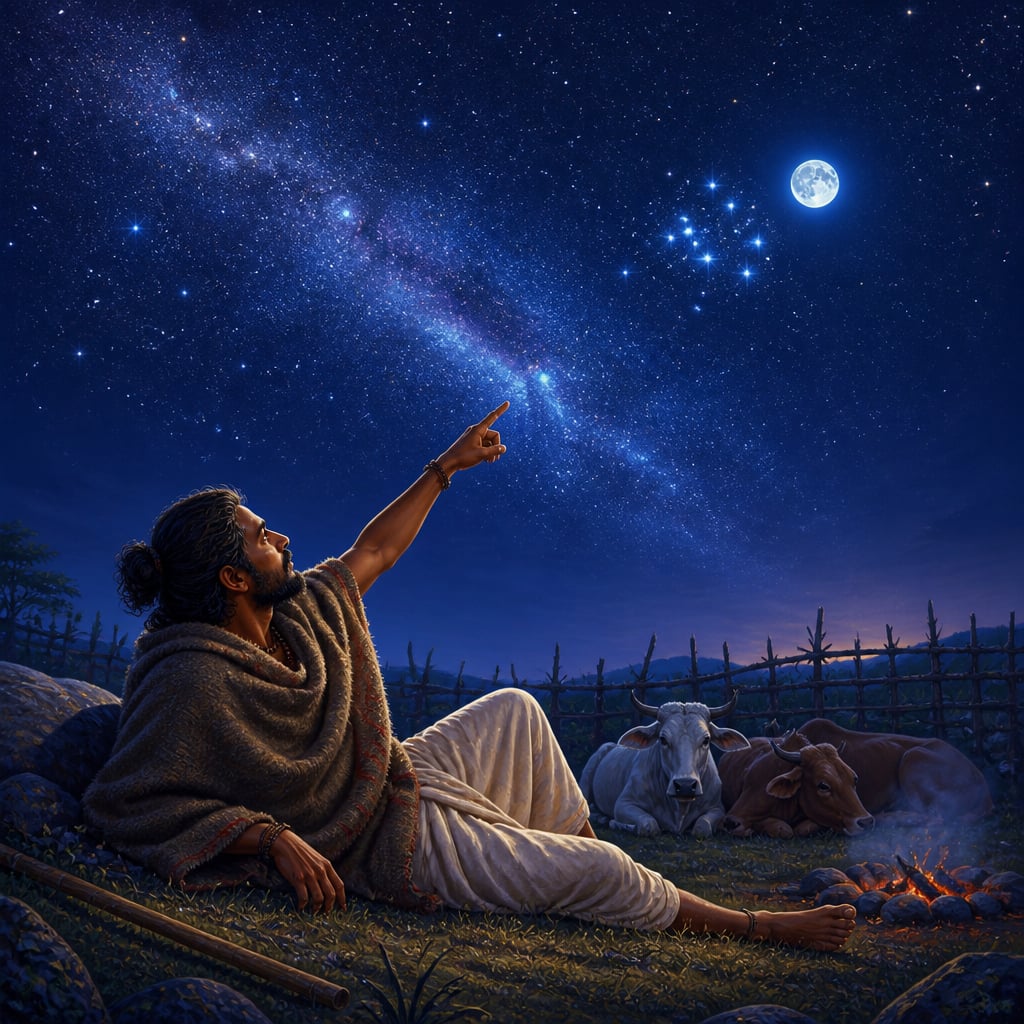
He keeps watching. Group by group, the moon walks eastward along a fixed road through the stars, and after about twenty-seven nights it comes back to rest beside the Pleiades where it started. He has just traced the oldest map of the Indian sky. Each of those resting-places has a name and a guardian star, and together they are the nakṣatras: the twenty-seven lunar mansions that Indian astronomy would use to locate everything in the heavens for the next three thousand years.
Twenty-Seven Mansions
The idea is beautifully simple. The moon takes about twenty-seven days to travel once around the sky against the background stars. So the Indian astronomers divided that circular road, the band the moon and planets move through, into twenty-seven equal segments, one for each night's step. Each segment is a nakṣatra, a 'mansion' where the moon lodges for a night, and each is marked by a recognisable star or star-group called its yogatārā, its junction-star.
The system is old enough that some of its mansions are already named in the Ṛgveda. The full list, each mansion with a presiding deity, appears in the Taittirīya Saṃhitā and the Atharvaveda, and the Vedāṅga Jyotiṣa sets the twenty-seven to work in the calendar and in ritual.
नक्षत्रदेवता एता एताभिर्यज्ञकर्मणि। यजमानस्य शास्त्रज्ञैर्नाम नक्षत्रजं स्मृतम्॥
nakṣatra-devatā etā etābhir yajña-karmaṇi yajamānasya śāstrajñair nāma nakṣatrajaṃ smṛtam
These are the deities of the nakṣatras. From these, in the work of sacrifice, the learned form the nakṣatra-name of the patron of the rite.
Vedāṅga Jyotiṣa (Yajus recension), verse 35