Dṛk-Gaṇita: When Observation Meets Calculation
The empirical tradition within Jyotiṣa that refined astronomical knowledge
Explore Dṛk-Gaṇita, the tradition's insistence that calculation must answer to observation, and the astronomers, above all Parameśvara of Kerala, who spent lifetimes making the computed sky and the observed sky agree.
Fifty-Five Years of Watching
On the coast of Kerala, sometime in the early 1400s, an astronomer named Parameśvara stood at the edge of the Nila river and watched an eclipse, as he had done many times before and would do many times again. He was not watching for wonder. He had a table in his head, computed from the inherited system, of exactly when the shadow should touch the moon. And he was watching to see whether the sky agreed.
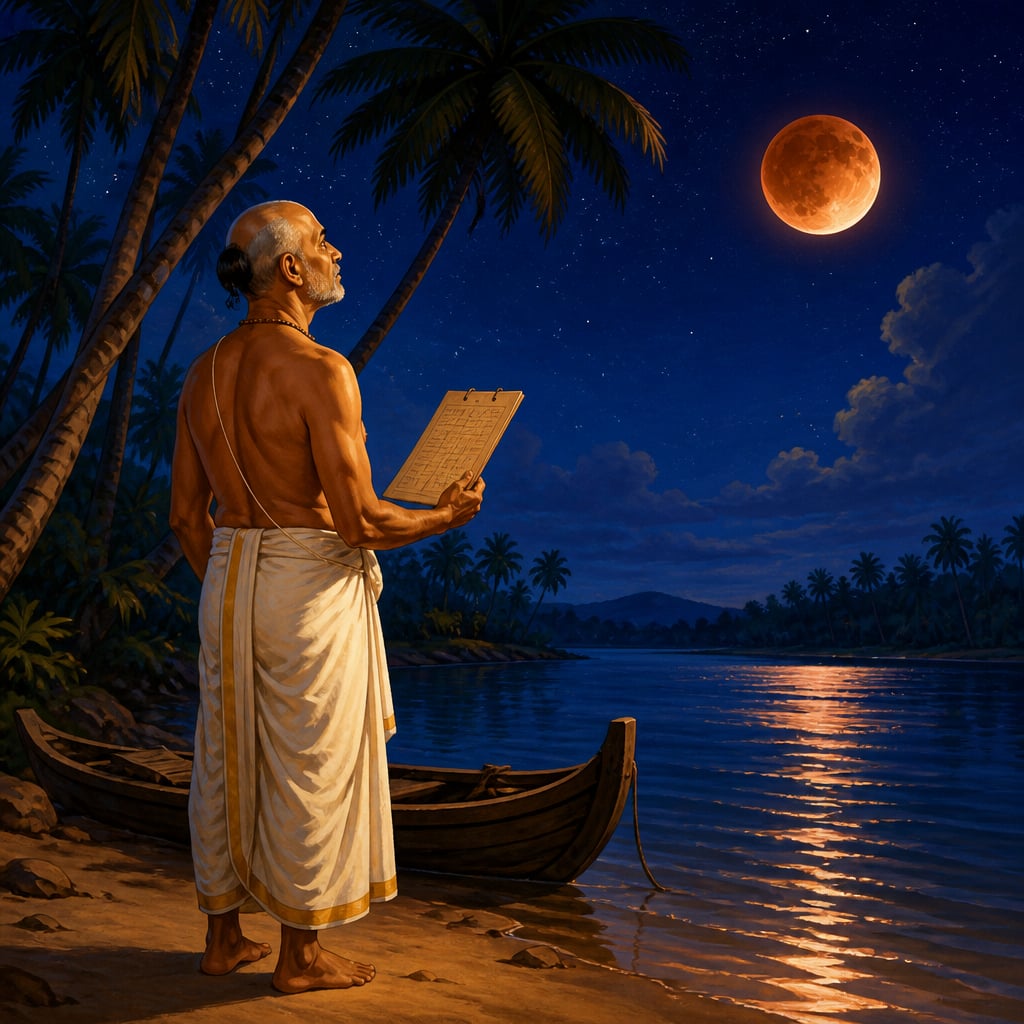
Often it did not, quite. The shadow came a little early, or a little late, by minutes that mattered. Most astronomers would have shrugged; the tables were old and revered. Parameśvara did something harder. He kept watching, eclipse after eclipse, for decades (his recorded eclipses run from 1393 to 1432, and by his own account he observed for fifty-five years), writing down each time the difference between what he computed and what he saw. Then, in 1431, he used those decades of observations to build a corrected system, which he called Dṛggaṇita, 'observation-and-calculation'.
That single word is the subject of this lesson, and it is the note on which the chapter ends. Dṛk means sight, what the eye sees. Gaṇita means calculation, what the mind computes. Indian astronomy at its best was the marriage of the two, and Parameśvara's fifty-five-year vigil is one of the great acts of patient observation in the history of science.
When the Table Drifts from the Sky
Why should a perfectly good calculation need correcting at all? Because a calculation is only as good as the numbers fed into it, and those numbers slowly go stale.
Every astronomical system rests on parameters: the exact length of the year, the precise speed of the moon, the size of an orbit. These are measured once, then used for centuries. But small errors in them accumulate. A tiny mistake in the moon's assumed speed is invisible in a year and glaring in three hundred. So a system that was accurate when Āryabhaṭa set it drifts, quietly, out of true, until the computed eclipse and the observed eclipse no longer land on the same minute. The only cure is to go back to the sky, measure again, and reset the numbers. That is what dṛk-gaṇita means: calculation kept honest by observation.