Siddhānta Paramparā: The Mathematical Astronomy Lineage
Why this course focuses on Siddhānta and its remarkable achievements
Understand the Siddhānta tradition, the unbroken lineage of mathematical astronomers from Āryabhaṭa to Bhāskarācārya, and why its achievements in calculation and observation form the core of this course.
The Book That Needed a Chain
In the year 629, in western India, an astronomer named Bhāskara sat down to write what is now the oldest surviving commentary on a scientific classic. He opened the Āryabhaṭīya, the revolutionary little treatise a mathematician named Āryabhaṭa had written 130 years earlier, and began to write a full commentary on it, verse by verse.
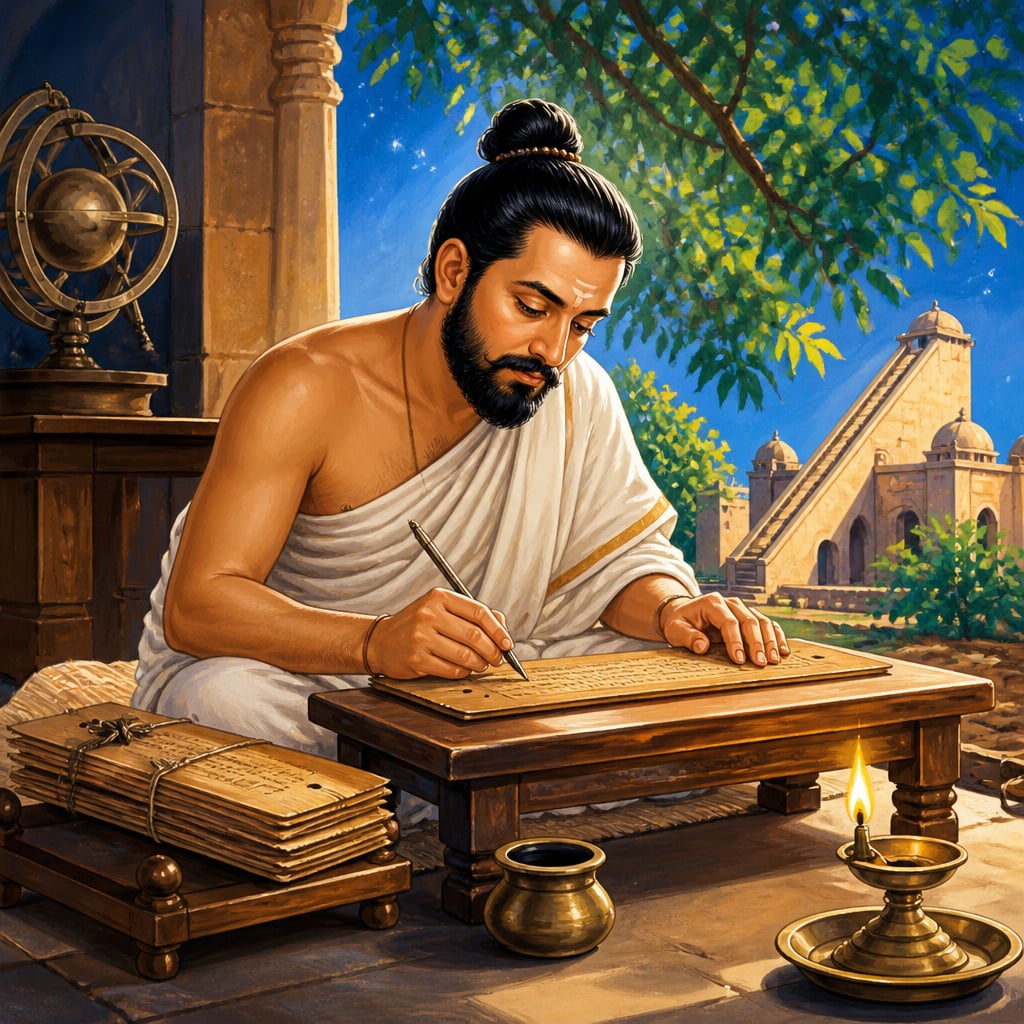
He had good reason to. The Āryabhaṭīya is brilliant and almost unreadable. Āryabhaṭa had compressed a whole system of astronomy, trigonometry, and planetary calculation into 121 terse verses, using a numeral code so dense that a single line could hide a table of sines. Without someone to unpack it, the book was a locked treasure. Bhāskara, whom later ages would call Bhāskara I to tell him from a greater namesake still to come, wrote the key.
That act, one astronomer preserving and explaining the work of another across more than a century, is the whole subject of this lesson. Indian mathematical astronomy did not survive as a pile of books. It survived as a paramparā: a living chain of teachers, students, and commentators, each holding the previous link and reaching forward to the next.
From Almanac to Cosmos
Remember where the last lesson left the tradition. Lagadha's Vedāṅga Jyotiṣa kept a calendar by arithmetic, with no geometry and no planets. Somewhere in the long centuries after, Indian astronomers made the leap that changed everything: they built a geometric model of the heavens and reached into it with trigonometry.
The man who crystallised that leap was Āryabhaṭa, whose Āryabhaṭīya of c. 499 CE opens the classical age. After him the chain is unbroken and its names are among the greatest in the history of science:
- Āryabhaṭa (c. 499 CE) builds the geometric system and its table of sines.
- Bhāskara I (629 CE) preserves and explains it, and extends the mathematics.
- Brahmagupta (628 CE) recasts astronomy with new algebra and rules for zero.
- Lalla, Vaṭeśvara, Muñjāla, and Śrīpati refine the calculations across the next centuries.
- Bhāskara II (1150 CE), the crown of the tradition, gathers it all into the Siddhānta Śiromaṇi.
- The Kerala school (14th to 16th century) carries it to infinite series and the doorstep of calculus.