Phalita vs. Gaṇita: Distinguishing Prediction from Calculation
The crucial distinction between predictive interpretation and verifiable calculation
Understand the distinction between Gaṇita (mathematical calculation, checkable against the sky) and Phalita (predictive interpretation), a distinction the Indian tradition itself drew, and the backbone of this whole course.
The Night the Sky Was the Judge
Picture a court astronomer, one of thousands whose names are lost, on the night his calculation is put to the test. Weeks earlier he announced that the moon would be eclipsed tonight, the Earth's shadow first touching its edge at a stated hour and minute. Now the court has gathered on the palace terrace. The full moon rides clear and bright. A water clock drips in the corner, counting down. If the shadow comes when he said it would, his standing is made. If it does not, no eloquence will save him. He cannot argue with the moon.
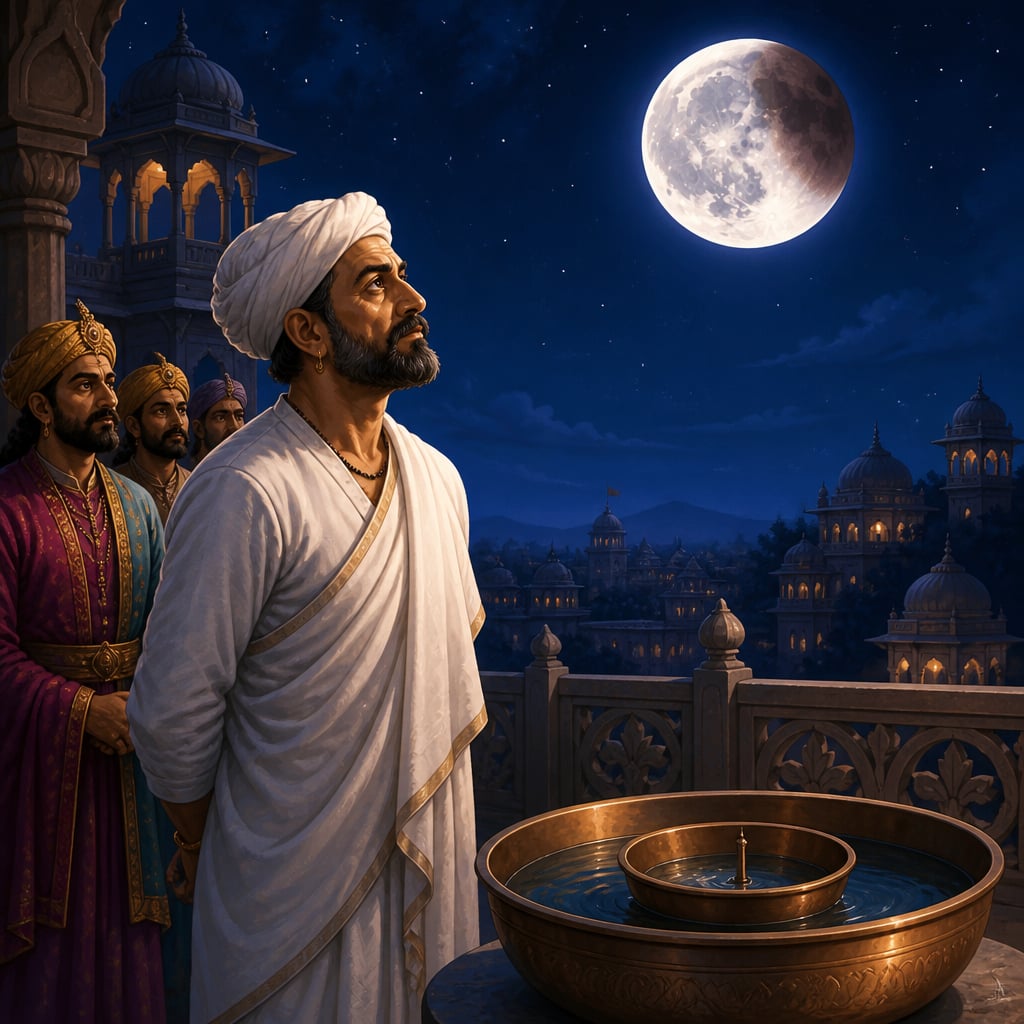
This is the peculiar terror, and the peculiar glory, of one kind of knowledge: the kind that can be proven wrong in public, tonight, in front of the king. The astronomer's predicted eclipse is gaṇita, calculation. Somewhere else in the same palace, another man studies a newborn prince's birth-chart and foretells a reign of glory. His forecast is phalita, interpretation. And here is the difference this whole course turns on: only one of these two can ever be caught out by the sky.
The Line the Tradition Drew
It would be easy to imagine that a civilization which kept astrology never noticed the difference between reading a horoscope and predicting an eclipse. The opposite is true. The Indian tradition drew the line itself, and kept two precise words for the two sides of it.
Gaṇita is calculation: the computed position of the moon, the exact minute of an eclipse, the length of the year. Phalita is the reading of results and fortunes from those positions. Gaṇita produces a number the sky will judge. Phalita produces a meaning that only a human can judge. Varāhamihira states the certainty of the first side plainly.
हीनातिरिक्तकाले फलमुक्तं पूर्वशास्त्रदृष्टत्वात्। स्फुटगणितविदः कालः कथञ्चिदपि नान्यथा भवति॥
hīnātirikta-kāle phalam uktaṃ pūrva-śāstra-dṛṣṭatvāt sphuṭa-gaṇita-vidaḥ kālaḥ kathañcid api nānyathā bhavati
The results for an eclipse coming too early or too late are stated because the earlier texts give them. For one who knows exact calculation, the time can in no way be otherwise.
Varāhamihira, Bṛhat Saṃhitā 5.25