Lakshmir Bhandar
The akhara in her own garden, the Pratapaditya sword, the rakhi oath, and the line she refused to cross
In 1902 Sarala Devi Ghosal, Rabindranath Tagore's niece and the editor of Bharati, cleared her Ballygunge back garden, hired an ustad named Murtaza, and taught Bengali boys lathi and sword. Her Pratapaditya Utsav of 1903, her Birashtami revival, her Lakshmir Bhandar swadeshi shop and her rakhi oath over a map of India all came before the partition of Bengal. When the men around her wanted the drill to become armed bands, she refused and walked away.
The Backyard at Ballygunge
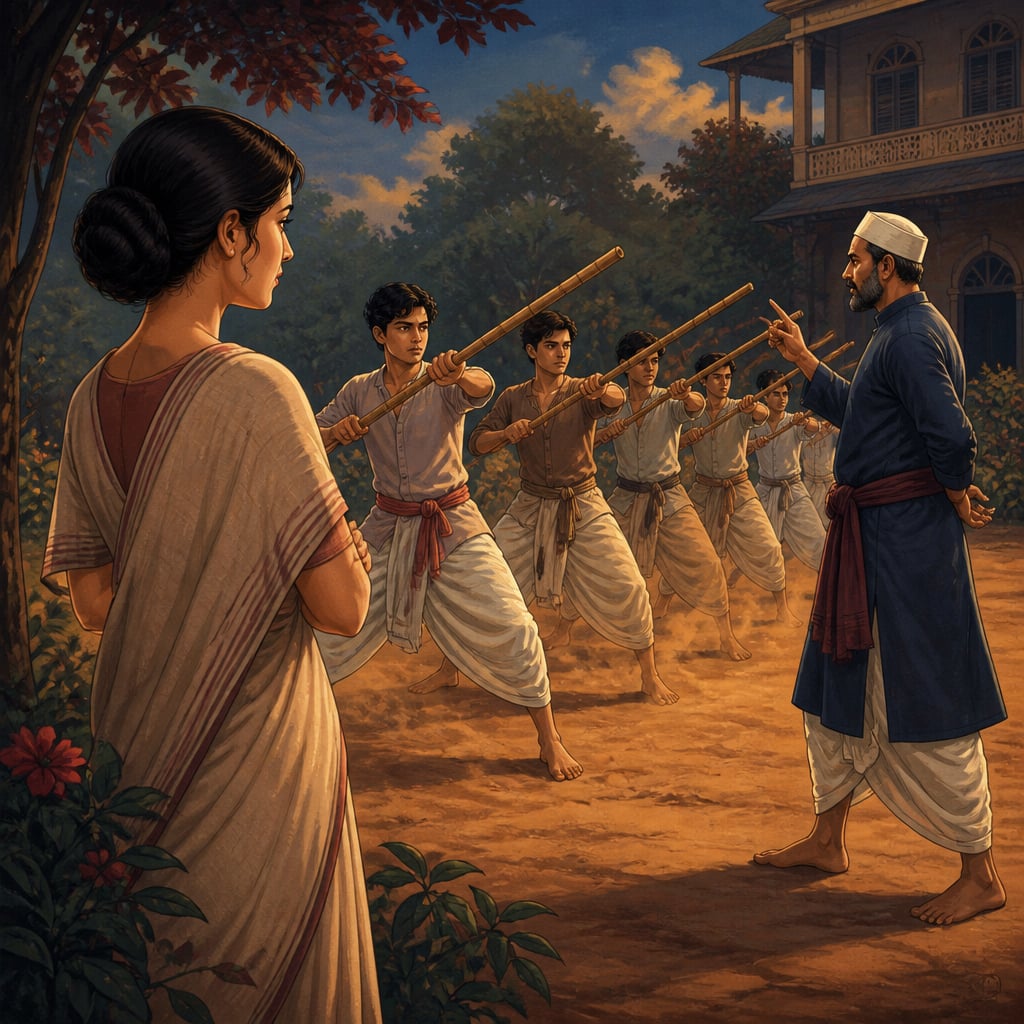
It is 1902, late afternoon, in the garden behind a house on Ballygunge Circular Road in south Calcutta. The ground has been cleared and beaten flat. A man the boys call Ustad Murtaza stands at one edge with a bamboo lathi in his hand, counting the strokes aloud. In front of him a line of Bengali schoolboys and college students swing sticks at the air, then at each other, in the drill he has set them. Dust rises off the beaten earth and settles on their dhotis.
The house belongs to a woman of twenty-nine named Sarala Devi Ghosal. She is Rabindranath Tagore's niece. She has a BA in English literature from Bethune College and the first Padmavati Gold Medal that college ever gave. She edits Bharati, one of the best Bengali literary monthlies of the day. She has turned her own back garden into a fighting school.
She wrote down why, forty years later. Her memoir names the trainer and the drills on page 126. What it does not say, because she could not know it, is what the boys in that dust would become. Inside six years, young men from schools like theirs would be making bombs in a garden at Muraripukur and standing in the dock at Alipore. She is the woman who taught Bengal to pick up a stick. She would also be the one who refused to let it become a gun.
The Charge She Was Answering
To understand the akhara you have to understand the insult.
Thomas Babington Macaulay had written that the Bengali was feeble, and the Raj repeated it for seventy years as settled fact. By the 1890s many educated Bengalis had half believed it about themselves. Sarala Devi decided the answer was not an essay. It was a body that could take a hit.