The Same Year, Far from Delhi
A register in a Deccan village, two refused adoptions, a rising on the Chhota Nagpur plateau, and a letter seized at Jorhat
While the textbooks watch Delhi and Lucknow, 1857 also broke out on the Chhota Nagpur plateau, in the Chhattisgarh plain, in upper Assam and in the Bombay Karnatak. This scene-setter maps those four fronts and the two pieces of paper behind them: the arms law of 11 September 1857 that the British called the Disarming Act, and the refusal to recognise an adopted heir. It carries the Palamu brothers Nilambar and Pitambar Bhogta, who have no lesson of their own.
A Clerk with a Register, Halagali, November 1857
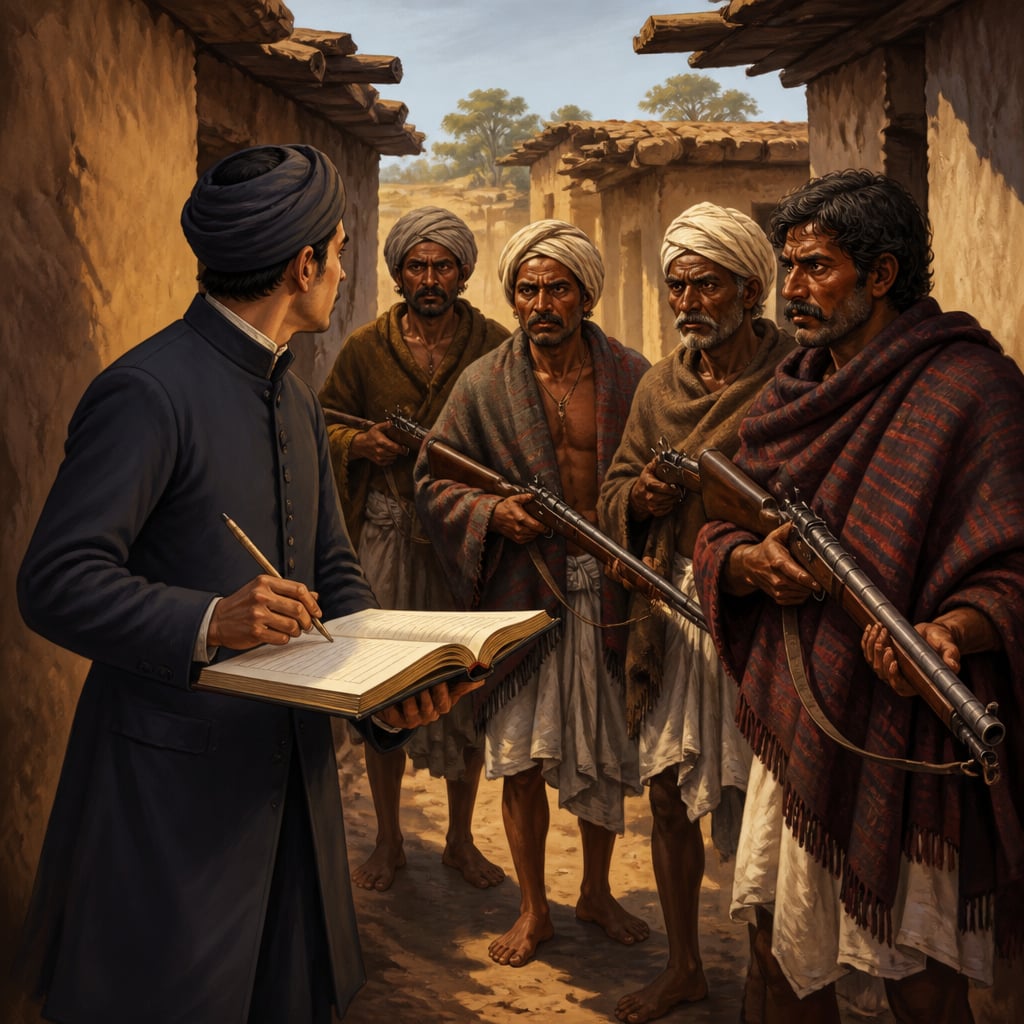
It is the middle of November 1857. Delhi fell to the British two months ago. Lucknow is still fighting. And in Halagali, a village in the small state of Mudhol in what is now Bagalkot district in Karnataka, a clerk arrives with a register and a question.
The question is: how many guns does this village own, and whose names are on them.
Halagali is a village of Bedas, a community of hunters who had carried their own arms for as long as anyone could remember. A gun in that village was not a weapon in a cupboard. It was the tool a family ate with. Now a new law said every gun had to be written into a register and carried only on a licence. The licences had to be taken out by 10 November.
The clerk had already had one small success. A man named Jadgya, one of the village's leading men, had been called to Mudhol and talked into taking a licence on 11 November. The administrator expected the rest of the village to follow him.
It did not. The village turned the clerk away. He came back on the fifteenth. He came back on the twentieth, and again on the twenty-first. Halagali would not let an official in and would not let the guns be counted.
Nineteen men of that village were hanged in the Mudhol market in December. Nobody in Delhi ordered it, nobody in Delhi heard about it, and no textbook chapter on 1857 has room for it. That is the subject of this chapter: what the year looked like from a thousand miles away from the story you were taught.
The Law That Reached the Villages
The mechanism at Halagali was not the greased cartridge. It was paperwork.
On 11 September 1857, with the fighting still on, the Company passed an arms law for the whole of India. It controlled the import, manufacture, sale and possession of firearms. Anyone holding a gun had to register it and hold a licence for it. It was written as a temporary measure. Arms licensing outlived it by decades, under the Indian Arms Act of 1878. The British themselves called the 1857 law what it was: the Disarming Act.