The Bedas of Halagali
A village of Beda hunters that refused the Disarming Act of 1857, and the nineteen hanged at Mudhol and Halagali that December
The Disarming Act of 1857 ordered every gun in the country registered and licensed. The Beda hunters of Halagali, a village in Mudhol state in what is now Bagalkot district, refused for three weeks, and about five hundred armed men held the village against the state. Colonel George Malcolm's cavalry took the village on 29 November 1857 and burnt it; about 290 people were captured and nineteen were hanged, eleven at Mudhol on 11 December and the rest at Halagali on 14 December. There is no single leader here, and the story survives not in the Bombay records but in a folk ballad that Karnataka's schoolchildren still study.
The Flat Roofs at Halagali
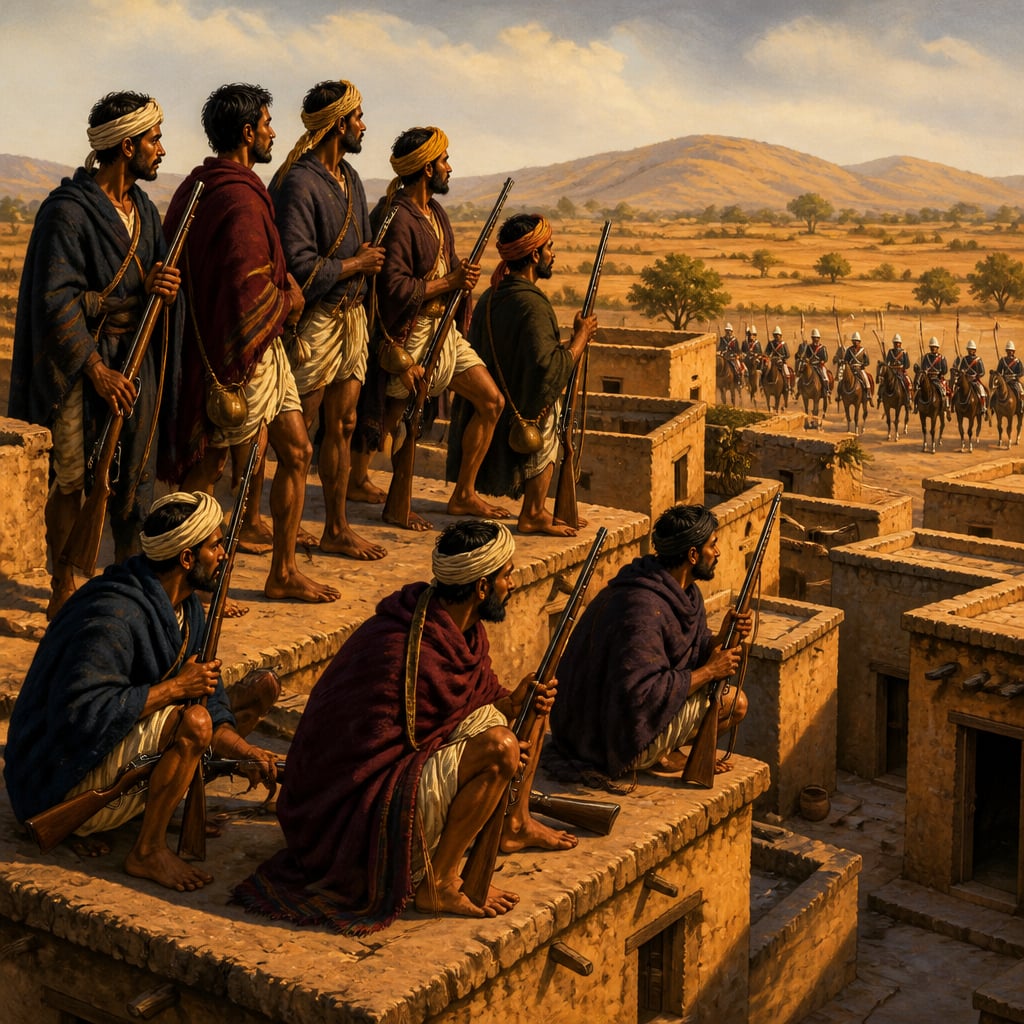
It is the afternoon of Sunday, 29 November 1857. A British cavalry officer named Colonel George Malcolm rides into a village of about a hundred houses in Mudhol state, in what is now Bagalkot district in north Karnataka. The village is called Halagali. Its lanes are narrow. Its houses have flat mud roofs that join one another, so a man can walk from one end of the village to the other without touching the ground.
Malcolm's cavalry has already been fighting in those lanes. Two of his officers, Kerr and La Touche, charged in ahead of him and were stopped. He writes later that his men got down off their horses. With one company of the 28th Native Infantry they climbed onto the flat roofs and came down on the villagers from above. That is how the fighting ended.
Inside the village are roughly five hundred armed men. Almost none of them is a soldier. They are Bedas, a community of hunters and village watchmen from Halagali and from Mantur, Boodni and Alagundi nearby. They have been ordered to bring in their guns and take a licence. They have refused for nearly three weeks.
Nobody in Halagali is a raja. Nobody has a fort, a treasury, or a claim to a throne. There is no single leader whose name the records agree on. What they have is a matchlock in the house and a sentence. They repeat it to every official who comes: bearing arms is our birthright, and we need nobody's permission for it. Nineteen of them will hang for that sentence within a fortnight.
The Law That Started It
On 11 September 1857, with Delhi just retaken and the rising still running across the north, the East India Company ordered the country disarmed. Every man who owned a firearm had to register it and take out a licence. In the Bombay Presidency the deadline was 10 November 1857.