The Flag at Tirupur, January 1932
A mill hand, a banned tricolour, and a lathi charge on the Noyyal riverbank
On 11 January 1932, a week after the government arrested Gandhi and declared the Congress unlawful, a twenty-seven-year-old mill worker named Kumaran carried the banned tricolour in a procession at Tiruppur and was beaten to death without letting go of it. Tamil Nadu calls him Kodi Kaatha Kumaran, the Kumaran who guarded the flag. He is the first of three flag-holders in this book, ten years ahead of Matangini Hazra and Kanaklata Barua.
A Piece of Cloth on a Pole
It is the second week of January 1932, in the mill town of Tiruppur in the Madras Presidency. The Noyyal river runs low here in January, a shallow brown stream between sandy banks, and the road that follows it is the road the procession takes.
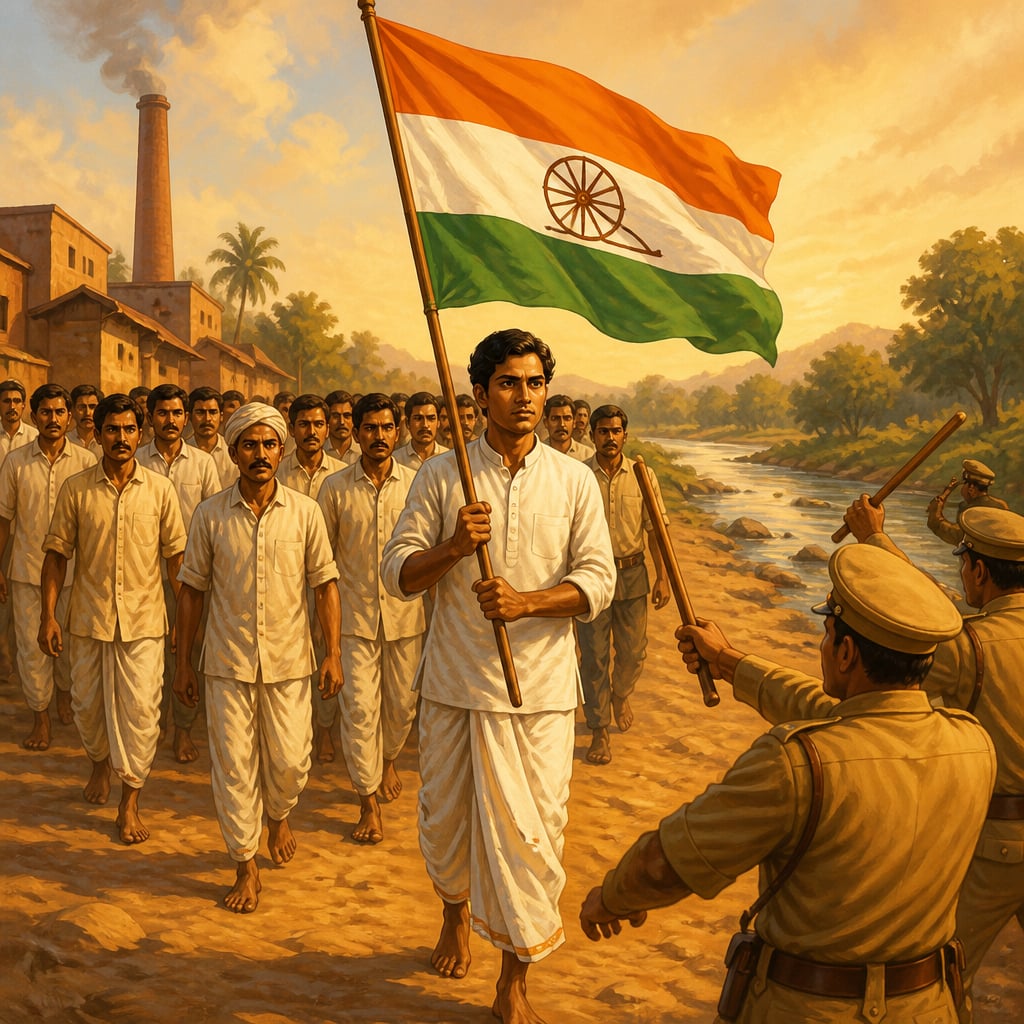
Near the front walks a mill hand of twenty-seven named Kumaraswamy Mudaliar, whom everybody calls Kumaran. He is holding a flagstaff. On it is a tricolour: saffron, white and green, with a spinning wheel in the middle. The Congress had settled this design only five months earlier.
Seven days ago the government made carrying it an offence.
Ahead of them is a police party with lathis. Kumaran is not armed, and neither is anyone behind him. He is a weaver's son who left school after the fifth standard. The only thing he carries that the state wants is the cloth on the pole.
Within a day he will be dead in the town hospital. Tamil Nadu will give him a name it still uses: Kodi Kaatha Kumaran, the Kumaran who guarded the flag.
The Week That Made It Illegal
To understand what happened on that road, start with the seven days before it.
On 4 January 1932 the government arrested Gandhi in Bombay. The Second Round Table Conference in London had ended with nothing. The Congress had announced it would restart Civil Disobedience. The government did not wait.
Within about a week every leader who could have organised the movement was in jail. Jawaharlal Nehru had been picked up days earlier. A set of emergency ordinances came down on top of the arrests. The Congress was declared an unlawful body. Its offices were seized, its funds were taken, and its volunteer organisations were banned.
The ordinances did something else too, something that sounds small and was not.