Thampanoor, October 1938
A schoolteacher, a crowd of twenty thousand, and a British police officer with orders to fire
On 23 October 1938, Accamma Cherian walked tens of thousands of people from Thampanoor station to the gates of Kowdiar Palace in Trivandrum. She was leading a banned organisation in a princely state, and her fight was against a Dewan propped up by the British Resident rather than against the Raj itself. When the order to fire came, she stepped in front of the crowd.
The Ground at Thampanoor
It is the afternoon of Sunday, 23 October 1938. The open ground beside Thampanoor railway station in Trivandrum is filling up. Men in white khaddar, women with Gandhi caps, students, coir workers, clerks. Tens of thousands of them, by every account of that day. The station's engines hiss behind the crowd. The road ahead runs three miles uphill to Kowdiar Palace.
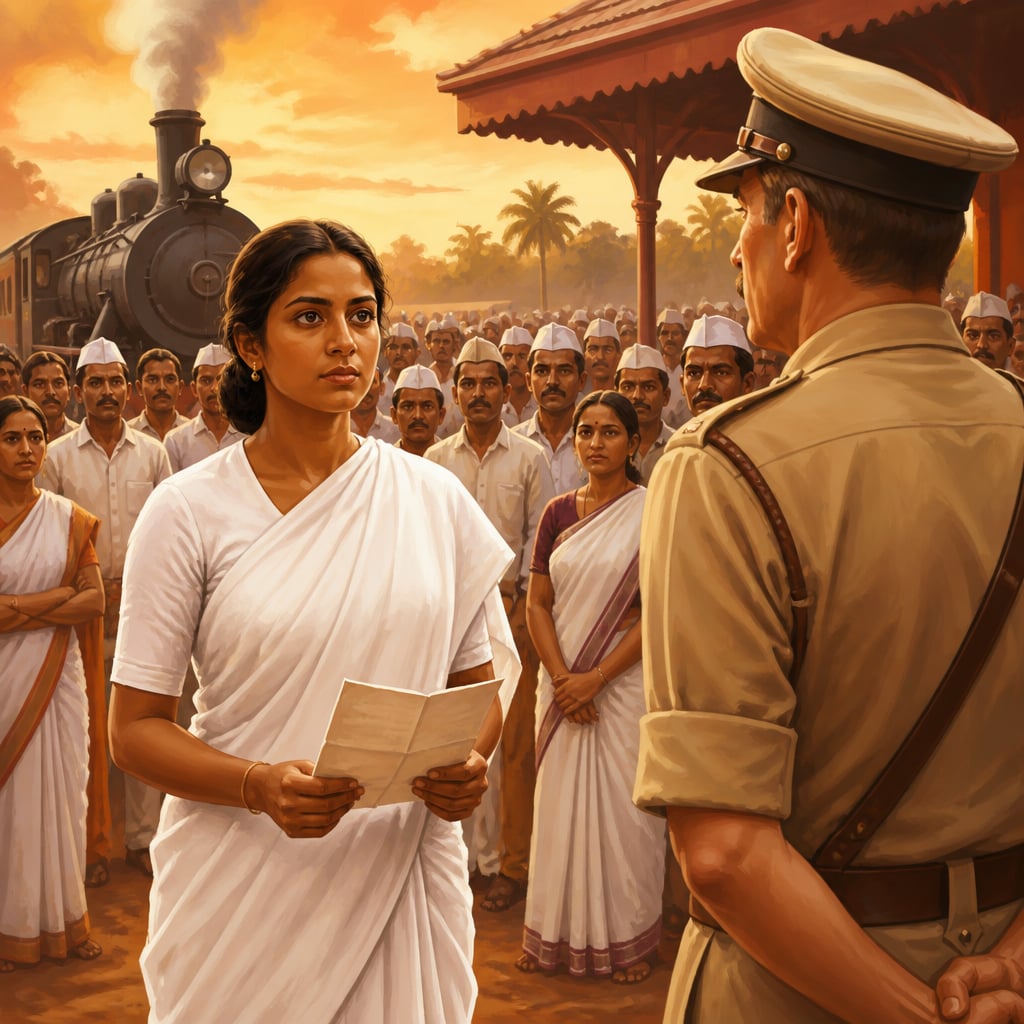
At the front stands a woman of twenty-nine in a white sari. Her name is Accamma Cherian. Two months ago she was the headmistress of a school at Edakkara, teaching history to girls. She has no party post that anyone has printed on paper. The people who had the posts are in jail.
Her job today is to walk this crowd to the palace gates and hand the Maharaja a memorandum. It asks two things: lift the ban on the Travancore State Congress, and release the men held under it. She has been told the police have orders. She writes later in her memoir that she knew what the consequences could be, and volunteered anyway.
The crowd starts to move. Somewhere ahead, a British police officer is waiting with armed men and an order to fire.
The State That Was Not Quite British
Here is the thing most people get wrong about this march. Accamma Cherian was not marching against the British Raj. Not directly. Travancore was a princely state. It had its own Maharaja, its own flag, its own police, its own jails. No British governor sat in Trivandrum. British India began at its borders.
What Travancore had instead was an arrangement. The princely states kept their internal rule. In exchange they accepted paramountcy, the overlordship of the British Crown, handled through a Resident, a British officer posted to watch the state and report to Delhi. In 1938 the Resident covering Travancore was Clarmont Skrine, the Agent for the Madras States.