Jodeghat, October 1940
A man who learned to read at thirty, twelve villages that stopped paying, and the law that came after the bullets
Komaram Bheem spent years asking the Nizam's government to recognise the land the Gond villages of Asifabad already farmed. When the petitions went unanswered he organised twelve hamlets around Jodeghat to refuse the tax, and he was shot there with a number of his men in October 1940. The rebellion lost the hill and won the argument: the inquiry the Nizam ordered afterwards produced the Hyderabad Tribal Areas Regulation of 1946.
The Hill Above Jodeghat
It is the night of the full moon of Ashwayuja, October 1940, in the forest hills of Asifabad, in what is now Telangana. The village of Jodeghat sits in a fold of the hills, about forty kilometres from the nearest railway line. Teak and bamboo run up the slopes. Below the village, the land the Gond families here cleared and planted is standing in crop.
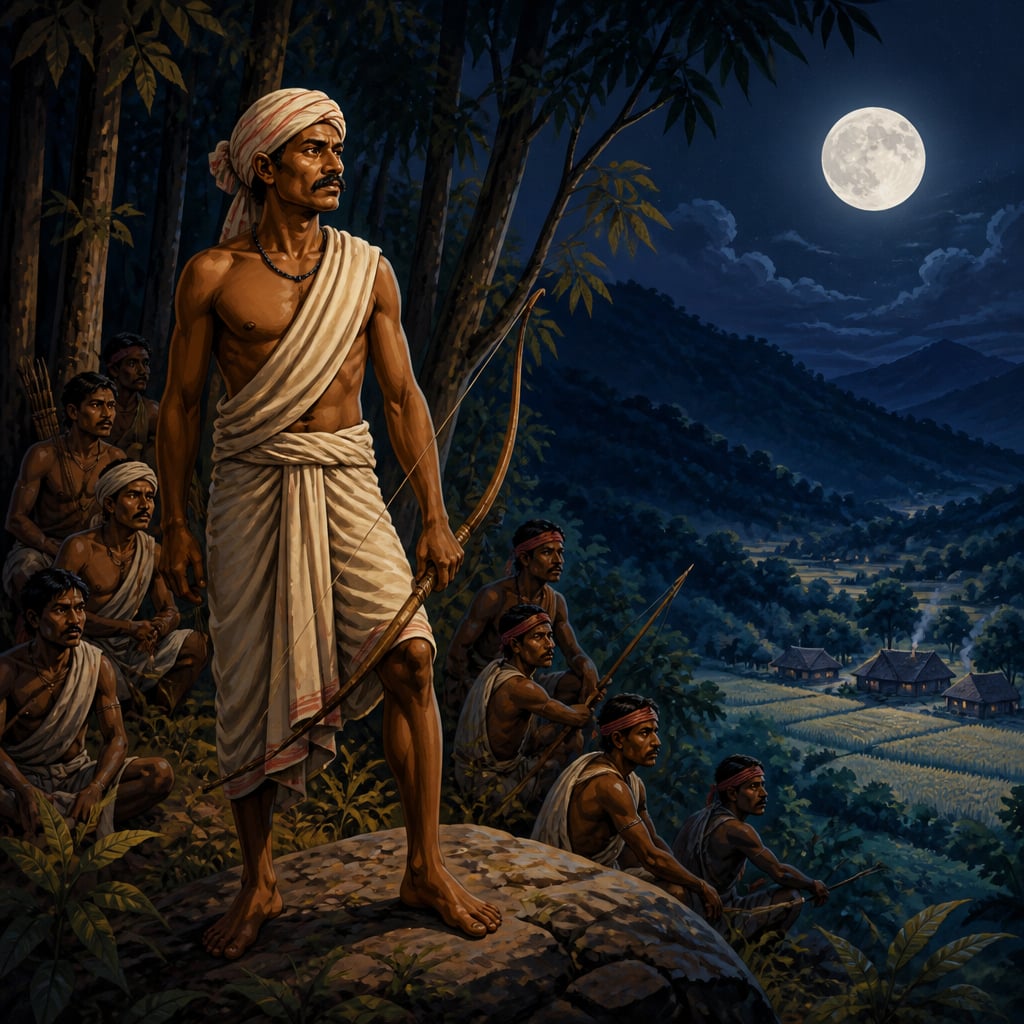
A man of about thirty nine named Komaram Bheem is on that hill with his men. They have lived in these forests for months, moving between villages, out of reach of the Nizam's police. He learned Urdu and Hindi as a grown man, well enough to send petitions to Hyderabad. None was answered.
Before the night ends, a police party led by the talukdar of Asifabad will come up the hill. Bheem will be killed, and a number of his men with him. The exact number is one of the things the records never settled.
What happened next is the reason this lesson exists. Within about a year the Nizam's government sent a foreign scholar into these same forests to find out why the Gonds had fought. That inquiry produced a law. This is the rare case of a rebellion that lost on the hill and won in the file.
Who He Was Fighting, and Who Stood Behind Them
Get the enemy right first, because this story is easy to tell wrong.
The Nizam of Hyderabad ruled the largest princely state in India. He was not a British official. He kept his own army, his own currency, his own courts and his own police. He also held his throne under British paramountcy, with a British Resident at his court. The Raja of Dhenkanal held his the same way in Baji Rout's lesson, and so did the Maharaja of Travancore in Accamma Cherian's.