The Free India Centre, Berlin
The journalist Bose left in charge of Azad Hind Radio and three thousand soldiers who never reached India
When Subhas Chandra Bose sailed from Kiel by submarine in February 1943, he left the Free India Centre and the Indian Legion in the hands of A.C.N. Nambiar, a Malabar journalist who had lived in Berlin for twenty years and had been a Gestapo prisoner in 1933. Nambiar ran Azad Hind Radio and about three thousand Indian soldiers in German uniform who never fought in India and ended the war guarding the coast of France. In 1955 independent India made him its first ambassador to West Germany.
The Man Left Behind in Berlin
It is the night of 8 February 1943, on a quay at Kiel on the German Baltic coast. A German submarine, U-180, is taking on stores in the dark. Two Indians are waiting to board. One is Subhas Chandra Bose, who has spent two years in Germany and has decided that his war has to be fought from Asia. The other is Abid Hasan, a young engineer from Hyderabad who will go with him as his only companion on a voyage of three months.
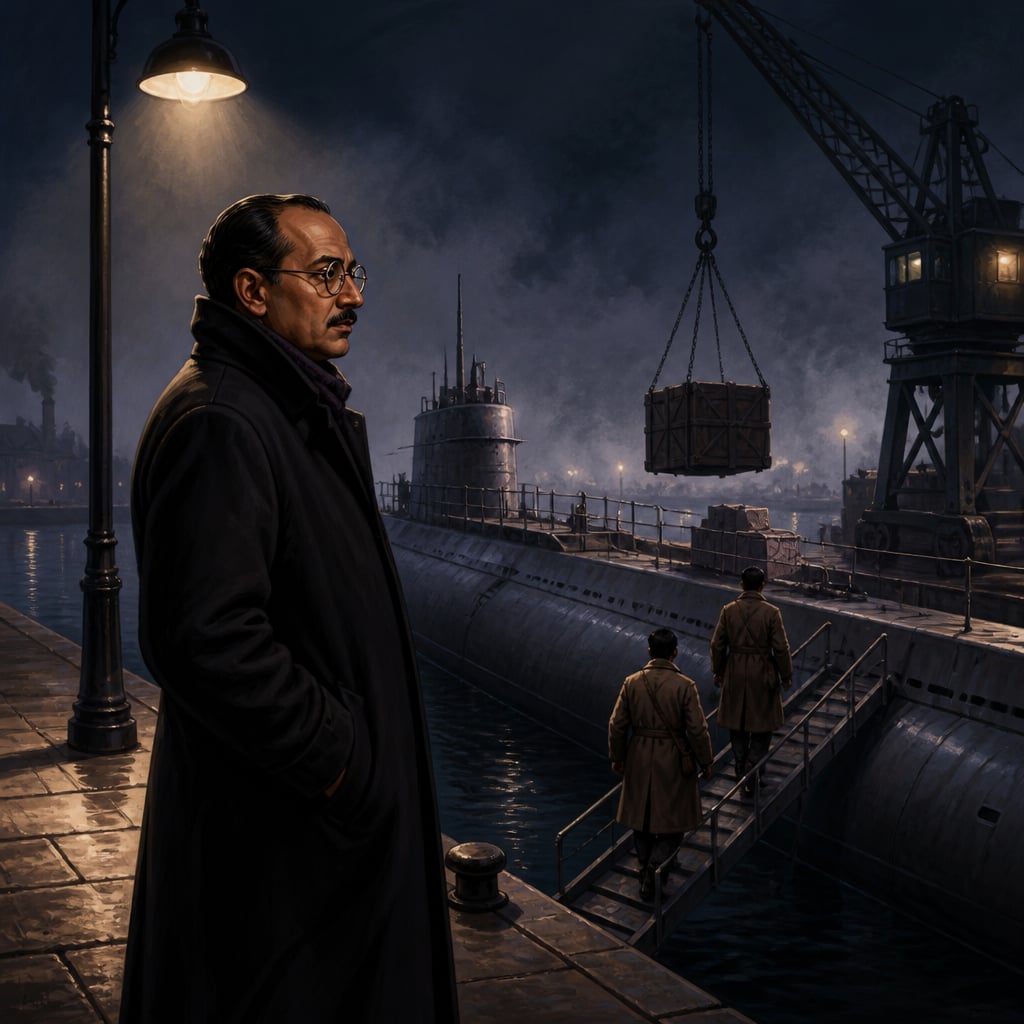
Standing on the quay, not boarding, is a thin, short-sighted man of forty-six in a heavy coat. He has lived in Berlin for most of twenty years. He has been beaten and jailed by the Gestapo once already. He is being left in charge of everything Bose is leaving behind: a propaganda office, a radio station, and about three thousand Indian soldiers in German uniform.
His name is Arathil Candeth Narayanan Nambiar, and almost nobody in India has heard of it.
The job he is inheriting has no good version. The soldiers under him will never see India. The radio he runs will broadcast into a country that cannot answer back. And the government he works for is one of the worst in human history. What a person does inside a job like that is the question this lesson is about.
The Journalist Who Was Already There
Nambiar was born in 1896 at Thalassery in north Malabar, in what is now Kerala. He went to Europe in the early 1920s and stayed. He was not sent by a party and he did not arrive as a soldier. He arrived as a reporter.
Through the 1920s and 1930s he worked in Berlin as a correspondent for Indian newspapers, filing on German politics for readers in Bombay and Madras. He married Suhasini Chattopadhyaya, who came from one of the most political families in India. Her sister was the poet and Congress president Sarojini Naidu. Her brother was Virendranath Chattopadhyaya, known as Chatto, who had run the India Independence Committee in Berlin during the First World War and later went to Moscow.