Quit India, on the Talwar
The night a telegraphist painted Quit India on a wooden platform, and the five days in February 1946 when the Empire's own fleet stopped taking orders
In the small hours of 2 February 1946 a leading telegraphist named Balai Chandra Dutt painted Quit India on a platform at HMIS Talwar in Bombay and went to solitary confinement for it. Sixteen days later the ratings struck, and the Royal Indian Navy mutiny spread to 78 ships, 20 shore establishments and about 20,000 sailors before the political leadership asked them to surrender. They were dismissed without pay and neither new country took them back.
The Wooden Platform at Colaba
It is the small hours of 2 February 1946, in the shore establishment HMIS Talwar at Colaba, Bombay. A twenty-two-year-old leading telegraphist named Balai Chandra Dutt is out of his bunk with a tin of paint and a pot of gum. He has five years of war behind him, most of them working a wireless key, some of them in Burma.
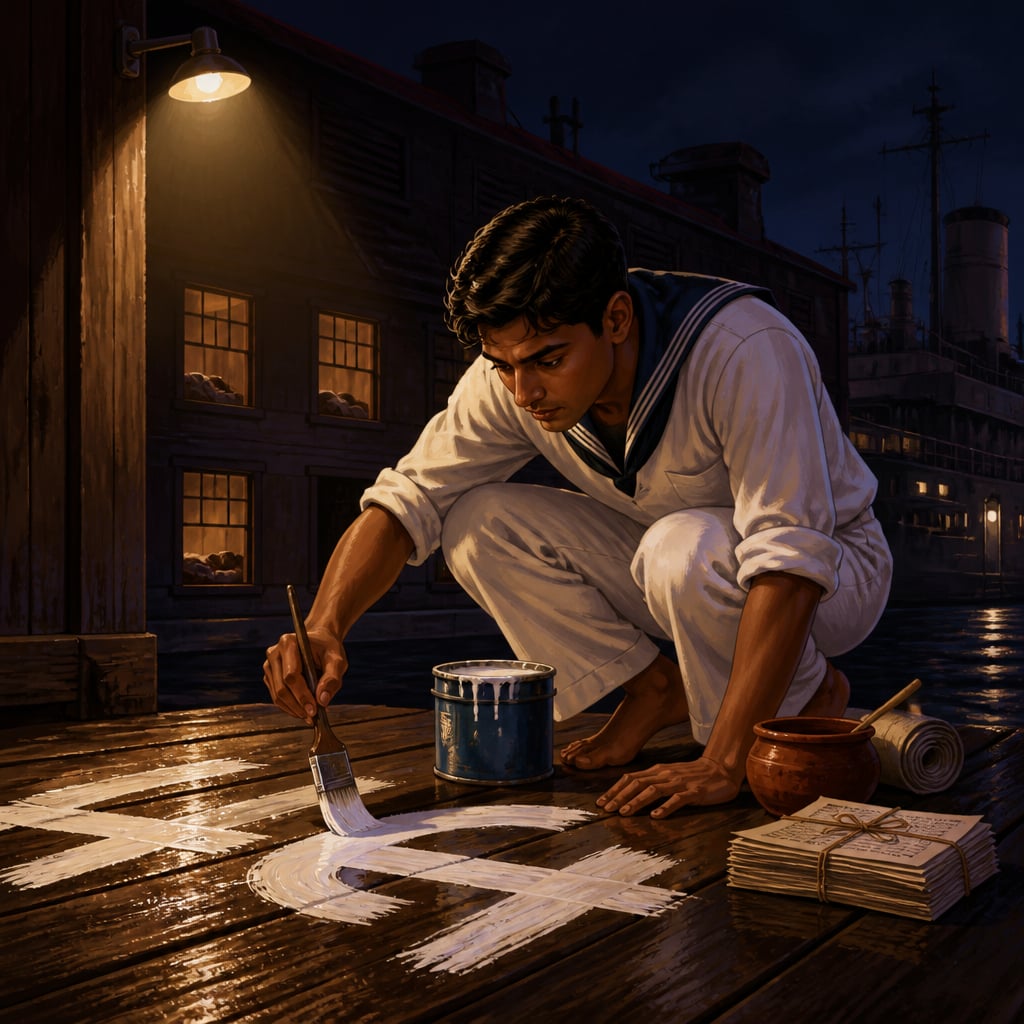
In front of him is a wooden platform. Later that day the Commander in Chief in India, Claude Auchinleck, is due to stand on it and address the officers and men. Dutt paints two phrases across it. Quit India. Jai Hind. Then he goes around the barracks pasting up leaflets.
He is caught with the paint and the gum still on him. A search of his locker turns up nationalist and communist literature. Questioned by senior officers, he admits what he did and tells them he is a political prisoner. He is put in solitary confinement for seventeen days.
The British officers treated this as vandalism by one man. It was not. Dutt belonged to a group of about twenty ratings who called themselves the Azad Hindis. Within seventeen days the fleet they served in stopped obeying orders, from Karachi to Calcutta. This is the last lesson of this book. It is about the moment the Empire found out that the men who worked its machines had stopped believing in it.
Who the Ratings Were
A rating is a sailor below officer rank. In the Royal Indian Navy of 1946 there were about twenty thousand of them, and almost none of them could ever become officers. The commissions went to the British.
The Navy had grown roughly ten times over during the war, and the men it pulled in were not the professionals of 1939. They were young, most between seventeen and twenty-four, and many of them had finished school. They had spent the war listening to signals traffic. They knew what was happening in the world before their officers announced it.