Red Fort, November 1945
Lieutenant Colonel Gurbaksh Singh Dhillon stood court martial at the Red Fort with Prem Sahgal and Shah Nawaz Khan, and the country's answer took the sentence away.
On 5 November 1945 three INA officers, a Sikh, a Hindu and a Muslim, went on trial inside the Red Fort for waging war against the King Emperor. Bhulabhai Desai led the defence with Nehru in a barrister's gown, and argued that a people under foreign rule may lawfully fight to be free. The court convicted them; three days later the Commander in Chief let them go, because he could no longer trust his own army to hold them.
The Courtroom Inside the Fort
It is Monday, 5 November 1945. Inside the Red Fort at Delhi, in a hall of the old British barracks, three Indian officers stand up when the court is called to order. They are in uniform. They have been in British custody for months.
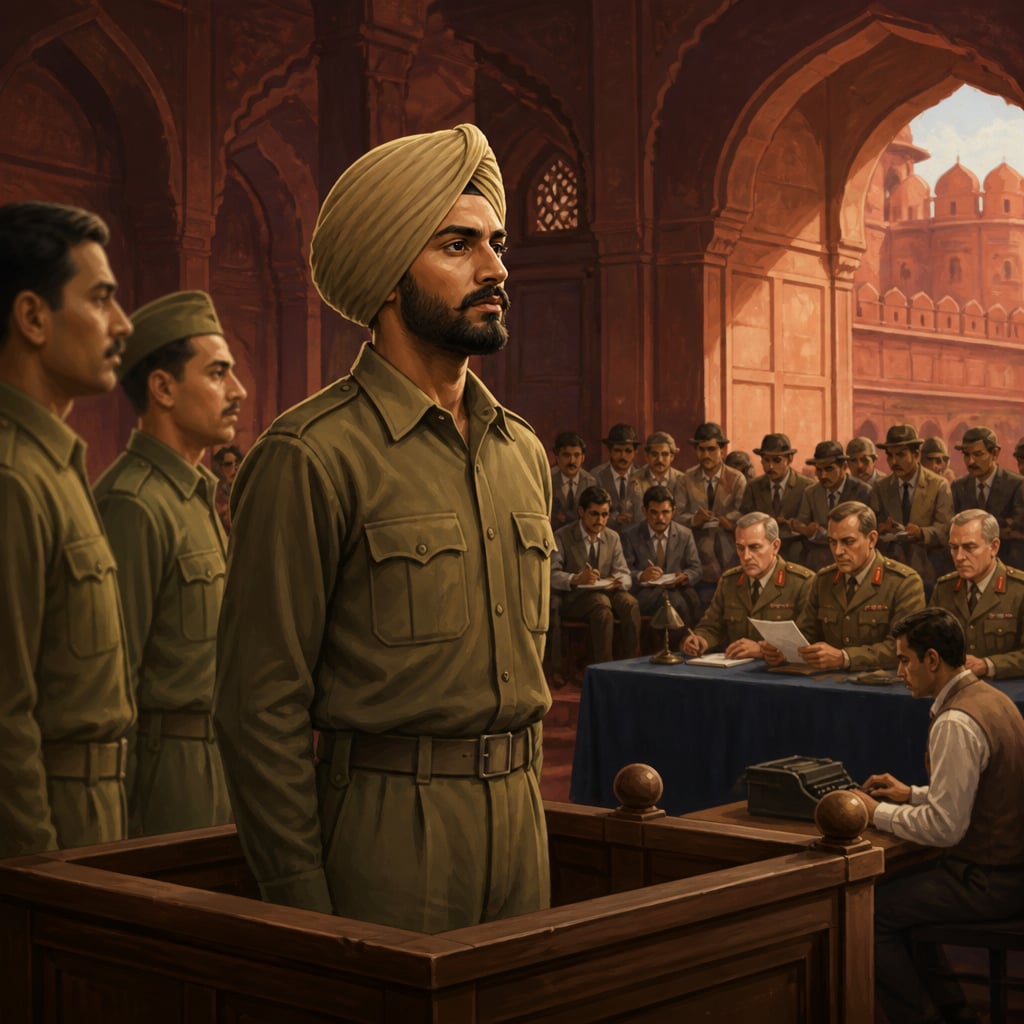
The one on the left is a Sikh officer of thirty-one from a village near Amritsar. His name is Gurbaksh Singh Dhillon. Beside him stand Prem Kumar Sahgal and Shah Nawaz Khan. One Sikh, one Hindu, one Muslim. The British did not pick that combination. It is simply who they caught.
The charge read out is waging war against the King Emperor, under section 121 of the Indian Penal Code. Two of the three face murder or abetment charges as well. The maximum penalty for the main charge is death.
Outside the walls, across the country, the press is printing every word. The British have brought the accused to the fort where the last Mughal emperor was tried in 1858. The choice is deliberate. The fort is meant to say one thing: this is what happens to men who fight the Crown. They will spend the next eight weeks learning what a symbol does when it turns around in your hand.
Who Dhillon Was Before the Fort
Gurbaksh Singh Dhillon was born on 18 March 1914 near Amritsar. He joined the Indian Army in 1933 as a sepoy, the rank of an ordinary soldier, in the 14th Punjab Regiment. He did well enough to be sent to the Indian Military Academy at Dehradun and come out an officer.
In 1941 his unit sailed for Malaya. The Japanese campaign there was short and total. Singapore fell on 15 February 1942, and around fifty-five thousand Indian troops became prisoners of war in a single surrender.