Talapatram

You Have No One But Yourself

Shumbha's taunt as every Shakti withdraws into the One Goddess; Her answer: all of them were always Me. Non-duality, landed as story.

Shumbha's taunt as every Shakti withdraws into the One Goddess; Her answer: all of them were always Me. Non-duality, landed as story.

A Taunt on an Empty Field

By now Shumbha had nothing left. Nishumbha was dead. Raktabija was drained. The armies that had climbed the mountain were gone into the ground and the Goddess's blows. And in the moment of his ruin, Shumbha looked at the field and thought he saw a weakness worth naming.
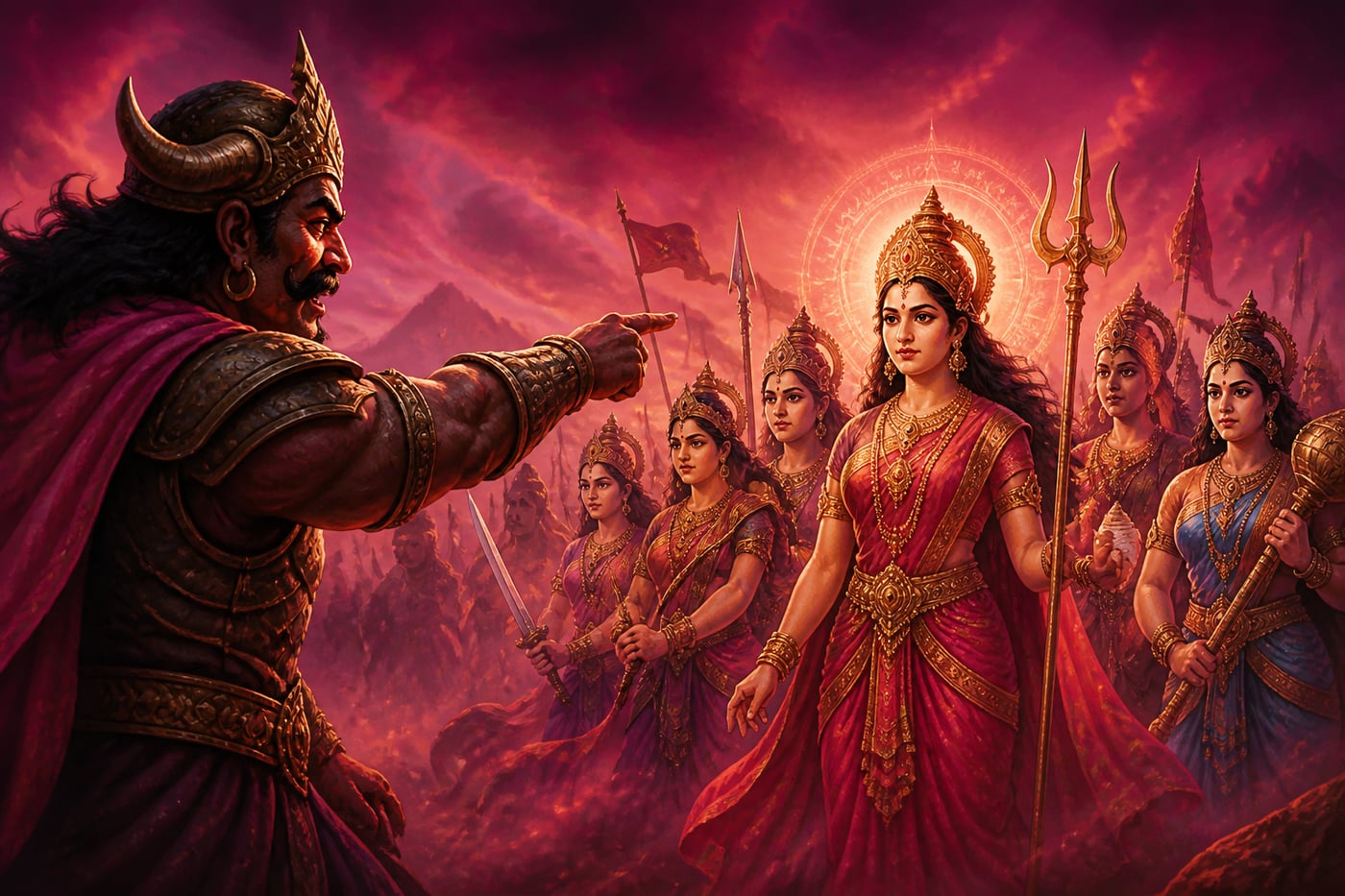
Shumbha taunts the Goddess and her circle

He had watched the Goddess fight surrounded by powers: Kali, the Mothers, Aindri and the rest, a whole circle of goddess-energies wheeling around her. So he threw the one accusation left to him.

बलावलेपदुष्टे त्वं मा दुर्गे गर्वमावह। अन्यासां बलमाश्रित्य युद्ध्यसे चातिमानिनी॥

balāvalepaduṣṭe tvaṃ mā durge garvamāvaha | anyāsāṃ balamāśritya yuddhyase cātimāninī ||

Do not be so proud of your strength, O Durga. You fight leaning on the power of others, and yet you boast as though it were your own.

Devi Mahatmyam 10.3

It was the sharpest thing he could say. You are not strong. You are a crowd. Send away your helpers and stand alone, if you dare. And the Goddess, hearing it, did something the whole text has been building toward. She did not send the powers away. She drew them in.

All of Them Were Always Me
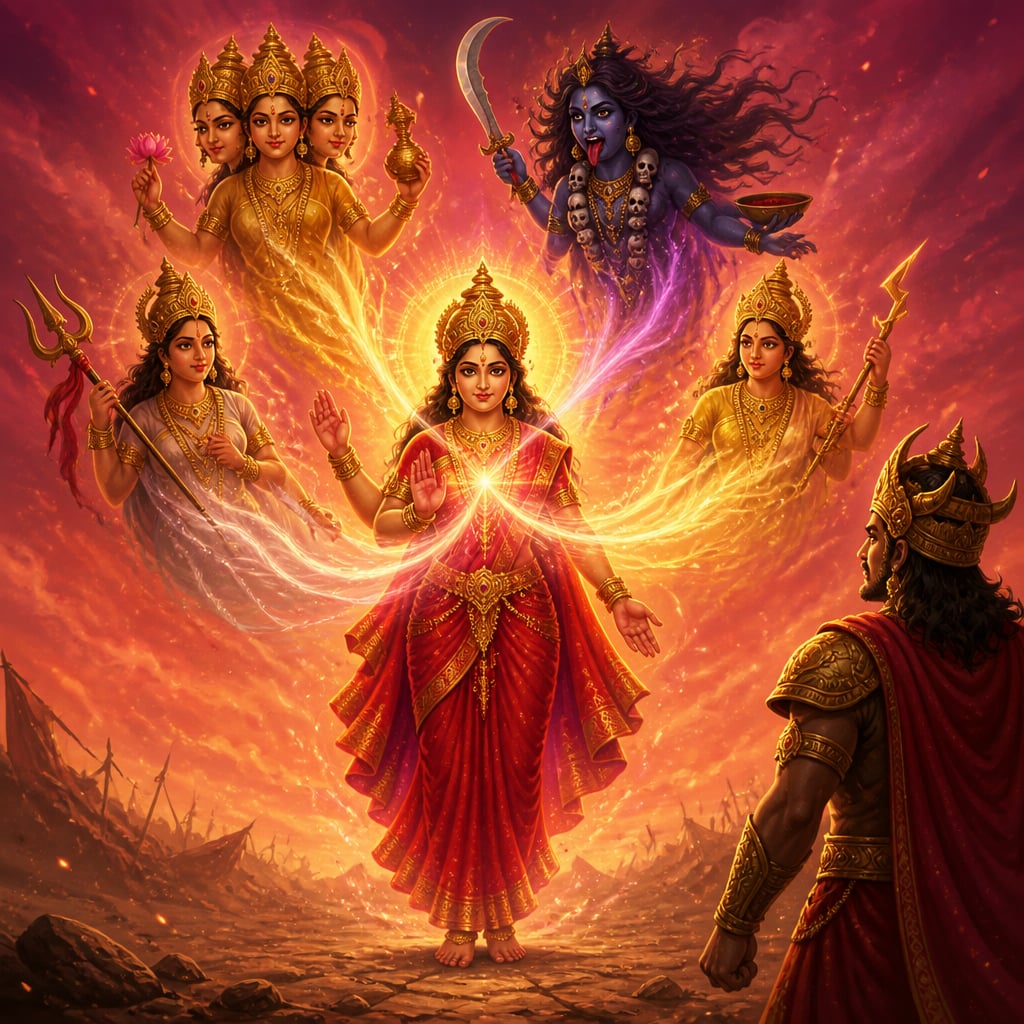
The Shaktis dissolve back into the one Goddess

One by one, as Shumbha watched, the goddesses around her, Kali, Brahmani, Maheshwari, Aindri, every Mother, every energy, dissolved back into the body of the one Goddess. They did not leave the field. They entered her. Where a moment before there had been a circle of many, now there was one, and her answer was the still centre of the entire Devi Mahatmyam.

एकैवाहं जगत्यत्र द्वितीया का ममापरा। पश्यैता दुष्ट मय्येव विशन्त्यो मद्विभूतयः॥

ekaivāhaṃ jagaty atra dvitīyā kā mamāparā | paśyaitā duṣṭa mayy eva viśantyo mad-vibhūtayaḥ ||

I alone exist here in the world; who else is there beside me? Look, O wicked one, how these, my own powers, enter back into me.

Devi Mahatmyam 10.5

I alone am here. Who is this second one you imagine? The many powers Shumbha had counted as her crutch were never other than her. They were her own energies, sent out and now called home. His taunt had assumed a crowd. Her answer revealed a single reality wearing many faces, and every face folding back into the one.

The word she uses is vibhuti, her own manifestations, her powers put forth. The Mothers were not allies she borrowed. They were vibhuti, herself extended, and to draw them back was simply to stop appearing as many.

The Ego Lives by Drawing Lines

Look at the exact shape of Shumbha's mistake. He looked at the one and saw many. He saw separation everywhere: her and her helpers, self and other, me and mine against you and yours. His whole existence as a demon of ego depended on that seeing. The ego lives by drawing lines.

This is what self-conceit actually is, underneath the boasting. It is the conviction that you are a separate thing, walled off, set against everything outside the wall. From that one belief the rest follows without effort:

Shumbha is that belief made into a person. So it is exactly right, and not a coincidence, that he falls to a truth about oneness. The teaching underneath the whole Uttama Charita surfaces here in a single line: the many is one. What looks like a world of separate selves and separate powers is one reality appearing as many. This is the seeing the tradition calls advaita, not-two. And it is the one thing the ego cannot survive, because the ego is nothing but the belief in two.

The Goddess stands alone yet radiant

Notice how the Goddess wins this exchange. Not with a weapon. With a fact. Shumbha's taunt was not answered by force but simply corrected, the way a true statement ends a false one. His error was to think the powers were separate. Her reply was to show they never were. When the truth of oneness is actually seen, the ego does not need to be beaten. It has already lost the ground it was standing on.

What the Line Costs You

Stay with this, because it is not only metaphysics; it is the texture of an ordinary anxious life. The self that draws hard lines is the self that is never at rest. It must guard the wall. It must track who is inside and who is outside, who is ahead and who is behind, what is mine and what is being taken. The comparison that poisons your days, the loneliness under the crowd, the sense of standing always slightly against the world, all of it grows from the one line Shumbha drew: I am separate.

The Goddess's answer is not a scolding but a release. If the many are one, the wall was never real, and the war it demanded was never necessary. You do not have to conquer the world you imagined yourself set against. You were never separate from it to begin with. Shumbha spent his whole existence defending a line that, the Goddess shows in a sentence, was only ever drawn in his own mind.

He does not understand her, of course. A being made entirely of the belief in two cannot hear I alone am. He hears only that she has sent away her helpers and now stands alone, and to the ego that looks at last like the fair fight he wanted. He gathers himself for it. What happens when separation itself charges at the one, and the war finally ends, is the close of this chapter, and the next lesson.

Living traditions

The Goddess's declaration, I alone am, who is there beside me, is one of the most quoted lines in the whole Devi Mahatmyam, and it binds the text to the non-dual heart of the tradition. Teachers of Advaita point to it as scripture's own dramatisation of oneness, and devotees hear in it the release it offers: the wall the ego defends was never real, and the war it demanded was never needed.

  • Sringeri Sharada Peetham: The southern seat established by Adi Shankara, the great teacher of Advaita, and a living centre of non-dual learning for over a thousand years. Here the Goddess is worshipped as Sharada, and the teaching of this lesson, that all multiplicity is one reality, is the very heart of the tradition the seat preserves. Pilgrims and students come to the place where I alone am is not only chanted but studied. (The Shakti Peethas course maps the wider network of Goddess sites.)

Reflection

  • Shumbha saw a crowd where there was one, separation everywhere. Where in your life do you draw the hardest line between yourself and others, and what does defending that line cost you?
  • The Goddess wins not with a weapon but with a truth: I alone am. Where might a pattern of pride or comparison in you dissolve not by being fought, but by clearly seeing you were never as separate as it assumes?
  • The comparison, the loneliness under the crowd, the sense of standing against the world, all grow from one line: I am separate. If that line were softer, what in your daily life would ease?

More in The Desire That Multiplies

All lessons in The Desire That Multiplies · Durga: The Goddess Who Saves the World ebook course