Talapatram

The World Restored

Shumbha falls; the cosmos is set right. What steadiness looks like on the far side of the inner war.

Shumbha falls; the cosmos is set right. What steadiness looks like on the far side of the inner war.

The Last Fight

Nishumbha had risen once more before the end. As the Goddess struck him down, a shining being tried to leap out from within his body, a last trick of the ego to slip free of its own defeat and fight on in a new form. The Goddess did not let it stand. She cut down the emerging figure as it came, and Nishumbha fell for good. There would be no fresh disguise this time.
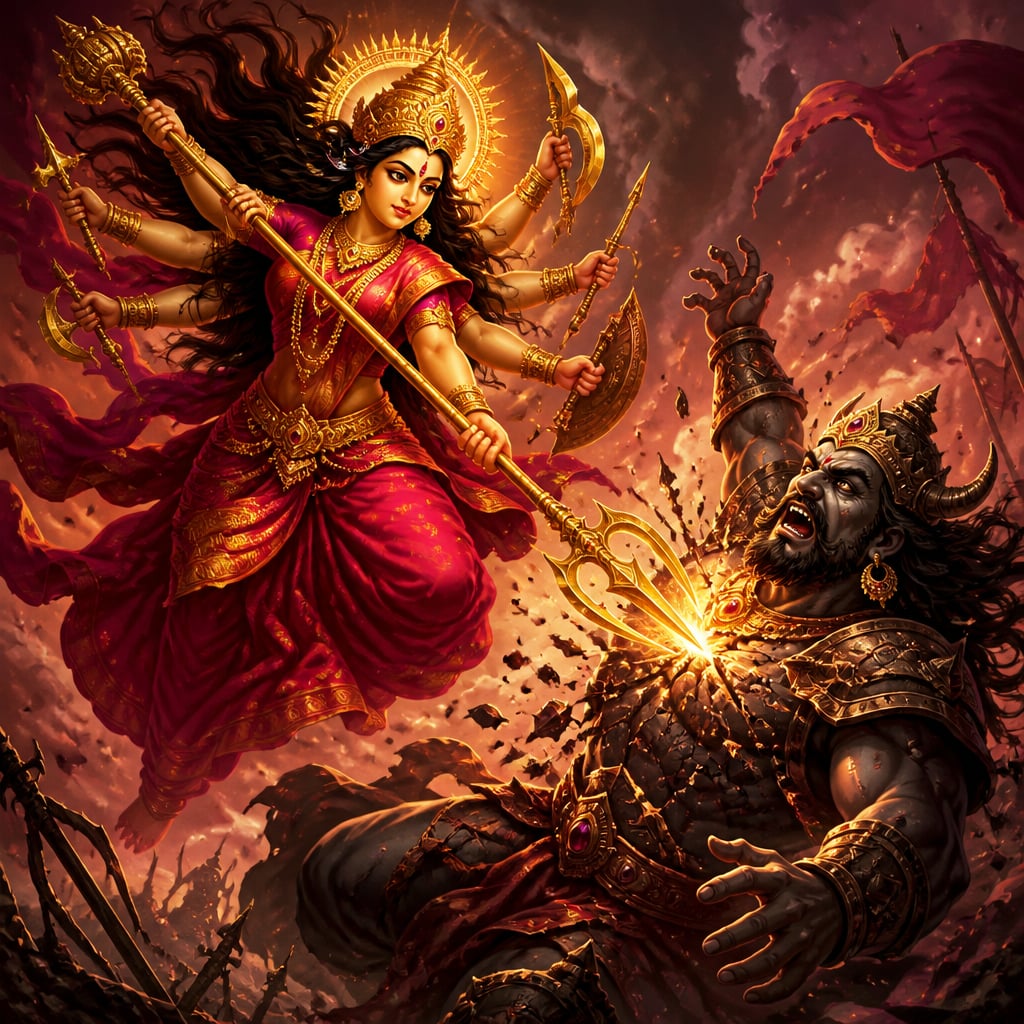
The Goddess strikes down the demon Shumbha

Then Shumbha, alone at last, the way he had demanded to be, came at her with everything he was. He rose into the sky and she rose after him; they fought in the air and on the earth. And when it was finished, the demon of self-conceit, the belief in two that had ruled the three worlds, lay dead on the field. The long war that began chapters ago in the fog of Madhu and Kaitabha was over.

The tradition marks the moment with care, because what comes next is not triumph. It is peace.

The World Sets Itself Right

The text does not linger on the corpse. It turns, at once, to the world. And the world, the moment the demon of separateness falls, begins to settle.

The signs it gives are quiet ones, and that quietness is the whole point:

Notice what restoration looks like here. Not fireworks. Not a new golden palace. Just every force of the world returned to its right measure: wind being wind, river being river, fire being fire, each thing doing quietly what it is meant to do. The word for this order is rita, the deep rightness of things when nothing is out of place. When the ego that grasped and warred is gone, rita does not have to be built. It simply returns.

देवि प्रपन्नार्तिहरे प्रसीद प्रसीद मातर्जगतोऽखिलस्य।

devi prapannārti-hare prasīda prasīda mātar jagato 'khilasya |

O Goddess who removes the suffering of all who take refuge in you, be gracious, be gracious, O Mother of the whole world.

Devi Mahatmyam 11.3

The gods, restored to heaven, do not boast that they have won. They sing. The long hymn they raise, the Narayani Stuti, is not a victory chant but a hymn of gratitude and refuge, praising the Goddess who removes the suffering of all who turn to her. This is the tone the whole chapter has been reaching toward.

Peace Is Not the Small Self Winning

Notice what the far side of the war actually looks like.

When the last enemy is the ego itself, its defeat cannot feel like a personal triumph, because there is no separate self left standing over the field to gloat. That is the trap the tradition is careful to avoid. If you imagine the end of the inner war as you finally winning, you becoming great, you having conquered, then Shumbha is not dead at all. He has just put on the robe of the victor. The self that congratulates itself on defeating its ego is the ego, wearing its last and cleverest disguise.

So the real end is not ecstasy and not conquest. It is shanti, peace: every force in you returned to its right measure. Consider what that steadiness looks like from the inside:

This is why the chapter ends in a hymn and not a boast. The peace on the far side of the inner war is not a prize the small self carries off. It is what remains when the small self stops warring: the world, and the mind, set quietly right. The gods know this, and so they do not thank themselves. They turn to the Goddess, in whom every power lives, and give the whole of it back to her.

सृष्टिस्थितिविनाशानां शक्तिभूते सनातनि। गुणाश्रये गुणमये नारायणि नमोस्तु ते॥

sṛṣṭi-sthiti-vināśānāṃ śakti-bhūte sanātani | guṇāśraye guṇamaye nārāyaṇi namo 'stu te ||

O eternal one, you who are the power behind creation, preservation, and dissolution; ground of all qualities and made of them; O Narayani, salutations to you.

Devi Mahatmyam 11.11

Gods praise Narayani in the restored world

They call her Narayani, the eternal power behind creation, holding, and dissolution alike, the one in whom all the forces of the world rest. The peace they are living in is not their achievement. It is her gift, and they know it. That knowing, that the steadiness on the far side of the war is received and not seized, is the last and quietest teaching of the chapter.

The demons are gone. The world is bright. What remains is a hymn, and a refuge, and the Goddess in whom the many are one. The course has one movement left: to gather up the great refrain that has run beneath all of this, the Ya Devi hymn and the names of the Goddess who saves. That is the final chapter.

Living traditions

The close of the great battle, the world settling into peace and the gods raising the Narayani Stuti, is recited every Navaratri and carries a teaching still worth hearing: that the end of a hard struggle looks less like triumph than like quiet, every force returned to its right measure. The name Shanta Durga, the Goddess who is both the slayer and the peace, keeps alive the chapter's insight that the far side of the inner war is not a prize seized but a stillness received.

  • Shanta Durga Temple: A beloved temple to the Goddess as Shanta Durga, Durga in her peace-giving form, the mediator who brings warring forces to rest. Her very name joins shanti, peace, to Durga, the slayer of demons, which is precisely the movement this lesson traces: from the fierce end of the war to the deep peace on its far side. Devotees come to the Mother who does not merely conquer but settles the world into rightness. (The Shakti Peethas course maps the wider network of Goddess sites.)

Reflection

  • Restoration here is quiet: winds gentle, rivers clear, each force in its right measure. When a long struggle in you has truly resolved, what were the small, settling signs, and did you mistake calm for anticlimax?
  • To imagine the end of the inner war as you having conquered lets the ego wear the victor's robe. Where have you felt pride in your own growth or discipline, and could that pride be the very self it claimed to defeat?
  • The gods meet the victory with a hymn of gratitude, not a boast, giving the peace back to the Goddess. When clarity returns to you after a hard passage, do you hold it as something you won or as something received?

More in The Desire That Multiplies

All lessons in The Desire That Multiplies · Durga: The Goddess Who Saves the World ebook course