Raktabija: The Demon Who Cloned from His Own Blood
Every drop that falls spawns another of him. The craving that multiplies the moment you strike at it.
One Wound, a Hundred Enemies
The field below the mountain was already won, or so it looked. Chanda and Munda had fallen. The great demon armies were broken. And then Shumbha sent Raktabija, and the battle turned into something no strength could finish.
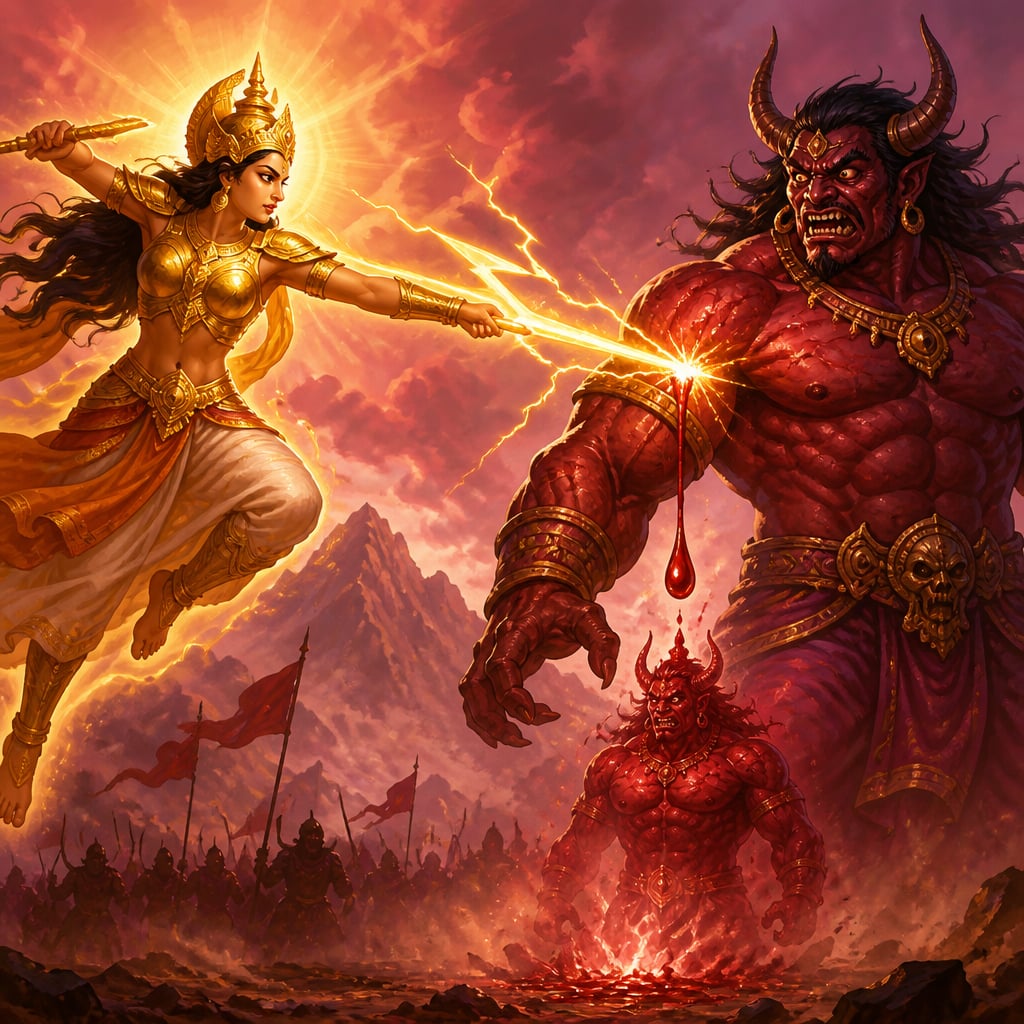
Aindri, the power of Indra, struck him first. Her thunderbolt opened a clean wound across his chest, and his blood ran down and touched the earth. What happened next stopped the gods cold. Where each drop soaked into the ground, a full Raktabija rose up, armed and roaring, exactly as strong as the first. One blow had made two demons. The Mother-powers struck again, harder, and it only made things worse: every cut spilled more blood, every drop of blood grew another warrior, and soon the plain was crawling with thousands of them, a forest of the same demon, born from his own wounds.
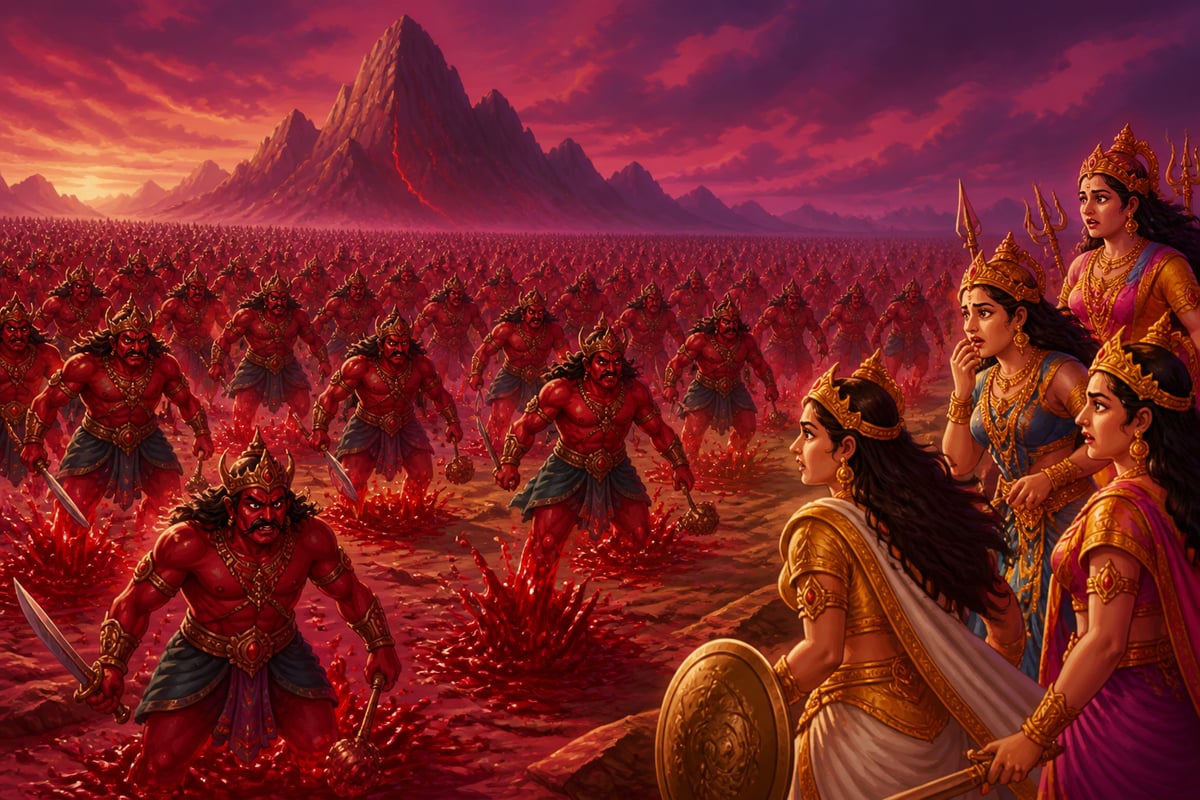
The harder they fought him, the more of him there was. That single, maddening fact is the whole of this lesson.
रक्तबिन्दुर्यदा भूमौ पतत्यस्य शरीरतः। समुत्पतति मेदिन्यां तत्प्रमाणो महासुरः॥
raktabindur yadā bhūmau pataty asya śarīrataḥ | samutpatati medinyāṃ tat-pramāṇo mahāsuraḥ ||
Whenever a drop of blood falls from his body to the ground, a great demon of his very size rises up from the earth.
Devi Mahatmyam 8.41
His name says it plainly. Rakta is blood; bija is seed. He is the demon whose blood is seed. Wound him, and you plant him.
The Craving That Feeds on Being Fought
The tradition reads Raktabija as a precise inner thing, and once you see it you will recognise it in yourself before the lesson is over. He is craving that multiplies the moment you strike at it. He is the desire that grows a new head every time you try to cut one off.
Think about how this actually works in a life. There is a kind of appetite that behaves exactly like this demon:
- You fight a craving head-on, force it down by sheer will, and an hour later it is back, stronger and angrier.
- You resolve never to check the phone again, break the resolve by evening, and now feel the pull twice as hard.
- You try to argue yourself out of a resentment, and each argument only gives the resentment fresh reasons and more life.
In each case the direct blow does not kill the wanting. It feeds it. The struggle itself becomes the blood, and the blood becomes another demon. This is why willpower alone loses to certain habits. You are Aindri on the field, striking clean and true, watching your enemy double with every hit.
The old word for this is vasana, the deep-grooved tendency of the mind, the habit-seed that sprouts again from the smallest trace left behind. A vasana is not defeated by force. Leave one drop, one unwatched trace, and the whole pattern grows back whole.
Why Strength Was Never Going to Be Enough
Look at where this demon sits in the long war. The course has climbed through confusion, through the shape-shifting ego of Mahishasura, through the arrogance and self-doubt of Shumbha and Nishumbha. The powers on the field are the fiercest yet, the Mother-goddesses themselves. And they are losing, not because they are weak, but because their whole method has met the one enemy it cannot touch.
Every enemy before this could be cut down. Raktabija cannot, because cutting is exactly what makes him. The gods watch the field fill with copies and understand, at last, that no amount of the same effort will do. More force means more blood means more demons. The equation only runs one way.
That is the honest despair at the centre of this lesson, and the tradition does not rush past it. Some things in you will not yield to effort, because effort is what they eat. You have felt this. The diet that fails harder the more grimly you enforce it. The worry you cannot think your way out of, because thinking is the worry. The self at war with itself, and every blow landing on its own body.
या देवी सर्वभूतेषु स्मृतिरूपेण संस्थिता। नमस्तस्यै नमस्तस्यै नमस्तस्यै नमो नमः॥
yā devī sarva-bhūteṣu smṛti-rūpeṇa saṃsthitā | namas tasyai namas tasyai namas tasyai namo namaḥ ||
To the Goddess who dwells in all beings as memory, salutations to Her, salutations to Her, again and again salutations.
Devi Mahatmyam 5 (Ya Devi refrain, the memory aspect)
The gods had praised the Goddess as smriti, memory, and there is a reason that aspect belongs here. A craving multiplies in you because you forget, in the heat of the wanting, what you actually are and what you actually want. Steady memory, the mind that remembers itself even while the appetite screams, is the first thing that does not feed the demon. It does not strike him. It simply refuses to forget.
The Goddess is watching too. She has seen what the blows are doing. And she is about to do the one thing that ends a demon who cannot be cut: not a harder strike, but a wholly different move, aimed not at the copies but at the source. That move, and the fierce form that makes it, is the next lesson.
Living traditions
Raktabija has outlived his text as a byword for the problem that grows by being fought. Teachers still use him to explain why willpower alone loses to certain habits, and why a craving struck head-on so often doubles. His image, a demon rising from every drop of his own blood, remains one of the tradition's sharpest pictures of the inner life.
- Kamakhya Temple: One of the most powerful Shakti shrines in the land, worshipped as the seat of the Goddess in her most primal, blood-and-life form. Kamakhya honours the Devi as the source of creative power itself, the very ground where life springs from life. It is a fitting place to sit with Raktabija's mystery, that blood becomes seed becomes life, and that such power is ended not by force but by being met at its root. (The Shakti Peethas course maps the wider network of Goddess sites.)
Reflection
- Where in your life is there a craving or worry that grows stronger the harder you fight it directly, a Raktabija that doubles every time you strike?
- A habit regrows from the smallest trace left behind. In a pattern you are trying to change, what is the one drop you keep leaving, the trigger or excuse you have not addressed?
- The gods praise the Goddess as smriti, memory. When an appetite is loudest, what would it change if, instead of fighting it, you simply remembered clearly what you truly want?