Talapatram

Kali Drinks the Blood

The only way to end him: consume the source before it touches the ground. You take multiplying desire at the root, not drop by drop.

The only way to end him: consume the source before it touches the ground. You take multiplying desire at the root, not drop by drop.

The Instruction on the Field

The plain was drowning in copies. For every Raktabija cut down, ten stood up from the wet earth, and the Mother-powers were tiring while the demon only grew. It was here, with the battle turning to a nightmare of multiplication, that the Goddess spoke to Kali. Her instruction was not strike harder. It was something no one on the field had thought to try.

मच्छस्त्रपातसम्भूतान् रक्तबिन्दून् महासुरान्। रक्तबिन्दोः प्रतीच्छ त्वं वक्त्रेणानेन वेगिना॥

mac-chastra-pāta-sambhūtān raktabindūn mahāsurān | raktabindoḥ pratīccha tvaṃ vaktreṇānena veginā ||

Receive into this swift mouth the blood-drops, and the great demons born of my weapon's blows upon Raktabija.

Devi Mahatmyam 8.53
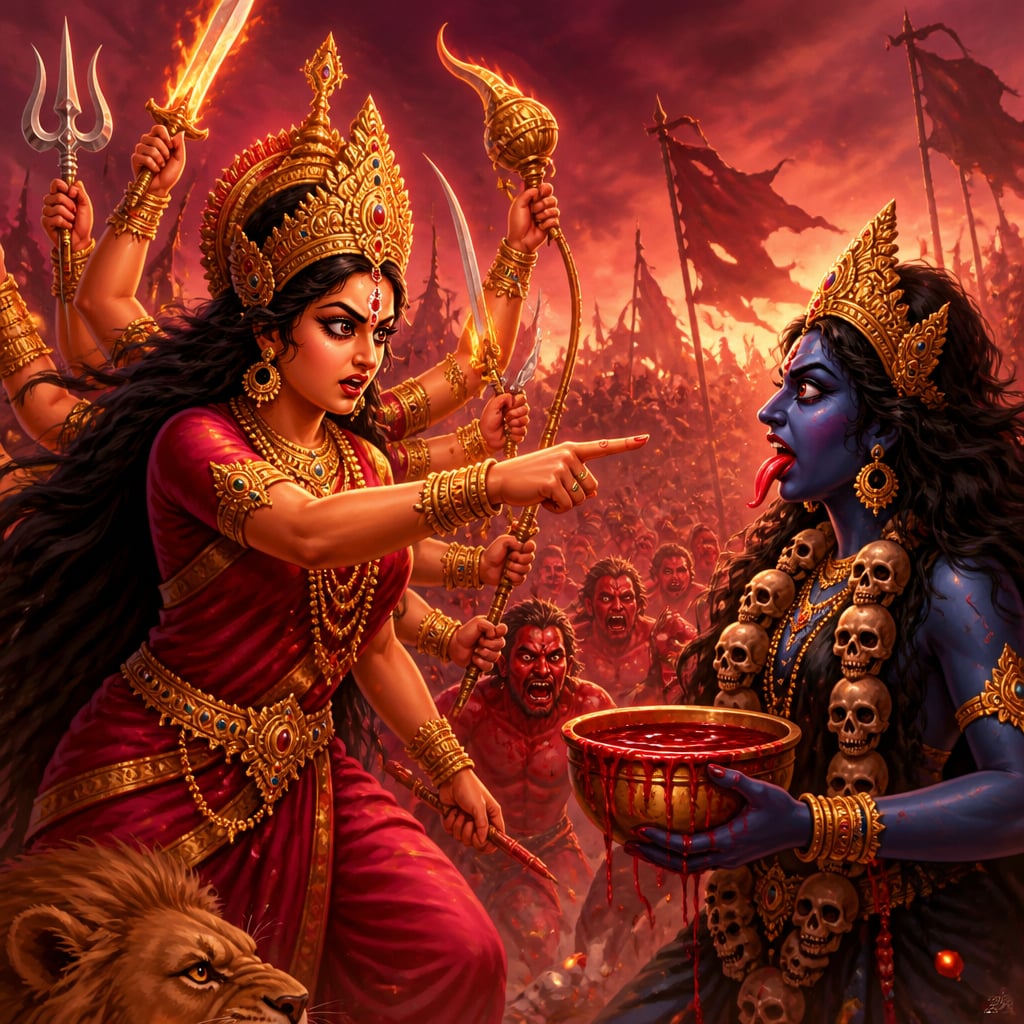
Chandika instructs Kali on the battlefield

The move was this. Kali would range across the field with her mouth open wide, and every drop of Raktabija's blood would fall not onto the ground but onto her tongue. She would drink the blood before it could touch the earth. And into that same mouth she would sweep the copies as they were cut, so that they never reached the ground to spill more. No blood to the earth, no new demon. The source was to be taken before it could seed.

Read the division of labour, because it is the heart of the lesson. The Goddess keeps striking. Kali keeps drinking. The blow and the drinking together do what the blow alone never could.

Why the Blow Alone Failed, and This Did Not

Set the two methods side by side and the whole teaching is in the contrast.

The Blow Alone The Blow Plus the Drinking
Strikes the copies as they appear Strikes the copies and consumes the source
Blood reaches the ground and seeds more No blood reaches the ground, nothing seeds
The enemy multiplies with every hit The enemy cannot renew itself and drains away
Fights the symptom, endlessly Cuts off the root, once

The blow was never wrong. It was simply not enough by itself, because it left the blood, and the blood was the real enemy. What Kali adds is not more violence. It is a way of closing the ground, of making sure the thing cannot regrow from what the fighting spills.

The tradition gives this its plain names. The mula is the root, the source. The counter to Raktabija is nirodha, restraint or containment at the source, not endless striking at the fruit. You do not defeat multiplying desire drop by drop. You take it at the mula, before it seeds.

The Ground Is Your Mind

Raktabija's blood seeds a new demon only when it touches the ground. Kali wins by keeping it from ever landing. So ask the obvious question: in you, what is the ground?

The ground is the mind, the inner soil where a passing impulse either lands and takes root or is caught before it does. A craving arises, a stray drop of wanting. If it falls onto the mind and is dwelt on, turned over, fed with attention, it takes root and grows a whole demon of desire, then another, then a field of them. But if it is caught the instant it arises, met and consumed before it can settle into the soil of thought, it seeds nothing. It simply drains away.

This is why the tradition does not counsel you to wrestle each craving to the ground. It counsels the opposite:

The one who catches the impulse at its arising, before it becomes a brooding, a plan, a habit, has done what Kali did. This is rakta-pana, the drinking of the blood, read inwardly: the trained attention that swallows a rising want before it reaches the soil where it would multiply.

The Demon Drains Away

Kali ranges the field devouring demon clones

As Kali ranged the field with her open mouth, the thing that force could not do began to happen on its own. No fresh blood reached the earth. No new demons rose. And the great Raktabija, still bleeding from the Goddess's blows but now with nowhere for his blood to seed, grew weaker with every drop he lost.

क्षीयमाणे ततो रक्ते रक्तबीजो महासुरः।

kṣīyamāṇe tato rakte raktabījo mahāsuraḥ |

Then, as his blood was drained away, the great demon Raktabija himself grew weak and fell.

Devi Mahatmyam, Chapter 8

Raktabija drains away as his blood ends

He who could not be killed by a thousand blows was undone the moment his source was closed. Not by a harder strike, but by a method that finally matched the enemy. The field, so lately crawling with copies of him, fell quiet. One demon, drained, where there had been thousands.

Keep that image, because Shumbha is watching it too, and it will drive him to a last and stranger move. Stripped of his armies, he will turn from force to a taunt, and the taunt will pull the deepest answer in the whole text out of the Goddess. That answer is the next lesson.

Living traditions

Kali drinking the blood of Raktabija is one of the most depicted scenes in all of Goddess art, painted and sculpted across the land wherever the dark Mother is worshipped. Beyond the icon, the episode survives as a working piece of wisdom: teachers of practice still point to it to explain why an impulse is best met at its arising, before it lands in the mind and multiplies, rather than wrestled with after it has already grown.

  • Kalighat Kali Temple: One of the most revered shrines to Kali and among the fifty-one Shakti Peethas, the temple that gave Kolkata its name. Here the dark Goddess of this lesson is worshipped in her fiercest, most compassionate form, the power that consumes what would otherwise overrun the world. Devotees come to the Mother who ends at the root what cannot be ended drop by drop. (The Shakti Peethas course maps the wider network of Goddess sites.)

Reflection

  • Kali wins by consuming the source rather than the endless copies. What problem in your life keeps regenerating because you are fighting instances instead of closing the one root that produces them?
  • The blood seeds only when it touches the ground, and the ground is the mind. Where do you let a passing impulse land and be dwelt on until it roots and multiplies, rather than catching it as it arises?
  • The demon dies not from a harder blow but from being cut off at the source and drained away. Where might restraint, removing a trigger or closing a supply, serve you better than more struggle?

More in The Desire That Multiplies

All lessons in The Desire That Multiplies · Durga: The Goddess Who Saves the World ebook course