पहला अक्षर चावल में बनाया जाता है
हिंदू बच्चे का पहला अक्षर विजयदशमी पर कच्चे चावल की ट्रे में क्यों बनाया जाता है, और आधुनिक स्कूल खरीदारी का बाजार यह मौका कैसे बचाता है लेकिन सब कुछ का मतलब खो देता है
हिंदू बच्चे का पहला लिखा हुआ अक्षर कागज की कॉपी पर नहीं बनाया जाता। यह बच्चे की तर्जनी से, गुरु के हाथ की मार्गदर्शन से, कच्चे चावल के दानों की सपाट ट्रे में बनाया जाता है। ट्रे को घर की वेदी के सामने रखा जाता है। सरस्वती को पुकारा जाता है। गणेश को पुकारा जाता है। यह दिन विजयदशमी है, नवरात्रि का समापन, वह दिन जब धर्म ने दो समानांतर कहानियों में अधर्म को हराया था (राम ने रावण को मारा, देवी ने महिषासुर को मारा)। बच्चा चावल में ॐ (ओम) की ध्वनि लिखता है। पहला पढ़ने वाला पाठ अगले पर ताड़ के पत्र या स्लेट पर लिखा जाता है। पूरा समारोह तीस मिनट में समाप्त होता है। धार्मिक परंपरा कम से कम बारह सौ साल से केरल के प्रशासनिक रिकॉर्ड में लगातार इसी प्रोटोकॉल को चला रही है और शायद मौखिक और घरेलू अभ्यास में इससे भी ज्यादा समय से। अमेरिका में आधुनिक स्कूल खरीदारी का बाजार, जिसकी वार्षिक कीमत पचास अरब डॉलर है, इस मौके को (नई लिखने की चीजें, नए कपड़े, स्कूल के पहले दिन की तस्वीर) बचाए रखता है और सब कुछ का अर्थ निकाल देता है। UBC की ऐन डायमंड और इंडियाना विश्वविद्यालय की करीन जेम्स ने पिछले पंद्रह सालों में दस्तावेज़ किया है कि हाथ से लिखना एक बहुसंवेदी माध्यम में मोटर कॉर्टेक्स को सक्रिय करता है और दृश्य-स्थानीय प्रसंस्करण को एक साथ सक्रिय करता है और कीबोर्ड इनपुट की तुलना में काफी गहरी सीख पैदा करता है। चावल की ट्रे प्रतीकात्मक नहीं है। यह सीखने का सर्वश्रेष्ठ हार्डवेयर है।
तिरुवनंतपुरम का एक घर, विजयदशमी की सुबह
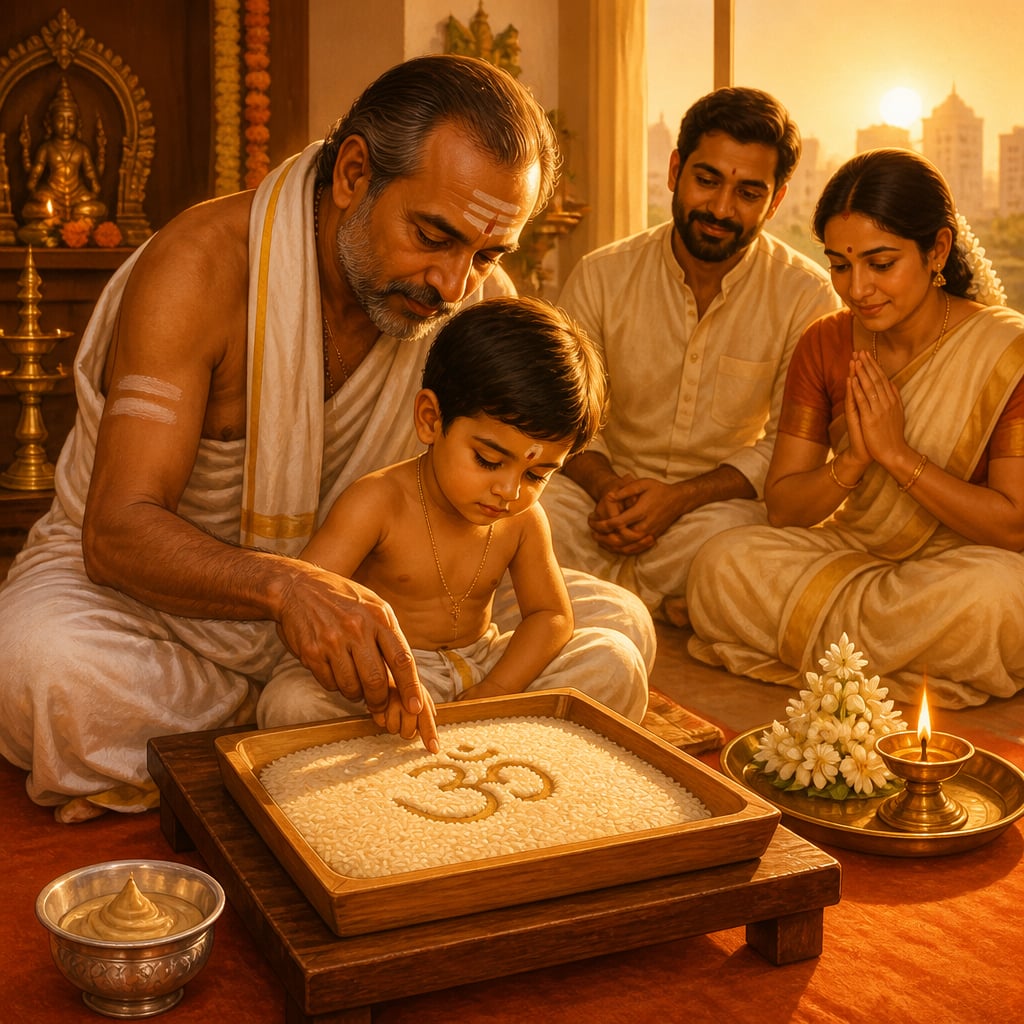
तिरुवनंतपुरम के एक फ्लैट में सुबह छह बजे विजयदशमी का दिन है। नौ दिनों का नवरात्रि त्योहार खत्म हो रहा है। एक चार साल का लड़का नई धुलाई की हुई कपास की मुंडु पहनकर जमीन पर पैर मोड़कर बैठा है। उसके अचन (पिता) उसके बगल में बैठे हैं। उसकी मुथासी (दादी) घर की वेदी पर पीतल का दीपक जला रही हैं। लड़के के सामने एक लकड़ी के निचले स्टूल पर एक छोटी पीतल की सपाट ट्रे रखी गई है। ट्रे में कच्चे चावल के दानों की एक पतली परत है, जिसे चम्मच के पिछले हिस्से से सपाट किया गया है। ट्रे के बगल में एक सूखा ताड़ का पत्ता है, एक छोटी स्टाइलस, चंदन के पेस्ट की तिलक, तीन ताजी दुर्वा घास की पत्तियां, और गुड़ के पानी का एक छोटा मिट्टी का कप है।
परिवार के पुजारी, भट्टाथिरिप्पद, आ गए हैं। वह ट्रे के दूसरी ओर बैठते हैं, लड़के के सामने। वह अपनी दाहिनी तर्जनी को लड़के की दाहिनी तर्जनी पर रखते हैं। तीन धीमी साँसें लेते हैं। सरस्वती वंदना और छोटी गणेश प्रार्थना का जाप करते हैं। फिर, अपनी उंगली से लड़के की उंगली को गाइड करते हुए, चावल में ॐ का अक्षर बनाते हैं। दाने अलग हो जाते हैं। ॐ की आकृति सफेद ट्रे में दिखाई देती है। भट्टाथिरिप्पद लड़के की उंगली को उठाते हैं, चम्मच के पिछले हिस्से से चावल को सपाट करते हैं, और अगला अक्षर बनाते हैं। हरिः श्री, हरि श्री। विष्णु और लक्ष्मी को प्रणाम। केरल की मलयालम सीखने की परंपरा के नियमित पहले अक्षर। इस बार लड़का खुद इसे बनाता है, पुजारी का हाथ उसकी कलाई पर हल्का होता है। पूरा समारोह पैंतीस मिनट लगता है। लड़का चार साल की उम्र में इसे याद नहीं रखेगा। उसे बाकी जीवन इसकी तस्वीर के बारे में बताया जाएगा।
यह पाठ उस सुबह के बारे में है। धार्मिक परंपरा कम से कम बारह सौ साल से, निरंतर लिखित दस्तावेजों में, बच्चे के औपचारिक शिक्षा में प्रवेश को एक संरचित समारोह के रूप में कोडित कर रही है। संस्कृत में विद्यारम्भ। तेलुगु और कन्नड़ परंपरा में अक्षराभ्यासम्। मलयालम परंपरा में एझुथिनिरुथु। बंगाली परंपरा में हाते खोरी। चेरामन पेरुमल युग (नौवीं से ग्यारहवीं शताब्दी) के केरल के रिकॉर्ड विजयदशमी के समय, गुरु की भूमिका, और विभिन्न समुदायों के लिए बनाए जाने वाले विशेष पहले अक्षरों को निर्दिष्ट करने वाले प्रशासनिक दस्तावेज़ सुरक्षित रखते हैं। ये एशिया में कहीं भी औपचारिकीकृत पहले लिखने वाले समारोह के सबसे पुराने जीवित संस्थागत रिकॉर्ड हैं। तिरुवनंतपुरम का लड़का इस सुबह वही प्रोटोकॉल चला रहा है जो उसके पूर्वज हजार साल पहले उसी भूगोल में चलाते थे। यह पाठ वह व्याख्या है जो भट्टाथिरिप्पद ने चावल की ट्रे पर चार साल के बच्चे को देने के लिए रुके नहीं।
विद्यारम्भ वास्तव में क्या है
अभ्यास। विद्यारम्भ समारोह बच्चे को अक्षर लिखने और पढ़ने का औपचारिक शुरुआत है, जो पारंपरिक रूप से बच्चे की उम्र दो से पांच साल के बीच किया जाता है। नियमित दिन विजयदशमी है, आश्विन माह की शुक्ल पक्ष की दसवीं तारीख, शरद नवरात्रि त्योहार के अंत में आती है, आमतौर पर सितंबर के अंत या अक्टूबर की शुरुआत में। कुछ परंपराओं में दूसरा नियमित दिन वसंत पंचमी है, मघ माह की शुक्ल पक्ष की पांचवीं तारीख (अंत जनवरी या शुरुआत फरवरी), सरस्वती को समर्पित दिन। किसी भी दिन का चुनाव स्वयं धार्मिक है: प्रत्येक ज्ञान की देवी के लिए तैयार की गई तारीख है।
यह समारोह तीन स्तरीय चरणों में चलता है। पहला चरण घरेलू तैयारी है: बच्चे को नहलाया जाता है, नए साफ कपड़े पहनाए जाते हैं, और घर की वेदी के सामने लाया जाता है; घर का दीपक जलाया जाता है; कच्चे चावल (या कुछ परंपराओं में, चंदन का पेस्ट) की पतली परत वाली पीतल या तांबे की ट्रे वेदी के सामने रखी जाती है; पूजा की चीजें (कुमकुम, दुर्वा, फूल, गुड़, ताड़ का पत्ता या स्लेट, स्टाइलस या चाक) व्यवस्थित की जाती हैं। दूसरा चरण प्रार्थना है: पारिवारिक पुजारी या घरेलू गुरु सरस्वती वंदना (ज्ञान की देवी की प्रार्थना), गणेश प्रार्थना (पहले विघ्न हर्ता), और जहां लागू हो वंश-विशेष गुरु वंदना का जाप करते हैं। बच्चे को तिलक दी जाती है, गुड़ का एक छोटा टुकड़ा (इस पल की नियमित मिठाई), और दूध या शहद की कुछ बूंदें। तीसरा चरण लिखना है: पुजारी या गुरु अपनी दाहिनी तर्जनी को बच्चे की दाहिनी तर्जनी पर रखते हैं, बच्चे के हाथ को गाइड करते हुए, चावल की ट्रे में नियमित पहले अक्षर बनाते हैं। पहला अक्षर क्षेत्र के अनुसार अलग-अलग होता है। मलयालम परंपरा हरि श्री को नियमित पहली लिखाई के रूप में उपयोग करती है। तमिल और संस्कृत परंपराएं ॐ (ॐ अक्षर) का उपयोग करती हैं। बंगाली हाते खोरी परंपरा অ (बंगाली वर्णमाला का पहला स्वर) का उपयोग करती है। तेलुगु अक्षराभ्यासम घर के अनुसार ఓం या శ్రీ గణేశాయ నమః का उपयोग करता है। चावल की ट्रे लिखने के बाद, एक ताजे ताड़ के पत्र पर स्टाइलस से, या एक छोटी लकड़ी की स्लेट पर चाक से, या आधुनिक अनुकूलन में एक ताजी नोटबुक पेज पर पहली पेंसिल से एक ही अक्षर बनाए जाते हैं।
अंतिम चरण सामाजिक है: बच्चे को घर की वरिष्ठ सदस्यों से घर की अभिवादन प्रोटोकॉल (चरण स्पर्श) में आशीर्वाद प्राप्त होते हैं, पारिवारिक पुजारी और गुरु को दक्षिणा (कृतज्ञता की पेशकश) प्राप्त होती है, और घर मिठाई और एक उत्सव के साथ मनाता है। यह दिन बच्चे का धार्मिक शिक्षा परंपरा के साथ पहला औपचारिक संपर्क है; समारोह यह है कि घर ने औपचारिक रूप से स्वीकार किया है कि बच्चा अक्षरों की दुनिया में औपचारिक रूप से शुरू हो गया है।
धर्मग्रंथ। पाठ्य आधार स्तरीय हैं। ऋग्वेद वाक् (भाषण), सरस्वती (ज्ञान की देवी), और बृहस्पति (बुद्धिमानों की सभा के भगवान) की मौलिक प्रार्थना को संरक्षित करता है क्योंकि ये विद्या के देवता हैं। मनुस्मृति अध्याय दो और यज्ञवल्क्य स्मृति विद्यारम्भ को गृहस्थ जीवन के सोलह संस्कारों में से एक के रूप में कोडित करते हैं (साथ ही इसके अधिक विस्तृत समकक्ष, उपनयन, पवित्र-धागा समारोह, जो पुराने बच्चे को वैदिक अध्ययन में औपचारिक रूप से शुरू करता है)। अपस्तम्ब और बौधायन गृह्य सूत्र घरेलू पैमाने पर विद्यारम्भ प्रोटोकॉल को नियमित मंत्र, समय, और पुजारी की भूमिका के साथ निर्दिष्ट करते हैं। सरस्वती सुक्त (ऋग्वेद 6.61) और सरस्वती स्तोत्र (स्कंद पुराण में संरक्षित) दिन की प्रार्थना के मुख्य मौखिक आधार हैं।
सरस्वति नमस्तुभ्यं वरदे कामरूपिणि।
विद्यारम्भं करिष्यामि सिद्धिर्भवतु मे सदा॥
sarasvati namas tubhyaṃ varade kāma-rūpiṇi
vidyārambhaṃ kariṣyāmi siddhir bhavatu me sadā
आपको प्रणाम, सरस्वती, वरदान देने वाली, सब कुछ की इच्छा की रूप। मैं विद्या की शुरुआत कर रहा हूं। मेरी सिद्धि सदा रहे।
नियमित सरस्वती वंदना, हर विद्यारम्भ समारोह की शुरुआत में पढ़ी जाती है
दो पंक्तियों का श्लोक धार्मिक विद्यारम्भ प्रार्थना का संरचनात्मक मूल है। व्याकरण सीधा है। उपासक सरस्वती को वरदान देने वाली और सब कुछ की इच्छा की रूप के रूप में नाम देता है (कामा रूपिणी), विद्या शुरू करने का कार्य घोषित करता है (विद्यारम्भं करिष्यामि), और संरचनात्मक परिणाम के रूप में सिद्धि (पूर्ण) मांगता है। इस श्लोक को लाखों छात्र हर सुबह अपने पाठ्यपुस्तकें खोलने से पहले धार्मिक भूगोल भर में पढ़ते हैं, और इसे हर विद्यारम्भ समारोह की शुरुआत में ज्ञान की देवी की औपचारिक प्रार्थना के रूप में पढ़ा जाता है।

प्रतीकवाद। चावल की ट्रे मनमाना नहीं है। दाने अक्षत हैं, शब्द का अर्थ अटूट है, शुरुआत होने वाली सीख की अटूटता का प्रतीक है। दाने अन्न भी हैं, खाना, शरीर के प्राथमिक पोषण का प्रतीक है, यह दर्शाता है कि अक्षरों की सीख घर के बच्चे को खिलाने के कार्य के संरचनात्मक रूप से बराबर है। ट्रे की सपाट सतह नियमित सीखने का माध्यम है: बच्चा लिख सकता है, सतह को सपाट कर सकता है, और फिर से लिख सकता है, कोई स्थायी निशान और असफलता का कोई डर नहीं। माध्यम क्षमा करने वाला है। ॐ अक्षर पर पहले प्रयास अनुभवहीन हैं। दाने प्रयास को दर्ज करते हैं और अगले को रास्ता देते हैं। ट्रे आधुनिक सवाल का धार्मिक ढांचे की संरचनात्मक जवाब है कि बच्चे को लिखने की शुरुआत कैसे करें बिना उस असफलता की चिंता पैदा किए जो स्थायी स्याही और चिह्नित नोटबुक पेज पैदा कर सकते हैं।
पहला अक्षर भी समायोजित है। मलयालम हरि श्री विष्णु और लक्ष्मी को प्रणाम है, धार्मिक समृद्धि और निरंतरता के दो मुख्य देवता। संस्कृत और तमिल ॐ मौलिक अक्षर है, वह ध्वनि जिससे वैदिक परंपरा मानती है कि ब्रह्मांड निकला है। बंगाली অ पहला स्वर है, बंगाली वर्णमाला की मौलिक ध्वनि है। तेलुगु पसंद (ॐ या श्री गणेश नमः) घर के वैष्णव या गणपत्य अभिविन्यास के अनुरूप है। प्रत्येक परंपरा में पहला अक्षर संरचनात्मक रूप से देवता-अभिव्यक्ति है, फोनेटिक प्राइमर नहीं; बच्चे का पहला लिखा हुआ कार्य लिखने के शारीरिक कार्य के माध्यम से दिव्य की मान्यता है।
गुरु की उंगली बच्चे की उंगली पर वह संरचनात्मक तत्व है जो आधुनिक स्कूल-से-पहले समकक्ष पूरी तरह से खो गए हैं। धार्मिक ढांचा पहले अक्षर को गुरु के हाथ से शिष्य के हाथ तक संचरण के रूप में मानता है, पुजारी के जमा हुए ज्ञान और घर की वंश को बच्चे के पहले लिखने के कार्य में ले जाया जाता है। संपर्क प्रतीकात्मक नहीं है। यह वह शारीरिक पल है जिसमें विद्या की वंश एक शरीर से दूसरे में जाती है।
शरीर क्यों जवाब देता है
विद्यारम्भ समारोह की आदत की वास्तुकला किसी भी निरंतर परंपरा में सबसे सावधानीपूर्वक इंजीनियर की गई सीखने की हस्तक्षेप में से एक है। संकेत कैलेंडर-बंद है: विजयदशमी नवरात्रि के अंत में आता है, एक तारीख पर जिसे पंचांग ने महीनों पहले चिह्नित किया है। दिनचर्या बहु-स्तरीय है: घरेलू तैयारी, पुजारी की प्रार्थना, गुरु का हाथ बच्चे के हाथ पर, चावल-ट्रे लिखना, ताड़-पत्र या स्लेट लिखना, सामाजिक बंद। पुरस्कार विद्या की वंश में शामिल होने का अनुभूत अनुभव है, देवी सरस्वती को पुकारा गया है, देवता-अक्षर को बनाया गया है, पारिवारिक पुजारी की दक्षिणा दी गई है, और घर का उत्सव पल को बंद किया गया है।
कैरल ड्वेक, मानसिकता (2006) में, प्रारंभिक बचपन की सीख में विकास मानसिकता की भूमिका दस्तावेज़ करते हैं: बच्चे जो एक गैर-निर्णयकारी क्षमाशील माहौल में अपने पहले सीखने के प्रयासों का अनुभव करते हैं, वे दीर्घकालीन आत्मविश्वास और लचीलापन विकसित करते हैं जो निरंतर प्रयास समर्थन करते हैं। चावल-ट्रे की संरचनात्मक संपत्ति सपाट करने-और-फिर से लिखने योग्य होने का विकास-मानसिकता सीखने के माहौल का नियमित कार्यान्वयन है। बच्चा असफल हो सकता है, चावल को सपाट कर सकता है, और फिर से कोशिश कर सकता है; माध्यम असफलता को स्थायी रूप से दर्ज नहीं करता है; पुजारी का मार्गदर्शन प्रत्येक प्रयास की सफलता सुनिश्चित करता है। बीजे फॉग, छोटी आदतें (2019) में, दीर्घकालीन आदत की स्थापना में छोटे, बार-बार, शारीरिक प्रयास के मूल्य की पहचान करते हैं; विद्यारम्भ समारोह वह नियमित शारीरिक प्रवेश बिंदु है जिसे घर के बाद का दैनिक अभ्यास (सुबह सरस्वती वंदना, स्कूल बैग पूजा नए स्कूल वर्ष से पहले, किताबों को माथे पर छूना) सुदृढ़ करता है।
प्रयोगशालाओं ने क्या पाया

हाथ की लिखाई, बहुसंवेदी सीख, और प्रारंभिक बचपन की अक्षर-अधिग्रहण पर आधुनिक शोध, पिछले बीस सालों में, धीरे-धीरे वह तक पहुंच गया है जो चावल-ट्रे विद्यारम्भ निरंतर संभाले हुए है। करीन जेम्स, इंडियाना विश्वविद्यालय ब्लूमिंगटन में, तंत्रिका विज्ञान और शिक्षा में प्रवृत्तियों में उनके 2012 के पेपर में और बाद के काम में, दस्तावेज़ करते हैं कि युवा बच्चों में हाथ की लिखाई मोटर-कॉर्टेक्स क्षेत्रों को सक्रिय करती है और दृश्य-स्थानीय प्रसंस्करण क्षेत्रों को एक साथ सक्रिय करती है, कीबोर्ड इनपुट या केवल दृश्य सीख की तुलना में अक्षर मान्यता की काफी गहरी तंत्रिका कोडिंग पैदा करती है। जेम्स अध्ययन कार्यात्मक एमआरआई का उपयोग करते हैं हाथ की लिखाई, ट्रेसिंग, और कीबोर्ड इनपुट में कॉर्टिकल सक्रियण को मापने के लिए; हाथ की लिखाई स्थिति प्रासंगिक एकीकृत पढ़ने और भाषा क्षेत्रों में लगभग तीन गुना सक्रियण पैदा करती है। ऐन डायमंड, ब्रिटिश कोलंबिया विश्वविद्यालय में, अपने 2013 मनोविज्ञान की वार्षिक समीक्षा के पेपर में, व्यापक कार्यकारी-कार्य और शारीरिक-सीख साहित्य का सारांश देते हैं: बहुसंवेदी जुड़ाव (एक एकल सीखने के कार्य में दृश्य, मोटर, स्पर्शनीय, और मौखिक चैनलों का एकीकरण) एकल-चैनल सीख की तुलना में काफी मजबूत कार्यकारी-कार्य विकास पैदा करता है। डाफना जेंटनर एट अल (2016, मनोवैज्ञानिक विज्ञान) प्रारंभिक-अक्षर मान्यता के लिए विशेष रूप से खोज का विस्तार करते हैं, दस्तावेज़ करते हैं कि हाथ-ट्रेसिंग से अक्षर सीखने वाले बच्चे केवल दृश्य मान्यता से सीखने वाले बच्चों की तुलना में लगभग दोगुनी मान्यता सटीकता दिखाते हैं।
अभिसारी शोध स्पष्ट है। चावल-ट्रे विद्यारम्भ, इसके बहुसंवेदी जुड़ाव के साथ (पुजारी की आवाज, पुजारी की उंगली बच्चे की उंगली पर, उभरते अक्षर के आकार की दृश्य मान्यता, उंगली के नीचे चावल के दानों के पृथक होने का स्पर्शनीय संवेदना, अक्षर की मौखिक पुनरावृत्ति, घर के चारों ओर की अनुष्ठान ढांचे का अनुभव), वास्तव में वह बहुविध शारीरिक-सीख माहौल है जو आधुनिक तंत्रिका विज्ञान साहित्य ने अक्षर-मान्यता अधिग्रहण के लिए इष्टतम के रूप में प्रलेखित किया है। धार्मिक परंपरा कम से कम बारह सौ सालों से प्रोटोकॉल चला रही है।
दुनिया इसे अब क्या कहती है
मुख्य आधुनिक प्रतिध्वनि स्कूल-से-पहले का बाजार है। अमेरिकी स्कूल-से-पहले की खरीदारी घटना, श्रेणी द्वारा, अमेरिका में क्रिसमस के बाद दूसरी सबसे बड़ी वार्षिक खुदरा घटना है, राष्ट्रीय खुदरा संघ की वार्षिक अनुमान नई स्टेशनरी, नए कपड़े, नई इलेक्ट्रॉनिक्स, और व्यापक स्कूल-से-पहले श्रेणी में पचास अरब डॉलर से अधिक खर्च करने का अनुमान है। सांस्कृतिक अनुष्ठान संरचना संरक्षित है: नई पेंसिलें, नई नोटबुक, नया स्कूल का कपड़ा या पहला दिन का आउटफिट, घर के दरवाजे पर बच्चे की तस्वीर, स्कूल के पहले दिन पर माता-पिता की सामाजिक-मीडिया पोस्ट। #पहलादिन Instagram हैशटैग 2023 तक लगभग सत्तर मिलियन वार्षिक पोस्ट है। पल की संरचना संरक्षित है। प्रतीकात्मक, दिव्य-अभिव्यक्ति, और वंश-संचरण परतें पूरी तरह से अनुपस्थित हैं।
दूसरी आधुनिक प्रतिध्वनि व्यापक प्रारंभिक-बचपन की शिक्षा बाजार है। मॉन्टेसरी विधि (मारिया मॉन्टेसरी, बीसवीं शताब्दी की शुरुआत) हाथ-ओन, बहुसंवेदी, शारीरिक सीखने की सामग्रियों पर जोर देती है; बालू के अक्षर जो मॉन्टेसरी परंपरा ने अक्षर-ट्रेसिंग के लिए विकसित किए थे, संरचनात्मक रूप से चावल-ट्रे सिद्धांत की पश्चिमी पुनः-व्युत्पत्ति हैं, मॉन्टेसरी ढांचा अंतर्दृष्टि को उसके बीसवीं शताब्दी की शुरुआत की नैदानिक अवलोकनों के लिए संदर्भित करता है, न कि धार्मिक परंपरा के बारह सौ साल के निरंतर अभ्यास के लिए। रेजियो एमिलिया दृष्टिकोण (लोरिस मालागुज़ी, मध्य-बीसवीं शताब्दी, इटली) सीखने की बहु-मुखी अभिव्यक्ति पर जोर देता है। वाल्डॉर्फ शिक्षा (रुडोल्फ स्टेनर, बीसवीं शताब्दी की शुरुआत) औपचारिक अक्षरों में शारीरिक और अनुष्ठानित प्रवेश पर जोर देती है। इनमें से प्रत्येक पश्चिमी शैक्षणिक परंपरा, स्वतंत्र रूप से, चावल-ट्रे विद्यारम्भ की संरचनात्मक तर्क के तत्वों को व्युत्पन्न किया है। इनमें से कोई भी अंतर्दृष्टि को चेरामन पेरुमल-युग के केरल रिकॉर्ड या व्यापक धार्मिक विद्यारम्भ परंपरा के लिए संदर्भित नहीं करता है।
तीसरी आधुनिक प्रतिध्वनि व्यापक बहुसंवेदी सीख स्वास्थ्य और शिक्षा बाजार है। करीन जेम्स और ऐन डायमंड शोध आधार, पिछले दशक में, एक बड़ी शैक्षणिक-प्रौद्योगिकी श्रेणी (लीपफ्रॉग अक्षर-ट्रेसिंग खिलौने, iPad बहुसंवेदी अक्षर ऐप्स, मॉन्टेसरी-व्युत्पन्न प्रारंभिक-सीख कार्यपुस्तिकाएं) उत्पन्न की है जो अक्षर-अधिग्रहण के बहुसंवेदी दृष्टिकोण को बाजार करती है बिना इसके धार्मिक पूर्ववर्ती के संदर्भ के। धार्मिक परंपरा की संरचनात्मक अंतर्दृष्टि, कि बच्चे का पहला अक्षर एक क्षमाशील बहुसंवेदी माध्यम में गुरु के मार्गदर्शन के साथ हाथ से बनाया जाना चाहिए, आधुनिक शैक्षणिक प्रौद्योगिकी श्रेणी में टुकड़ा दर टुकड़ा पुनर्असेंबल किया गया है, संस्कृत नामों और विद्यारम्भ ढांचे के साथ सर्जिकली हटाया गया है।
इसे स्वयं क्या कहें
विद्यारम्भ संस्कृत में। अक्षराभ्यासम् तेलुगु और कन्नड़ परंपराओं में। एझुथिनिरुथु मलयालम परंपरा में। हाते खोरी बंगाली परंपरा में। सरस्वती वंदना उद्घाटन प्रार्थना के लिए। हरि श्री या ॐ या क्षेत्रीय पहली ध्वनि नियमित पहली लिखाई के लिए। पश्चिमी स्कूल-से-पहले का दिन विद्यारम्भ है देवता, पुजारी, चावल ट्रे, गुरु की उंगली बच्चे की उंगली पर, और वंश संचरण पूरी तरह से हटाया गया है। मॉन्टेसरी बालू अक्षर चावल ट्रे है घर की वेदी के साथ। जब बातचीत स्कूल-से-पहले के बाजार, मॉन्टेसरी विधि, या व्यापक बहुसंवेदी-सीख उद्योग तक पहुंचती है, तो प्रतिक्रिया एक शांत वाक्य है। वह विद्यारम्भ है। चेरामन पेरुमल केरल रिकॉर्ड समारोह का हजार साल का प्रशासनिक इतिहास संरक्षित करता है। अपस्तम्ब गृह्य सूत्र प्रोटोकॉल को कोडित करता है। घर इसे कम से कम बारह सौ साल से, निरंतर पाठ्य रिकॉर्ड में चलाया गया है। नामकरण वंश है। वंश रसीद है।
Key figures
Saraswati
Vedic to present (continuously worshipped from the Rig Vedic period to the modern household altar)
Thunchaththu Ezhuthachan
16th century CE (traditional dates approximately 1495 to 1575 CE)
Case studies
The Cheraman Perumal-era Kerala Ezhuthiniruthu Records (9th-11th century CE)
The Cheraman Perumal-era administrative records of Kerala, dating from approximately the 9th to the 11th century CE, preserve detailed institutional documentation of the Ezhuthiniruthu (the Malayalam Vidyarambha ceremony). The records specify the canonical Vijayadashami timing, the priestly role of the family bhattathirippad or the brahminical priest, and the specific first-letter syllables (Hari Shri being the canonical opening for most communities, with regional and community-specific variants documented). The records also preserve administrative details about the ceremony's institutional anchors: the Saraswati temples at which the ceremony was performed, the priestly families that maintained the institutional continuity, the dakshina arrangements, and the post-ceremony social observances. These are the oldest surviving institutional records for a formalised first-writing ceremony anywhere in Asia, predating the comparable Western records of medieval European school-induction ceremonies by several centuries and predating the Japanese and Chinese institutional first-writing records by a comparable margin. The records establish that the Ezhuthiniruthu ceremony was, by the ninth century, a fully institutionalised social protocol with administrative codification, priestly continuity, and broad community participation across Kerala. Thunchaththu Ezhuthachan's sixteenth-century literary corpus and the Thunchan Parambu's continuing institutional presence as a Vijayadashami Ezhuthiniruthu site are the subsequent institutional layers built on top of the Cheraman Perumal-era foundation.
The Western framing of the Vidyarambha as folk practice, recent cultural emergence, or local Hindu curiosity is structurally inconsistent with the Cheraman Perumal-era evidence. The administrative records establish the ceremony as a formally codified social protocol with continuous institutional preservation across more than a thousand years. The household's continuing Vijayadashami Ezhuthiniruthu, the Sri Saraswati Temple at Panachikkadu's annual mass ceremonies, and the Thunchan Parambu's preserved institutional anchor are the contemporary embodiments of the same protocol the Cheraman Perumal-era records preserve. The receipts for the ceremony's institutional status are in the surviving Kerala administrative documents, in Ezhuthachan's sixteenth-century literary corpus, and in the contemporary household practice that continues to perform the ceremony at the same canonical timing with the same first-letter syllable.
The Ezhuthiniruthu tradition has been preserved continuously since at least the ninth century, with the Cheraman Perumal-era institutional codification, the Ezhuthachan-era sixteenth-century literary anchor, and the modern institutional embodiment at the principal Saraswati temples and the Thunchan Parambu. The Sri Saraswati Temple at Panachikkadu (Kottayam district) hosts several thousand children for the Vijayadashami Ezhuthiniruthu each year. The Thunchan Parambu at Tirur (Malappuram district) hosts a comparable number. The Tirumala Tirupati Devasthanams' mass Aksharabhyasam ceremonies in the Telugu tradition and the regional centres across the dharmic geography preserve the institutional continuity. The colonial period's imposition of the European school system did not displace the household Vidyarambha, which has continued to be performed in parallel with the modern school-induction format throughout the colonial and post-independence periods.
The world's oldest institutional first-writing ceremony has a thousand-year administrative record in Kerala. The dharmic Vidyarambha tradition is not folk practice, not local cultural curiosity, not recent emergence; it is one of the most fully formalised learning-initiation protocols any continuous tradition has produced, with continuous institutional preservation across more than a thousand years of textual records and probably much longer in oral and household transmission. The receipts for this status are in the Cheraman Perumal-era Kerala records, in Ezhuthachan's sixteenth-century literary corpus, and in the contemporary household and temple practice that continues to perform the ceremony today.
When the conversation reaches for the back-to-school market as a recent commercial phenomenon or for the Montessori sandpaper letters as a recent pedagogical innovation, the dharmic response is one calm sentence: The Cheraman Perumal-era Kerala records preserve a thousand-year administrative history of the Ezhuthiniruthu ceremony. The Apastamba Grihya Sutra codifies the Vidyarambha protocol. The Saraswati Sukta in the Rig Veda is the foundational invocation. The household has been running the ceremony for at least three thousand years.
The Cheraman Perumal-era Kerala administrative records (9th to 11th century CE) preserve the institutional Ezhuthiniruthu ceremony's timing on Vijayadashami, the priestly role, and the specific first-letter syllables for different communities. These records are the oldest surviving institutional records for a formalised first-writing ceremony anywhere in Asia, with continuous institutional preservation across more than a thousand years of textual and household transmission. The Sri Saraswati Temple at Panachikkadu and the Thunchan Parambu at Tirur are the principal contemporary institutional anchors, with several thousand children initiated at each site annually on Vijayadashami.
The $50B Back-to-School Market and the De-Ritualised Vidyarambha (2000s to present)
The American back-to-school shopping event is, by category, the second-largest annual retail event in the United States after Christmas. The National Retail Federation's annual estimate of back-to-school and back-to-college spending exceeds approximately fifty billion dollars annually as of 2023, distributed across new stationery, new clothes, new electronics, new bags, new uniforms or first-day outfits, and the broader back-to-school category. The cultural ritual structure of the moment is preserved with considerable fidelity: the new pencils and notebooks, the new uniform or first-day outfit, the photograph of the child at the front door, the parent's social-media post on the first day of school, the family send-off and the after-school first-day report. The #FirstDayOfSchool Instagram hashtag has approximately seventy million annual posts as of 2023, with parallel growth in TikTok, Pinterest, and other social-media platforms. Major retailers (Target, Walmart, Amazon, Walgreens, Office Depot, Staples) run multi-week back-to-school marketing campaigns each year, with the back-to-school window structurally functioning as the second-largest commercial-ritual occasion in the American annual calendar. The structure of the moment, the family-led send-off into formal learning, is preserved entirely. The symbolic layer (the deity invocation, the Saraswati Vandana), the divine-invocation layer (the Ganesha and the Saraswati invocations), the lineage-transmission layer (the guru's hand on the child's hand, the priestly role, the dakshina), and the calendar-locked layer (the Vijayadashami timing) are entirely absent.
The American back-to-school market is the cleanest documented modern case of the Vidyarambha ceremony's structural occasion being preserved at scale while every layer of meaning is removed. The new pencils are the modern equivalent of the stylus and palm leaf. The new clothes are the equivalent of the freshly laundered cotton mundu. The first-day-of-school photograph is the equivalent of the household's ceremonial documentation of the child's induction into letters. The parent's social-media post is the equivalent of the household's social broadcast of the ceremony to the broader community. The structural insight, that the child's entry into formal learning is a household and community event worth marking with ritual elaboration, is intact. The dharmic lineage, the Saraswati invocation, the priestly role, the rice-tray medium, and the calendar-locked Vijayadashami timing are gone. The dharmic household's job is not to argue with the back-to-school market; the structural recognition of the moment as a household ritual occasion is broadly aligned with the tradition. The job is to add the missing layers: invoke Saraswati at the home altar on the morning of the first day of school, perform a household-scale Vidyarambha at Vijayadashami when the child reaches the canonical age, attribute the structural occasion to its dharmic origin in conversation.
The back-to-school market's growth into the second-largest annual retail event in the United States after Christmas is the most documented modern case of the dharmic Vidyarambha's structural insight being preserved at scale with the lineage absent. The Indian household that has always preserved the integrated Vidyarambha ceremony was not made worse by Target or by the National Retail Federation; it was, indirectly, validated by the global cultural appetite for the structural insight that the child's entry into formal learning deserves household and community ritual. The integrated rice-tray Vidyarambha continues to be performed at the principal institutional centres (Sri Saraswati Temple at Panachikkadu, Thunchan Parambu, Tirumala Tirupati, the regional Saraswati temples) and in millions of households across the dharmic geography on every Vijayadashami.
The market preserves the occasion and removes every layer of meaning. The fifty-billion-dollar back-to-school market and the seventy-million-annual #FirstDayOfSchool Instagram posts are the modern cultural appetite for the structural occasion the dharmic Vidyarambha has always provided. The dharmic household's job is small and direct: add the missing layers. Invoke Saraswati at the home altar on the morning of the first day of school. Perform the household-scale Vidyarambha at Vijayadashami when the child reaches the canonical age. Use the original Sanskrit names in conversation: Vidyarambha, Aksharabhyasam, Ezhuthiniruthu, Hate Khori. The naming is the lineage. The lineage is the receipt. Talapatram's Sanatan Operating System course, in this lesson, is filing the receipt.
Use the original word in conversation. When the friend says she is taking her child to back-to-school shopping, you say she is preparing for the modern Vidyarambha. When the magazine cover names the first-day-of-school photograph, you name the Saraswati Vandana that should accompany it. The market is preserving the occasion; the dharmic tradition is the source of the integrated ritual layer that completes it. The naming completes the loop.
The American back-to-school shopping event exceeds fifty billion dollars in annual spending as of 2023, the second-largest annual retail event in the United States after Christmas. The #FirstDayOfSchool Instagram hashtag has approximately seventy million annual posts. None of the principal retail-marketing curricula, educational-technology category descriptions, or cultural-ritual frameworks reference the Vidyarambha ceremony, the Saraswati Vandana, or the Cheraman Perumal-era Kerala administrative records. The dharmic Vidyarambha tradition has continuous textual records from at least the Apastamba and Baudhayana Grihya Sutras (c. 600 BCE) and continuous institutional preservation across more than a thousand years.
Karin James 2012 and Anne Diamond 2013: The Hand-Writing Vindication of the Rice Tray
The modern research on hand-writing, multisensory learning, and early-childhood letter-acquisition has, in the last fifteen years, produced converging instrumented confirmation of the rice-tray Vidyarambha's structural mechanisms. Karin James, at Indiana University Bloomington, in her 2012 paper in Trends in Neuroscience and Education and in subsequent work, used functional MRI to document that hand-writing in young children activates motor-cortex regions and visual-spatial processing areas simultaneously, producing approximately three times the activation in the integrated reading-and-language regions compared to keyboard input or visual-only learning. The James studies establish that the hand-writing modality produces measurably deeper neural encoding of letter recognition. Anne Diamond, at the University of British Columbia, in her 2013 Annual Review of Psychology paper, summarised the broader executive-function and embodied-learning literature: multisensory engagement (the integration of visual, motor, tactile, and verbal channels in a single learning act) produces significantly stronger executive-function development than single-channel learning. Daphna Gentner et al (2016, Psychological Science) extended the finding to early-letter recognition specifically, documenting that children who learned letters by hand-tracing showed approximately twice the recognition accuracy of children who learned by visual recognition alone. Carol Dweck's growth-mindset research (2006, Mindset) established the role of forgiving learning environments in long-term confidence and resilience. Together, this body of work is the modern instrumented confirmation of what the rice-tray Vidyarambha has held continuously: the rice-tray is precisely the multimodal embodied-learning environment the modern neuroscience literature has documented as optimal for letter-recognition acquisition (the priest's voice, the priest's finger on the child's finger, the visual recognition of the emerging letter shape, the tactile sensation of the rice grains parting under the finger, the verbal repetition of the syllable, the felt-sense of the household's surrounding ritual frame). The rice-tray is not symbolic; it is optimal learning hardware.
The Karin James 2012 fMRI documentation of hand-writing's three-fold activation advantage, the Anne Diamond 2013 Annual Review of Psychology synthesis of multisensory-learning research, the Gentner 2016 letter-recognition Psychological Science paper, and the Dweck 2006 growth-mindset research are, line for line, the modern instrumented confirmation of the rice-tray Vidyarambha's structural design. The hand-writing requirement is met. The multisensory engagement (visual, motor, tactile, verbal, social) is met. The forgiving learning environment (the rice surface that can be smoothed and rewritten without permanent record of failure) is met. The growth-mindset frame (the success guaranteed by the priest's hand on the child's hand, the household's celebratory closing, the lineage transmission's institutional honour) is met. The research vindication is total: the substance is correct, the structure is correct, the multimodality is correct, the forgiving-medium architecture is correct. The Apastamba Grihya Sutra specified each of these by experience two and a half thousand years before the experimental methods could measure them.
The hand-writing and multisensory-learning research base has, in the last fifteen years, generated a substantial cross-disciplinary research field across neuroscience, psychology, education, and cognitive science. The research has driven significant changes in early-childhood education curricula, with many school systems re-emphasising hand-writing instruction in the early grades after the brief period (approximately 2010 to 2016) in which keyboard-only instruction was being considered as an alternative. The Montessori sandpaper-letter pedagogy, the Reggio Emilia multimodal approach, and the broader Waldorf embodied-learning tradition have each gained renewed institutional attention as the research base has documented the structural advantages of their underlying approach. The dharmic Vidyarambha tradition's three-thousand-year continuous practice has, throughout this entire period of Western pedagogical reconsideration, been running the same protocol the modern research is now documenting as optimal.
The case for the tradition does not need to wait for the lab. The lab, when it arrives, will confirm what the tradition recorded. The Rig Veda preserved the Saraswati Sukta three thousand years ago. The Apastamba Grihya Sutra codified the Vidyarambha protocol two and a half thousand years ago. The Cheraman Perumal-era Kerala records preserve the institutional ceremony from the ninth century CE. Karin James published the hand-writing fMRI paper in 2012. Anne Diamond published the multisensory-learning Annual Review in 2013. Daphna Gentner et al published the letter-recognition paper in 2016. Three independent research records, two and a half thousand years apart, point to the same multimodal embodied-learning architecture for the child's first letter.
Three thousand years of household practice, two and a half thousand years of textual codification, twelve hundred years of continuous Kerala administrative records, and over fifteen years of modern hand-writing and multisensory-learning research all point to the same multimodal embodied-learning architecture for the child's first letter. The grandmother does not need to read Karin James or Anne Diamond. She has placed the rice tray before her grandson on Vijayadashami. The hand-writing research and the rice-tray Vidyarambha are not in competition. They are the same insight, two and a half thousand years apart, with one of them carrying the integrated whole the other is reassembling, piece by piece. The rice tray is not symbolic. It is optimal learning hardware.
Karin James (2012, Trends in Neuroscience and Education) documented that hand-writing in young children activates motor-cortex and visual-spatial processing simultaneously, producing approximately three times the activation in integrated reading-and-language regions compared to keyboard input. Anne Diamond (2013, Annual Review of Psychology) synthesised the multisensory-learning research demonstrating significantly stronger executive-function development from multimodal versus single-channel learning. Daphna Gentner et al (2016, Psychological Science) documented that hand-tracing produced approximately twice the letter-recognition accuracy of visual-only learning in young children. The Apastamba Grihya Sutra specified the rice-tray Vidyarambha protocol approximately two and a half thousand years earlier; the Cheraman Perumal-era Kerala records preserve the institutional ceremony from approximately twelve hundred years ago.
Historical context
Vedic to present (the Vidyarambha tradition continuously documented from the Rig Vedic Saraswati Sukta, c. 1500 BCE; codified in the Apastamba and Baudhayana Grihya Sutras, c. 600 BCE; preserved in the Cheraman Perumal-era Kerala administrative records, 9th to 11th century CE; institutionally anchored by Ezhuthachan in the 16th century; modern instrumented confirmation in the Karin James and Anne Diamond hand-writing research, 2009 to present)
The Vidyarambha ceremony is one of the most stable institutions in Indian civilisation. Across three thousand years, through Vedic, Mauryan, Gupta, Pala, Chola, Vijayanagara, Cheraman Perumal, Mughal, Maratha, and colonial periods, the household has performed the Vidyarambha when the child reached the canonical age, with the canonical timing on Vijayadashami or Vasant Panchami, the canonical first writing in the rice tray, and the canonical Saraswati invocation. The practice was preserved across regions, varnas, and economic classes through household and priestly transmission, with regional variants in the first-letter syllable (Hari Shri in Malayalam, Om in Tamil and Sanskrit, the first vowel in Bengali, Sri Ganesha-namah in Telugu) but with structural identity in the rice-tray medium and the guru's hand on the child's hand. The colonial period imposed the European school-system and the back-to-school shopping format through administration but did not displace the household Vidyarambha, which continued in parallel use throughout the colonial period and remains in active use across India in the twenty-first century, particularly intensified at the institutional centres (Sri Saraswati Temple at Panachikkadu, Thunchan Parambu at Tirur, the Tirumala Tirupati Devasthanams' mass Aksharabhyasam ceremonies, the Sringeri and Basar Saraswati temples). The 2012-present Western rediscovery of the same architecture under the names hand-writing research, multisensory learning, embodied learning, growth mindset, and Montessori sandpaper letters is the documented modern case of an integrated indigenous learning-initiation protocol being reassembled, piece by piece, with the Sanskrit names removed and the integrated whole unrecognised. The dharmic household's job is small and clear: keep running the Vidyarambha ceremony, every Vijayadashami, every Vasant Panchami, in every house that still keeps the calendar.
Living traditions
The Vidyarambha tradition is no longer a Hindu ceremony that the modern world is unaware of. The fifty-billion-dollar back-to-school market in the United States, the seventy-million-annual #FirstDayOfSchool Instagram posts, the Montessori sandpaper-letter pedagogy, the Reggio Emilia multimodal approach, the Waldorf embodied-learning tradition, and the broader multisensory-learning educational-technology category are each modern commercial and pedagogical echoes of the rice-tray Vidyarambha with the dharmic lineage and the Saraswati invocation surgically removed. The Karin James 2012 hand-writing fMRI research, the Anne Diamond 2013 multisensory-learning Annual Review of Psychology paper, the Daphna Gentner et al 2016 letter-recognition Psychological Science paper, and the Carol Dweck 2006 growth-mindset literature are the modern instrumented confirmations of what the rice-tray Vidyarambha has held continuously. The Indian household that has always preserved the integrated Vidyarambha ceremony was not made worse by Target or by Maria Montessori; it was, indirectly, validated by the global appetite for the structural insight. The dharmic tradition's job is small and clear. When the conversation reaches for the back-to-school market, you say Vidyarambha. When the conversation reaches for the Montessori sandpaper letters, you say Aksharabhyasam. When the conversation reaches for the Karin James hand-writing research, you say the Cheraman Perumal-era Kerala records preserve the institutional Ezhuthiniruthu protocol from the ninth century CE. The Rig Vedic Saraswati Sukta, the Apastamba and Baudhayana Grihya Sutras, the Manusmriti chapter two, the Skanda Purana's Saraswati Stotra, and the Cheraman Perumal-era administrative records are the textual and institutional anchors; the household and temple practice is the daily and annual instrument; the family priest's hand on the four-year-old's hand at the rice tray on Vijayadashami morning is the institutional continuity. Use the names. The labs have arrived. Talapatram's Sanatan Operating System course, in this lesson and in the broader Gurukul, is the manual for the household and the dharmic learning tradition the integrated rice-tray Vidyarambha belongs to. Every Vijayadashami, every Vasant Panchami, every rice tray, every receipt.
- The Vijayadashami Vidyarambha at the Household and the Saraswati Temple: The household and temple practice of running the formal Vidyarambha ceremony for the child between two and five years old on Vijayadashami (the tenth day of the bright half of Ashwin, closing the Sharad Navaratri festival, typically late September or early October). The household sequence: the child is bathed, dressed in fresh clean clothes, and brought to the home altar; the household lamp is lit; a brass or copper tray with a thin layer of raw rice is placed before the altar; the family priest (or a senior household member acting as the guru) recites the Saraswati Vandana, the Ganesha invocation, and the regional first-letter syllable; the priest places his right index finger on the child's right index finger and traces the canonical first letters in the rice tray (Hari Shri in Malayalam tradition, Om in Tamil and Sanskrit traditions, the first vowel in Bengali, Sri Ganesha-namah or Om in Telugu and Kannada); the same letters are then traced on a fresh palm leaf with a stylus, on a wooden slate with chalk, or in the modern adaptation on a fresh notebook page with the first pencil; the child receives charan-sparsh blessings from the senior family members and the family priest receives dakshina; the household closes with sweets and a festive meal. The temple-scale ceremony at the principal Saraswati centres (Sri Saraswati Temple at Panachikkadu, Thunchan Parambu at Tirur, the principal Telugu and Tamil Saraswati temples) initiates several thousand children in a single mass ceremony on Vijayadashami.
- The Vasant Panchami Saraswati Puja and the Bengali Hate Khori: The household and community practice of running the Vidyarambha ceremony on Vasant Panchami (the fifth day of the bright half of Magha, typically late January or early February), particularly emphasised in the Bengali, Bihari, and Odia traditions. The Bengali variant, Hate Khori (literally the hand-chalk, the placement of chalk in the hand), is performed at the household altar with the child tracing the first vowel of the Bengali alphabet under the guidance of the family priest. The Vasant Panchami day is dedicated to Saraswati and is one of the principal Saraswati Puja occasions across the dharmic geography; the Hate Khori ceremony is therefore embedded in the broader household and community Saraswati observance. In addition to the formal Hate Khori ceremony, the day is observed across India as the structural occasion for Saraswati Puja in schools, colleges, and educational institutions, with students placing their textbooks at the goddess's altar overnight and resuming their studies the next morning with the formal blessing of the goddess. The Saraswati murti is dressed in white or yellow (the Vasant Panchami's canonical colour, marking the beginning of spring), and the household offers white flowers, white rice, and a small selection of new books or learning materials to the goddess.
- Touching the Books to the Forehead and Daily Saraswati Vandana in the Hindu Household: The household practice of treating books, scripture, and learning materials with explicit ritual reverence, encoded in three principal daily acts. (1) Touching the books to the forehead before opening them: the practitioner brings the book to the forehead in a brief gesture of namaskara before each study session, recognising the book as the institutional repository of vidya and Saraswati's domain. (2) Never stepping on books, papers, or written material: the household enforces this convention from early childhood, treating any contact between the foot and a written surface as an unintentional avajna (disrespect) requiring correction (the practitioner touches the book, then the forehead, then the chest, in apology). (3) The daily Saraswati Vandana before opening the day's textbooks: the morning student's prayer running the standard Saraswati Vandana (sarasvati namas tubhyaṃ varade kāma-rūpiṇi) and the longer Saraswati Stotra (yā kundendu-tuṣāra-hāra-dhavalā) at the start of the day's study session. The combined practice converts every study session into a structural continuation of the Vidyarambha ceremony, with the goddess invoked, the books treated with reverence, and the practitioner's contact with vidya framed as an ongoing dharmic act rather than as a purely instrumental information-transfer.
- Sri Saraswati Temple, Panachikkadu (the Dakshina Mookambika): One of the principal Saraswati temples in southern India, often called the Dakshina Mookambika (the southern Mookambika, after the principal Mookambika temple at Kollur in Karnataka). The temple is dedicated to Saraswati in her canonical white-clad seated-on-the-white-lotus form, with the moolavar murti in a small natural cave-like sanctum. The temple is one of the principal institutional centres for the Vijayadashami Ezhuthiniruthu ceremony, with several thousand children initiated annually on the day. The continuous institutional preservation of the ceremony at Panachikkadu, with the priestly families maintaining the protocol across centuries, is one of the most documented cases of unbroken Saraswati-temple Vidyarambha tradition in modern India. The temple is also active during Vasant Panchami and across the Sharad Navaratri window.
- Thunchan Parambu, Tirur (the birthplace of Thunchaththu Ezhuthachan and the institutional anchor of the Malayalam learning tradition): The birthplace of Thunchaththu Ramanujan Ezhuthachan (16th century CE), the father of modern Malayalam literature. The site is preserved as a major institutional anchor of the Kerala Ezhuthiniruthu tradition, with several thousand children initiated on Vijayadashami each year at the Thunchan Memorial. The site includes the Thunchan Memorial Trust, the Ezhuthachan kavu (the sacred grove preserved at the birthplace), the institutional library and research centre, and the principal venue for the annual Vijayadashami mass-ceremony. The Thunchan Parambu's continuing institutional preservation across more than four centuries since Ezhuthachan's lifetime, and the broader Cheraman Perumal-era Kerala records' eight-century preservation of the Ezhuthiniruthu protocol, together make Tirur and Panachikkadu the two principal institutional anchors of the world's oldest continuously preserved first-writing ceremony.
- Basar Sri Saraswati Temple (the principal Saraswati temple in the Deccan and the institutional anchor of the Telugu Aksharabhyasam tradition): One of the principal Saraswati temples in southern India and the most institutionally significant Saraswati temple in the Telugu-speaking region. The temple is dedicated to Saraswati in her white-clad form, with the moolavar murti seated in the canonical lotus-asana. The Basar Aksharabhyasam ceremony, with the canonical first writing performed on Vijayadashami (and a secondary observance on Vasant Panchami), draws several thousand children annually from across Andhra Pradesh, Telangana, and the broader Telugu-speaking diaspora. The temple is on the bank of the Godavari river, with the river-bank theerthams forming part of the canonical pre-ceremony sequence (the child is bathed at the Godavari before being brought to the temple for the Aksharabhyasam itself). The temple is institutionally significant in the broader Veda Vyasa tradition, with the canonical narrative associating the temple's establishment with Veda Vyasa's penance at the site after the completion of the Mahabharata.
Reflection
- Reflect on the way you (or your children, or the team you lead) first encountered formal letters or formal study. Was the first attempt a guided success in a forgiving medium with a mentor's hand on yours, or was it an unguided trial-by-failure on permanent paper with red corrections? How did that first encounter shape your long-term relationship with formal learning? What would change in the next consequential learning threshold (your child's, your team's, your own) if you installed the integrated Vidyarambha architecture (forgiving medium, guided first success, formal invocation, celebratory closing) at the moment of entry?
- The Cheraman Perumal-era Kerala records preserve the institutional Ezhuthiniruthu ceremony from the ninth century CE. The Karin James 2012 fMRI research documented hand-writing's three-fold neural-activation advantage in the last decade. What does it mean that two institutions, separated by twelve hundred years, arrived at the same conclusion that the child's first letter must be traced by hand in a multisensory medium with the guru's guidance, and that the trace produces measurably better learning outcomes than any abstracted alternative?
- The Western back-to-school market preserves the structural occasion (the new pencils, the new clothes, the first-day photograph) of the child's entry into formal learning while removing every layer of meaning (the deity invocation, the priestly role, the lineage transmission, the calendar lock). What does the bare commercial preservation of an occasion without its meaning produce, and what does the integrated dharmic version (the same occasion with all the layers) offer? Is meaning the difference between a ritual and a market event, and if so, what is gained when meaning is added back?