पहले सुर, फिर अर्थ

स्वर, वेदांग शिक्षा, और वह 200 करोड़ का बाज़ार जो उदात्त को नहीं समझता

वैदिक परंपरा ने कविता का सुर सीखना अर्थ से पहले क्यों जरूरी माना, और मैसूर का एक आठ साल का लड़का अभी भी उस सुर में ऋग्वेद गाता है जो उसके दादा गाते थे। 2009 में नॉर्थवेस्टर्न के और 2012 में हार्वर्ड के वैज्ञानिकों ने साबित किया कि सुर सीखना पढ़ने की क्षमता को बहुत बेहतर बनाता है। आज की कैल्म एप्प ने वही 432 हर्ट्ज की सुर प्रणाली को बाज़ार में बेचा है जिसे वेदांग शिक्षा ने 2500 साल पहले व्यवस्थित किया था।

मैसूर का आठ साल का लड़का
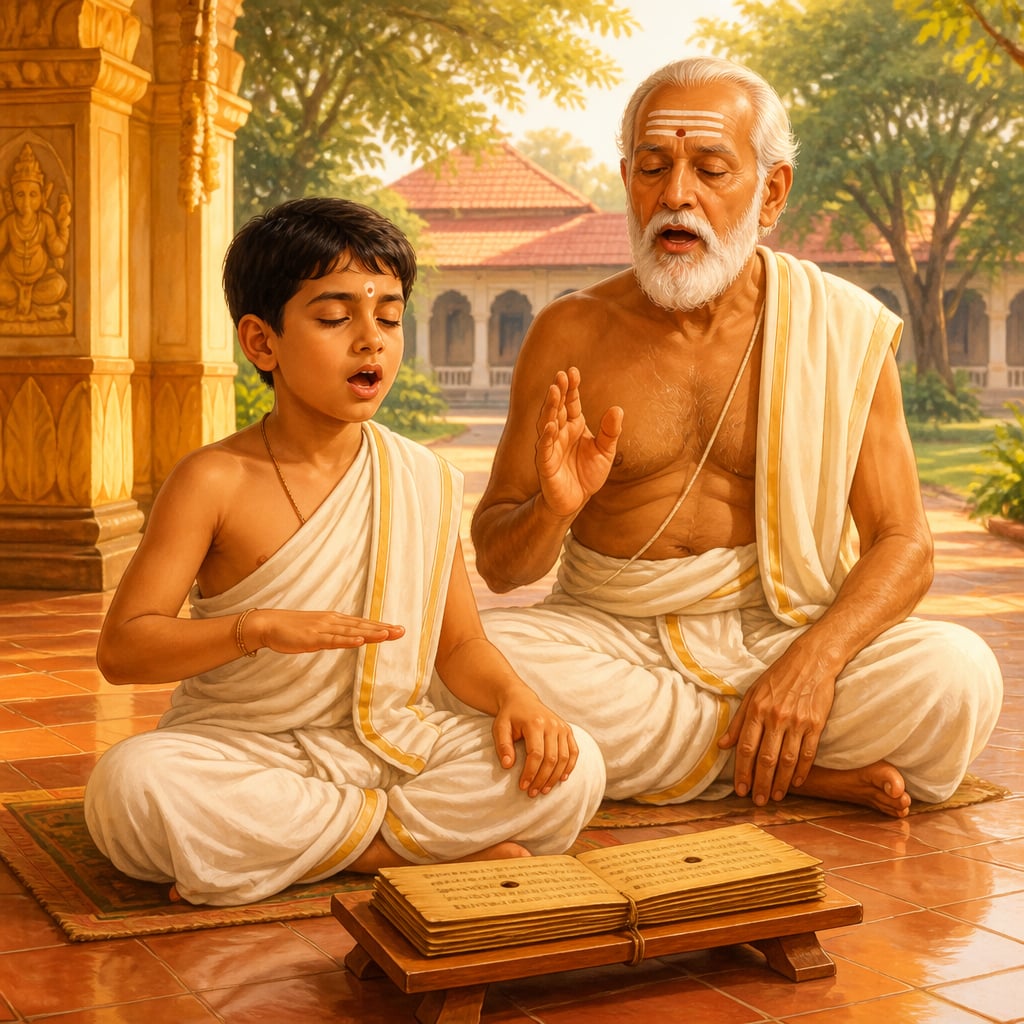
Anirudh and his grandfather chanting Rig Veda at Mysuru

मैसूर के श्री गणपति सच्चिदानंद आश्रम के एक संगमरमर के बरामदे में, सितंबर 2014 की एक शनिवार की सुबह, अनिरुद्ध नाम का एक आठ साल का लड़का अपने दादा के सामने बैठा है। उसके दादा, श्री कृष्णमूर्ति शास्त्री, सेवानिवृत्त डाकपाल हैं। वह सत्तर साल के हैं और खुद छह साल की उम्र से वेदिक गान सीखते रहे हैं - अपने दादा के पैरों में, तिरुनेलवेली के बाहर एक गाँव में।

अनिरुद्ध पिछले चौदह महीनों से शनिवार की सुबह पाँच बजे जाग रहा है। आज की कविता ऋग्वेद की शुरुआत है - अग्निमीले पुरोहितम मंत्र। वह इसी एक पंक्ति को साठ शनिवारों में चार सौ बार गा चुका है। फिर भी वह नहीं जानता कि "अग्नि" (आग) का असली मतलब क्या है। वह नहीं जानता कि "पुरोहितम" मतलब घर के पुजारी। वह नहीं जानता कि "यज्ञस्य देवम ऋत्विजम" माने यज्ञ का देवता।

लेकिन जो वह जानता है - अपने गले में, अपने पेट में, अपने गले के आसपास की छोटी मांसपेशियों में - वह है इस कविता का सटीक सुर। वह जानता है कि "अ" को ऊँचे सुर पर, "उदात्त" पर, रोका जाता है। वह जानता है कि "नि" नीचे जाता है, "अनुदात्त" में। वह जानता है कि "मि" फिर से ऊपर आता है, "स्वरित" में - वह सुर जो बाकी दोनों के बीच लहराता है। वह समझता है कि हर अक्षर को कितना समय देना है। ये समय के टुकड़े हैं जिन्हें वेदांग शिक्षा एक आँख झपकने जितना सटीक बताती है।

जब दादा एक गलत सुर पकड़ते हैं, अनिरुद्ध पंक्ति फिर से गाता है। दादा जब सिर हिलाते हैं, अनिरुद्ध आगे बढ़ता है। सुधार बहुत सटीक होते हैं। दादा मतलब नहीं सिखा रहे हैं। दादा सुर सिखा रहे हैं।

जब अनिरुद्ध बारह साल का हो जाएगा, तब दादा इस कविता का मतलब समझाना शुरू करेंगे। तब तक अनिरुद्ध ने इस कविता को हज़ारों बार सटीक सुर के साथ गाया होगा। तब मतलब एक मजबूत आधार पर बैठेगा - एक ऐसा आधार जो चार साल पहले से बना दिया गया होगा। उसके शास्त्री पूर्वज यह तरीका कम से कम तीन हज़ार साल से चला रहे हैं। और वह इसे जानते हैं कि यह क्रम बहुत अहम है - सुर पहले, मतलब बाद में, और यह क्रम उलट नहीं सकता।

यह पाठ वही है जो वेदांग शिक्षा ने बताया। यह वही है जो बृहदारण्यक उपनिषद् ने २००० साल पहले कहा था - कि आप पहले सुन सकते हो, फिर समझ सकते हो। यह वही तरीका है जो हार्वर्ड और नॉर्थवेस्टर्न के वैज्ञानिकों ने २०१२ में साबित किया। और यह वही तरीका है जिसे बिना समझे, २००० डॉलर की सलामत ऐप्स अब बेच रहीं हैं।

सुर-पहले-मतलब-बाद असल में क्या है

हिंदू शिक्षा प्रणाली में सुर-पहले-मतलब-बाद के तीन हिस्से हैं।

यह क्रम है - शब्द पहले, अर्थ बाद में। अनिरुद्ध को मैसूर में यही सीख रहे हैं - वही क्रम जो उसके पूर्वज तीन हज़ार साल पहले सीखते थे।

शास्त्र क्या कहते हैं

यह विचार तीन जगह से आता है। वेदांग शिक्षा (जिसे पाणिनि ने सुव्यवस्थित किया - लगभग ५०० ईसा पूर्व) एक किताब है जो बताती है कि किस सुर को कहाँ रखना चाहिए। बृहदारण्यक उपनिषद् में याज्ञवल्क्य और मैत्रेयी की बातचीत है जो दर्शाती है कि पहले सुन्ना ज़रूरी है। जैमिनी सूत्र (जो २०० ईसा पूर्व के आस-पास लिखे गए) यह साबित करते हैं कि शब्द ही सब कुछ है।

ओ३म् अग्निमीळे पुरोहितं यज्ञस्य देवमृत्विजम्। होतारं रत्नधातमम्॥

agnim īḷe purohitaṃ yajñasya devam ṛtvijam hotāraṃ ratna-dhātamam

मैं अग्नि की पूजा करता हूँ, वह घर के पुजारी हैं, वह यज्ञ के देवता हैं। वह सब कुछ देते हैं।

ऋग्वेद 1.1.1, वेद की पहली पंक्ति

यही वह कविता है जिसे अनिरुद्ध चार सौ बार गा चुका है - बिना इसका मतलब जाने। जो सुर है, उसे सीख गया है। अब मतलब आएगा। पहले सुर आएगा, फिर मतलब आएगा - यही क्रम है।

वेदांग शिक्षा की पहली पंक्ति यह क्रम समझाती है:

मात्रा वर्णस्य प्रोक्ता ध्वनिः कालकृतः सदा। स्वरो हि वेदविन्यासो नादब्रह्मेति कथ्यते॥

mātrā varṇasya proktā dhvaniḥ kāla-kṛtaḥ sadā svaro hi veda-vinyāso nāda-brahmeti kathyate

हर अक्षर का समय है। आवाज़ समय में बनी होती है। स्वर ही वेद की व्यवस्था है। इसे नाद-ब्रह्म कहते हैं - दिव्य आवाज़।

वेदांग शिक्षा

यह पंक्ति समय, आवाज़, स्वर, और ब्रह्म को एक व्यवस्था में बाँधती है। मात्रा माने समय की एक छोटी इकाई। ध्वनि माने आवाज़ जो समय में जीती है। स्वर माने वह व्यवस्था जो सब को सजाती है। और स्वर ही नाद-ब्रह्म है - परम सत्य। यह कोई शाइरी नहीं है। यह एक इंजीनियरिंग की बात है।

याज्ञवल्क्य की दलील

Yajnavalkya teaching Maitreyi under a banyan tree

सुर-पहले-मतलब-बाद का दर्शन याज्ञवल्क्य के शब्दों से आता है। बृहदारण्यक उपनिषद् में वह अपनी पत्नी मैत्रेयी को कहते हैं। याज्ञवल्क्य संन्यास लेने जा रहे हैं - घर छोड़ रहे हैं। वह अपना सब कुछ बाँट रहे हैं। मैत्रेयी पूछती है - क्या पैसे से अमरता मिलेगी? याज्ञवल्क्य कहते हैं - नहीं। फिर क्या देगा? याज्ञवल्क्य आत्मा की बात करते हैं - आप जो सुनेंगे, सोचेंगे, ध्यान लगाएँगे उसी से।

वह कहते हैं - पहले सुनो, फिर सोचो, फिर ध्यान लगाओ। क्रम इसी तरह है। सुनना पहले आता है। सोचना उसके बाद। ध्यान सब से अंत में। सुना हुआ बातें समझ में आती हैं। समझी हुई बातें आत्मा में बैठती हैं।

यह दलील २००० साल पहले की है। जब पश्चिम के दार्शनिक अभी आवाज़ को महत्त्व दे रहे थे, भारत तो पहले से ही जानता था कि आवाज़ सब से महत्त्वपूर्ण है। मैसूर का लड़का शनिवार को यही कर रहा है - दादा को सुन रहा है। सोचना-समझना बाद में आएगा।

दिमाग़ इसमें क्यों सुनता है

आजकल की विज्ञान ने भी वेदांग शिक्षा को सही कहा है।

Adam Tierney's pitch-accent EEG study at Northwestern

नॉर्थवेस्टर्न विश्वविद्यालय में टिएर्नी ने २००९ में एक अध्ययन किया - उन्होंने पाया कि जब आप सुर के साथ सीखते हो तो दिमाग़ की कुछ जगह बहुत मजबूत हो जाती है। जो सुर सीखते हैं उन का दिमाग़ ज़्यादा तेज़ी से काम करता है। वेदांग शिक्षा का तीन सुरों का तरीका बिल्कुल इसी तरह बना है।

हार्वर्ड के क्रिस्टोफर चब्रिस ने २०१२ में देखा - जब आप किसी चीज़ को सुर और लय के साथ सीखते हो तो वह आपके दिमाग़ में बहुत अच्छे से बैठ जाती है। यही वेद का भी तरीका है - गान के साथ, समूह में, फिर-फिर करके। तीन हज़ार साल से वेद को इसी तरह सीखा जाता है और कोई गलती नहीं होती।

टफ्ट्स विश्वविद्यालय के अनिरुद्ध पटेल ने दिखाया - सुर और लय सीखने से आप की पढ़ने की क्षमता बढ़ती है। जो तरीका वेद ने हज़ारों साल पहले बनाया था, वह ठीक वही है जो दिमाग़ को सीखने के लिए सब से अच्छा है।

कोई भी वैज्ञानिक बृहदारण्यक उपनिषद् को नहीं पढ़ा। मैसूर का दादा भी उन पर निर्भर नहीं है। आने वाले २०-३० सालों में जब अनिरुद्ध बड़ा हो जाएगा तो समझेगा - विज्ञान तो बहुत सालों बाद समझा। दादा तो जानते थे।

आजकल इसे क्या कहते हैं

कैल्म ऐप - शुरू हुई २०१२ में, पहले से ही १००+ मिलियन डाउनलोड हो चुकी है। यह ४३२ हर्ट्ज़ का संगीत बेचती है और कहती है कि यह "हीलिंग" है। इनसाइट टाइमर भी ऐसा ही करती है। सब मिलाकर २००+ मिलियन डॉलर का बाज़ार है।

यह सब तो वेद का विचार ही है - हर सुर का अपना असर है। हर आवाज़ का अपना प्रभाव है। वेदांग शिक्षा ने सात सुरों को सात अलग-अलग अवस्थाओं से जोड़ा - तीन हज़ार साल पहले। लेकिन आजकल की ऐप्स इसे दिव्य सुर कहती हैं, हिंदू सुर नहीं। नाम भूल दिया गया है। विचार चोरी हो गया है।

"साउंड बाथ" - यह एक नई चीज़ है। कैलिफोर्निया में तिब्बती घंटों से यह करते हैं, और ५० से २०० डॉलर लेते हैं। यह भी वेद का तरीका है - हज़ारों साल पहले का। पर नाम कुछ और है।

ध्यान की ऐप्स - यह संस्कृत मंत्र बेचती हैं। ये मंत्र हमारे धर्म से हैं पर कहती हैं कि ये "गुप्त" हैं। धर्म को नहीं बताया जाता।

अपने लिए नाम रखो

जब कैल्म ऐप कहे "सोलफेजियो फ़्रीक्वेंसी" - तुम कहो स्वर। जब वेलनेस का लेख कहे "बायनॉरल बीट्स" - तुम कहो शब्द। जब कोई "वोकल टोनिंग" कहे - तुम कहो उद्गीथ। जब ट्रांसेंडेंटल मेडिटेशन वाले कुछ कहें - तुम कहो वेदांग शिक्षा, ५०० ईसा पूर्व। जब कोई "साउंड हीलिंग" कहे - तुम कहो नाद ब्रह्म

यह प्रैक्टिस को कोई पैसा नहीं चाहिए। घर में ही हो सकता है। कुछ सरल तरीके हैं:

यह तरीका - सुन, सोचो, ध्यान लगाओ - यही है जो हिंदुओं ने हज़ारों सालों से किया है।

बरामदे पर अंत

मैसूर के आश्रम के बरामदे में, शनिवार की सुबह ख़त्म होती है। अनिरुद्ध ने अग्निमीले को १५ बार गाया है। दादा ने तीन गलत सुर और एक गलत समय को ठीक किया। सूरज आँगन से बाहर निकल गया। दोपहर की हवा आई। माँ दूध और खीर लेकर आई।

२० साल बाद, जब अनिरुद्ध २८ साल का इंजीनियर बन गया होगा, बैंगलोर में रहेगा, तब एक दिन। सैन फ़्रांसिस्को में अपनी सहकर्मी की बेटी को "ट्विंकल ट्विंकल लिटिल स्टार" गाते सुनेगा। अचानक उसका गला उसी अग्निमीले सुर को गाने लगेगा। वह नहीं जानेगा कि यह सुर उसके दिमाग़ में २० साल से बैठा है। वह बस गाएगा - ठीक वैसे जैसे दादा ने सिखाया था। सुर पहले आया, मतलब बाद में आया। और यह क्रम कभी नहीं बदला।

विज्ञान दादा को अब समझ गया - ३००० साल देर से।

Case studies

Yajnavalkya and the Brihadaranyaka Upanishad: The Oldest Argument for Phonocentrism (800-600 BCE)

In the Brihadaranyaka Upanishad, composed between 800 and 600 BCE in the Shukla Yajurveda lineage, the rishi Yajnavalkya gives his teaching to his wife Maitreyi at the moment of his renunciation. The dialogue, preserved in Adhyaya 2 Brahmana 4 of the Upanishad, contains the four-stage epistemic sequence: the Self is to be seen, to be heard, to be reflected upon, to be meditated upon. The order is load-bearing: shravana (hearing) precedes manana (reflection), which precedes nididhyasana (meditation). The teaching enters first as sound, then as sense, then as direct realisation. Twenty-six centuries before Jacques Derrida critiqued Western philosophy for its hidden privileging of sound over writing, the Brihadaranyaka had already placed sound at the head of the epistemic sequence and prescribed it as the right order. The argument is the foundational philosophical claim for phonocentrism in world intellectual history.

In the dharmic frame, the Yajnavalkya-Maitreyi dialogue is not a casual teaching but the philosophical anchor of the entire Hindu transmission system. The Pathshala tradition that has transmitted the Veda for three thousand years operates precisely on this principle: sound is laid first, sense arrives later, the order is not reversible. The Mimamsa school's defence of shabda's eternal character, the Vedanga Shiksha's procedural specification of swara, and the Tantric tradition's elaboration of nada-brahman all run downstream of this Upanishadic source.

The Yajnavalkya-Maitreyi dialogue has remained one of the most-cited passages in Advaita Vedanta and the textual basis for the universal Hindu pedagogical principle of shravana-first. Adi Shankaracharya's eighth-century commentary on the Brihadaranyaka extends the argument into the foundational text of post-Upanishadic philosophy. Modern linguistics, from Saussure through Chomsky, has independently arrived at the centrality of phonology in language acquisition. The Tierney 2009 Northwestern paper and the Patel program at Tufts provide the neural confirmation. None of these traditions have yet placed the Brihadaranyaka in their citation networks.

The textual record places the philosophical argument for sound-before-sense at the heart of the Upanishadic corpus, written down twenty-six centuries before the Western academic tradition would arrive at the same conclusion. The Pathshala system that operates on this principle has produced the most accurate textual transmission of any large-scale literature in any civilisation. The dismissal of Vedic chant as folk repetition belongs to a colonial-era misreading. The right reading is that the chant is the operational kernel of one of the longest-running, most carefully engineered transmission systems in human history.

Brihadaranyaka Upanishad, Adhyaya 2 Brahmana 4, c. 800-600 BCE: the four-stage epistemic sequence (drashtavyah, shrotavyah, mantavyah, nididhyasitavyah) places sound at the head of the order. Twenty-six centuries before any Western philosophical argument for phonocentrism. The textual basis of the universal Hindu pedagogical principle of shravana-first.

Calm, Insight Timer, and the $200 Million Solfeggio-Frequency Industry: Selling Swara Without Knowing What Udatta Is

The Calm app, launched in 2012 by Michael Acton Smith and Alex Tew, has reached over 100 million downloads with annual recurring revenue exceeding 350 million dollars by 2022. A significant portion of its content library is built on solfeggio frequencies and binaural beats: 432 Hz music marketed as healing, 528 Hz tracks marketed as the love-frequency, 396 Hz tracks marketed as fear-release. Insight Timer, with 28 million users, runs a parallel library. The combined binaural-beats and solfeggio-frequency wellness market exceeded 200 million dollars in annual revenue by 2022 per industry trade publications. The entire premise of the market is the Vedic argument: specific sound equals specific state, the precise frequency carries the precise effect, the contour is the content. The Vedanga Shiksha systematised exactly this claim three thousand years ago, with the seven musical svaras (sa-ri-ga-ma-pa-dha-ni) mapped to seven specific psychological-physiological states and three Vedic tones (udatta-anudatta-svarita) prescribed for the precise transmission of every Vedic syllable. None of the major apps reference the Vedanga Shiksha, the Mimamsa Sutras, or the Pathshala tradition.

In the dharmic frame, the Calm app's solfeggio claim and the binaural-beats market are operating one fragment of the Vedic sound-state mapping system without the philosophical, procedural, or pedagogical apparatus that makes the system work. The Vedanga Shiksha's three-tone specification, the matra-based duration discipline, the group-chant entrainment, and the multi-decade Pathshala training are all absent from the app product. What remains is a thirty-second 432 Hz track in a streaming queue. The Hindu tradition treated sound-state mapping as a complete engineering system; the modern wellness market treats it as a stand-alone audio file.

The binaural-beats and solfeggio-frequency industry continues to grow with new app launches, integration into corporate wellness programs, and adoption by sleep-tracking and meditation platforms. None of the major apps reference the Vedanga Shiksha as the institutional ancestor of the discipline being sold. The Pathshala tradition continues to transmit the Veda with negligible textual drift, free of charge, with the boy at Mysuru and his grandfather as the canonical example. The asymmetry is one of the clearest illustrations of how a fragment of an ancient engineering system can be marketed as a complete wellness product.

The right response to the asymmetry is articulation. Use the Calm app or Insight Timer if you want a single audio track at a specific frequency for fifteen minutes of relaxation. Listen to a structured Vedic chant recording from Tirupati or Sringeri if you want the source layer with its full philosophical and procedural apparatus, free of charge, with three thousand years of transmission backing. The wellness app is selling a fragment. The Pathshala tradition is operating the whole system. Choose the source over the fragment.

Calm app: 100 million+ downloads, $350M ARR (2022). Insight Timer: 28 million users. Combined binaural-beats and solfeggio-frequency market: over $200 million annual revenue (2022). Vedanga Shiksha (c. 500 BCE): the foundational engineering specification of the sound-state mapping system the modern wellness market sells in fragmented form.

Tierney, Patel, and Chabris-Simons: Three Labs That Vindicated the Vedanga Shiksha's Pedagogical Sequence

Across two decades of cognitive neuroscience research, three independent programs have vindicated the Vedic sound-before-sense pedagogy. Adam Tierney and Erika Skoe at Northwestern University in 2009, in Neurosciences and Music, demonstrated through EEG that subjects trained in pitch-accent languages develop measurably stronger neural encoding in the auditory brainstem than subjects trained in non-tonal languages. Aniruddh Patel at Tufts University, in his 2008 Music, Language, and the Brain and the subsequent research program, established that musical and rhythmic training strengthens the neural networks underlying reading, language processing, and executive function. Christopher Chabris and Daniel Simons at Harvard in 2012 demonstrated that information learned through structured rhythmic and pitch-organised repetition is encoded with significantly greater fidelity and longer retention than information learned through silent reading. None of these papers cite the Brihadaranyaka Upanishad, the Vedanga Shiksha, or the Pathshala tradition.

The Hindu sound-before-sense pedagogy has held three empirical claims for three thousand years: that pitch-accent training builds the auditory substrate on which all higher-order language processing is built (Tierney 2009), that rhythmic-musical training strengthens reading and executive function (Patel 2008+), and that structured rhythmic-pitched repetition encodes information with greater fidelity than silent reading (Chabris and Simons 2012). The Vedanga Shiksha's three-tone system, the matra-based duration discipline, and the Pathshala's daily group-chant protocol are exactly the training regime these labs have measured. The dharmic frame and the modern frame describe the same neural phenomena at different levels of language.

The Tierney 2009 paper has been cited in over a thousand subsequent studies in cognitive neuroscience, music cognition, and language acquisition. The Patel program has become foundational in modern music-and-language research. The Chabris and Simons mnemonic-encoding work has been cited in over five hundred studies. None of the lines of research has yet incorporated the Brihadaranyaka Upanishad or the Vedanga Shiksha into its citation network. The Pathshalas at Tirupati, Sringeri, Kanchi, Udupi, and across Tamil Nadu, Karnataka, Andhra Pradesh, and Maharashtra continue to transmit the Veda without needing the citation network.

When three independent laboratory programs at Northwestern, Tufts, and Harvard converge on the same conclusion the Hindu textual tradition codified two and a half thousand years earlier, the right response is not surprise. It is recognition. The sound-before-sense pedagogy is not folk repetition that happens to coincide with neuroscience. It is one of the longest-running, most carefully engineered transmission systems in any civilisation, and the modern academic catch-up has only confirmed what the Pathshala tradition has known for three thousand years. The right reading is that Vedic chant training is evidence-based dharmic engineering whose evidence base has been published in journals the practitioners themselves never needed to read.

Tierney and Skoe 2009 Neurosciences and Music: pitch-accent training strengthens auditory-brainstem encoding. Patel 2008 Music, Language, and the Brain: musical-rhythmic training strengthens reading and executive function. Chabris and Simons 2012: rhythmic-pitched repetition encodes information with greater fidelity than text-only learning. The Vedanga Shiksha (c. 500 BCE) and the Brihadaranyaka Upanishad (c. 800-600 BCE) had named all three findings two and a half thousand years earlier.

Historical context

From the Rig Veda's oral composition (c. 1500-1200 BCE) and the Brihadaranyaka Upanishad's Yajnavalkya-Maitreyi dialogue (c. 800-600 BCE), through Panini's stabilisation of the Vedanga Shiksha (c. 500 BCE), Jaimini's Mimamsa Sutras on shabda-eternality (c. 200 BCE), the Indian Pathshala system of oral Vedic transmission (continuous from c. 1000 BCE), Tierney and Skoe's Northwestern Neurosciences and Music paper on pitch-accent training (2009), Chabris and Simons's Harvard mnemonic-encoding research (2012), the Aniruddh Patel program at Tufts on music-language-brain (2008-2023), to the modern $200 million binaural-beats and solfeggio-frequency wellness market and the Calm app's $350M ARR (2022-2023).

The sound-before-sense pedagogy is the operational kernel of the entire Hindu transmission system. The Veda has been transmitted orally for three thousand years through the Pathshala system with negligible textual drift across the entire period, a fidelity unmatched in any other civilisation. The transmission runs on the precise application of the Vedanga Shiksha's three-tone system, the matra-based duration discipline, and the four-stage Yajnavalkya-Maitreyi sequence of shravana-manana-nididhyasana-darshana. The Pathshalas at Tirupati, Sringeri, Kanchi, Udupi, and the Veda Vidyalayas across Tamil Nadu, Karnataka, Andhra Pradesh, and Maharashtra continue the tradition unbroken into the twenty-first century, with several thousand boys currently in residential training. The transmission system is the longest-running educational protocol in any civilisation.

Living traditions

The Calm app reaches over 100 million downloads with annual recurring revenue exceeding 350 million dollars, with a significant portion of its content library built on solfeggio frequencies and binaural beats. The combined binaural-beats and solfeggio-frequency wellness market exceeded 200 million dollars in annual revenue by 2022. Insight Timer reaches 28 million users with a parallel library. The Hindu source layer is almost entirely deleted from the product copy. The Pathshala tradition at Tirupati, Sringeri, Kanchi, Udupi, and across Tamil Nadu, Karnataka, Andhra Pradesh, and Maharashtra continues to transmit the Veda free of charge with the boy at Mysuru and his grandfather as the canonical example. Re-Sanskritize: when the Calm app says solfeggio frequency, you say swara. When the wellness column says binaural beats, you say shabda. When the executive coach says vocal toning, you say udgitha. When the TM centre says transcendental mantra, you point at the Vedanga Shiksha and the date 500 BCE. When the Goop article says sound healing, you say nada brahman. Chant Om aloud at sandhya, twice a day, holding the udatta, anudatta, and svarita resonance for three breath cycles each. Listen to a structured Vedic chant recording from Tirupati or Sringeri for fifteen minutes per week. If you have access, enrol your child in a Vedic chant class at a local Pathshala, an Arsha Vidya Gurukulam, or a Chinmaya Mission centre. The combined protocol costs nothing and runs the same engineering specification the Vedanga Shiksha codified twenty-five hundred years ago.

Reflection

More in विद्या: ज्ञान और शिक्षण

All lessons in विद्या: ज्ञान और शिक्षण · संस्कार: सनातन संचालन प्रणाली course