सरस्वती किताबों पर बैठीं
मार्कण्डेय पुराण, बेंगलुरु की खराद, और एमआईटी निर्माता आंदोलन 1,500 साल पुरानी उपकरण पूजा को नए तरीके से बना रहे हैं
एक हिंदू हर अक्टूबर की सुबह काम रोक देता है, लैपटॉप को फूलों की माला पहनाता है, खराद पर चॉक से स्वास्तिक बनाता है, और अगली सुबह तक कोई भी उपकरण नहीं छूता। मार्कण्डेय पुराण ने करीब 600 ईसवी में विजयदशमी की दोहरी कहानी दर्ज की: देवी ने महिषासुर को मारा और राम ने रावण को मारा, दोनों एक ही दिन, ज्ञान की अहंकार पर जीत। चिक्सेन्त्मिहाली (1990) और सेलिगमन (2011) ने फ्लो रिसर्च और वीआईए कैरेक्टर स्ट्रेंथ फ्रेमवर्क से इसे सिद्ध किया। यह विचार अब एमआईटी में 'पहली बार बनाने का दिन' और जापान की फैक्ट्रियों में जिजो समारोह के रूप में दिखता है, लेकिन असली आयुध पूजा और सरस्वती को भुला दिया गया है।
आज खराद नहीं चलेगी
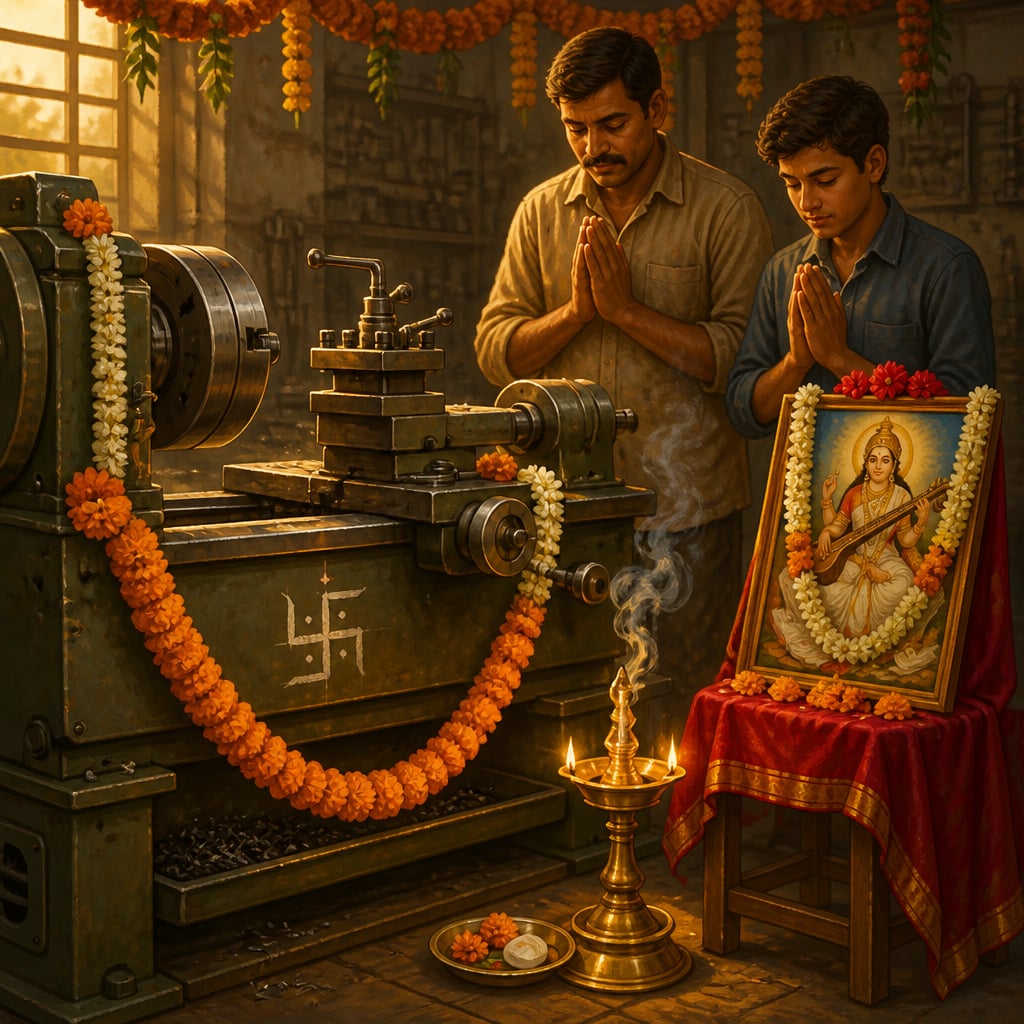
बेंगलुरु के पीन्या इंडस्ट्रियल एरिया में एक छोटी मशीन की दुकान, 12 अक्टूबर 2018 की सुबह। मालिक, चौवन साल का, सफेद कुर्ता पहने और माथे पर ताजा चंदन का तिलक लगाए, अपनी दुकान की कोई भी मशीन नहीं चलाई है। चारों खराद, मिलिंग मशीन, ग्राइंडर, और छोटी प्रेस सब चुप हैं। फर्श झाड़ू लगाई गई है। पिछले महीने की धातु की बुरादा साफ कर दिया गया है। हर मशीन को पोंछा गया है और गेंदों की माला पहनाई गई है। हर खराद के आगे केले के पत्ते रखे हैं, और उन पर नारियल, पान का पत्ता, और दूध का एक छोटा सा कटोरा रखा है।
दुकान के कोने में, लाल कपड़े से सजे एक लकड़ी की चौकी पर, सरस्वती की एक छोटी मूर्ति बैठी है। वह वीणा पकड़े हुए हैं और अपना दाहिना हाथ ताड़-पत्र की किताबों के ढेर पर रखे हुए हैं। उनके पास विश्वकर्मा की एक छोटी मूर्ति है, जो दिव्य शिल्पी हैं। मालिक का सबसे छोटा बेटा, सोलह साल का, नए कपड़े पहने, सबसे बड़ी खराद के आगे नारियल तोड़ रहा है। यह वही खराद है जो उसके पिता ने बाईस साल पहले खरीदी थी। नारियल साफ तरीके से टूट जाती है। लड़के की बड़ी बहन, दुकान की हिसाब-किताब देखने वाली, खराद की मुख्य धुरी के चारों तरफ लाल पवित्र धागा बांधती है और अपने पिता की कलाई के चारों तरफ भी।
यह दिन विजयदशमी है, शरद नवरात्रि के शुरुआत के दसवें दिन। पूरे देश में उसी सुबह, करोड़ों लोग यही काम अलग-अलग स्तरों पर कर रहे हैं। केरल में एक स्कूल की शिक्षिका अपनी चाक और रजिस्टर सरस्वती की मूर्ति के पास रख रही है और आज पढ़ाना नहीं चाहती। पंजाब में एक ट्रक ड्राइवर अपनी ताटा 1612 के स्टेयरिंग व्हील को माला पहना रहा है। हैदराबाद में एक डॉक्टर अपनी स्टेथोस्कोप को घर के मंदिर में देवी की मूर्ति के सामने छू रही है। पुणे में एक सॉफ्टवेयर इंजीनियर कोड नहीं दे पाता है; वह git status चलाता है, मुस्कुराता है, और लैपटॉप बंद कर देता है। कोई भी इसे कोई क्षेत्रीय रीति-रिवाज नहीं मान रहा है। वे सब एक ही पूजा कर रहे हैं जो मार्कण्डेय पुराण ने करीब 600 ईसवी में दर्ज की थी, आयुध पूजा - अपने काम के उपकरणों की पूजा।
आयुध पूजा वास्तव में क्या है
आयुध पूजा अपने काम के उपकरणों, साधनों, हथियारों, और मशीनों की पूजा का संस्कृत नाम है। शब्द दो भागों में बंटा है: आयुध (हथियार, उपकरण, साधन) और पूजा (औपचारिक पूजन)। यह पूजा साल में एक बार विजयदशमी को की जाती है, जो शरद नवरात्रि का दसवां दिन है, और सितंबर या अक्टूबर के आखिरी हफ्ते में पड़ता है। नियम बिल्कुल साफ हैं: उपकरण को साफ करो, उसे माला पहनाओ, चंदन और कुमकुम से निशान लगाओ, उसके आगे नारियल और पान का पत्ता रखो, उस दिन उसे मत छुओ, और उसे देवता की तरह आराम दो।
उपकरण को उस दिन इस्तेमाल न करने का नियम पूरी पूजा का दिल है। मकैनिक स्पैनर नहीं छूता। शिक्षक चाक नहीं पकड़ता। व्यापारी बहीखाता नहीं खोलता। ड्राइवर इंजन नहीं चलाता। संगीतकार तार नहीं झनकाता। गणितज्ञ सूत्र नहीं लिखता। साल में एक दिन, पूरे चौबीस घंटे के लिए, भारत की पूरी अर्थव्यवस्था रुक जाती है। सब लोग मानते हैं कि उपकरण ही काम को संभव बनाता है। अगली सुबह, विजयदशमी या उत्तर में दशहरा कहलाने वाले दिन, उपकरण को नई माला से छुआ जाता है, काम फिर शुरू हो जाता है, और साल की मेहनत का सीजन शुरू हो जाता है।
यह पूजा किसी भी सभ्यता में सबसे बराबरी वाली परंपरा है। ब्राह्मण विद्वान अपनी ताड़-पत्र की किताबें सरस्वती के सामने रखता है। क्षत्रिय योद्धा अपनी तलवार को माला पहनाता है। वैश्य व्यापारी अपनी बहीखाता को माला पहनाता है। शूद्र कारीगर अपने हथौड़े, करघे, कुम्हार के पहिये, जूते बनाने के औजार को माला पहनाता है। एक ही पूजा, एक ही दिन, एक ही विचार। उपकरण की गरिमा उसे इस्तेमाल करने वाले व्यक्ति की गरिमा है। हिंदू परंपरा इस पूजा के माध्यम से एक बड़ी बात कह रही है: हर काम सम्मानजनक है क्योंकि हर काम के अपने उपकरण होते हैं, और हर उपकरण इसी दिन, एक देवता है।
ग्रंथ दोनों जीत का नाम लेते हैं
मार्कण्डेय पुराण, विशेष रूप से देवी महात्म्य के अध्याय, और वाल्मीकि रामायण मिलकर विजयदशमी की दोहरी कहानी देते हैं। मार्कण्डेय पुराण, जो करीब 600 ईसवी में लिखा गया था, कहता है कि इसी दिन देवी दुर्गा ने महिषासुर को मारा था, नौ रातों की लड़ाई के बाद। उसी पुराण और परंपरा में यह भी कहा जाता है कि इसी दिन राम ने लंका में रावण को मारा था, दस दिनों की घेराबंदी के बाद। ये दोनों जीतें अलग नहीं हैं। वे एक ही जीत को दो तरीकों से बताते हैं। दोनों में ज्ञान अहंकार को हराता है, धर्म अधर्म को हराता है, सम्मान से इस्तेमाल किया गया उपकरण अहंकार से इस्तेमाल किए गए उपकरण को हराता है।

या देवी सर्वभूतेषु शक्तिरूपेण संस्थिता। नमस्तस्यै नमस्तस्यै नमस्तस्यै नमो नमः॥
जो देवी सब जीवों में शक्ति के रूप में बैठी है। उन्हें नमस्कार। उन्हें नमस्कार। उन्हें बार-बार नमस्कार।
देवी महात्म्य 5.16 (या देवी भजन)
यह श्लोक हर आयुध पूजा में घरों, स्कूलों, और दुकानों में सारे देश में गाया जाता है। जो देवी सब जीवों में शक्ति के रूप में बैठी है, वह उस उपकरण में भी बैठी है जो काम करने देती है। खराद शक्ति है। चाक शक्ति है। स्पैनर शक्ति है। त्योहार का दावा आध्यात्मिक है: देवी शक्ति हर उत्पादनशील काम का सिद्धांत है, और उपकरण उसका स्थानीय रूप है।
सरस्वती और किताबें
इस दिन की दूसरी देवी सरस्वती हैं, ज्ञान, भाषा, संगीत, और कलाओं की देवी। आयुध पूजा का सरस्वती रूप, जिसे कई जगहों पर सरस्वती पूजा और दक्षिण में सरस्वती आवाहन कहते हैं, अलग-अलग परंपराओं में अलग-अलग समय पर होता है। दक्षिण में यह विजयदशमी के समय होता है, और उत्तर और बंगाल में वसंत पंचमी (जनवरी या फरवरी के आखिरी हफ्ते) को होता है। इस दिन, घर की किताबें, संगीत के वाद्य, लिखने की चीजें, और पढ़ाई के सामान सरस्वती के पैरों में रख दिए जाते हैं। उस दिन घर में कोई भी पढ़ता नहीं है। अगली सुबह, किताबों को माथे से छुआ जाता है, और साल की पढ़ाई शुरू की जाती है।
इस पूजा का एक खास नियम है: सरस्वती के पैरों में रखी गई कोई भी किताब या वाद्य, परंपरा के अनुसार, अगली सुबह किसी भी पन्ने पर खोली जाती है, और उस पन्ने की पहली पंक्ति या संगीत को ऊंची आवाज में पढ़ा जाता है। इसे साल का अरे (भविष्य संकेत) माना जाता है। यह पूजा पढ़ाई को फिर से शुरू करना एक सम्मान का काम मानती है। विद्यार्थी किताब को मरी हुई चीज की तरह नहीं, बल्कि एक प्रिय मित्र की तरह लेता है जिसका सम्मान किया गया है।
शरीर क्यों जवाब देता है
यह परंपरा न सिर्फ उपकरण पर, बल्कि व्यक्ति पर भी असर डालती है। मिहाली चिक्सेन्त्मिहाली, क्लेरेमॉन्ट ग्रेजुएट यूनिवर्सिटी में, अपनी 1990 की किताब 'फ्लो: द साइकोलॉजी ऑफ ऑप्टिमल एक्सपीरिएंस' में फ्लो के बारे में बताते हैं। फ्लो वह है जब आप किसी काम में इतना खो जाते हो कि दुनिया भूल जाते हो। फ्लो के लिए जरूरी चीजें हैं: साफ लक्ष्य, तुरंत फीडबैक, चुनौती और कौशल का संतुलन, और एक बहुत महत्वपूर्ण बात: जो कारीगर अपने उपकरणों से प्यार करते हैं, वे फ्लो की स्थिति में बहुत ज्यादा समय रहते हैं, और उन्हें काम से ज्यादा संतुष्टि मिलती है।
मार्टिन सेलिगमन, पेनसिलवेनिया यूनिवर्सिटी में, अपनी 2011 की किताब 'फ्लोरिश' में कहते हैं कि प्रत्येक व्यक्ति में 24 ताकतें होती हैं। इन ताकतों में से 'सुंदरता और बेहतरी की कद्र करना' सबसे महत्वपूर्ण है। यह ताकत जीवन की लंबी खुशी का सबसे बड़ा कारण है। पैसा, स्थिति, या परिवार से भी ज्यादा। जो लोग अपने काम और उपकरणों की कद्र करते हैं, वे बहुत ज्यादा खुश रहते हैं।
ये दोनों बातें मिलकर एक पूरी तस्वीर बनाती हैं। आयुध पूजा साल में एक बार हर व्यक्ति को अपने उपकरणों का सम्मान करने के लिए कहती है। इस पूजा में साफ करना, माला पहनाना, निशान लगाना, और आराम देना होता है। यह विजयदशमी को होता है। और इसका मतलब है: उपकरण शक्ति है। चिक्सेन्त्मिहाली की फ्लो और सेलिगमन की कद्र की बात दोनों ही इसी आयुध पूजा में छिपी हुई हैं। आयुध पूजा हर घर, हर स्कूल, हर दुकान, हर मंदिर में एक ही दिन करते हैं।
दुनिया इसे क्या कहती है
आधुनिक दुनिया को यह विचार फिर से मिला है: उपकरणों का सम्मान करो। लेकिन इसे नए नाम दे दिए हैं, और पुराने नाम को भूल गई है।

एमआईटी मीडिया लैब में, नील गेर्शेनफेल्ड ने 2005 से 'मेकर मूवमेंट' (निर्माता आंदोलन) शुरू किया। इसमें नई मशीनों (लेजर कटर, 3डी प्रिंटर) को पहली बार चलाने से पहले कुछ समारोह किए जाते हैं। कुछ लोग मशीन को हल्का फूंक मारते हैं। कुछ चाक से निशान बनाते हैं। लेकिन कोई भी मार्कण्डेय पुराण या आयुध पूजा का नाम नहीं लेता, जो 1500 साल पहले से यही काम कर रहा है।
जापान में, कारखानों में 'जिजो समारोह' होता है। यह भी उपकरणों को आशीर्वाद देता है और सुरक्षित काम के लिए प्रार्थना करता है। यह बौद्ध परंपरा है, और शायद यह भी आयुध पूजा से जुड़ी है, लेकिन यह नाम कोई नहीं देता।
बड़ी कंपनियां जब नई मशीन, जहाज, या हवाई जहाज चलाते हैं, तो शैंपेन की बोतल तोड़ते हैं। यह भी एक समारोह है, लेकिन असली बात खो गई है।
कोई भी मार्कण्डेय पुराण, देवी महात्म्य, या आयुध पूजा का नाम नहीं लेता। बस विचार बचा है, इतिहास भूल गया है।
अपने लिए इसे क्या कहें
नाम देना बहुत सरल है। जब एमआईटी इसे 'पहली बार बनाने का दिन' कहे, तो आप कहो 'आयुध पूजा'। जब कोई निर्माता आंदोलन की किताब इसे 'उपकरणों का सम्मान' कहे, तो आप कहो 'मार्कण्डेय पुराण, देवी महात्म्य 5.16, 600 ईसवी'। जब कोई कंपनी इसे 'समारोह' कहे, तो आप कहो 'विश्वकर्मा पूजा' या 'आयुध पूजा'। जब कोई दोस्त कहे कि वह शुक्रवार को अपनी मेज को साफ करके अच्छा महसूस करता है, तो आप कहो कि यही आयुध पूजा है, पूरी दुनिया में, एक दिन, एक ही समय।
यह पूजा हर घर में, हर स्कूल में, हर दुकान में कर सकते हो। अगले विजयदशमी की सुबह (तारीख हर साल बदलती है), काम मत करो। अपने सबसे जरूरी उपकरण को साफ करो: लैपटॉप, रसोई का चाकू, मेज, करघा, खराद, किताब, स्टेथोस्कोप, स्टेयरिंग व्हील। कोई भी फूल से इसे माला पहना दो, एक फूल भी चल जाएगा। एक फल, एक नट, एक मिठाई इसके आगे रख दो। उस दिन इसे मत छुओ। अगली सुबह, इसे माथे से छूओ, और काम शुरू कर दो। यह सिर्फ एक दिन का काम का नुकसान है और कुछ फूल की कीमत है। लेकिन देवी महात्म्य कहती है कि असली फायदा यह है कि तुम समझ गए कि जो शक्ति हर जीव में है, वही तुम्हारे उपकरणों में भी है।
आधुनिक गूंज और दूसरी तरफ की कहानी
यह सब सच है। चिक्सेन्त्मिहाली 1990 ने फ्लो बताया। सेलिगमन 2011 ने कद्र की बात बताई। मार्कण्डेय पुराण ने 600 ईसवी में विजयदशमी बताई। देवी महात्म्य ने कहा कि देवी सब जीवों में है, उपकरणों में भी। सरस्वती और विश्वकर्मा 1500 सालों से भारत में काम की देवी और देवता हैं।
बाजार को यह विचार समझ में आ गया है। एमआईटी में पहली बार बनाने का समारोह होता है। जापान में हर साल जिजो समारोह होता है। बड़ी कंपनियां जहाज, हवाई जहाज, कारखाने, और सर्वर चलाते हैं। लेकिन कोई भी हिंदू परंपरा का नाम नहीं लेता।
आयुध पूजा हर साल, एक ही सुबह, करीब 200 करोड़ घरों, दुकानों, स्कूलों में होती है। मार्कण्डेय पुराण, देवी महात्म्य, 1990 की फ्लो किताब, और 2011 की कद्र की किताब सब इसे सहारा देते हैं।
बेंगलुरु की दुकान में खराद चुप है। इसके ऊपर ताजा गेंदें हैं। मालिक ने नारियल को माथे से छुआ है और अपने बच्चों के साथ फर्श पर बैठा है। वह दूध पी रहा है, जो हर मशीन के आगे रखा था। कल सुबह छः बजे, वह खराद को हाथ लगाएगा, धुरी घूमेगी, और साल की धातु काटने लगेगी। चिक्सेन्त्मिहाली यहां नहीं पढ़ी गई। सेलिगमन यहां नहीं पढ़ी गई। लेकिन देवी महात्म्य 5.16 लड़के और लड़की ने एक साथ पढ़ी है। फ्लो खुद आ जाएगी, कल सुबह, समय पर।
Case studies
मार्कण्डेय पुराण और दोहरी विजयदशमी: एक दिन, दो जीतें
600 ईसवी के आसपास, मार्कण्डेय पुराण ने विजयदशमी को दो जीतों का दिन कहा: देवी दुर्गा ने महिषासुर को मारा, और राम ने रावण को मारा। ये दोनों अलग कहानियां नहीं हैं - एक ही कहानी दो तरीकों से बताई गई है। दोनों में ज्ञान अहंकार को हराता है, धर्म अधर्म को हराता है। देवी महात्म्य कहता है कि देवी सब जीवों में शक्ति के रूप में हैं, और इसलिए उपकरण में भी हैं। मार्कण्डेय पुराण की इस दोहरी कहानी ने विजयदशमी को हिंदू कैलेंडर का सबसे अर्थपूर्ण दिन बना दिया, और आयुध पूजा को सबसे व्यावहारिक त्योहार बना दिया।
The Hindu tradition does not treat the two narratives as competing origin myths. It treats them as the same teaching from two angles. The Devi Mahatmya's Mahishasura-mardini story emphasises the destruction of ego (the buffalo-demon's arrogance and his demand to be worshipped) by knowledge in its feminine form. The Ramayana's Ravana-vadha emphasises the destruction of ego (the rakshasa-king's abduction of Sita and his refusal to return her) by dharma in its masculine kingly form. The Ayudha Puja takes both teachings into the household and the workshop: the tool, when honoured properly and used with reverence, is dharma; the same tool, when used arrogantly and without ritual recognition, is the seed of Mahishasura and Ravana's failure. The festival's claim is structural: every craft is the daily replay of the same victory the Purana narrates.
The Markandeya Purana's codification has held for fifteen hundred years. Vijayadashami is observed at full national scale across India today, with both narratives invoked simultaneously: the Mahishasura effigies are built and burnt in some regions, the Ravana effigies are built and burnt in others, and the Ayudha Puja runs in households, workshops, schools, and offices everywhere on the same morning. The Vijayanagara empire elevated the festival to state-ceremony scale at Hampi in the fifteenth and sixteenth centuries, and the Mahanavami-dibba platform at Hampi remains the most documented historical venue for an empire-scale Ayudha Puja review. The festival's institutional continuity from 600 CE to 2026 is the longest unbroken record of any tool-honouring ritual in any civilisation.
The Hindu tradition's choice to give Vijayadashami two simultaneous narrative justifications is not a contradiction. It is a teaching about the universality of the underlying victory. The same dharma that the goddess wields against Mahishasura is the dharma the king wields against Ravana, the dharma the schoolteacher wields with her chalk, the dharma the surgeon wields with her scalpel, and the dharma the engineer wields with her lathe. The Ayudha Puja institutionalises the recognition that all these are the same victory, on the same day, in the same household, every year. The maker movement's first-make ceremonies are reinventing this recognition without the institutional scale or the dual scriptural anchor that the Markandeya Purana built fifteen hundred years ago.
Markandeya Purana, c. 600 CE: codifies Vijayadashami as the day of the dual victory of Durga over Mahishasura and Rama over Ravana, the most narrative-rich day in the Hindu calendar. The Vijayanagara empire (14th-16th c CE) elevates the Ayudha Puja to state-ceremony scale at the Mahanavami-dibba platform at Hampi, documented by foreign visitors including Domingo Paes and Abdur Razzaq.
एमआईटी मीडिया लैब का पहली बार बनाने का दिन और जापान का जिजो समारोह: एक विचार दोबारा खोजा जाता है
Since 2005, Neil Gershenfeld's Center for Bits and Atoms at the MIT Media Lab has anchored the global maker movement and the international fab-lab network. Within the maker-movement literature and the fab-lab community, structured 'first make' ceremonies have emerged spontaneously across labs worldwide: some labs blow on the new laser cutter or 3D printer before its first run; others have the lab director draw a small chalk symbol on the new machine; the MIT Media Lab itself has held small ceremonial first-cut events for major new equipment. In parallel, Japanese factories and craft workshops conduct annual Jizo ceremonies, blessing tools and instruments and offering small prayers for safe operation in the year ahead. The Jizo tradition is a Buddhist transmission with roots that almost certainly trace back, through the Indo-Tibetan Buddhist corridor, to the same dharmic source as Ayudha Puja. Neither the maker-movement literature nor the Japanese ritual literature names the Markandeya Purana or the Ayudha Puja's fifteen-hundred-year institutional precedent. The corporate-launch tradition of breaking a champagne bottle on a ship's hull, and the various commissioning ceremonies for new factories, planes, and server installations, run on the same impulse with the underlying dharma deleted.
The dharmic frame did not separate the impulse to honour tools from the lineage that supports it. The Ayudha Puja works because the Markandeya Purana named the dual victory, the Devi Mahatmya placed the goddess as the form of power in all beings (including the tool), the Vishwakarma tradition gave the workshop its specific patron deity, and a hundred generations of craftspeople kept the practice in continuous operation across every region and every craft. To extract the impulse (honour the tools), monetise it as a maker-movement protocol, and name it 'first make day' is permitted, but the lineage is what gave the impulse its civilisational scale. The maker movement's two decades of first-make ceremonies cover roughly ten thousand fab-labs worldwide. The Hindu Ayudha Puja covers roughly two hundred million households on a single day every year.
The maker movement, the Japanese Jizo tradition, and the corporate-launch ceremony continue. The structures are now standard inventory in fabrication-lab culture, Japanese industrial practice, and global corporate ritual. The underlying lineage is invisible to almost all of the participants. The asymmetry is one of the clearest illustrations in the modern industrial economy of how a deeply useful disposition can be reinvented multiple times in different cultures, each time without naming the institutional civilisational ritual that already encoded it at scale.
The right response to the asymmetry is not to dismiss the maker movement or the Jizo tradition. Both do real work. The maker-movement first-make ceremony genuinely changes how the lab treats the new machine. The Jizo ceremony genuinely strengthens the bond between the worker and her instrument. The right response is articulation. Run a first-make ceremony at your lab if you want the Western iconography. Observe Vijayadashami at your home, your workshop, or your office if you want the protocol. The first-make ceremony is improvised; the Ayudha Puja has fifteen hundred years of institutional refinement, the Markandeya Purana, the Devi Mahatmya, and the 1990 Flow research and 2011 VIA framework all in the supporting literature.
Neil Gershenfeld's Center for Bits and Atoms at MIT Media Lab: founded 2005, anchors the global maker movement and the fab-lab network of approximately 2,000+ labs worldwide. Japanese Jizo ceremonies: annual tool-blessing tradition at factories and craft workshops, Buddhist transmission with roots in the Indo-Tibetan corridor. Hindu Ayudha Puja: continuously observed since at least 600 CE, runs in roughly 200 million households on a single morning every year.
चिक्सेन्त्मिहाली 1990 और सेलिगमन 2011: दो किताबें जो खराद की माला को सिद्ध करती हैं
In 1990, Mihaly Csikszentmihalyi published Flow: The Psychology of Optimal Experience, establishing the foundational findings of modern flow research. The book documented the ten or so conditions that produce flow, including clear goals, immediate feedback, balance between challenge and skill, and a deep relationship with the tools of one's craft. Csikszentmihalyi's chapters on autotelic personalities documented that craftspeople who report a deep relationship with their tools report significantly higher rates of flow, longer durations of flow, and greater post-flow satisfaction. In 2011, Martin Seligman published Flourish, articulating the VIA Character Strengths framework developed with Christopher Peterson. The framework's strength of appreciation of beauty and excellence is one of the strongest single predictors of long-term life satisfaction across the populations studied, exceeding the predictive value of wealth, status, or family structure. Neither book cites the Markandeya Purana, the Devi Mahatmya, the Vishwakarma Sukta of the Rig Veda, or any element of the Ayudha Puja corpus.
The Hindu Ayudha Puja prescribes annual reverence for the tools of one's craft, with a specific procedural sequence (clean, garland, mark, rest), a specific timing (Vijayadashami), and a specific theological frame (the tool is shakti, the goddess in the form of power). Csikszentmihalyi 1990 documents the productivity-and-satisfaction effect of the underlying disposition. Seligman 2011 documents the long-term well-being effect of the appreciation-of-excellence character strength. The dharmic frame names the combined effect as the merit of the daily reverence and the festival merit of Vijayadashami. The modern frame names it as flow and the VIA transcendence cluster. The grandmother who garlands her loom and the mechanic who garlands his lathe are running both interventions in the same morning, three times a year on average across Vijayadashami, Saraswati Puja, and Vishwakarma Jayanti.
Csikszentmihalyi 1990 has become the foundational citation in the modern flow literature and is referenced across organisational psychology, education research, sports science, and management theory. Seligman 2011 and the VIA framework are the empirical foundation for the modern positive-psychology field, with the framework now used in clinical, educational, and corporate contexts worldwide. Neither line of research has incorporated the Hindu Ayudha Puja corpus into its citation network. The maker movement, the Jizo tradition, and the corporate launch ceremony that built on the same disposition cite neither the dharmic source nor the modern empirical research with the Hindu source named alongside.
When the labs vindicate a household ritual, the right response is not surprise. It is recognition. The Bangalore workshop owner did not need Csikszentmihalyi 1990 or Seligman 2011 to know that garlanding the lathe on Vijayadashami morning produced something measurable in the year's work. He had the Markandeya Purana, the Devi Mahatmya 5.16, and his father and grandfather's example. The journals and the books catching up are welcome, and they make the case to a generation that trusts the citation more than it trusts the grandfather's example. The Ayudha Puja is, in this frame, the most-practised and best-vindicated tool-honouring ritual in the literature.
Csikszentmihalyi, Flow (1990): foundational text of modern flow research, documenting that craftspeople with deep tool-relationships report higher flow rates and durations. Seligman, Flourish (2011) and the VIA Character Strengths framework: appreciation of beauty and excellence is one of the strongest single predictors of long-term life satisfaction across populations studied. Markandeya Purana, c. 600 CE: codifies Vijayadashami and the Ayudha Puja as institutionalised reverence for the tools of every craft.
Historical context
From the Rig Vedic Vishwakarma Sukta (c. 1500 BCE) and the Markandeya Purana's codification of the dual Vijayadashami narrative (c. 600 CE), through the Vijayanagara empire's elevation of the festival to state-ceremony scale (15th-16th centuries CE), to the 1990 publication of Csikszentmihalyi's Flow, the 2005 founding of Neil Gershenfeld's Center for Bits and Atoms at the MIT Media Lab, and the 2011 publication of Seligman's Flourish.
The Ayudha Puja is one of the most institutionally continuous festivals in any civilisation, running unbroken from at least the Vijayanagara period (and almost certainly earlier) at full national scale to the present. The continuity across class context (the schoolteacher, the soldier, the merchant, the craftsman, the modern software engineer all observe the same day with the same procedural sequence), across region (Vijayadashami in the South, Dussehra in the North, Saraswati Puja in Bengal, Ayudha Puja in Tamil Nadu and Karnataka), across the diaspora (Indian-origin engineers in Silicon Valley, Indian-origin doctors in Toronto, Indian-origin teachers in London all observe the day), and across the modernisation of the tools themselves (the lathe replaced the loom; the laptop replaced the manuscript; the puja remained) is the proof that the protocol survives because the disposition it institutionalises is foundational. The tool deserves reverence; the worker who reverses her tool produces better work; the well-being of the household that observes the disposition is measurable.
Living traditions
The maker movement at the MIT Media Lab and the global fab-lab network has spent two decades developing first-make ceremonies for new fabrication tools, with no citation to the Ayudha Puja's fifteen-hundred-year institutional precedent. The Japanese Jizo tradition blesses tools and instruments annually at factories and workshops, with no acknowledgement of the dharmic source from which the impulse almost certainly travelled through the Indo-Tibetan Buddhist corridor. The corporate-launch tradition (champagne on a ship's hull, ribbon-cutting at a new factory, ceremonial first cut at a server installation) runs the same impulse globally with the underlying dharma deleted. Csikszentmihalyi's 1990 Flow and Seligman's 2011 Flourish vindicate the underlying mechanism without citing the Hindu corpus. Re-Sanskritize: when the MIT Media Lab calls it 'first make day', you say Ayudha Puja. When the maker-movement essay calls it 'honouring the tools of fabrication', you point at the Markandeya Purana, the Devi Mahatmya 5.16, and the year 600 CE. When the corporate launch press release calls it 'commissioning ceremony', you say Vishwakarma Puja or Ayudha Puja depending on the trade. On the next Vijayadashami morning, do not work. Clean the tools you use most: the laptop, the kitchen knife, the desk, the loom, the lathe, the textbook, the stethoscope, the steering wheel. Garland them with any flower available. Place a small token in front of each. Do not touch the tools for the day. On the next morning, touch each tool to the forehead, and resume the year's work. The cost is one day of foregone work and a few flowers. The merit, in the Devi Mahatmya's language, is the recognition that the shakti who dwells in all beings as the form of power dwells in your tools too.
- महानवमी-दिब्बा मंच, हम्पी: हम्पी का बड़ा पत्थर का मंच, जहां विजयनगर के राजा 15वीं-16वीं सदी में महानवमी और विजयदशमी के समय अपनी सेना और उपकरणों की परेड देखते थे। मंच 12 मीटर ऊंचा है और घोड़ों, हाथियों, विदेशियों, और कारीगरों की नक्काशी से सजा है। पुर्तगाली लेखक और फारसी राजदूत ने यहां राजकीय आयुध पूजा देखी और लिखा है। यह दुनिया में राजकीय आयुध पूजा का सबसे पुराना और प्रमाणित स्थान है।
- मैसूर पैलेस और मैसूर दशरा जुलूस का रास्ता: मैसूर पैलेस (अंबा विलास पैलेस) यहां दशरा जुलूस होता है - भारत में विजयदशमी का सबसे पुराना और सबसे बड़ा समारोह। वोडेयार राजवंश का दशरा विजयनगर से आता है। सुबह सरस्वती और आयुध पूजा, दोपहर को राजकीय हाथी के साथ जुलूस, शाम को मशाल की परेड। महल रात भर 97,000 बल्बों से जगमगाता है।
- सरस्वती मंदिर, बसर: भारत में सरस्वती के नाम पर सिर्फ तीन मंदिर हैं - बसर, पुष्कर, कश्मीर। यह सबसे प्रसिद्ध है। हजारों बच्चों को यहां पहली बार सीखने के लिए लाया जाता है विजयदशमी और वसंत पंचमी को। गोदावरी नदी के किनारे है। कहा जाता है कि महर्षि व्यास ने यहां महाभारत लिखी थी।
Reflection
- Of the tools you use most in your daily work (laptop, phone, kitchen knife, vehicle, primary instrument of your craft), which is the one you most take for granted, and what would change in your relationship to it if, on the next Vijayadashami morning, you cleaned it, garlanded it, and refused to use it for twenty-four hours?
- Why might the Markandeya Purana have given Vijayadashami two simultaneous narrative justifications (Durga's destruction of Mahishasura and Rama's destruction of Ravana on the same day) rather than one? What is the Purana saying about the underlying victory by giving it two faces?
- If Csikszentmihalyi 1990 and Seligman 2011 independently confirmed the productivity-and-well-being effects of the disposition the Ayudha Puja institutionalises, why has the modern academic literature on flow, positive psychology, and craftsperson identity not yet incorporated the Markandeya Purana, the Devi Mahatmya, or the Vishwakarma Sukta into its citation network? What would have to change, in academic norms or in the framing of the source material, for the older citations to enter the literature?