गुरु शिक्षक नहीं है

गुरु-शिष्य का रिश्ता, तक्षशिला गुरुकुल, दक्षिणा का अनुबंध, और क्यों एक-से-एक सीखना कक्षा से पुराना है

अंग्रेजी शब्द 'teacher' एक ऐसे व्यक्ति को नाम देता है जिसे पाठ्यक्रम देने के लिए भुगतान किया जाता है। संस्कृत शब्द 'guru' का अर्थ बिल्कुल अलग है। गुरु वह व्यक्ति है जो परंपरा को संभालता है, जिसे उसके अपने गुरु ने प्रेषित किया है, जो परंपरा को ले जाता है, और जिसे शिष्य सीखने के अंत में न कि पाठ्यक्रम शुल्क बल्कि दक्षिणा अर्पित करता है। तक्षशिला ने गुरु-शिष्य मॉडल और दक्षिणा अनुबंध पर दुनिया का सबसे पुराना प्रलेखित विश्वविद्यालय चलाया - एक हजार वर्षों तक, उस समय से बहुत पहले जब ट्यूशन एक श्रेणी थी। पाणिनि, चंद्रगुप्त, चाणक्य और चिकित्सक जीवक सभी ने तक्षशिला की गुरु-शिष्य परंपरा में अध्ययन किया। आधुनिक कार्यकारी प्रशिक्षण उद्योग एक बीस अरब डॉलर का वैश्विक बाजार है जिसने इस संरचनात्मक रिश्ते को 'mentorship' और 'one-on-one coaching' के नामों से फिर से खोजा है, लेकिन मूल को कोई श्रेय नहीं देता। एरिकसन का दस हजार घंटे का शोध और कोलिन्स तथा ग्रीनो का संज्ञानात्मक शिष्यता मॉडल आधुनिक वैज्ञानिक पुष्टि है कि किसी माहिर के अधीन स्थित सीखना कक्षा निर्देश से तंत्रिकीय रूप से बेहतर है। वह दादी जो गुरु पूर्णिमा पर गुरु के पैर छूती है, वह इस अनुबंध को जानती है। पाठ समझ का विषय है।

पुणे में संगीत पाठ, जब लड़का आठ साल का हुआ
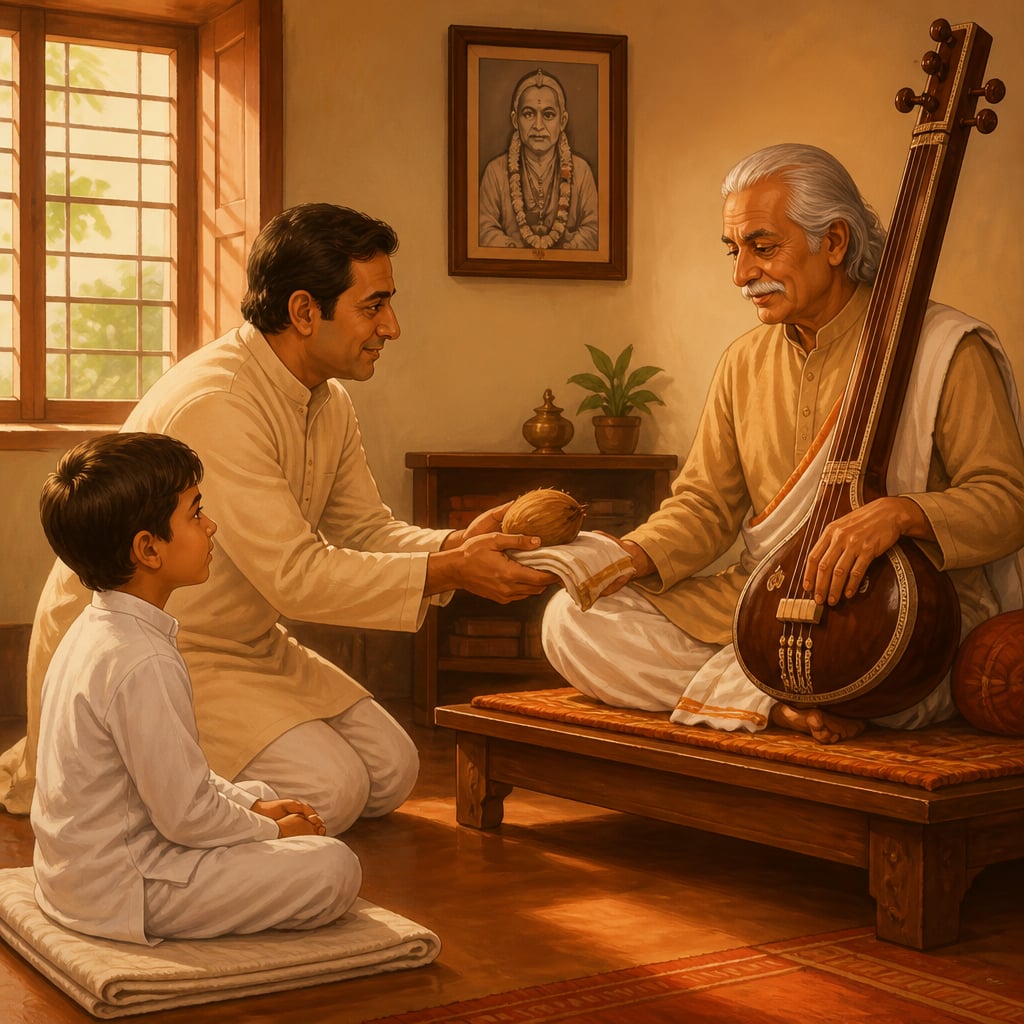
Boy with father at a music gurudev's house in Sadashiv Peth Pune

लड़का आठ साल का है और उसे गुरुदेव के घर में लाया गया है। पुणे के सदाशिव पेठ की एक छोटी गली में। लड़के के पिता के पास एक छोटी पीतल की प्लेट है जिस पर पांच चीजें हैं - नारियल, सुपारी का पैकेट, चावल का ढेर, केला, और एक मुड़ा हुआ एक रुपये का नोट। गुरुदेव साठ के दशक का एक पतला आदमी है। वह पद्मासन में बैठा है एक पतले सूती गद्दे पर। उसके पीछे तंबूरा है और पास में पीतल की पीकदान है। वह लंबे समय तक कुछ नहीं कहता। लड़के के पिता प्लेट को गुरुदेव के पैरों पर रखते हैं, अपनी हथेलियां जोड़ते हैं, और कहते हैं, "महाराज, मुलाला स्वीकार करा।" मास्टर, लड़के को स्वीकार करो।

गुरुदेव लड़के को लंबे समय तक देखते हैं। फिर मराठी में कहते हैं, "तु का आलस?" तुम क्यों आए हो। लड़का, जिसे केवल बताया गया था कि वह गुरुदेव से गीत सीखने आएगा, को पता नहीं कि क्या कहे। गुरुदेव इंतजार करते हैं। आखिरकार लड़का सच कहता है कि उसके पिता उसे लाए हैं। गुरुदेव सिर हिलाते हैं। वह कहते हैं, "ही तुझी प्रतम गुरु-भेट आहे। माझा शिष्य बनलास तर माझा घर ही तुझा घर आहे। माझा गुरु ही तुझा गुरु आहे। माझी परंपरा ही तुझी परंपरा आहे। तु एकुन शब्द आइक्ला का?" यह तुम्हारी पहली गुरु-भेट है। अगर तुम मेरे शिष्य बन गए, तो मेरा घर तुम्हारा घर है। मेरा गुरु तुम्हारा गुरु है। मेरी परंपरा तुम्हारी परंपरा है। क्या तुमने हर शब्द सुना।

लड़के ने नहीं सुना। लड़का केवल "परंपरा" शब्द को समझा। लड़का समझा कि संगीत पाठ से कुछ बड़ा दिया जा रहा है। गुरुदेव यह नहीं पूछ रहे कि क्या लड़का गीत सीखना चाहता है। वह पूछ रहे हैं कि क्या लड़का एक ऐसी परंपरा में प्रवेश करना चाहता है जो गुरुदेव के गुरु और गुरुदेव के गुरु के गुरु के माध्यम से सदियों पीछे चली जाती है। लड़का सिर हिलाता है। पिता को झुकता है। गुरुदेव प्लेट से एक चावल का दाना लेते हैं, इसे लड़के की जीभ पर रखते हैं, और कहते हैं, "माझा शिष्य। आता प्रतम राग शिखुया।" मेरा शिष्य। अब हम पहला राग सीखेंगे।

यह पाठ उसी दृश्य के बारे में है। धार्मिक परंपरा में "शिक्षक" नाम की कोई श्रेणी नहीं है। आधुनिक पश्चिमी अर्थ में नहीं, जहां शिक्षक एक व्यक्ति है जिसे अजनबियों के कमरे में पाठ्यक्रम देने के लिए भुगतान किया जाता है। धार्मिक परंपरा में गुरु है, जो बिल्कुल अलग है। गुरु वह व्यक्ति है जो परंपरा को संभालता है, ज्ञान की अटूट परंपरा। गुरु वह व्यक्ति है जिसे उसके अपने गुरु ने प्रेषित किया है। गुरु वह व्यक्ति है जिसे शिष्य अध्ययन के अंत में पाठ्यक्रम शुल्क नहीं बल्कि दक्षिणा अर्पित करता है। कोई अनुबंध नहीं, कोई फीस सूची नहीं, कोई इनवॉइस नहीं। गुरु-शिष्य संबंध मानव इतिहास में सबसे पुरानी लगातार प्रलेखित शैक्षिक संस्था है। आधुनिक दुनिया इसे सदी भर "mentorship", "coaching", "apprenticeship" नामों से फिर से खोज रही है। वह तक्षशिला गुरुकुल एक हजार साल तक दक्षिणा पर चलता था।

गुरु और शिष्य: जिस संबंध को अंग्रेजी शब्द नहीं ले सकते

अभ्यास। गुरु-शिष्य परंपरा (शिक्षक-शिष्य की परंपरा) धार्मिक सीखने की संस्थागत संरचना है। यह संबंध एक लेन-देन नहीं है, यह एक बंधन है। शिष्य एक कोर्स में नामांकन नहीं करता, वह गुरु द्वारा स्वीकृत होता है। गुरु एक पाठ्यक्रम नहीं पढ़ाता, वह एक परंपरा को प्रेषित करता है। संबंध एक सेमेस्टर के लिए नहीं, शिष्य के पूरे जीवन के लिए चलता है। आगे जाकर शिष्य खुद गुरु बनता है और वह भी अपने शिष्यों को यह ज्ञान प्रेषित करता है।

गुरु-शिष्य संबंध के मुख्य प्राचीन रूप हैं - गुरुकुल (आवासीय प्रारूप जहां शिष्य गुरु के घर में रहता है, आम तौर पर वेदिक अध्ययन के लिए बारह साल, कोई फीस नहीं पर शिष्य घर की सेवा करता है); आचार्य कुल (मंदिर-आधारित प्रारूप जहां आचार्य एक सांप्रदायिक दर्शन पढ़ाता है); घराना (संगीत, नृत्य में घर-आधारित प्रारूप, घराने का नाम विशिष्ट शैली को बताता है); और परंपरा (किसी भी गुरु-शिष्य संचरण के लिए व्यापक शब्द)।

गुरु-शिष्य प्रारूप में संरक्षित मुख्य अनुशासन हैं - वैदिक (चार वेद और उनके विज्ञान), दर्शन (छह दार्शनिक स्कूल), आगम (वैष्णव, शैव, शक्त परंपराएं), शास्त्र (आयुर्वेद, राजनीति, कानून), कला (संगीत, नृत्य, पेंटिंग), और मार्शल (कलारिपयट्टु, गटका)।

वैदिक अध्ययन के लिए संबंध की शुरुआत उपनयन से होती है, या गैर-वैदिक अनुशासन के लिए गुरु-भेट समारोह। शिष्य को औपचारिक रूप से स्वीकार किया जाता है। पीतल की प्लेट की चीजें (नारियल, सुपारी, चावल, केला, दक्षिणा) अर्पित की जाती हैं। चावल का एक दाना जीभ पर रखा जाता है। अनुशासन समाप्त होने के बाद, संबंध का समापन समावर्तन (स्नातकोत्तर) में होता है। शिष्य अंतिम दक्षिणा देता है और दुनिया में प्रवेश करता है।

दक्षिणा अनुबंध। दक्षिणा धार्मिक शिक्षा अर्थव्यवस्था का दिल है। यह गुरु-शिष्य संचरण को आधुनिक फीस-आधारित मॉडल से अलग करता है। दक्षिणा वह उपहार है जो शिष्य गुरु को अध्ययन के अंत में देता है। जितना शिष्य उपयुक्त समझे, उतना दे सकता है। यह स्वैच्छिक है, अनिवार्य नहीं। कोई अनुबंध नहीं, कोई फीस सूची नहीं, कोई इनवॉइस नहीं। तक्षशिला गुरुकुल एक हजार साल तक दक्षिणा पर चला और कोई ट्यूशन फीस नहीं लिया।

एकलव्य और द्रोण के उदाहरण। महाभारत की एकलव्य कहानी दक्षिणा प्रश्न का सीमांत उदाहरण है। एकलव्य, एक आदिवासी धनुर्धर, को द्रोण ने स्वीकार करने से इनकार कर दिया। एकलव्य ने द्रोण की मूर्ति बनाई और उसके अधीन अभ्यास किया। वह अर्जुन से भी बेहतर हो गया। जब द्रोण को पता चला, उन्होंने दक्षिणा मांगी - एकलव्य का दाहिना अंगूठा। एकलव्य ने बिना हिचकिचाहट दिया। कहानी अलग तरीकों से पढ़ी जाती है। मुख्य पाठ है कि द्रोण की मांग धर्मिक विफलता थी और एकलव्य की वफादारी धर्मिक विजय थी। कहानी यह सवाल उठाती है कि क्या शिष्य की वफादारी गुरु के दुरुपयोग से महत्वपूर्ण है।

द्रोण-अर्जुन संबंध सकारात्मक उदाहरण है। वह गुरु जो शिष्य की परीक्षा लेता है, उसके सामर्थ्य को पहचानता है, उसे सीमाओं के पार ले जाता है, और अंत में पूरी प्रशिक्षा के साथ रिहा करता है। यह गुरु-शिष्य चक्र का मॉडल है।

तक्षशिला: दुनिया का सबसे पुराना प्रलेखित विश्वविद्यालय

Acharya teaching shishyas under a banyan at ancient Taxila

तक्षशिला गुरुकुल (आधुनिक पाकिस्तान में, रावलपिंडी के पास) दुनिया की सबसे पुरानी प्रलेखित उच्च शिक्षा संस्था है। लगभग छठी शताब्दी ईसा पूर्व से पांचवीं शताब्दी तक चलती रही। तक्षशिला रिकॉर्ड असाधारण है। शिक्षकों के नाम, छात्रों के नाम, अनुशासन, रहने की अवधि, दक्षिणा के नियम - सब कुछ प्रलेखित है। जातक कथाओं में, बौद्ध विनय साहित्य में, ग्रीक रिकॉर्ड में (326 ईसा पूर्व में सिकंदर ने तक्षशिला का दौरा किया), और चीनी तीर्थयात्रियों की डायरियों में (फाक्सियान, चौथी-पांचवीं शताब्दी, और ह्यूएन त्सांग, सातवीं शताब्दी)।

तक्षशिला के स्नातक स्वयं एक इतिहास हैं। पाणिनि, महान संस्कृत व्याकरणकार, जिन्होंने अष्टाध्यायी लिखी (दुनिया का सबसे पुराना जीवित व्याकरण), तक्षशिला में पढ़ते थे। चाणक्य (कौटिल्य), मौर्य साम्राज्य के आर्किटेक्ट, अर्थशास्त्र के लेखक, तक्षशिला में शिक्षक और छात्र दोनों थे। चंद्रगुप्त मौर्य, मौर्य राजवंश के संस्थापक, तक्षशिला में चाणक्य के शिष्य थे। जीवक, बुद्ध के व्यक्तिगत चिकित्सक, आयुर्वेद की परंपरा के संस्थापक, तक्षशिला में सात साल की चिकित्सा प्रशिक्षण पूरी की।

तक्षशिला में अनुशासन थे - चार वेद, छह दर्शन, आयुर्वेद, संस्कृत व्याकरण, राजनीति, सैन्य विज्ञान, धनुष विज्ञान, कला, और विशेषज्ञ अनुशासन। रहने की अवधि सात साल (आयुर्वेद) से बारह साल (वेद) तक थी। वित्तपोषण पूरी तरह दक्षिणा-आधारित था। छात्र जो उनके परिवार दे सकते थे वह ले जाते थे, घर की सेवा करते थे, और अध्ययन के अंत में दक्षिणा देते थे। तक्षशिला इस मॉडल पर लगभग एक हजार साल चला।

गुरु के पीछे का ग्रंथ

मुख्य ग्रंथ। उपनिषद गुरु-शिष्य संबंध के मूल ग्रंथ हैं। मुंडक उपनिषद शौनक के अंगिरा के पास जाने से शुरू होता है - जैसे शिष्य गुरु के पास जाता है। कठ उपनिषद में नचिकेता और यम (मृत्यु देवता) के बीच संवाद है। छांदोग्य उपनिषद में श्वेतकेतु और उसके पिता उद्दालक के बीच संवाद है। भगवद गीता स्वयं एक गुरु-शिष्य संवाद है। कृष्ण गुरु हैं, अर्जुन शिष्य है।

मनुस्मृति के दूसरे अध्याय में वैदिक गुरुकुल में शिष्य के कर्तव्य हैं - सुबह की सेवा, लकड़ी इकट्ठा करना, खाना बनाना, घर की सहायता, और गुरु के निर्देशों पर ध्यान। आपस्तंब धर्म सूत्र और आश्वलायन गृह्य सूत्र उपनयन और गुरुकुल रहने का विवरण संरक्षित करते हैं।

गुरुर्ब्रह्मा गुरुर्विष्णुः गुरुर्देवो महेश्वरः।

गुरुः साक्षात् परब्रह्म तस्मै श्रीगुरवे नमः॥

यह श्लोक गुरु की ऊंचाई को एन्कोड करता है। गुरु को त्रिमूर्ति (निर्माण, संरक्षण, विघटन) और परब्रह्म (सर्वोच्च वास्तविकता) के साथ पहचाना जाता है। यह रूपक नहीं है। प्रेषण के समय, गुरु वह माध्यम है जिसके माध्यम से परब्रह्म शिष्य के लिए उपलब्ध हो जाता है।

शरीर क्यों प्रतिक्रिया करता है: आदत की संरचना

गुरु-शिष्य संबंध की आदत संरचना महारत और कौशल अर्जन के लिए असाधारण रूप से अच्छी तरह से इंजीनियर है। संकेत है - गुरु के घर की दहलीज, सुबह का पहला नमस्कार। दिनचर्या है - गुरु की निगरानी में अनुशासित दैनिक अभ्यास, तत्काल प्रतिक्रिया, पुनरावृत्ति। पुरस्कार है - प्रगति की अनुभूति, परंपरा के मानक के विरुद्ध, महारत तक पहुंचना, और आखिरकार शिष्य का गुरु बनना।

व्यवहार विज्ञान सटीक है। गुरु-शिष्य संबंध को आधुनिक संज्ञानात्मक विज्ञान संज्ञानात्मक शिष्यता कहता है। नौसिखिया माहिर से सीखता है - निरंतर प्रतिक्रिया के साथ स्थित अभ्यास के माध्यम से, सार कक्षा नहीं। एंडर्स एरिकसन के दशकों का शोध यह दिखाता है कि विशेषज्ञ कोच के अधीन जानबूझकर अभ्यास महारत का एकमात्र तरीका है। प्रसिद्ध "दस हजार घंटे" निष्कर्ष (एरिकसन के शब्दों में) दस हजार घंटे की विशेषज्ञ मार्गदर्शन के साथ जानबूझकर अभ्यास है, केवल दस हजार घंटे की गतिविधि नहीं। बिना गाइड के, अभ्यास महारत नहीं देता।

कोलिन्स, ब्राउन, और न्यूमैन ने चार संरचनात्मक विशेषताओं की पहचान की - मॉडलिंग (माहिर कौशल दिखाता है), स्कैफोल्डिंग (चरणबद्ध समर्थन), आर्टिकुलेशन (तर्क को स्पष्ट करना), फेडिंग (जिम्मेदारी स्थानांतरण)। ये तक्षशिला गुरुकुल की गुरु-शिष्य संरचना से बिल्कुल मेल खाते हैं।

शोध ने क्या खोजा

एरिकसन, क्रैम्पे, टेश-रॉमर (1993): विशेषज्ञ महारत के लिए विशेषज्ञ कोच के अधीन जानबूझकर अभ्यास जरूरी है।

कोलिन्स, ब्राउन, न्यूमैन (1989): संज्ञानात्मक शिष्यता के चार-विशेषता मॉडल ने दिखाया कि किसी माहिर के अधीन सीखना कक्षा निर्देश से बेहतर है।

डैनियल कॉयल (2009), द टैलेंट कोड: एरिकसन अनुसंधान को न्यूरोसाइंस के साथ मिलाया। विशेषज्ञ मार्गदर्शन के अधीन अभ्यास तंत्रिकीय परिवर्तन लाता है जो कक्षा नहीं लाती।

रॉबर्ट बजॉर्क (यूसीएलए): वांछनीय कठिनाइयों पर शोध। सीखना सबसे स्थायी होता है जब शिक्षार्थी को चरणबद्ध चुनौती के अधीन ज्ञान पुनः प्राप्त करना पड़ता है।

ये सभी पत्र वही पुष्टि करते हैं जो तक्षशिला गुरुकुल एक हजार साल तक करता था। महारत के लिए एक माहिर के अधीन अभ्यास, निरंतर प्रतिक्रिया, चरणबद्ध चुनौती, स्पष्ट तर्क, और अंतिम रिहाई जरूरी है।

दुनिया अब इसे क्या कहती है

Modern executive coaching session in a glass meeting room

आधुनिक कार्यकारी कोचिंग और mentorship उद्योग गुरु-शिष्य संबंध की मुख्य पुनः खोज है। उद्योग का अनुमान है कि २०२३ में बीस अरब डॉलर से अधिक है। इसमें कार्यकारी कोच, कैरियर कोच, प्रदर्शन कोच, wellness कोच, और कार्पोरेट mentorship प्रोग्राम हैं। इंटरनेशनल कोच फेडरेशन (ICF) दुनिया भर में पचास हजार कोच को प्रमाणित करता है। ये सभी गुरु-शिष्य संबंध के संरचनात्मक चचेरे हैं, पर मूल को स्वीकार नहीं करते।

वाई कॉम्बिनेटर स्टार्टअप एक्सेलेरेटर (छोटे समूह, अनुभवी mentors, तीन महीने) गुरुकुल का संकुचित संस्करण है। कलाकार निवास (Yaddo, MacDowell) घराने का संस्करण है। चिकित्सा निवास (residents, attending physicians, तीन से सात साल) शास्त्र-अनुशासन गुरुकुल के सबसे करीब है।

सुजुकी विधि, मॉन्टेसरी विधि, रेजियो एमिलिया, जर्मन apprenticeship, मध्ययुगीन craft-guild - ये सभी धार्मिक गुरु-शिष्य संरचना को विभिन्न नामों से संरक्षित या पुनः खोजते हैं।

MOOC (Coursera, edX, Khan Academy) और आधुनिक विश्वविद्यालय व्याख्यान गुरु-शिष्य संबंध के विरोधी हैं। स्केलेबल, सस्ते, माहिर-शिष्य बंधन से अलग। MOOC उद्योग सैकड़ों मिलियन नामांकन के बावजूद लगभग कोई महारत का प्रलेखित मामला नहीं दिखाता। समाप्ति दर एकल अंकों में है। जो कुछ महारत हासिल करते हैं वे आमतौर पर व्यक्तिगत mentor अभ्यास जोड़ते हैं। अंतर्दृष्टि की पुष्टि हुई है। बिना माहिर-शिष्य बंधन के कक्षा निर्देश महारत नहीं देता।

अपने लिए इसे क्या कहें

संस्कृत में गुरु। संस्कृत में शिष्य। परंपरा के लिए परंपरा। आवासीय प्रारूप के लिए गुरुकुल। मंदिर प्रारूप के लिए आचार्य कुल। कला प्रारूप के लिए घराना। समापन उपहार के लिए दक्षिणा। अंग्रेजी शब्द teacher बहुत पतला है। mentor करीब है पर अधूरा है। master (master-apprentice अर्थ में) और भी करीब है पर परंपरा आयाम की कमी है।

जब कोई व्यक्ति अपने नए कार्यकारी कोच के बारे में बात करता है, तो एक वाक्य कहें। "वह तुम्हारा गुरु है। तुम जिस संबंध को वर्णित कर रहे हो वह गुरु-शिष्य परंपरा है। तक्षशिला गुरुकुल इस मॉडल पर एक हजार साल चला और पाणिनि, चाणक्य, चंद्रगुप्त को पढ़ाया। अंत में तुम जो दक्षिणा देते हो वह तुम्हारे कोच के इनवॉइस से पुरानी है।"

जब कोई Y Combinator के अनुभव के बारे में बताता है, स्रोत का नाम लें। "वह एक संकुचित गुरुकुल है। mentor-cohort संरचना वह है जो धार्मिक परंपरा ढाई हजार साल से चलाती है। एरिकसन दस हजार घंटे का शोध यह आधुनिक माप है कि संरचना क्यों काम करती है।"

पुणे के सदाशिव पेठ में गुरुदेव के घर में लड़का इस सब को नहीं जानता। लड़का केवल जानता है कि गुरुदेव ने उसकी जीभ पर एक चावल का दाना रखा, कि परंपरा उसके लिए खुल गई, और कि संगीत की परंपरा जो वह दर्ज करने वाला है गुरुदेव और गुरुदेव के गुरु के माध्यम से सदियों पीछे जाती है। बीस साल बाद, जब वह एक प्रदर्शन संगीतकार बन गया, और एक wellness पत्रिका उसके महारत के रहस्य के बारे में पूछती है, तो वह एक शब्द कहता है। गुरुजी। पत्रिका इसे teacher के रूप में अनुवादित करती है। लड़का कुछ नहीं कहता। अनुवाद बंधन को नहीं ले सकता। बंधन अनुवाद के अधिकार के अधीन नहीं है। बंधन रसीद है, और रसीद गुरुदेव के घर की दहलीज पर है, जब से पत्रिका का ऐसा श्रेणी भी नहीं था।

Key figures

Chanakya (Vishnugupta, also called Kautilya)

c. 375 - 283 BCE

Panini

c. 6th-4th century BCE (the dating is debated; the Ashtadhyayi internal evidence suggests approximately the fifth or fourth century BCE)

Anders Ericsson (with Krampe and Tesch-Romer)

1947 - 2020

Case studies

Taxila and the Thousand-Year Dakshina Economy (6th c BCE - 5th c CE)

The Taxila (Takshashila) gurukul, established in the Gandhara region of the northwestern subcontinent in approximately the sixth century BCE and operating continuously until the fifth century CE, is the world's oldest documented institution of higher learning with verified guru-shishya transmissions. The institution's thousand-year operation is preserved in the documentary record across multiple independent sources: the Jataka tales (the Buddhist birth-story collection that includes detailed accounts of Taxila's institutional life), the Buddhist Vinaya literature (the monastic disciplinary code that includes references to the Taxila-trained monks), the Greek records of Alexander's 326 BCE contact (preserved in Strabo, Arrian, and the lost Macedonian historians), and the Chinese pilgrim records of Faxian (4th-5th c CE) and Xuanzang (7th c CE, recording the period of decline). The graduates of Taxila include Panini (the foundational classical Sanskrit grammarian whose Ashtadhyayi shaped the next two and a half millennia of Sanskrit grammar), Chanakya (the architect of the Mauryan empire and author of the Arthashastra), Chandragupta Maurya (Chanakya's shishya, founder of the Mauryan dynasty), Jivaka (the personal physician to the Buddha, foundational figure in the Ayurveda tradition), and Kumarajiva (the Buddhist scholar whose translations shaped East Asian Buddhism). The disciplines taught included the four Vedas, the six classical philosophical schools, Ayurveda (with Atreya as the foundational teacher), Sanskrit grammar, Arthashastra and political science, military science, archery (with Drona's lineage at Taxila), the eighteen classical arts, and various specialist disciplines. The duration of residence varied from seven years (Ayurveda) to twelve years (Vedic studies) and longer for the comprehensive scholar. The financing was entirely dakshina-based: students brought what their families could afford, performed household service in lieu, and offered the closing dakshina at the discipline's completion in whatever amount and kind they felt appropriate. The institution operated on this model for approximately one thousand years, educating tens of thousands of shishyas across the period.

The Taxila gurukul is the institutional flagship of the dharmic guru-shishya parampara at the highest scholarly scale and across the longest institutional duration. The dakshina-based financing model is the foundational economic feature: the institution did not charge tuition; the institution ran on the voluntary post-discipline gifts that the shishyas offered to their gurus, on the household service the shishyas performed during residence, and on the patronage of the local rulers and merchant families. The model presupposes a high-trust society in which the dakshina contract is taken seriously by the shishya, the patronage is taken seriously by the rulers, and the institution's reputation is taken seriously by the surrounding community. The model produced one thousand years of continuous operation and educated some of the most influential figures in classical Indian civilisation. The Panini Ashtadhyayi, the Chanakya Arthashastra, the Mauryan empire, the Jivaka medical tradition, and the broader Taxila intellectual output are the documented receipts of the dakshina-based gurukul model.

The Taxila gurukul operated for approximately one thousand years (c. 6th c BCE to 5th c CE) until the institutional decline coincident with the Hephthalite (White Hun) invasions of the fifth and sixth centuries CE that destroyed the broader Gandhara civilisational complex. The Taxila precedent was extended by the Nalanda mahavihara (5th c CE to 1193 CE) at substantially greater scale (up to ten thousand resident students, approximately two thousand teachers at peak) and by the medieval acharya-kulas, gharanas, and sampradaya-paramparas across the subsequent millennium. The dharmic guru-shishya tradition has been preserved continuously across the entire period from Taxila to the present, through the gurukul format, the acharya-kula format, the gharana format, and the various sectarian-paramparic formats.

The world's oldest documented university ran on voluntary gifts, not tuition fees, for one thousand years. The institutional achievement is documented across multiple independent textual traditions and through the documented intellectual output of the graduates. The framing of higher education as a commercial transaction with fee-paying students and salaried teachers is a recent innovation; the dharmic tradition has the prior and longer-running model. The receipts for the dakshina-based gurukul model are the Ashtadhyayi, the Arthashastra, the Mauryan empire, the Ayurveda tradition, and the foundational Sanskrit grammatical and philosophical corpus.

Every modern claim that high-quality higher education requires fee-paying tuition or government-funded subsidy can be answered with one citation. The Taxila gurukul ran for one thousand years on voluntary post-discipline gifts and produced foundational intellectual contributions (Sanskrit grammar, political theory, medicine) that have shaped human civilisation for two and a half millennia. The modern higher-education debt crisis (one point seven trillion dollars in US student debt as of 2023) and the global tuition-cost spiral are downstream of an institutional model the dharmic tradition discarded as inadequate two and a half thousand years ago.

The Taxila gurukul operated continuously from approximately the sixth century BCE to the fifth century CE, a duration of approximately one thousand years. The institution educated tens of thousands of shishyas across the period, with documented graduates including Panini (Ashtadhyayi), Chanakya (Arthashastra), Chandragupta Maurya (Mauryan empire founder), Jivaka (Ayurvedic physician to the Buddha), and Kumarajiva's predecessors. The institution ran entirely on dakshina-based financing with no tuition fees whatsoever for the entire thousand-year duration.

The $20B Executive Coaching Industry: Mentorship Without the Lineage

The modern executive coaching and mentorship industry, emerging in the 1980s and expanding rapidly across the subsequent decades, has reached approximately twenty billion dollars in global annual revenue as of 2023. The industry includes executive coaches working with C-suite executives at hourly rates from three hundred to three thousand dollars; career coaches working with mid-career professionals at lower rates; performance coaches in athletics, music, and the performing arts; wellness coaches in fitness, nutrition, and lifestyle; and the formal mentorship programmes of the major corporations (Google, Microsoft, the various consulting and finance industry mentorship structures). The International Coach Federation (ICF), founded in 1995, certifies over fifty thousand coaches globally and has become the principal credentialing body of the industry. The Y Combinator model of the start-up accelerator (founded 2005), in which a small cohort of founders works with experienced mentors over three months, is the most documented compressed-gurukul format in the modern technology industry; YC has produced approximately three thousand alumni companies with a combined valuation of over six hundred billion dollars. The artist residency at the MacDowell, Yaddo, and the various international writing and visual-art residencies preserves the gharana format in compressed form. The medical residency in the Western teaching-hospital tradition is the closest direct institutional parallel to the dharmic shastra-discipline gurukul, with three to seven years of master-apprentice training under attending physicians. The relational structure across all of these institutional formats is identical to the guru-shishya relationship: master-apprentice transmission, situated practice with continuous feedback, the gradual release of the apprentice into the discipline. None of these institutional formats acknowledges the dharmic tradition as the structural source. The Taxila gurukul model, which ran on the same relational structure for one thousand years on dakshina-based financing, is mentioned in approximately zero of the principal English-language coaching curricula, mentorship-programme materials, or executive-development textbooks.

The modern executive coaching industry is a clean documented case of the dharmic guru-shishya relationship reaching mainstream Western audiences with the dharmic lineage surgically removed. The structural insight is intact: master-apprentice transmission produces mastery in a way that classroom instruction cannot. The lineage is gone: no parampara, no acharya-kula, no Taxila precedent, no dakshina contract. The dharmic learner's job is not to argue with the executive coaching industry; the industry's structural advice is broadly aligned with the tradition. The job is to use the original word. Guru, not executive coach. Shishya, not coachee. Parampara, not professional development. Dakshina, not the invoice the coach will send. The naming is the lineage. The lineage is the receipt.

The executive coaching industry has helped a generation of Western professionals experience a structural format for skill acquisition and professional development that the post-Reformation Western education system had largely abandoned in favour of the lecture-hall classroom model. The Indian sampradaya-tradition that has always preserved the guru-shishya parampara was not made worse by the executive coaching industry; it was, indirectly, validated by the global appetite for the structural insight. The MOOC industry's failure (single-digit completion rates, near-zero documented mastery outcomes despite hundreds of millions of enrolments) is the obverse documentation: classroom-style instruction without the master-apprentice bond does not produce mastery, no matter how scalable the format.

The market rewards the rebrander, not the source. The dharmic learner's job is not to sue the International Coach Federation. The job is to use the original word. Guru, not executive coach. Parampara, not mentorship lineage. Dakshina, not coaching invoice. When the friend describes her new executive coach, the response is one calm sentence: 'That is your guru. The relationship you are describing is the guru-shishya parampara. The Taxila gurukul ran on this model for a thousand years and educated Panini and Chanakya and Chandragupta.' Talapatram's Sanatan Operating System course, in this lesson, is filing the receipt.

Use the original word in conversation. When the friend says she is meeting her executive coach, you say she is meeting her guru. When the magazine cover names mentorship as the secret to career mastery, you name the Taxila gurukul. When the conscious-development workshop charges five thousand dollars for the introductory weekend, you note that the local gurukul's parampara has been delivering the structural format for two thousand five hundred years on dakshina-based financing. The naming completes the loop.

The modern executive coaching and mentorship industry exceeds twenty billion dollars in global annual revenue as of 2023. The International Coach Federation certifies over fifty thousand coaches globally. The Y Combinator alumni cohort represents over six hundred billion dollars in combined company valuation. The Taxila gurukul-and-dakshina model specified the underlying relational architecture approximately two thousand five hundred years earlier. The Taxila precedent is mentioned in zero of the principal English-language coaching curricula, mentorship-programme materials, or executive-development textbooks.

Ericsson 1993 and Collins-Brown-Newman 1989: The Cognitive-Apprenticeship Vindication of Guru-Shishya

In 1989, Allan Collins, John Seely Brown, and Susan Newman published 'Cognitive Apprenticeship: Teaching the Crafts of Reading, Writing, and Mathematics' in Knowing, Learning, and Instruction, establishing the four-feature model of cognitive apprenticeship: modelling (the master demonstrates the skill), scaffolding (the master provides graded support that is gradually withdrawn), articulation (the master makes explicit the implicit reasoning behind expert moves), and fading (the master gradually transfers responsibility to the apprentice). The paper demonstrated through controlled comparisons that situated learning under a master produces measurably better outcomes than equivalent classroom instruction. In 1993, Anders Ericsson, Ralf Krampe, and Clemens Tesch-Romer published 'The Role of Deliberate Practice in the Acquisition of Expert Performance' in Psychological Review, drawing on detailed analyses of the practice histories of expert performers (the Berlin Music Academy violinists, the Polgar chess prodigies, the elite surgeons, the world-record athletes) and demonstrating that the common factor across all documented cases of expert mastery is structured engagement with deliberate practice (specifically targeted drills, immediate feedback, gradual extension of difficulty) under the guidance of an expert coach. The famous 'ten thousand hours' finding popularised by Malcolm Gladwell's Outliers (2008) is, in Ericsson's actual formulation, ten thousand hours specifically of deliberate practice under expert guidance, not ten thousand hours of unsupervised activity. Daniel Coyle's The Talent Code (2009) extended the framework with neuroscience findings on myelination and established the institutional category of 'talent hotbeds' for environments (the Spartak Tennis Club in Moscow, the Suzuki music method, the Brazilian futsal academies) that institutionally embody the cognitive-apprenticeship structure. Robert Bjork's UCLA research on 'desirable difficulties' established that learning is most durable when the learner is required to retrieve and apply knowledge under graduated challenge. Together, this body of work is the modern instrumented confirmation of what the Taxila gurukul institutionally delivered for one thousand years and what the broader dharmic guru-shishya parampara has institutionalised continuously for two and a half thousand years: that mastery requires situated practice under an expert master, with continuous feedback, graduated challenge, articulated reasoning, and the eventual release of the apprentice into the discipline.

The Collins-Brown-Newman 1989 four-feature model of cognitive apprenticeship maps almost exactly onto the dharmic guru-shishya format the Taxila gurukul codified two and a half thousand years ago. Modelling: the guru demonstrates the discipline daily. Scaffolding: the guru provides graded correction across the years of residence, gradually withdrawing the support as the shishya develops mastery. Articulation: the guru makes explicit the parampara's reasoning, the implicit logic behind the expert moves of the discipline. Fading: the guru gradually transfers responsibility to the shishya across the discipline's duration, releasing the shishya at the samavartana into the world as a practitioner. The Ericsson 1993 deliberate-practice framework is the same insight expressed in measurable terms: the ten thousand hours under expert guidance, the structured drills, the immediate feedback. The Bjork 'desirable difficulties' research is the same insight as the guru's testing of the shishya across the years. The wellness-industry myelination literature (Coyle 2009) is the same insight as the dharmic 'gurumukha' tradition of the realised teaching's living presence in the body of the shishya. The receipts for the cognitive-apprenticeship architecture are the Mundaka Upanishad's 'samit-pani' verse, the Bhagavad Gita's 'pranipata, pariprashna, seva' verse, the Manusmriti's chapter two on the gurukul, and the Apastamba Dharma Sutra's procedural codifications. The modern instrumented confirmation is the Collins-Brown-Newman paper, the Ericsson paper, the Coyle book, and the Bjork research.

The cognitive apprenticeship and deliberate practice literature has, in the last three to four decades, broadly confirmed the structural insight the dharmic guru-shishya parampara institutionalised two and a half thousand years earlier. The modern executive coaching industry, the Y Combinator and accelerator model, the medical residency tradition, the artist residency format, the Suzuki and Montessori educational methods, and the broader apprenticeship-revival movement (the resurgence of trade-apprenticeship programmes in the United States and the United Kingdom, the German manufacturing tradition's continued institutional preservation of the apprentice format) are each downstream of the same structural insight: that situated practice under an expert master produces mastery in a way that classroom instruction cannot. The MOOC industry's failure at scale (single-digit completion rates, near-zero documented mastery outcomes despite hundreds of millions of enrolments) is the obverse documentation.

The case for the tradition does not need to wait for the lab. The lab, when it arrives, will confirm what the tradition recorded. The Mundaka Upanishad specified the proper approach to the guru in approximately the sixth or fifth century BCE. The Bhagavad Gita's verse on pranipata, pariprashna, and seva is approximately the same age. The Taxila gurukul institutionally embodied the cognitive-apprenticeship structure across one thousand years of continuous operation. Collins, Brown, and Newman published the four-feature model in 1989. Anders Ericsson published the deliberate-practice framework in 1993. Three independent records, two and a half millennia apart, point to the same structural feature of human mastery: situated practice under an expert master, with continuous feedback, graduated challenge, articulated reasoning, and the eventual release of the apprentice into the discipline. The cognitive science literature is doing serious good work. The dharmic guru-shishya parampara is the structural source.

Two and a half thousand years of guru-shishya practice, two thousand years of textual codification, and over thirty-five years of modern cognitive-apprenticeship and deliberate-practice research all point to the same architecture. The shishya in the Pune gurudev's house does not need to read Anders Ericsson. The shishya has touched the gurudev's feet at the threshold of every learning session and has received the continuous correction that the deliberate-practice framework now measures. The cognitive science literature and the dharmic guru-shishya parampara are not in competition. They are the same insight, two and a half thousand years apart, with one of them carrying the integrated architecture the other is reassembling, paper by paper. The bond is the structure. The structure is the receipt.

Allan Collins, John Seely Brown, and Susan Newman published 'Cognitive Apprenticeship' in 1989. Anders Ericsson, Krampe, and Tesch-Romer published the deliberate-practice paper in Psychological Review in 1993. Daniel Coyle published The Talent Code in 2009. The Mundaka Upanishad, the Bhagavad Gita's chapter four verse 34, and the Taxila gurukul's institutional embodiment of the cognitive-apprenticeship structure all predate the modern research by approximately two and a half thousand years. The dharmic textual sources and the Taxila institutional record are mentioned in zero of the principal English-language cognitive-apprenticeship, deliberate-practice, or executive-coaching curricula.

Historical context

Vedic gurukul foundations (c. 1500-500 BCE) through the Taxila and Nalanda institutional periods (6th c BCE - 12th c CE), the medieval gharana and acharya-kula traditions (8th-18th c CE), the colonial disruption of the gurukul system (19th c CE), the post-independence revival, and the modern cognitive apprenticeship and executive-coaching research (1989-present)

The integrated guru-shishya parampara is the institutional core of dharmic learning and has been preserved continuously across two and a half thousand years through the late-Vedic, Mauryan, Gupta, Pala, Chola, Vijayanagara, Maratha, and modern periods. The Taxila gurukul's thousand-year continuous operation is the foundational documented case; the Nalanda mahavihara's seven-hundred-year operation extended the Taxila precedent at substantially greater scale. The medieval Vedanta acharya-kulas (the Adi Shankara lineage of the four mathas at Sringeri, Dwarka, Puri, and Jyotirmath; the Ramanuja lineage at Srirangam; the Madhva lineage at Udupi) preserved the philosophical and ritual transmission across the post-classical period. The classical music gharanas of northern India (Gwalior, Agra, Kirana, Patiala, Jaipur-Atrauli, Mewati) and the Carnatic guru-shishya paramparas of southern India preserved the artistic transmission across the medieval and modern periods. The colonial-period disruption of the formal gurukul system through the imposition of the Macaulay-system schooling and the Western university format displaced the gurukul from institutional dominance in higher education but preserved it in the rural and sectarian sphere; the post-independence revival movements (the Arya Samaj's Gurukul Kangri, the various sectarian acharya-kulas, the contemporary residential gurukul institutions) have continued the tradition into the present. The 1989-present Western rediscovery of the underlying cognitive-apprenticeship structure under the names mentorship, executive coaching, deliberate practice, and one-on-one tuition is the most documented modern case of an integrated indigenous learning architecture being reassembled, paper by paper, with the Sanskrit names removed and the integrated whole unrecognised. The dharmic learner's job is small and clear: keep approaching the guru with samit-pani in hand, keep offering the dakshina at the close, keep transmitting the parampara forward when the time comes.

Living traditions

The integrated guru-shishya parampara is no longer a Hindu tradition that the modern world is unaware of. The modern executive coaching and mentorship industry is the principal institutional rediscovery, with twenty billion dollars in annual revenue, fifty thousand-plus ICF-certified coaches, and the institutional formats of executive coaching, career coaching, performance coaching, wellness coaching, and corporate mentorship programmes. The Y Combinator and the broader accelerator-cohort model is the start-up-industry rediscovery in compressed gurukul format. The medical residency, the artist residency, the Suzuki and Montessori educational methods, the German manufacturing apprenticeship tradition, and the various craft-guild apprenticeship structures of the modern global economy are each downstream of the same structural insight. The cognitive-apprenticeship literature (Collins, Brown, and Newman 1989), the deliberate-practice research (Ericsson 1993), the talent-hotbeds framework (Coyle 2009), and the broader expert-performance research literature is the modern instrumented confirmation. The dharmic tradition's job is small and clear. When the conversation reaches for executive coaching, you say guru. When the conversation reaches for mentorship, you say guru-shishya parampara. When the conversation reaches for the start-up accelerator's mentor cohort, you say compressed gurukul. The Mundaka Upanishad, the Bhagavad Gita's chapter four, the Manusmriti's chapter two, and the Apastamba Dharma Sutra are the textual anchors; the Taxila gurukul's thousand-year operation, the Nalanda mahavihara's seven-hundred-year operation, the medieval acharya-kulas, and the gharana traditions are the institutional lineage; the daily practice in the gurudev's house in Sadashiv Peth in Pune is the living embodiment. Use the names. The labs have arrived. The Taxila gurukul ran for one thousand years on dakshina before tuition existed as a category. The Mundaka Upanishad specified the proper approach to the guru in approximately the sixth or fifth century BCE, two and a half thousand years before Anders Ericsson published his deliberate-practice research. Talapatram's Sanatan Operating System course, in this lesson and in the broader Gurukul, is the manual for the integrated guru-shishya parampara the dharmic tradition has always run. Every guru-bhet, every dakshina, every Guru Purnima, every receipt.

Reflection

More in समाज: सामाजिक, नैतिक, संबंधपरक

All lessons in समाज: सामाजिक, नैतिक, संबंधपरक · संस्कार: सनातन संचालन प्रणाली course