दान एक विकल्प नहीं है
दान, गुप्त-दान, और सामुदायिक भोजन: कैसे हिंदू सभ्यता ने दान को गृहस्थ के जीवन का एक अनिवार्य हिस्सा बनाया, न कि एक वैकल्पिक गुण, और दुनिया की सबसे बड़ी प्रतिबद्ध दानशीलता इसी नियम को दोबारा सीख रही है
हिंदू परंपरा में गृहस्थ का जीवन दान देना एक भावना नहीं है। यह एक संरचनात्मक आवश्यकता है। रोम से भी पुराने ग्रंथों में गृहस्थ को बताया गया है कि हर भोजन का एक हिस्सा अप्रत्याशित अतिथि के लिए है, हर आय का एक हिस्सा उन लोगों के लिए है जिनके पास कम है, और सबसे शक्तिशाली दान वह है जिसे कोई नहीं देखता। यह सबक दान के तीन रूप खोलता है: दान गृहस्थ की संरचनात्मक जिम्मेदारी के रूप में, गुप्त-दान सबसे ऊँचे रूप के रूप में, और सामुदायिक भोजन जो घर की रसोई को मूल कल्याण प्रणाली में बदल देता है। शास्त्र, प्रतीकवाद, आदत विज्ञान, आधुनिक शोध, और छः सौ अरब डॉलर की गिविंग प्लेज सभी उसी नियम को दिखाते हैं जो दादी बिना बताए निभाती रहीं।
दादर स्टेशन पर एक ट्रेन प्लेटफॉर्म, पाँच पैंतालीस की लोकल
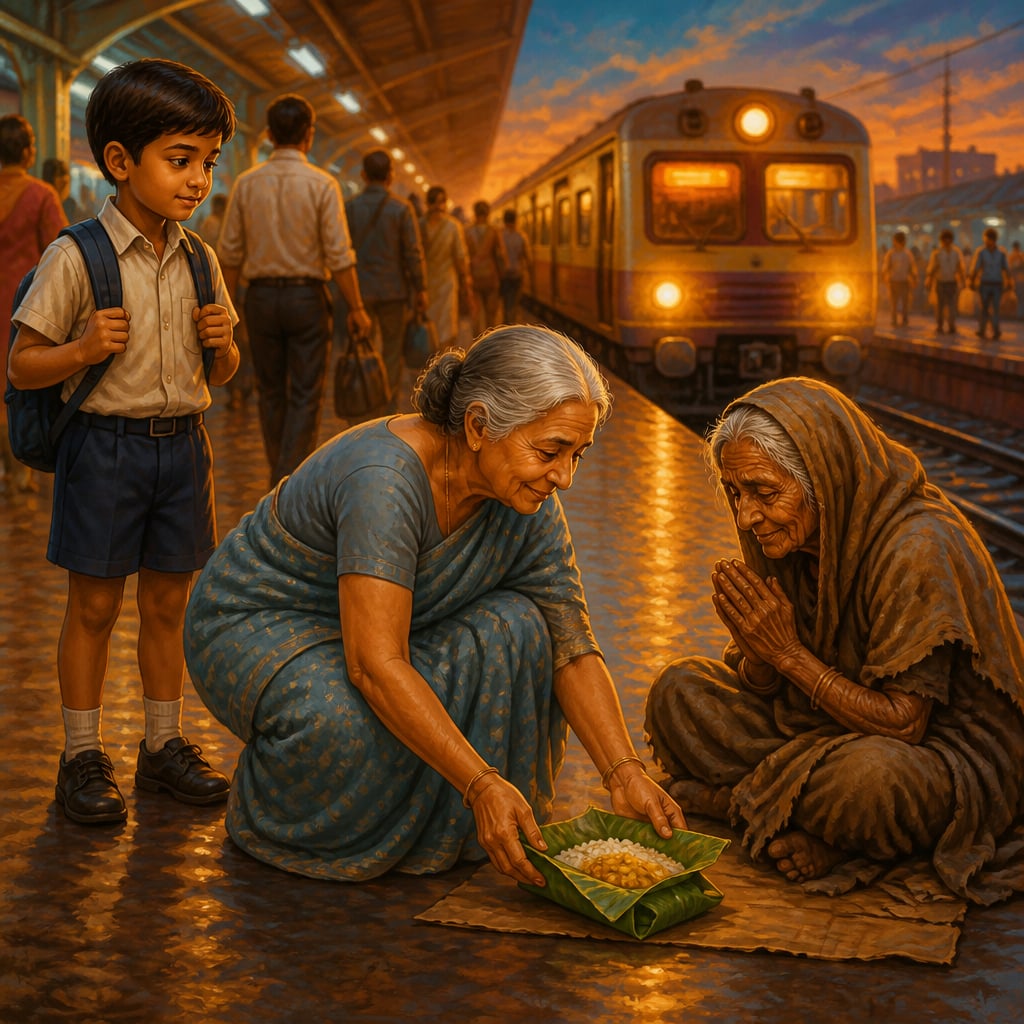
अक्टूबर की एक मंगलवार शाम है। दादर से करजत जानी वाली पाँच पैंतालीस की लोकल आ रही है। प्लेटफॉर्म भीड़ से भरा है। एक बारह साल का लड़का अपनी दादी के साथ खड़ा है, दोनों के हाथों में कपड़े की एक छोटी थैली है जिसमें कुछ गरम है। घर के दरवाज़े पर यह थैली लड़के के हाथों में रखी गई थी, बस दो शब्दों के साथ। आजी ने दिया। दादी ने दे दिया। उसे नहीं बताया गया कि इसके अंदर क्या है या यह किसके लिए है।
प्लेटफॉर्म के किनारे, पैदल पुल के पास, एक बुजुर्ग महिला गत्ते के एक टुकड़े पर बैठी है। उसकी साड़ी धुली हुई है लेकिन पतली है। वह सक्रिय तरीके से भीख नहीं माँग रही है। वह बस वहीं है। दादी उसकी ओर चलती है, थैली को उसके बगल में गत्ते पर रखती है, बिना आँख मिलाए, थैली के ऊपर एक मुड़ा हुआ दस का नोट रखती है, और वापस लड़के के पास चली आती है। गत्ते वाली महिला ऊपर नहीं देखती। यह लेन-देन उन दो लोगों की तरह लगता है जिन्होंने पहले से ही तय कर रखा है कि एक दूसरे को नहीं देखेंगे।
ट्रेन में, लड़का पूछता है कि उसने कुछ क्यों नहीं कहा। दादी कहती है, दिया है। बोला तो क्या, न बोला तो क्या। दे दिया गया है। चाहे आप कुछ कहें या न कहें, कोई फर्क नहीं पड़ता। लड़के को तीस साल बाद पता चलेगा कि वह क्या देख रहा था। वह बिल गेट्स और वारेन बफेट को गिविंग प्लेज की घोषणा करते देखेगा एक हज़ार पत्रकारों के सामने। वह कॉर्पोरेट सीएसआर ब्रोशर देखेगा जिसमें दानकर्ता का नाम हर पृष्ठ पर तीन जगह है। वह फॉर्ब्स फिलांथ्रोपी 50 के बारे में पढ़ेगा। कुछ भी दादर स्टेशन की उस मंगलवार शाम जैसा नहीं दिखेगा।
दादी के पास जो वह कर रही थी उसके लिए एक शब्द था। उसने इसे दान कहा। जिस विशेष रूप का वह पालन करती थी, छिपा हुआ रूप, उसे उसने गुप्त-दान कहा। दरवाज़े पर खाना देने का कार्य, बिना पूछे कि अतिथि कौन है, उसे उसने अन्नदान कहा। तीन नाम, एक प्रथा, हिंदू गृहस्थ के जीवन की सबसे पुरानी अनिवार्य विशेषताओं में से एक।
भारत भर में यह प्रथा
दान वह संरचनात्मक दान है जो गृहस्थ, घर के मालिक को, अपने दैनिक और मौसमी कर्तव्यों के हिस्से के रूप में करना आवश्यक है। मनुस्मृति, महाभारत और गृह्य सूत्र सभी इसे पंचमहायज्ञ में से एक के रूप में वर्गीकृत करते हैं, गृहस्थ के पाँच महान दैनिक यज्ञ। ये पाँच हैं: घर की वेदी पर देवताओं को नैवेद्य, पूर्वजों को नैवेद्य, अध्ययन के माध्यम से ऋषियों को नैवेद्य, बिखरे हुए अन्न या खाना देकर सभी जीवों को नैवेद्य, और अप्रत्याशित मानव अतिथि को नैवेद्य। पाँचों में से तीन दान के रूप हैं। दान गृहस्थ के जीवन के ऊपर चढ़ाया गया एक गुण नहीं है। यह इस बात का एक पाँचवां हिस्सा है कि एक घर को घर क्या बनाता है।
यह प्रथा भारत भर में कई रूपों में होती है। अन्नदान, पका खाना देना, सबसे सार्वभौमिक है। हर परंपरागत घर हर भोजन में एक अतिरिक्त हिस्सा रखता है, अगर कोई अतिथि अचानक आ जाए। मंदिर इसे औद्योगिक पैमाने पर करते हैं। तिरुमला तिरुपति के प्रसाद रसोई हर दिन लगभग डेढ़ लाख लोगों को खाना देते हैं। अमृतसर के स्वर्ण मंदिर की लंगर लगभग एक लाख लोगों को खिलाती है। जगन्नाथ पुरी के अन्न प्रसाद, जो मंदिर के मध्यकालीन सुदृढ़ीकरण के बाद से लगातार परोसे जा रहे हैं, आक्रमण, भुखमरी या महामारी के दौरान कभी नहीं रुके। दक्षिण भारत के सार्वजनिक मंदिर रसोइयों के अक्षय पात्र आज बीस हज़ार से ज़्यादा सरकारी स्कूलों में बच्चों को खाना देते हैं।
वस्त्र-दान, कपड़े देना, दूसरा सार्वभौमिक रूप है। त्योहारों पर नए कपड़े। पुराने कपड़े कभी भी, धुले हुए, मुड़े हुए और दिए गए। विद्या-दान, शिक्षा देना, प्राचीन ग्रंथों में नाम दिया गया सबसे ऊँचा रूप है। किसी बच्चे की स्कूली शिक्षा के लिए फंड देना, किसी शिक्षक या पाठशाला को बनाए रखना, हर प्राचीन सूची में भौतिक दान से ऊपर आता है। भूमि-दान, ज़मीन देना, सबसे स्थायी है। विनोबा भावे का 1950 का भूदान आंदोलन, जिसमें ज़मींदारों ने तेरह साल में चौवन लाख एकड़ ज़मीन ज़मीन रहित लोगों को दी, आधुनिक इतिहास में सबसे बड़ा स्वैच्छिक ज़मीन का हस्तांतरण है।
फिर गुप्त-दान है, गुमनाम दान। प्राचीन ग्रंथ, विशेषकर महाभारत का अनुशासन पर्व, गुप्त-दान को सभी अन्य रूपों से ऊपर रखते हैं। दानकर्ता घोषणा नहीं करता। लाभार्थी धन्यवाद नहीं देता। कोई तीसरा पक्ष इस कार्य को दर्ज नहीं करता। महाभारत स्पष्ट है। दाहिना हाथ को पता नहीं होना चाहिए कि बाएँ हाथ ने क्या दिया है। इस रूप में दान को आध्यात्मिक रूप से सबसे शुद्ध माना जाता है क्योंकि दान का कोई भी हिस्सा सामाजिक श्रेय के रूप में वापस नहीं लिया जा रहा है।
शास्त्र क्या कहता है
धर्म की एक अनिवार्य विशेषता के रूप में दान पर आधारभूत श्लोक भगवद् गीता से आता है।
दातव्यमिति यद्दानं दीयतेऽनुपकारिणे। देशे काले च पात्रे च तद्दानं सात्त्विकं स्मृतम्॥
dātavyam iti yad dānaṃ dīyate'nupakāriṇe | deśe kāle ca pātre ca tad dānaṃ sāttvikaṃ smṛtam ||
जो दान दिया जाना चाहिए इसलिए दिया जाता है, ऐसे व्यक्ति को जो बदले में नहीं दे सकता, सही जगह पर, सही समय पर, सही व्यक्ति को, वह दान सात्त्विक कहा जाता है।
भगवद् गीता 17.20
यह श्लोक गीता के अध्याय सत्रह के तीन श्लोकों में से एक है जो दान को तीन तरीकों में वर्गीकृत करते हैं: सात्त्विक, वह दान जो धर्म के कारण दिया जाता है, ऐसे व्यक्ति को जो बदले में नहीं दे सकता; राजसिक, वह दान जो बदले या पहचान की उम्मीद में दिया जाता है; और तामसिक, वह दान जो अनिच्छा से, गलत समय पर, गलत व्यक्ति को दिया जाता है। कृष्ण का तरीका भावुक नहीं है। दान को दान के आकार से नहीं मापा जाता। इसे दान देने की संरचना से मापा जाता है।

महाभारत का अनुशासन पर्व, जो भीष्म की मृत्युशय्या पर युधिष्ठिर को कुरुक्षेत्र में बाणों की शय्या पर दिए गए शिक्षण के लिए जिम्मेदार है, किसी भी भारतीय ग्रंथ में दान का सबसे लंबा एकल उपचार रखता है। भीष्म श्रेणियों, प्राप्तकर्ताओं, समय, सामग्री और सापेक्ष आध्यात्मिक वजन की गणना करते हैं। वह बार-बार इस नियम पर लौटते हैं कि गुप्त-दान, गुमनाम दान, सार्वजनिक दान से ऊपर आता है। तर्क आध्यात्मिक भौतिकी है। सार्वजनिक रूप से दिया गया दान आंशिक रूप से दानकर्ता के गर्व से खपत होता है इससे पहले कि वह प्राप्तकर्ता तक पहुँचता है। गुमनाम दान अक्षय होता है।
मनुस्मृति, अध्याय चार में, पंचमहायज्ञ को संहिताबद्ध करती है और निर्धारित करती है कि गृहस्थ को हर भोजन में अप्रत्याशित अतिथि, कुत्ते, कौए, चींटी और निर्धन के लिए एक हिस्सा अलग रखना चाहिए। इसलिए घर की रसोई, धर्मशास्त्र की पढ़ाई में, एक निजी स्थान नहीं है। यह एक छोटी सार्वजनिक संरचना है जो उन लोगों को खिलाती है जो इसके दहलीज़ पर पहुँचते हैं।
तैत्तिरीय उपनिषद का प्रसिद्ध समापन निर्देश स्नातक छात्र को, श्रद्धया देयम्, श्रद्धा के साथ दें, आस्था के साथ दें, इसके बाद अश्रद्धया देयम्, बिना श्रद्धा के न दें, श्रिया देयम्, बहुतायत के साथ दें, ह्रिया देयम्, विनम्रता के साथ दें, भिया देयम्, भय के साथ दें, संविदा देयम्, समझ के साथ दें। उपनिषद छात्र से नहीं पूछती कि क्या देना है। यह बताती है कि कैसे। दान माना जाता है।
प्रतीकवाद
अप्रत्याशित अतिथि को इतना वजन क्यों दिया जाता है। संस्कृत शब्द अतिथि का शाब्दिक अर्थ है वह व्यक्ति जिसके आने की तारीख ज्ञात नहीं है, जिसके पास कोई तिथि नहीं है। अप्रत्याशित अतिथि, धर्मशास्त्र की पढ़ाई में, वह रूप है जिसमें दिव्य अक्सर घर के दरवाज़े पर आता है। अतिथि को बिना खिलाए भेजना, बिना खिलाए, एक संभावित देवता को दूर करना है। प्रसिद्ध लाइन अतिथि देवो भव, अतिथि देवता है, इसलिए रूपक नहीं है। यह एक व्यावहारिक निर्देश है।
गुप्त-दान को सार्वजनिक दान से ऊपर क्यों रखा जाता है। तर्क संरचनात्मक है। सार्वजनिक दान के दो लाभार्थी हैं: प्राप्तकर्ता, जिसे दान मिलता है, और दानकर्ता, जिसे सामाजिक श्रेय मिलता है। दानकर्ता का हिस्सा, प्राचीन पढ़ाई में, दान के आध्यात्मिक वजन से लिया जाता है। गुमनाम दान का केवल एक लाभार्थी है। दान का पूरा वजन प्राप्तकर्ता तक पहुँचता है। दानकर्ता को इस दुनिया में कुछ नहीं मिलता। प्राचीन ग्रंथ कहते हैं कि दानकर्ता को दूसरे तरीके से जो मिलता है वह इसी कारण से अधिक है।

घर की रसोई, केवल मंदिर नहीं, अन्नदान का केंद्र क्यों है। घर सामाजिक व्यवस्था में धर्म की सबसे छोटी इकाई है। अगर परोपकार को मंदिरों, गैर सरकारी संगठनों और राज्य को सौंप दिया गया है, तो घर ने इस कार्य से अपना संबंध खो दिया है। धर्मशास्त्र घर की रसोई को कल्याण की मूल जगह के रूप में संरक्षित करता है क्योंकि परिवार और अप्रत्याशित अतिथि के बीच दैनिक मुलाकात वह है जो अगली पीढ़ी को प्रशिक्षित करती है। दादर स्टेशन पर लड़के ने अपनी दादी के साथ एक मंगलवार की शाम से गुप्त-दान सीखा। कोई गैर सरकारी संगठन, कोई कल्याण मंत्रालय और कोई परोपकार पॉडकास्ट उसे वही सिखा नहीं सकता था।
शरीर क्यों प्रतिक्रिया करता है
चौथी परत, आदत की संरचना। दान, जब सही तरीके से डिज़ाइन किया जाता है, एक पहचान-केंद्रित संकेत-दिनचर्या-पुरस्कार लूप का एक उदाहरण है। संकेत प्राप्तकर्ता के साथ मुलाकात है: दरवाज़े पर अप्रत्याशित अतिथि, गत्ते पर निर्धन महिला, कैलेंडर पर आने वाला त्योहार। दिनचर्या दान देना ही है। पुरस्कार भौतिक नहीं है। जेम्स क्लीयर, आणविक आदतें में, आदत पुरस्कार की सबसे ऊँची परत को पहचान मज़बूती कहते हैं। दान का हर कार्य छोटा साक्ष्य है कि दानकर्ता वह व्यक्ति है जो देता है। दादर की दादी एक ऐसी व्यक्ति नहीं है जो देने के लिए होती है। वह दानकर्ता है। दोनों मिल गए हैं।
हिंदू संरचना एक दूसरी व्यवस्था जोड़ती है जिसका नाम जेम्स क्लीयर स्पष्ट रूप से नहीं देते लेकिन धर्मशास्त्र स्पष्ट करता है। यह कार्य गुमनाम है। कोई बाहरी पुरस्कार नहीं, कोई सामाजिक श्रेय नहीं, कोई इंस्टाग्राम पोस्ट नहीं, कोई दानकर्ता दीवार की पट्टिका नहीं। मज़बूती विशुद्ध रूप से आंतरिक है। एडम ग्रांट, दें और लें में, दानकर्ताओं को लेने वालों और मिलाने वालों से अलग करते हैं, और दिखाते हैं कि अधिकांश क्षेत्रों में सबसे अच्छा प्रदर्शन करने वाले लेने वाले नहीं बल्कि दानकर्ता हैं, बशर्ते दान संरचित हो न कि तदर्थ हो। हिंदू दान संरचित है। पंचमहायज्ञ श्रेणियों का नाम देता है। अनुशासन पर्व तरीकों का नाम देता है। तैत्तिरीय उपनिषद तरीके का नाम देता है। गृहस्थ को संरचना दी जाती है, केवल प्रोत्साहन नहीं।
सामाजिक व्यवस्था भी है। हिंदू घर जो अन्नदान, गुप्त-दान और पंचमहायज्ञ रखता है अगली पीढ़ी को बताकर नहीं दिखाकर प्रशिक्षित करता है। अलबर्ट बंडुरा का सामाजिक सीखने का सिद्धांत, 1960 के दशक से विकास मनोविज्ञान में आधारभूत, यह संचरण तरीका ठीक से वर्णित करता है। बच्चे उन व्यवहारों की नकल करते हैं जो वे मॉडल किए हुए देखते हैं, विशेषकर जब मॉडल एक विश्वसनीय सत्तावादी व्यक्ति हो जो स्पष्ट पुरस्कार के बिना व्यवहार कर रहा हो। दादर प्लेटफॉर्म पर दादी पाठ्यपुस्तक का मामला है। साठ साल बाद, लड़का बिना पहचान की उम्मीद किए देगा क्योंकि यह बारह साल की उम्र में इस प्रथा को देखने के लिए था।
प्रयोगशालाएँ क्या खोज रही हैं
लारा अकनिन और सहकर्मी, ब्रिटिश कोलंबिया विश्वविद्यालय और हार्वर्ड में काम कर रहे, 2013 में व्यक्तित्व और सामाजिक मनोविज्ञान जर्नल में प्रकाशित एक अंतरसांस्कृतिक अध्ययन आयोजित किया। अध्ययन में एक सौ छत्तीस देश शामिल थे। खोज हैरान करने वाली थी। परोपकारी खर्च, दूसरों के बजाय स्वयं पर खर्च किया गया पैसा, सभी आय स्तरों पर और सभी संस्कृतियों में बढ़ी हुई व्यक्तिनिष्ठ कल्याण की भविष्यवाणी करता है। प्रभाव आकार, कल्याण के संदर्भ में, घरेलू आय को दोगुना करने के बराबर था। प्रभाव अमीर और गरीब देशों में, सामूहिकतावादी और व्यक्तिवादी संस्कृतियों में, धार्मिक और धर्मनिरपेक्ष आबादी में रहता है। दान लोगों को अंतरसांस्कृतिक मज़बूत तरीके से खुश करता है।
उसी शोध कार्यक्रम का दूसरा निष्कर्ष, विलियन्स और सहकर्मियों के साथ 2016 में मनोविज्ञान विज्ञान में लिखा, वह है जो गुप्त-दान को सही साबित करता है। गुमनाम दान सार्वजनिक दान की तुलना में मज़बूत कल्याण प्रभाव दिखाता है, क्योंकि आंतरिक प्रेरणा शुद्ध है और दानकर्ता सामाजिक रिटर्न की गणना के साथ कार्य को दूषित नहीं करता है। महाभारत का निर्देश कि दाहिना हाथ को पता नहीं होना चाहिए कि बाएँ हाथ ने क्या दिया है अब एक सहकर्मी-समीक्षित मनोविज्ञान निष्कर्ष है।
शोध की एक तीसरी धारा, सामुदायिक भोजन और ऑक्सीटोसिन पर, ऑक्सफोर्ड के रॉबिन डनबार और 2010 के दशक के दौरान अन्य, यह साबित करते हैं कि साझा खाना सामाजिक बंधन, ऑक्सीटोसिन रिलीज़ और परोपकारी व्यवहार में मापनीय वृद्धि पैदा करता है। मंदिर लंगर, सामुदायिक अन्नदान, और अन्न प्रसाद की लाइन, प्रयोगशाला की पढ़ाई में, भक्तिपूर्ण जिज्ञासा नहीं हैं। वे सबसे प्रभावी सामाजिक-बंधन हस्तक्षेप हैं जिन्हें मानवता ने डिज़ाइन किया है। हिंदू सभ्यता ने यह हस्तक्षेप मंदिर वास्तुकला में तीन हज़ार साल पहले बनाया था इससे पहले कि प्रयोगशाला ऑक्सीटोसिन को मापे।
दुनिया अब इसे क्या कहती है
सबसे प्रमुख आधुनिक प्रतिध्वनि गिविंग प्लेज है। 2010 में वारेन बफेट और बिल गेट्स द्वारा शुरू किया गया, यह प्लेज दुनिया के सबसे अमीर व्यक्तियों को अपनी संपत्ति का कम से कम आधा अपने जीवनकाल में या अपनी वसीयत में परोपकारी कारणों के लिए प्रतिबद्ध करने के लिए आमंत्रित करता है। 2024 तक, नौ देशों के दो सौ चालीस से अधिक हस्ताक्षरकर्ताओं ने कुल छः सौ अरब अमरीकी डॉलर की प्रतिबद्धता दी थी। बफेट, प्लेज के साथ अपने व्यक्तिगत पत्र में, स्पष्ट रूप से कहा है कि दान पारस्परिक लाभ के बिना और सार्वजनिक पहचान के बिना किया जाना चाहिए, यह वही गुप्त-दान सिद्धांत है जिसे अनुशासन पर्व ने दो सहस्राब्दी पहले संहिताबद्ध किया था। वह सिद्धांत को ग्राहम और डॉड मूल्य निवेश दर्शन को जिम्मेदार ठहराते हैं। अनुशासन पर्व का उल्लेख नहीं किया गया है।
प्रभावी परोपकार आंदोलन, विलियम मैकएस्किल और पीटर सिंगर द्वारा 2010 के दशक में लोकप्रिय, अत्यधिक लाभदायक कारणों के लिए संरचित गुमनाम दान निर्धारित करता है। आंदोलन का केंद्रीय निर्देश, बदले की उम्मीद के बिना दें, सबसे बड़ा कल्याण लाभ उत्पन्न करने वाले कारण को दें, लाभार्थी के प्रति भावनात्मक लगाव के बिना दें, धर्मशास्त्र का सात्त्विक दान वर्गीकरण आधुनिक अंग्रेजी में है। 2024 तक, प्रभावी परोपकार आंदोलन ने गिववेल-अनुशंसित दान के माध्यम से वार्षिक रूप से लगभग एक सौ लाख डॉलर भेजे थे। संस्कृत पूर्वज की स्थापना ग्रंथों में दिखाई नहीं देती है।
गुमनाम दानकर्ता संस्कृति 1980 के दशक में एक सीमांत प्रथा से आज कुल दान का एक महत्वपूर्ण भाग तक बढ़ी है। फिडेलिटी चैरिटेबल और श्वाब चैरिटेबल, दो सबसे बड़े दानकर्ता-सलाह वाली निधि प्रदाता, 2023 में एक साथ पचास अरब डॉलर से अधिक भेजे। संरचनात्मक रूप गुप्त-दान है, एक वित्तीय उत्पाद द्वारा मध्यस्थ।
सामुदायिक रसोई की अपनी आधुनिक प्रतिध्वनि है। खाद्य बैंक, सामुदायिक फ्रिज, सूप रसोई, और खरीदें कुछ नहीं आंदोलन, 2013 में स्थापित और 2024 तक चौवन देशों में सात लाख से अधिक प्रतिभागियों तक बढ़ा, सभी अन्नदान की संरचनात्मक टेम्पलेट पर बैठे हैं। संस्कृत नाम मार्केटिंग में दिखाई नहीं देता है।
अपने लिए इसे क्या कहें
इस पाठ से आगे, शब्दावली बदल जाती है। इसे दान कहो, परोपकार नहीं। गुमनाम रूप को गुप्त-दान कहो, गुमनाम दान नहीं। दरवाज़े पर भोजन को अन्नदान कहो, सूप रसोई नहीं। दिवाली पर नए कपड़े को वस्त्र-दान कहो, मौसमी दान नहीं। फंडिंग शिक्षा को विद्या-दान कहो, छात्रवृत्ति नहीं। अगली बार जब फॉर्ब्स फिलांथ्रोपी 50 प्रकाशित होती है, तो मुस्कुराओ और सूची के राजसिक रजिस्टर को पहचानो। अगली बार जब कोई अरबपति अपने नाम के साथ एक प्रतिबद्धता की घोषणा करता है, तो उस संरचना को पहचानो जिसे महाभारत ने पहले से ही दो हज़ार साल पहले वर्गीकृत किया था।
दादर प्लेटफॉर्म पर लड़का अब बड़ा हो गया है। उसकी दादी चली गई है। एक मंगलवार की शाम, वह एक अलग स्टेशन पर एक अलग लोकल से उतरता है और पैदल पुल के पास गत्ते पर एक बुजुर्ग महिला के पास से गुजरता है। वह उसका चेहरा नहीं देखता। वह अपनी घोषणा नहीं करता। वह गत्ते के बगल में एक मुड़ा हुआ नोट और गरम खाना की एक छोटी पार्सल रखता है, आगे निकल जाता है, और निकास की ओर जाता है। वंश एक अलग दशक में, एक अलग प्लेटफॉर्म पर, उसी मौन में जारी रहता है।
Key figures
Bhishma
Grand patriarch of the Kuru dynasty; great-uncle to the Pandavas and Kauravas; on the bed of arrows at Kurukshetra after the eighteenth day of battle, the speaker of the longest single Hindu treatise on daana inside the Mahabharata's Anushasana Parva.
Ashoka
Mauryan emperor, ruler of nearly the entire Indian subcontinent and parts of Central Asia between c. 268 and 232 BCE; author of the Pillar and Rock Edicts that codified daana as state policy and built the world's first documented welfare infrastructure.
Vinoba Bhave
Twentieth-century Indian thinker, freedom fighter, and disciple of Mahatma Gandhi; founder of the Bhoodan movement (1951), in which landowners across India voluntarily gave forty four lakh acres to the landless across thirteen years; the largest voluntary land transfer in modern history, structured on the dharmashastra principle of bhumi-daan.
Case studies
Ashoka's Rock Edict IV: The World's First Welfare State, Funded by Daana
Sometime around 260 BCE, on a polished sandstone column standing at the edge of a Mauryan road, an emperor's edict was carved in Brahmi script. Rock Edict IV of Ashoka declares that the king owes the people not military protection alone but daana, structured giving as a state obligation. Across the next twenty eight years of his reign, Ashoka built what the Buddhist tradition records as eighty four thousand stupas, dharmashalas, wells, hospitals, and rest houses across the subcontinent and into Central Asia. Veterinary hospitals were established alongside hospitals for humans. Roads were lined with shade-giving banyan trees and rest stops at calculated intervals. The state granaries were used not to feed armies but to feed the destitute during famine. Greek and Roman ambassadors who visited the Mauryan court reported back on a king who treated the wealth of the state as held in trust for those who could not feed themselves. The world's first documented welfare state predates the European welfare state by twenty two centuries. The funding principle was not taxation alone. It was the dharmic conviction that the ruler is, structurally, the largest practitioner of daana in the realm.
In the Hindu reading, what Ashoka did was not innovation. It was the application of an already-articulated dharmashastra principle at imperial scale. The Manusmriti had already codified the king's duty to provide for the destitute. The Mahabharata's Rajadharma sections in the Shanti Parva had already prescribed the welfare obligations of the sovereign. Ashoka took these prescriptions, scaled them with the resources of an empire, and produced the documented infrastructure that fifteen edicts now record. The principle is older than the emperor. The application is what the emperor's reign is remembered for.
The dharmashalas Ashoka built remained in use for centuries. The principle that the state owes daana to its people became foundational to Indian political theory. The Gupta emperors followed the same template. The Cholas extended it. The medieval temple economies, with their land grants for community feeding, are direct descendants of the Mauryan welfare logic. Modern Indian welfare programmes, including the Public Distribution System and the Mid-Day Meal scheme, sit inside the same lineage that Ashoka's Rock Edict IV opened.
A welfare state is older than industrial capitalism, older than the Reformation, older than the European Enlightenment. The world's first welfare state was funded by daana, in the third century BCE, on the dharmic conviction that the ruler is the chief giver. The Western political theory that traces welfare to nineteenth-century Bismarckian Germany has the wrong founding date by twenty two centuries.
When the European Union celebrates the welfare state as a uniquely modern Western achievement, the receipts include Rock Edict IV. The dharmic welfare state was running on the Indian subcontinent twenty two centuries earlier.
Ashoka's Rock Edicts, particularly Rock Edict IV (c. 260 BCE), surviving in multiple Brahmi-script copies across the subcontinent. Buddhist tradition records eighty four thousand stupas and welfare facilities established during his reign. The Pillar Edicts at Sarnath and the Rock Edicts at Junagadh, Dhauli, and Kandahar are the primary inscriptional evidence.
Aknin, Whillans, and the One Hundred and Thirty Six Country Confirmation of Bhishma
In 2013, Lara Aknin and colleagues at the University of British Columbia and Harvard University published a study in the Journal of Personality and Social Psychology titled Prosocial spending and well-being. The study covered one hundred and thirty six countries, drawing on Gallup World Poll data and follow-up experimental work. The finding was striking. Money spent on others, rather than on oneself, predicted increased subjective well-being across all income levels and across all cultures. The effect held in rich and poor countries, in collectivist and individualist cultures, in religious and secular populations. The effect size, in well-being terms, was equivalent to doubling household income. Three years later, Whillans and colleagues at Harvard Business School extended the finding in Psychological Science. They demonstrated that anonymous giving showed stronger well-being effects than public giving. The reasoning was structural. When the giver does not know the receiver and the receiver does not know the giver, the giver's internal motivation is purer and the act is not contaminated by the calculation of social return. The two papers, taken together, rendered as peer-reviewed psychology what the Mahabharata's Anushasana Parva had said in plain Sanskrit two millennia earlier.
The Hindu tradition has always held two claims about daana that the Aknin and Whillans research has now confirmed. First, that giving is itself the reward, and that the giver is the primary beneficiary of the act. The Bhagavad Gita 17.20 is precise on this. The sattvic giver does not expect return, and the absence of expectation is what makes the act spiritually weighty. Second, that gupt-daan is the highest form of giving because the absence of social attribution preserves the moral substance of the gift. The Anushasana Parva is explicit. The Whillans 2016 paper is, structurally, a peer-reviewed restatement of Bhishma. The dharmashastra is not a museum artefact. It is a working specification that modern research has now caught up to.
The Aknin and Whillans findings have been cited extensively in the prosocial behaviour literature. The effective altruism movement draws on this evidence base. Corporate wellness programmes that include charitable giving components reference the research. Insurance-funded mental health interventions have begun including prosocial spending as a recommended practice. The science is downstream of the practice. Every individual who experiences increased well-being from anonymous giving is replicating, at the level of personal experience, the finding the dharmashastra encoded in plain Sanskrit and the laboratory confirmed in plain English.
Anonymous giving makes the giver happier than public giving, because the absence of social attribution preserves the internal motivation that produces the well-being benefit. The mechanism is the same whether the giver calls it gupt-daan or prosocial spending. The lineage chose the structure on the basis of what it produced in the giver. The instruments confirm the choice.
When you give anonymously and the act produces a quiet warmth that public giving does not, you are experiencing what Bhishma named at Kurukshetra and what Aknin and Whillans peer-reviewed in 2013 and 2016. Two strands of evidence, twenty centuries apart, on the same finding.
Aknin, L. B. et al, 2013, Journal of Personality and Social Psychology, Prosocial spending and well-being: cross-cultural evidence for a psychological universal. Whillans, A. V. et al, 2016, Psychological Science, on anonymous versus public giving and well-being. Sample: one hundred and thirty six countries; effect size equivalent to doubling household income.
The Six Hundred Billion Dollar Giving Pledge: Buffett Rediscovers Bhishma
In June 2010, Warren Buffett and Bill and Melinda Gates announced the Giving Pledge, a public commitment by individuals to give at least half of their wealth to charitable causes during their lifetimes or in their wills. By 2024, over two hundred and forty individuals from twenty nine countries had signed, with combined pledged commitments exceeding six hundred billion United States dollars. Buffett's accompanying letter is the most read philanthropy document of the twenty-first century. He writes that giving should be done without expectation of reciprocal benefit, that the giver should not require public recognition, and that the act of giving itself produces the only return that matters. Buffett attributes these insights to the Graham and Dodd value investing philosophy and to his own decades of accumulated thinking on the matter. The Mahabharata's Anushasana Parva, which had codified the identical principle in roughly 200 BCE, is not mentioned. The effective altruism movement, popularised by William MacAskill and Peter Singer in the same decade, prescribes structured giving to highly leveraged causes, without sentimental attachment to the recipient, in modes that produce the largest welfare gain. The movement's central instruction is, structurally, the Bhagavad Gita's classification of sattvic daana from chapter seventeen. The Gita is not in the founding texts. The anonymous donor culture, with Fidelity Charitable and Schwab Charitable together moving over fifty billion dollars in 2023 through donor-advised funds, has institutionalised gupt-daan as a financial product. The Sanskrit name does not appear in the marketing materials.
The course's response to this is not litigation. The course's response is naming. Daana is daana. Gupt-daan is gupt-daan. Annadana is annadana. Vidya-daan is vidya-daan. When Buffett describes giving without expectation of reciprocal benefit, name the older form. When MacAskill prescribes structured giving without sentimental attachment, name the older form. When a donor-advised fund routes a gift anonymously, name the older form. The Hindu version is older, more precisely classified, and built into the daily life of the householder rather than the once-in-a-lifetime gesture of the billionaire. The two structures are the same. The framing is different. The user is allowed to choose which one to name.
The Giving Pledge continues to grow. The effective altruism movement continues to direct hundreds of millions of dollars annually through GiveWell-recommended charities. The donor-advised fund industry continues to scale. The Sanskrit names continue to be absent from the public-facing materials. The Hindu daana lineage continues, in tens of millions of households, in the same kitchens where the grandmothers are doing what the philosophers and billionaires have now caught up to. The two trajectories run in parallel. The course is the receipt that says they were always the same practice.
The largest pledged philanthropy operation in human history is a stripped-down rebrand of a giving structure that the Mahabharata classified two thousand years earlier. Buffett has rediscovered Bhishma, without the Sanskrit. The course names the older lineage so that the reader can hold both at once.
From this lesson onward, when you read about a billionaire announcing a charitable pledge, recognise the rajasic register. When you read about a quiet anonymous donor through a fund, recognise the gupt-daan structure. The vocabulary is the discipline. Use it.
Giving Pledge (launched 2010): over two hundred and forty signatories from twenty nine countries; combined pledged commitments exceeding six hundred billion United States dollars by 2024. Effective altruism movement: approximately one hundred million United States dollars annually directed through GiveWell-recommended charities by 2024. Fidelity Charitable and Schwab Charitable: combined over fifty billion United States dollars moved through donor-advised funds in 2023.
Historical context
Vedic to modern: Taittiriya Upanishad's Shikshavalli closing on the manner of daana (c. 800 to 600 BCE); Manusmriti codification of the panchamahayajna and the householder's daily giving (c. 200 BCE to 200 CE); Mahabharata's Anushasana Parva on Bhishma's deathbed teaching of daana (c. 400 BCE to 400 CE); Ashoka's Rock and Pillar Edicts on daana as state policy (c. 268 to 232 BCE); medieval consolidation of temple anna prasadam at Jagannath Puri, Tirupati, and Srirangam; Vinoba Bhave's Bhoodan movement (1951 to 1964); the Giving Pledge launch (2010); Aknin and Whillans research on prosocial spending (2013 to 2016); Buy Nothing movement and global community fridge culture (2013 onward).
Living traditions
Daana is alive in tens of millions of Hindu households today. The portion set aside at every meal for the unexpected guest. The new cloth at Diwali. The funded relative's education. The folded note placed silently beside the destitute on a railway platform. The community kitchen at the local temple. The Bhandara at the family wedding. The lineage has not skipped a meal since the late Vedic period.
Call it daana, not philanthropy. Call the anonymous form gupt-daan, not strategic anonymous giving. Call the food at the door annadana, not a food bank donation. Call the funded education vidya-daan, not a scholarship. Call the community meal Bhandara, not catering. Call the day of multiplied giving Akshaya Tritiya, not Giving Tuesday. The vocabulary is the inheritance. The grandmother on the Dadar platform did not need the words to keep the practice. The world that has rediscovered the practice does. Use them.
- Annadana at the Home and the Temple: Across India and the diaspora, traditional Hindu households keep a small extra portion at every cooked meal in case an unexpected guest arrives. The portion is called atithi-bhag in some lineages, vipra-bhag in others. If no human guest arrives, the portion is given to the dog at the door, the cow on the street, the crow on the parapet, or the ant on the floor. The Manusmriti's panchamahayajna instruction is built into daily kitchen practice. The temple version operates at industrial scale. The prasadam kitchen at Tirumala Tirupati feeds approximately one hundred and fifty thousand people every single day. The anna prasadam at Jagannath Puri has not stopped in eight hundred years. The langar at the Golden Temple in Amritsar feeds approximately one hundred thousand. The akshaya patra public temple kitchens feed children in over twenty thousand government schools.
- Gupt-Daan at the Festival and the Threshold: Across north India, especially during Diwali, Sankranti, and Ekadashi, traditional households practise the deliberate anonymous gift. A folded note slipped under the door of a relative whose finances are tight. A bag of grain left at the threshold of a household whose father has lost his job. A stranger paying the bill at a small dhaba and walking out before the recipient knows. The practice is rarely advertised. The Mahabharata's Anushasana Parva instruction that the gift should not be revealed is held as a working principle. Modern donor-advised funds in urban India, including the India Donor-Advised Fund operated by the Sattva Group, have institutionalised gupt-daan at scale.
- Bhandara: The Community Meal at Weddings, Funerals, and Festivals: The Bhandara is the open community meal hosted by a household at a major life-cycle event: a wedding, a death anniversary, a child's birthday, a festival. The meal is open to all who arrive. The household feeds neighbours, relatives, employees, and strangers without distinction. The classical practice is to feed the poorest and the unhoused first, with the family eating last. The Bhandara at the close of a Shraddha or Pind Daan ceremony, at the close of a wedding, at the closing day of a vrata, is held as a structural completion of the household ritual. Without the Bhandara, the ritual is held to be incomplete.
- Bhoodan Memorial, Pochampally: Pochampally is the village where Vinoba Bhave received the first land gift in the Bhoodan movement on 18 April 1951. A small Dalit community asked Bhave for land. Vinoba turned to the assembled villagers and asked who would give. Vedre Ramachandra Reddy, a local landowner, stood up and pledged one hundred acres to the community. Bhave then walked across India for the next thirteen years, collecting forty four lakh acres in voluntary land gifts from landowners. The village now holds a small Bhoodan memorial commemorating the moment that opened the largest voluntary land redistribution in modern history.
- Akshardham Annakoot Mahotsav, Delhi: Akshardham hosts an Annakoot Mahotsav, mountain of food, every year on the day after Diwali. The festival presents thousands of food items to the deity and subsequently distributes the entire offering as Annaprasadam to all who arrive. The 2023 Annakoot at Akshardham presented approximately fifteen hundred different food items in a single day. The practice draws on the Govardhan tradition in which Krishna lifted the hill to shelter the cowherds, and the cowherds offered the entire mountain of cooked food to him in gratitude. Annakoot festivals are observed at Akshardham temples globally and at the Vrindavan, Nathdwara, and Kolkata Iskcon temples on the same day.
- Jagannath Temple, Puri: The Jagannath temple at Puri runs the world's largest continuous community kitchen, called the Ananda Bazaar. The kitchen has, by tradition, never stopped operating since the temple's medieval consolidation. It feeds approximately one hundred thousand people on ordinary days and several lakh during the Rath Yatra and other festival peaks. The kitchen uses seven hundred and fifty earthen pots stacked on top of each other on wood-fired stoves. The Mahaprasad, the food prepared in the kitchen, is shared without distinction of caste, class, or origin. The same Mahaprasad is served to the deity, the king of Puri, the visiting pilgrim, and the destitute beggar. The system has run, with only minor interruptions during specific invasions, since the twelfth century CE.
- Tirumala Tirupati Devasthanams Annaprasadam: The Tirumala Tirupati Devasthanams operates the world's most operationally efficient large-scale temple food distribution. The Annaprasadam complex serves free meals to approximately one hundred and fifty thousand pilgrims every day, three meals a day, with breakfast, lunch, and dinner. The kitchen handles the entire pilgrimage volume of one of the world's most visited religious sites. The famous Tirupati laddu, manufactured at the temple's own laddu kitchen at the rate of approximately three hundred thousand laddus per day, is offered to the deity and distributed as prasadam to every pilgrim. The model has been studied as a case in operations research and food logistics by management institutes including the Indian Institute of Management Bangalore.
Reflection
- When you give, do you give because you have decided that giving is something you must do, or because the gift makes you feel a particular way at the moment of giving? What would change about your charitable practice if you treated daana as a structural requirement of being a householder rather than a feeling that occasionally arises?
- The Mahabharata declares that the gift that has been revealed is no gift at all. The Whillans 2016 paper in Psychological Science confirms that anonymous giving produces stronger well-being effects than public giving. Why might the absence of social attribution be what makes a gift spiritually weighty, and what does this say about the social-credit nature of so much modern philanthropy?
- The boy on the Dadar railway platform learnt gupt-daan from a single Tuesday evening with his grandmother. She did not explain. She did not announce. She did the act in silence and walked away. What practice in your own family or community is being transmitted, or failing to be transmitted, by the same silent showing? What would you have to do, in front of someone watching, to pass on a practice you care about?