अतिथि देवो भव
तैत्तिरीय उपनिषद, अक्षय पात्र, और 75 अरब डॉलर की शेयरिंग इकॉनमी जो एक अश्रेय सूत्र पर बनी है
हिंदू घर में अचानक आने वाले मेहमान को पहले खाना क्यों दिया जाता है, सवाल बाद में पूछे जाते हैं। अन्नदान धर्मराज का पहला कर्तव्य क्यों है और गृहस्थ का पहला स्वभाव। तैत्तिरीय उपनिषद ने 3000 साल पहले इस नियम को 'अतिथि देवो भव' कहा। एलिजाबेथ डन का 2008 का विज्ञान पत्र और ब्राउन-हैरिस का अवसाद अनुसंधान इस तंत्र को सिद्ध करता है। आज यही भावना Airbnb जैसी 75 अरब डॉलर की होम-होस्पिटैलिटी इंडस्ट्री को चलाती है, पर मूल सूत्र और रसोई का नाम लिया ही नहीं गया।
गेट पर दस्तक
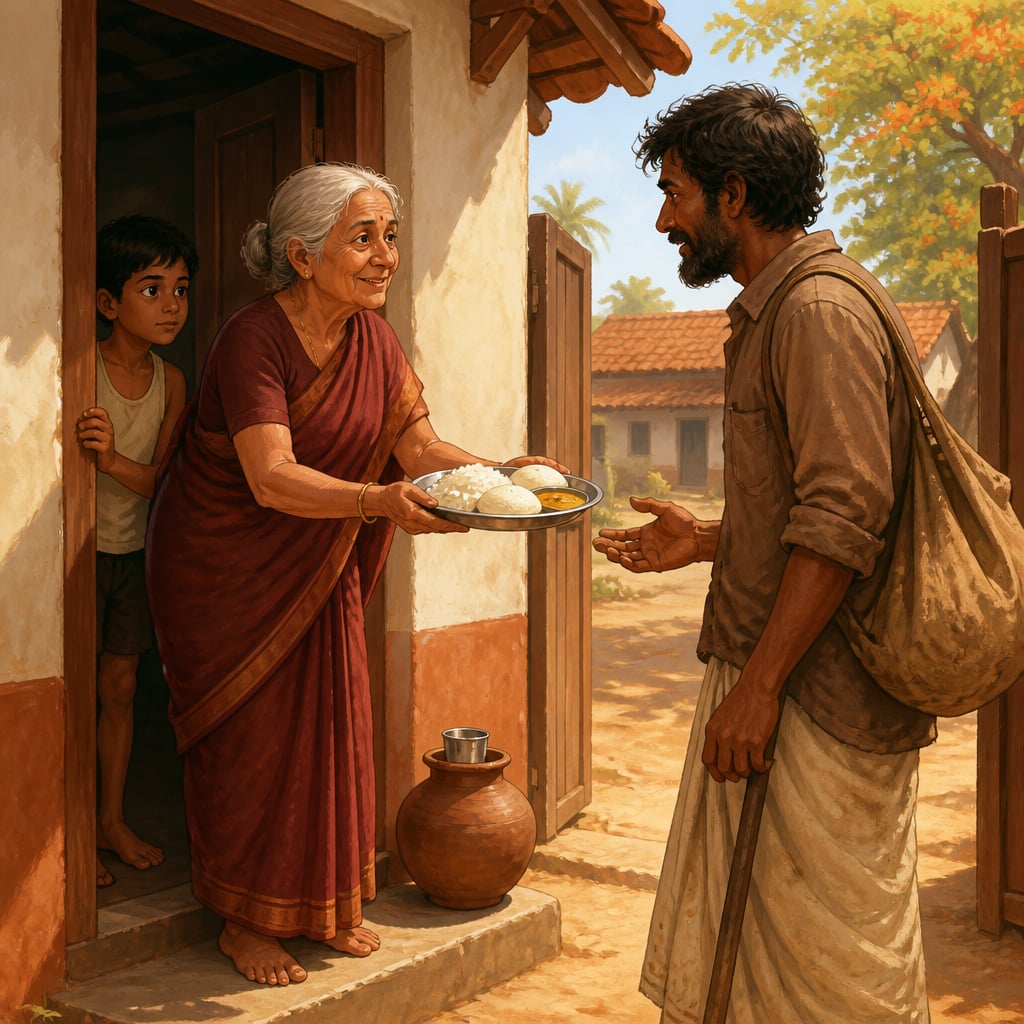
मद्रै के पास एक गांव में एक दो कमरे का घर, 1987 की एक मंगलवार की दोपहर। अट्ठावन साल की दादी, हल्के नीले कपास की साड़ी पहने, शाम के इडली के लिए चावल का आटा पत्थर पर पीस रही है। चावल सुबह से भिगोया जा रहा है। एक छोटा मिट्टी का दीपक कोने के मंदिर में जल रहा है। उसके पोते, छह साल के, बगल के कमरे में बेंत की चटाई पर सो रहे हैं। परिवार का दोपहर का भोजन एक घंटा पहले खत्म हो गया, और बचा हुआ सांभार रसोई की अलमारी पर एक छोटे स्टील के बर्तन में है। शाम के भोजन के लिए चावल काफी है। किसी और काम के लिए अतिरिक्त चावल नहीं है।
गेट पर दस्तक होती है। दादी अपनी साड़ी के ढीले सिरे पर हाथ पोंछती हैं, गेट तक चलती हैं, और इसे खोलती हैं। एक आदमी वहां खड़ा है, शायद चालीस साल का, धूल भरे ट्रावल कपड़ों में, कंधे पर एक छोटा कपड़े का बंडल। वह एक अजनबी है। वह दक्षिणी लहजे में पूछ रहा है जिसे दादी नहीं समझती, क्या वह पानी का एक गिलास और एक घंटे के लिए आराम करने की जगह पा सकता है। वह सुबह से चल रहा है। अगली बस दो घंटे में है।
दादी उसकी कहानी की जांच नहीं करती। वह उसकी जाति, काम, गंतव्य, या नाम नहीं पूछती। वह एक तरफ खड़ी हो जाती है और गेट खोलती है। वह उसे पानी का एक पीतल का गिलास लाती है, फिर दोपहर के बचे हुए चावल की एक स्टील की प्लेट, अलाव पर गर्म किया गया बचा हुआ सांभार, अचार का एक छोटा चम्मच, और सुबह की अंतिम दो इडलियां। वह उसे धीरे-धीरे खाने के लिए कहती है। वह चावल के आटे को पीसना जारी रखती है। शाम की इडलियां अब परिवार के लिए एक कम होंगी। वह इसका आदमी को नहीं बताती। वह इसे अपने पोते को नहीं बताती जब वह जागता है।
जो उसने अभी किया है उसका एक नाम है। तैत्तिरीय उपनिषद, जिसे ईसा पूर्व आठवीं शताब्दी के आसपास संकलित किया गया था, इसे तीन संस्कृत शब्दों में संहिताबद्ध किया: अतिथि देवो भव। अतिथि ईश्वर है। दादी को नियम जानने के लिए श्लोक जानने की जरूरत नहीं है। यह नियम उसके परिवार में किसी भी श्लोक से ज्यादा समय से है जो उसका परिवार याद कर सकता है।
अतिथि वास्तव में क्या है
संस्कृत शब्द अतिथि का अर्थ आधुनिक अर्थ में मेहमान नहीं है। इसका अर्थ है वह जो बिना तिथि (नियत दिन) के आता है। शब्द टूटता है अ (बिना) और तिथि (नियुक्त दिन) में। अतिथि, परिभाषा के अनुसार, अचानक आने वाला दर्शक है। जिस मेहमान को आपने आमंत्रित किया है वह आपका अभ्यागत है, स्वागत किया गया मित्र। अतिथि गेट पर अजनबी है।
यह अंतर संरचनात्मक है। आमंत्रित मित्र के प्रति आतिथ्य सभी मानव संस्कृतियों में सार्वभौमिक है और किसी सभ्यता के प्रोटोकॉल की आवश्यकता नहीं है। अचानक आने वाले अजनबी के प्रति आतिथ्य, जिसका आना आपके दिन की योजना में नहीं था, वह व्यक्ति जिसके प्रति आप कुछ भी बकाया नहीं हैं और जिसे कभी नहीं मिले हैं, यह परीक्षा है जिसे लगभग कोई सभ्यता व्यवस्थित रूप से पास नहीं करती। हिंदू परंपरा ने अतिथि-सेवा को गृहस्थ के दैनिक कर्तव्य के केंद्र में रखा और इसे सुबह के संध्या के बाद पहला अनुष्ठान दायित्व बनाया। पांच महान दैनिक यज्ञ, पंचमहायज्ञ, जो मनु स्मृति और अपस्तंब गृह्य सूत्र में निर्धारित हैं, मनुष्य यज्ञ (मनुष्यों के लिए बलिदान) को गृहस्थ के अपने भोजन से पहले आने वाले किसी भी अचानक मेहमान को खाना देने के दैनिक कर्तव्य के रूप में नाम देते हैं। व्याकरण स्पष्ट है: परिवार अतिथि के बाद खाता है, पहले नहीं।
यह नियम ग्रंथों में स्केल करता है। तैत्तिरीय उपनिषद अतिथि को दिव्य की स्थिति तक उन्नीत करता है। मनु स्मृति निर्दिष्ट करती है कि गृहस्थ जो गेट पर अतिथि के इंतजार के दौरान खाता है, वह केवल चोरी का पुण्य अर्जित करता है, भोजन का नहीं। महाभारत अक्षय पात्र का वर्णन करता है, युधिष्ठिर को दिया गया अक्षय पात्र, एक ऐसा उपकरण जिसका कार्य राजा के अन्नदान कर्तव्य को पूरा करना है: यह तब तक भोजन पैदा करता है जब तक रानी द्रौपदी खा नहीं लेती, और फिर रुक जाता है, क्योंकि राजा को दुनिया को खिलाना है अपनी रसोई को खिलाने से पहले।
शास्त्र स्पष्ट है
मातृदेवो भव। पितृदेवो भव। आचार्यदेवो भव। अतिथिदेवो भव॥
mātṛ-devo bhava | pitṛ-devo bhava | ācārya-devo bhava | atithi-devo bhava
वह बनो जिसके लिए माता ईश्वर है। वह बनो जिसके लिए पिता ईश्वर है। वह बनो जिसके लिए शिक्षक ईश्वर है। वह बनो जिसके लिए अचानक आने वाला मेहमान ईश्वर है।
तैत्तिरीय उपनिषद 1.11.2
यह श्लोक शिक्षा वल्ली का समापन निर्देश है, उपनिषद का अध्याय जो शिक्षक को छात्र को गुरुकुल छोड़ने से पहले बताता है। चार सूत्र बढ़ती कठिनाई के क्रम में व्यवस्थित हैं। माता ईश्वर है, पिता ईश्वर है, शिक्षक ईश्वर है यह सहज है: घर और गुरुकुल दृश्यमान और सीमित हैं। चौथा सूत्र परीक्षा है। अतिथि ईश्वर है यह वह पंक्ति है जो गृहस्थ को गेट पर आने वाले व्यक्ति के प्रति उसी श्रद्धा को बढ़ाने के लिए कहती है जो छात्र ने शिक्षक के प्रति दी।
मनु स्मृति इस नियम को विशिष्ट प्रक्रिया में कठोर करती है। गृहस्थ को अतिथि के आने पर उठना चाहिए, आसन प्रदान करना चाहिए, पैरों के लिए पानी (पाद्य), हाथों के लिए पानी (अर्घ्य), मुंह के लिए पानी (आचमनीय), और भोजन प्रदान करना चाहिए, आगंतुक की पहचान, काम, या गंतव्य में कोई जांच से पहले। सवाल भोजन के बाद पूछे जा सकते हैं। पहले नहीं पूछे जा सकते। क्रम गैर-परिवर्तनीय है। वही मनु स्मृति, एक ही अध्याय में, अतिथि को भोजन देने से इनकार को सात पापों में से एक नाम देती है जिसके लिए पूर्ण उपवास और सार्वजनिक दान के अलावा कोई प्रायश्चित्त नहीं है।
अक्षय पात्र और राजा का कर्तव्य

अक्षय पात्र, युधिष्ठिर को पांडवों के बारह साल के वनवास के दौरान दिया गया अक्षय पात्र, महाभारत में अन्नदान पर सबसे लंबा शास्त्रीय चिंतन है। यह पात्र सूर्य, सूर्य देव से एक उपहार था। यह मांग पर भोजन पैदा करता था जब तक कि रानी द्रौपदी ने अपना भोजन नहीं खा लिया, और फिर दिन के लिए रुक गया। संरचनात्मक नियम जानबूझकर था: पात्र अनंत संख्या में मेहमानों को खिला सकता था जब तक कि रानी नहीं खाती थी, लेकिन जैसे ही वह खाती थी, यह सूख जाता था।
इस कहानी का एक मनाया हुआ परीक्षण है। ऋषि दुर्वास, जो अपनी आतिथ्य मांगों को विफल करने वाले लोगों को श्राप देने के लिए कुख्यात हैं, पांडवों के वन झोपड़ी में अपने दस हजार शिष्यों के साथ आए, जब द्रौपदी पहले से खा चुकी थी। पात्र खाली था। पांडवों को बर्बादी का सामना करना पड़ा। कृष्ण ने हस्तक्षेप किया: उन्होंने द्रौपदी से पात्र में भोजन का कोई भी अनाज मांगा, एक चिपका हुआ चावल का दाना और सब्जी का एक टुकड़ा स्वीकार किया, और ब्रह्मांड की ओर से इसे खाया। दुर्वास और उसके शिष्य, नदी पर दूर, अचानक पूर्ण महसूस हुए। वे कभी झोपड़ी में लौटे बिना पीछे मुड़ गए। संकट टल गया।
जो पाठ महाभारत सिखा रहा है वह सटीक है: धर्मिक राजा का पहला कर्तव्य अन्नदान है। अक्षय पात्र उस कर्तव्य का प्रतीकात्मक उपकरण है। पात्र का संरचनात्मक नियम, कि जब रानी खाती है तो यह रुक जाता है, घर के नियम का नाटकीय संस्करण है कि परिवार अतिथि के बाद खाता है। राजा परिवार को स्केल किया हुआ है। राज्य रसोई को स्केल किया हुआ है। अतिथि-सेवा समान है।
शरीर क्यों प्रतिक्रिया देता है
यह अभ्यास केवल अतिथि पर नहीं, बल्कि मेजबान पर भी मापने योग्य काम करता है। एलिजाबेथ डन ब्रिटिश कोलंबिया विश्वविद्यालय में और उसके सहयोगियों ने 2008 में विज्ञान में पारसामाजिक खर्च पर सबसे अधिक उद्धृत आधुनिक पत्र प्रकाशित किया। अध्ययन ने दो विषयों की तुलना की: एक को अपने पर खर्च करने के लिए पैसा दिया गया, दूसरे को दूसरों पर खर्च करने के लिए समान राशि दी गई। पारसामाजिक समूह ने दिन के अंत में महत्वपूर्ण रूप से उच्च खुशी के अंक की सूचना दी। प्रभाव खर्च की मात्रा से स्वतंत्र था। अजनबी पर पांच डॉलर ने अपने ऊपर पांच सौ डॉलर की तुलना में बड़ा खुशी लाभ पैदा किया।
जॉर्ज ब्राउन और तिरिल हैरिस, अपनी 1978 की किताब अवसाद की सामाजिक उत्पत्ति में, यह मूल खोज स्थापित की कि कामकाजी वर्ग की ब्रिटिश महिलाओं में नैदानिक अवसाद के विरुद्ध सबसे मजबूत एकल सुरक्षात्मक कारक एक विश्वास सामाजिक नेटवर्क की उपस्थिति थी जिसमें साझा भोजन शामिल था। इस खोज को सामाजिक-महामारी विज्ञान साहित्य के चालीस वर्षों में दोहराया गया है। तंत्र अब अच्छी तरह से समझा जाता है: साझा भोजन ऑक्सीटोसिन बढ़ाते हैं, कोर्टिसोल कम करते हैं, और परासंपत्ति-प्रभावी अवस्था पैदा करते हैं जिसमें मेजबान की तंत्रिका तंत्र स्वयं ठीक हो जाता है।
दो निष्कर्षों का संयोजन सटीक है। हिंदू अतिथि-सेवा प्रोटोकॉल पारसामाजिक खर्च (अजनबी को दिया गया भोजन) और साझा भोजन (मेजबान अक्सर अतिथि के साथ बैठता है जबकि वह खाता है) निर्धारित करता है। डन 2008 ने पारसामाजिक-खर्च खुशी प्रभाव का दस्तावेज किया; ब्राउन और हैरिस 1978 ने साझा-भोजन सुरक्षात्मक प्रभाव का दस्तावेज किया। मद्रै गांव की रसोई में दादी दोनों को समान बीस मिनट में, औसतन महीने में तीन या चार बार करती है, पचास साल के लिए।
दुनिया इसे अब क्या कहती है

अतिथि-सेवा के संरचनात्मक आवेग पर बना सबसे बड़ा आधुनिक उद्योग शेयरिंग इकॉनमी है। प्रमुख उत्पाद Airbnb है, जिसे 2008 में ब्रायन चेस्की, जो गेब्बिया, और नाथन ब्लीचर्जिक द्वारा स्थापित किया गया था, जिसे 2024 तक लगभग पचहत्तर अरब डॉलर का बाजार मूल्यांकन था और एक सौ नब्बे देशों से अधिक में सात मिलियन से अधिक संपत्तियां सूचीबद्ध थीं। उत्पाद का मूल पिच यह था कि अजनबी सुरक्षित रूप से, सस्ते में और बड़े पैमाने पर अपने घरों में अजनबियों को होस्ट कर सकते हैं। Airbnb की विपणन, 2014 के बाद से, नारा कहीं भी संबंधित का उपयोग किया है और स्पष्ट रूप से अजनबियों को होस्ट करने की परंपरा को मंच के दार्शनिक आधार के रूप में आमंत्रित किया है। नारा सही है। परंपरा का नाम छोड़ दिया गया है।
शेयरिंग इकॉनमी व्यापक रूप से, कुश-सर्फिंग से भोजन-साझा करने वाले ऐप्स से घर-पका भोजन मंच जैसे EatWith और Bonappetour तक, घर से निकाली गई समान अतिथि-सेवा आवेग पर चलता है और मंच पैमाने पर मौद्रिकृत किया जाता है। शेयरिंग इकॉनमी पर 2017 हार्वर्ड बिजनेस रिव्यू लेख ने कुल श्रेणी मूल्य का अनुमान तीन सौ अरब डॉलर से अधिक पर लगाया और अजनबियों के बीच विश्वास को एकल सबसे महत्वपूर्ण परिसंपत्ति वर्ग नाम दिया जो क्षेत्र ने बनाया था। अतिथि-सेवा परंपरा ने समान परिसंपत्ति वर्ग बनाया और कभी इसके लिए शुल्क नहीं लिया।
कॉर्पोरेट आतिथ्य उद्योग, 2023 में 5.6 ट्रिलियन डॉलर के वैश्विक होटल क्षेत्र, संरचनात्मक रूप से अतिथि-सेवा से दूर है: यह भुगतान आतिथ्य है, बिना शर्त आतिथ्य नहीं। लेकिन विलासिता खंड की विपणन भाषा, विशेष रूप से ताज और ओबेरॉय जैसी भारतीय स्वामित्व वाली श्रृंखलाएं, स्पष्ट रूप से अतिथि-देवो-भव सूत्र को आमंत्रित करती हैं। ताज का 2008 मुंबई मुंबई हमले के दौरान सुरक्षा रिकॉर्ड, जब कर्मचारी खाली करने के बजाय मेहमानों के साथ रहे, अंतरराष्ट्रीय स्तर पर प्रसिद्ध हो गया और बाद में साक्षात्कार में, कर्मचारियों द्वारा स्वयं को अतिथि-देवो-भव प्रशिक्षण के लिए पता चला जो श्रृंखला ने अपने प्रोटोकॉल में बनाई थी।
इसे स्वयं क्या कहें
नाम परिवर्तन छोटा और सटीक है। जब वायर्ड लेख शेयरिंग इकॉनमी कहता है, तो आप अतिथि-सेवा कहते हैं। जब Airbnb पिच कहीं भी संबंधित कहता है, तो आप तैत्तिरीय उपनिषद 1.11.2 की ओर इशारा करते हैं और तारीख ईसा पूर्व 800 है। जब wellness स्तंभ डिनर-विथ-स्ट्रेंजर्स को 21वीं सदी का नवाचार कहता है, तो आप मनु स्मृति की ओर इशारा करते हैं और पाद्य, अर्घ्य, और आचमनीय का निर्धारित क्रम। जब एक मित्र अजनबी को खिलाना उदारता की विचित्रता के रूप में वर्णित करता है, तो आप कहते हैं कि यह दैनिक मनुष्य यज्ञ है, अपस्तंब गृह्य सूत्र के पांच महान घर यज्ञों में से तीसरा।
अभ्यास स्वयं किसी भी घर के लिए एक रसोई और एक दरवाजे के साथ पोर्टेबल है। हर भोजन में बर्तन में एक अतिरिक्त व्यक्ति के लिए पर्याप्त चावल रखें। दस्तक पड़ने पर पहले दरवाजा खोलें, सवाल बाद में पूछें। भोजन से पहले पानी दें। परिचय से पहले भोजन दें। आगंतुक के साथ बैठें जबकि वह खाता है। लागत एक अतिरिक्त कप चावल की कीमत और बीस मिनट का ध्यान है। योग्यता, मनु स्मृति की भाषा में, दैनिक मनुष्य यज्ञ की योग्यता है। खुशी, डन 2008 की भाषा में, मापने योग्य है।
आधुनिक गूंज और दूसरी ओर की रसीदें
संयोग दस्तावेज किया गया है। डन एट अल, विज्ञान 2008, पारसामाजिक-खर्च खुशी तंत्र नाम। ब्राउन और हैरिस 1978 साझा-भोजन सुरक्षात्मक तंत्र नाम। तैत्तिरीय उपनिषद 1.11.2 ने शिक्षा वल्ली के समापन निर्देश के रूप में नियम नाम दिया। मनु स्मृति ने प्रक्रियात्मक क्रम निर्दिष्ट किया। महाभारत ने अक्षय पात्र कहानी में राजा के अन्नदान कर्तव्य को नाटकीय रूप दिया।
बाजार ने ध्यान दिया है और पुनः ब्रांडेड किया है। Airbnb का 75 अरब डॉलर मूल्यांकन घर से निकाली गई अतिथि-सेवा आवेग पर चलता है। व्यापक शेयरिंग इकॉनमी ने 2017 तक लेनदेन मूल्य में 300 अरब डॉलर से अधिक उत्पन्न किया। विलासिता भारतीय आतिथ्य श्रृंखलाओं ने अपने कर्मचारी प्रोटोकॉल और विपणन भाषा में अतिथि-देवो-भव प्रशिक्षण बनाई है, और दुनिया ने 2008 ताज हमले जैसी घटनाओं के दौरान ध्यान दिया है।
हिंदू अतिथि-सेवा भारत भर में लगभग दो सौ मिलियन घरों में मुक्त चलता है, औसतन प्रति घर प्रति माह तीन या चार बार, तैत्तिरीय उपनिषद, मनु स्मृति, महाभारत, 1978 ब्राउन-हैरिस खोज, और 2008 डन पत्र के साथ सभी सहायक साहित्य में विज्ञान।
मद्रै के पास गांव में वापस, आदमी बचे हुए चावल और इडलियों की स्टील प्लेट को खत्म करता है। वह खड़ा होता है, अपनी हथेलियां एक साथ रखता है, और कुछ नहीं कहता। दादी सिर हिलाती है और कुआं की ओर इशारा करती है। वह प्लेट को स्वयं धोता है, इसे रैक पर रखता है, अपने कपड़े का बंडल उठाता है, और अपना नाम दिए बिना गेट से बाहर चली जाती है। दादी नहीं पूछती। वह चावल के आटे को पीसना जारी रखती है। शाम की इडलियां परिवार के लिए एक कम होंगी। पोता ध्यान नहीं देगा। दादी, सहज रूप से, उसे अपनी दे देगी।
Case studies
The Akshaya Patra and the Durvasa Episode: The King's Annadanam Made Cosmic
The Mahabharata's Vana Parva, chapter 263, narrates the most sustained scriptural meditation on annadanam in the Hindu corpus. During the Pandavas' twelve-year forest exile, Surya the sun god grants Yudhishthira the Akshaya Patra, the inexhaustible vessel that produces food on demand. The structural rule is deliberate: the vessel produces food until Draupadi, the queen, has eaten her own meal, and then stops for the day. The episode that puts the rule to the test is Durvasa's arrival. The famously short-tempered sage, with ten thousand disciples in tow, arrives at the Pandavas' forest hut after Draupadi has already eaten. The patra is empty. Refusing the sage's hospitality demand carries the standard Hindu consequence: a curse capable of destroying a kingdom. Krishna intervenes. He asks Draupadi for any single grain still in the vessel, accepts one stuck-on grain of rice and one shred of vegetable, and eats it on behalf of the universe. Durvasa and his disciples, miles away at the river, suddenly feel full. They turn around without ever returning to the hut. The crisis is averted.
The Mahabharata is teaching annadanam as the dharmic king's first duty. The Akshaya Patra is the symbolic instrument of that duty. The vessel's structural rule, that it stops when the queen eats, is the dramatised version of the household rule that the family eats after the atithi. The Durvasa episode tests the king's fidelity to the rule under the highest possible stakes: the loss of the kingdom itself. Krishna's resolution is significant: the rule is preserved through bhakti (Draupadi's surrender), through tyaga (Krishna eats one grain on behalf of the universe), and through cosmic accounting (Durvasa is fed by the same one grain at a distance). The dharmic frame holds the rule even under impossible pressure.
The Akshaya Patra story has remained, for two thousand years, the single most-cited Hindu narrative on annadanam-as-royal-duty. Its modern institutional descendant, the Akshaya Patra Foundation, registered in 2000, serves over two million midday meals to school children across India every day under the same name and the same operating principle. The foundation's logo is the vessel itself. The operating model, that public institutions exist to feed the population before they tax it, is the Mahabharata's annadanam principle scaled to the modern Indian state.
The Mahabharata is not narrating a curiosity. It is establishing the legal-ethical basis for hospitality as samskara at every scale: the household feeds the atithi before the family, the king feeds the kingdom before the queen, the public institution feeds the citizen before it taxes him. The same rule scales from a steel plate of leftover rice to a midday meal programme serving two million children daily. The rule does not change with scale. The recipient does.
Mahabharata, Vana Parva, chapter 263, c. 400 BCE-400 CE: the Akshaya Patra runs dry when the queen has eaten. The Akshaya Patra Foundation, founded 2000, serves over 2 million midday meals daily across India, named directly after the Mahabharata vessel and operating on the same annadanam principle.
Airbnb at $75 Billion: The Sharing Economy Built on an Unattributed Sutra
Airbnb was founded in 2008 by Brian Chesky, Joe Gebbia, and Nathan Blecharczyk in San Francisco. By 2024 the company carried a market valuation of approximately $75 billion and listed more than 7 million properties in over 190 countries. The product's foundational pitch was that strangers could host strangers in their homes safely, cheaply, and at scale. Airbnb's public marketing has, since at least 2014, explicitly invoked 'the tradition of hosting strangers' as the philosophical basis of the platform, with the slogan 'belong anywhere' as its commercial expression. The wider sharing economy, including couch-surfing, meal-sharing platforms (EatWith, Bonappetour), and home-cooked food apps, runs on the same atithi-seva impulse. The 2017 Harvard Business Review estimated the total category value at over $300 billion and named 'trust between strangers' as the single most important asset class the sector had created. None of the marketing material cites the Taittiriya Upanishad, the Manusmriti, or the Mahabharata's Akshaya Patra.
The dharmic frame did not separate the impulse to host the stranger from the lineage that supports it. The atithi-seva works because the Taittiriya Upanishad named it as one of the four reverences, the Manusmriti specified the procedural sequence, the Mahabharata gave the king-scale dramatic instance, and a hundred generations of grandmothers in village kitchens kept the practice in continuous operation. To extract the impulse (host the stranger), monetise it at platform scale, and rename it 'belong anywhere' is permitted, but the lineage is what gave the impulse its civilisational reach. A $75 billion industry running on the impulse without a single citation to the verse is the cleanest available illustration of how form travels faster than name.
The sharing economy continues to grow. Airbnb's valuation and listing count have risen consistently since the company's IPO in 2020. The platform's safety record has remained, on aggregate, remarkable: hundreds of millions of stranger-stays have been completed without serious incident. The underlying lineage is invisible to almost all of the participants, both hosts and guests. The asymmetry is one of the clearest illustrations in the modern economy of how an impulse can scale globally while losing the lineage that made it scaleable in the first place.
The right response to the asymmetry is not to dismiss Airbnb. The platform does real work, and the founders' citation of 'the tradition of hosting strangers' is sincere. The right response is articulation. List your spare room on Airbnb if you want the iconography. Open the gate to the unannounced visitor with a brass tumbler of water, a steel plate of rice, and no questions if you want the protocol. The Airbnb listing earns income. The atithi-seva earns the merit of the daily manushya-yajna and the measurable happiness gain Dunn 2008 documented, with the Taittiriya Upanishad 1.11.2 and three thousand years of household practice in the supporting literature.
Airbnb: founded 2008, market valuation ~$75 billion (2024), 7+ million listings in 190+ countries. Sharing economy total category value: >$300 billion (HBR 2017). Foundational marketing slogan 'belong anywhere' (2014-present), explicitly invokes 'the tradition of hosting strangers' without citing the Taittiriya Upanishad, the Manusmriti, or any element of the atithi-seva corpus.
Dunn 2008 and Brown-Harris 1978: Two Studies That Vindicate the Grandmother's Reflex
In 1978, George Brown and Tirril Harris published 'Social Origins of Depression' in London, establishing the foundational finding that the strongest single protective factor against clinical depression in working-class women was the presence of a confiding social network that included shared meals. The finding has been replicated across forty years of social-epidemiology literature. The mechanism is now well understood: shared meals raise oxytocin, lower cortisol, and produce the parasympathetic-dominant state in which the host's nervous system itself recovers. In 2008, Elizabeth Dunn and colleagues published in Science the most-cited modern paper on prosocial spending. The study compared two groups: one given money to spend on themselves, the other given the same money to spend on others. The prosocial group reported significantly higher happiness scores. The effect was independent of the amount spent. Neither paper cites the Taittiriya Upanishad, the Manusmriti, or the Mahabharata's Akshaya Patra story.
The Hindu atithi-seva corpus prescribes prosocial spending (food given to a stranger) and shared meals (the host often sits with the atithi while he eats), timed and structured by the procedural manual of the Manusmriti and ritualised as the daily manushya-yajna. Dunn 2008 documents the prosocial-spending happiness effect; Brown and Harris 1978 document the shared-meal protective effect. The dharmic frame names the combined effect as punya (merit) and the practice as the third of the panchamahayajnas. The modern frame names it as a happiness intervention and a depression-protective factor. The grandmother in the Madurai village kitchen does both in the same twenty minutes, three or four times a month, for fifty years.
Brown and Harris 1978 has become the foundational citation in the social-origins-of-depression literature and is referenced across psychiatry, social epidemiology, and public-health intervention design. Dunn 2008 has been cited in over four thousand subsequent studies on prosocial behaviour, happiness, and well-being. Neither line of research has incorporated the Hindu atithi-seva corpus into its citation network. The wellness, happiness-research, and prosocial-design industries that built on the two findings cite vague 'cross-cultural traditions of generosity' rather than the specific Sanskrit corpus that named the mechanism three thousand years earlier.
When the labs vindicate a household reflex, the right response is not surprise. It is recognition. The grandmother in the Madurai village did not need Dunn 2008 or Brown and Harris 1978 to know that opening the gate to the unannounced traveller and feeding him before her own family settled something in her body that her own dinner could not. She had the Taittiriya Upanishad, the Manusmriti, and three thousand years of family practice. The journals catching up are welcome, and they make the case to a generation that trusts the journal more than it trusts the grandmother. Atithi-seva is, in this frame, the most-practised and best-vindicated single happiness intervention in the literature.
Dunn et al, Science 2008: prosocial spending produces measurable happiness gains independent of amount; $5 on a stranger > $500 on oneself. Brown and Harris 1978: confiding social network with shared meals is the strongest single protective factor against clinical depression. Taittiriya Upanishad 1.11.2, c. 800 BCE: 'atithi devo bhava'. Three texts, the same finding, three thousand years apart.
Historical context
From the Taittiriya Upanishad's atithi-devo-bhava sutra (c. 800 BCE) and the Apastamba Grihyasutra's panchamahayajna prescription, through the Manusmriti's procedural codification (c. 200 BCE-200 CE) and the Mahabharata's Akshaya Patra story, to the 1978 Brown and Harris social-origins-of-depression study, the 2008 Dunn et al Science paper on prosocial spending, the 2008 founding of Airbnb, and the 2008 Mumbai Taj attack.
The atithi-seva corpus is the Hindu household's most universal daily ritual after the morning sandhya. The continuity across regional context (the Tamil grandmother in the Madurai village, the Punjabi household at the gate, the Kashmiri kahwa for the unannounced visitor, the Marwari guest-room kept perpetually swept), across economic context (the same rule operates in the two-room village house and the corporate Mumbai apartment), and across the diaspora (the same reflex operates in the Tamil household in Toronto and the Gujarati household in London) is the proof that the protocol survives because the impulse is foundational. The practice does not depend on belief, on caste, or on prosperity. It depends on a kitchen and a door.
Living traditions
The Airbnb platform, founded 2008, carries a market valuation of approximately $75 billion in 2024 and lists over 7 million properties in 190+ countries, built explicitly on 'the tradition of hosting strangers' but without a single citation to the Taittiriya Upanishad. The wider sharing economy generated over $300 billion in transaction value by 2017 (HBR estimate). Elizabeth Dunn's 2008 Science paper on prosocial spending and the Brown and Harris 1978 social-origins-of-depression study are the empirical foundations of the modern happiness-research industry; neither cites the Hindu atithi-seva corpus. Re-Sanskritize: when the Wired column says 'sharing economy', you say atithi-seva. When the Airbnb pitch says 'belong anywhere', you point at the Taittiriya Upanishad 1.11.2 and the date 800 BCE. When the wellness column calls dinner-with-strangers a 21st-century innovation, you point at the Manusmriti and the prescribed sequence of padyam, arghyam, and achamaniyam. When a friend describes feeding a stranger as a quirk of generosity, you say it is the daily manushya-yajna, the third of the five great household yajnas of the Apastamba Grihyasutra. Keep enough rice in the pot at every meal for one extra person. Open the door first when there is a knock, and ask the questions later. Offer water before food. Offer food before introduction. Sit with the visitor while she eats. The cost is the price of one extra cup of rice and twenty minutes of attention. The merit, in the Manusmriti's language, is the merit of the daily manushya-yajna. The happiness, in Dunn 2008's language, is measurable.
- The Akshaya Patra Foundation Central Kitchen, Vrindavan: One of the largest centralised midday-meal kitchens in the world, operating under the Akshaya Patra Foundation's national programme to serve over two million school children daily across India. The Vrindavan kitchen prepares roughly 200,000 meals per day at peak capacity. Visitors can tour the kitchen's industrial-scale operations: the rice cookers (each producing a thousand kilos of cooked rice per cycle), the dal vats, the chapati machines, the sambar pipelines, and the loading bays from which insulated containers depart for hundreds of schools every morning. The kitchen is a working modern institutional descendant of the Mahabharata's Akshaya Patra and the cleanest available illustration of annadanam at industrial scale.
- Annapurna Temple, Varanasi: The temple of Annapurna Devi, the goddess of food, located adjacent to the Kashi Vishwanath shrine. The temple is the most institutionally famous annadanam centre in North India: it has, by tradition, never refused food to anyone who asks, in any state or status. The annaprasada is distributed daily, and the akshaya-patra-style continuous distribution is intensified during Navaratri and Akshaya Tritiya. The temple's foundation legend (Shiva himself begs food from Annapurna) is the symbolic basis for the entire annadanam corpus: even the supreme deity must come to the goddess of food before the household can.
- The Taj Mahal Palace Hotel, Mumbai: The Taj Mahal Palace, built in 1903 by J.N. Tata, is the most institutionally famous modern application of atithi-devo-bhava in the corporate hospitality sector. The hotel's staff training, since the chain's founding, has placed the Sanskrit verse at the centre of its service philosophy. During the 26-29 November 2008 terrorist attack, the hotel's staff stayed with guests rather than evacuating, and several staff members died protecting them. The episode became internationally famous as the modern test case of corporate hospitality grounded in dharmic principle. Harvard Business School and the Indian School of Business both teach the case as the canonical example of values-driven service culture.
Reflection
- When was the last time you opened your door (literally or metaphorically) to an unannounced person and gave them something concrete (food, time, attention, help) before asking who they were or what they wanted? What stopped you from doing it more often, and what would have to change in your daily structure for the manushya-yajna to become a daily reflex rather than an occasional choice?
- Why might the Taittiriya Upanishad have placed atithi-devo-bhava as the fourth and highest of its four reverences, after mother-as-god, father-as-god, and teacher-as-god? What is the verse asking you to extend to the unannounced stranger that is intuitive for the mother, the father, and the teacher?
- If Dunn 2008 in Science and Brown and Harris 1978 in Social Origins of Depression independently confirmed the host-side and recipient-side benefits of prosocial spending and shared meals, and if the Taittiriya Upanishad codified the atithi-devo-bhava sutra by the eighth century BCE, why has the modern academic literature on happiness, prosocial behaviour, and depression prevention not yet incorporated the Hindu atithi-seva corpus into its citation network? What would have to change, in academic norms or in the framing of the source material, for the older citation to enter the literature?