सूर्य का संक्रमण

संक्रांति, उत्तरायण, और 30 मिलियन डॉलर की सर्दियों की पर्यटन उद्योग जो ड्रूइड्स ने नहीं बनाई

हिंदू साल सिर्फ जनवरी के चारों ओर नहीं, बल्कि सूर्य के दो महान संक्रमणों के चारों ओर बनाया गया है। तिल और गुड़ का लड्डू, आकाश में पतंग, और गंगा संगम में नहान - ये सभी एक ही अनुष्ठान हैं, बस तीन अलग-अलग पैमानों पर। वेदांग ज्योतिष ने छठी शताब्दी ईसा पूर्व में उज्जैन में संक्रांति के अवलोकन की प्रणाली को कोडित किया था, स्टोनहेंज पर्यटन से दो हजार साल पहले। लीवी 2006 और वेहर 1998 ने मौसमी प्रभावी विकार के अनुसंधान के माध्यम से इस तंत्र को सिद्ध किया।

भोर में तिल-गुड़ का लड़्डू
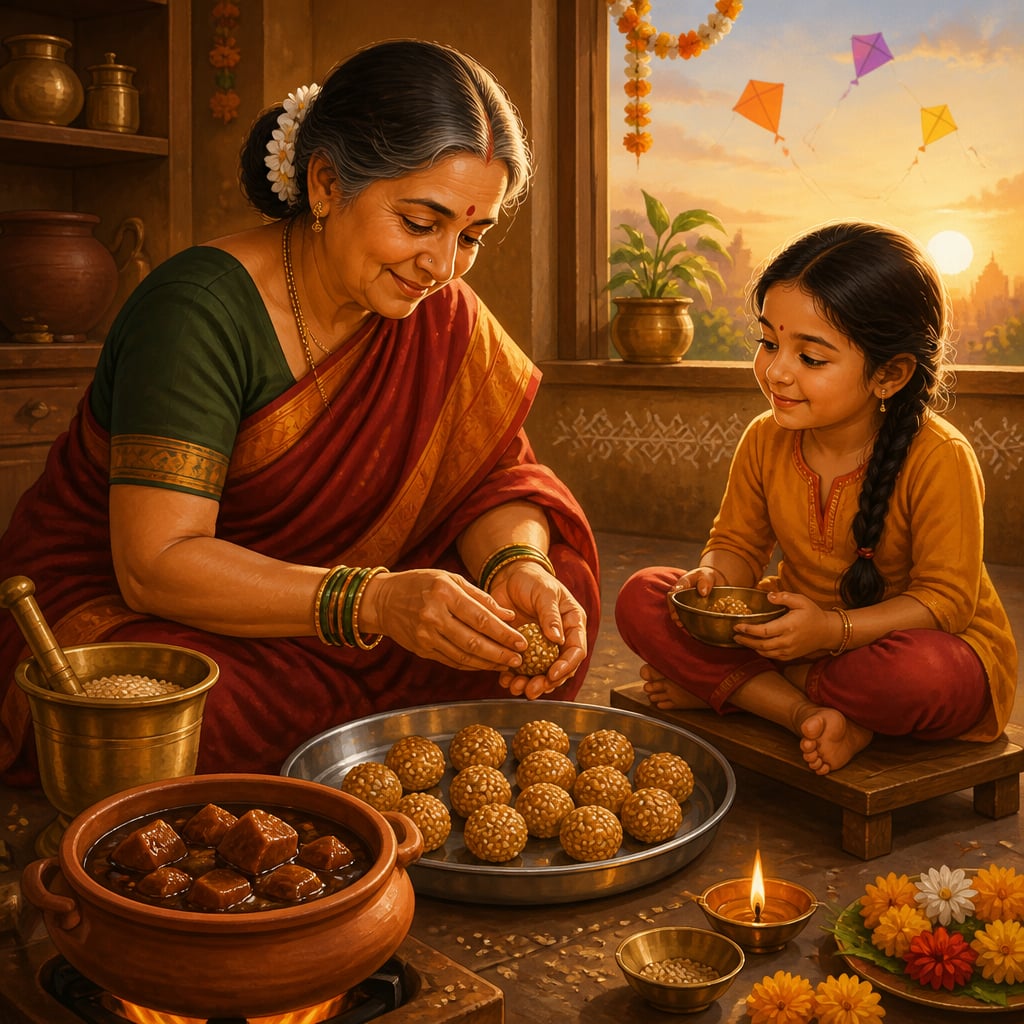
Pune grandmother rolling sesame and jaggery laddoos on Makar Sankranti

A kitchen in Pune, on the morning of 14 January 1996. A grandmother, age sixty-one, in a green nine-yard saree, has been awake since five. On the steel counter in front of her sits a stainless steel thali with two hundred small round laddoos, each the size of a marble, made of roasted white sesame seeds bound with melted jaggery. She has been rolling them since six. Her hands are sticky. Her granddaughter, age nine, has woken up and is watching from the doorway, holding a kite the size of her own torso.

The grandmother looks up, hands the granddaughter a small steel bowl of the laddoos, and says, in Marathi, til-gul ghya, god god bola. Take the sesame and jaggery, and speak sweetly. The granddaughter repeats the line back, mouth full of one laddoo, and runs out to the terrace where her father is already untangling the manja for the kite.

The day is Makar Sankranti, the Hindu festival of the sun's crossing into Capricorn. Across India on the same morning, several hundred million people are eating a sesame-and-jaggery sweet, flying a kite, taking a bath at a river confluence, lighting a bonfire of last year's wood, or performing a tarpana for ancestors. The grandmother in Pune is not thinking about the Tropic of Cancer, the Vedanga Jyotisha, or seasonal affective disorder. She is thinking about whether the laddoos will hold their shape until lunch. She is also performing the most astronomically precise civilizational festival in continuous practice anywhere in the world.

What Sankranti Actually Is

Sankranti is the Sanskrit word for the sun's transit from one zodiac sign into the next. The word breaks into sam (together, completely) and kranti (a stepping-across, a revolution). The sun makes twelve such crossings in a year, one per month, and each is technically a sankranti. But two of the twelve are the festival-grade events: Makar Sankranti in mid-January, when the sun enters Capricorn (Makara), and Karka Sankranti in mid-July, when the sun enters Cancer (Karka).

The two crossings mark the two solstices in the Hindu astronomical calendar. Makar Sankranti is the start of Uttarayana, the six-month period during which the sun moves north across the sky. Karka Sankranti is the start of Dakshinayana, the six-month period during which the sun moves south. Uttarayana is, in the dharmic frame, the auspicious half: light increasing, days lengthening, the gods awake. Dakshinayana is the inward half: light decreasing, days shortening, the time for retreat and tapas. Bhishma Pitamaha, in the Mahabharata, lay on the bed of arrows for fifty-eight nights waiting for the sun to turn north before he chose to die. The day he died was Makar Sankranti.

Sankranti is one festival scaled across three layers. At the household scale: the til-gud laddoo, the new clothes, the morning oil bath, the small fire in the courtyard. At the community scale: the kite festival in Gujarat, the bonfire of Lohri in Punjab, the bull-jumping of Jallikattu in Tamil Nadu's Pongal. At the civilizational scale: the dip at the Ganga Sagar confluence in Bengal, where five hundred thousand pilgrims gather every year, and the dip at the Triveni Sangam at Prayagraj on the same morning.

Ujjain, the Original Greenwich

The Hindu astronomical calendar is not an inheritance from the Babylonians or the Greeks. It is built from observations made at one specific city. The Tropic of Cancer passes through Ujjain. The Tropic is the latitude at which the sun is directly overhead at the summer solstice, the Karka Sankranti. The ancient observers at Ujjain could measure the solstice by the simple fact that on that day, at noon, a vertical pole cast no shadow at all. The shadow returned the next day. The sun had turned south.

The Vedanga Jyotisha, the oldest Hindu text on astronomical timekeeping, codified the solstice observation protocol at Ujjain by the sixth century BCE. The text gives the solstice dates, the equinox dates, the lunar-solar year-length calculations, and the rules for inserting an extra month every two and a half years to keep the lunar and solar calendars aligned. The text predates the Greek work of Hipparchus by four hundred years and the Roman Julian calendar by five hundred. By the time Aryabhata reworked the calculations at Kusumapura in 499 CE, Ujjain had been the prime meridian of Indian astronomy for more than a thousand years.

Ujjain's role is not metaphorical. Aryabhata, Varahamihira, and the entire Surya Siddhanta tradition use Ujjain as the zero longitude for their calculations, the same way Greenwich is used today. Every Hindu panchanga in continuous use, including the printed almanacs in any pooja shop in any Indian city today, ultimately references Ujjain. The British, when they imposed the Greenwich meridian on Indian railway timetables in 1884, did not introduce the concept of a prime meridian. They displaced one that had been operating for two and a half thousand years.

The Scripture Names the Crossing

The Mahabharata, the Bhagavad Gita, the Vishnu Purana, and the Surya Siddhanta all name the two ayanas as the central organising axis of the year. The most-quoted verse is from the Gita.

शुक्लकृष्णे गती ह्येते जगतः शाश्वते मते। एकया यात्यनावृत्तिमन्ययावर्तते पुनः॥

śukla-kṛṣṇe gatī hyete jagataḥ śāśvate mate ekayā yāty anāvṛttim anyayā āvartate punaḥ

The bright path and the dark path are the two eternal courses of this world. By the one, the soul goes and does not return; by the other, the soul returns again.

Bhagavad Gita 8.26

Krishna is teaching Arjuna the cosmology of the soul's departure. The bright path is Uttarayana, the sun's northern course; the dark path is Dakshinayana, the sun's southern course. The verse encodes a calendar fact, the two ayanas, into a soteriological frame: when you die matters as much as how you die. Bhishma's choice to wait fifty-eight nights for Uttarayana is the most-cited dharmic application of the Gita's teaching. The grandmother in Pune does not need to read the verse to know that Makar Sankranti is the day the gods wake up.

Why the Body Responds

The two ayanas are not a metaphor. They are a measurable change in light exposure that produces a measurable change in human biology.

Alfred Lewy and colleagues at Oregon Health and Science University published in 2006 in the Proceedings of the National Academy of Sciences the most-cited modern paper on Seasonal Affective Disorder, the cluster of mood, sleep, and energy disturbances that track the winter shortening of daylight. The paper showed that the human circadian system is exquisitely sensitive to the photoperiod, the daily ratio of light to dark, and that the six-month decline in photoperiod from summer solstice to winter solstice produces a measurable shift in melatonin secretion, serotonin synthesis, and cortisol rhythm. Thomas Wehr at the National Institute of Mental Health, in his 1998 Journal of Psychiatry paper, had earlier established the underlying mechanism: humans have a residual mammalian photoperiodic response, the same response that governs hibernation in bears and reproduction in deer.

The combined finding is precise. The six-month cycle from Karka Sankranti to Makar Sankranti and back is not a cultural convention. It is the photoperiodic axis around which mammalian biology is organised. The Hindu calendar's choice of the two solstices as the festival-grade days is the calendar's recognition of the two days in the year when the photoperiod's direction reverses. Lewy 2006 and Wehr 1998 did not cite the Vedanga Jyotisha. The Vedanga Jyotisha had named the two days as the structural pivots of the year two and a half thousand years earlier.

Three Tools, One Crossing

Three household tools run across the Sankranti corpus, and they share one logic: each is a small bodily intervention timed to the photoperiod reversal.

The til-gud laddoo, the sesame and jaggery sweet eaten on Makar Sankranti morning, is the warming food. Sesame is one of the most concentrated sources of bioavailable calcium and healthy fat. Jaggery is unrefined cane sugar with intact iron and minerals. The combination is the Ayurvedic prescription for the cold, dry phase that ends with Sankranti. The grandmother in Pune does not call it a thermogenic seasonal nutrient bolus. She calls it til-gul. The biochemistry is the same.

Ahmedabad rooftops filled with kites on Uttarayan morning

The kite flying, the visible symbol of the Gujarat festival, is the morning-light exposure protocol. Lewy 2006 named bright morning light as the most effective single intervention for the resetting of the circadian rhythm. Kite flying requires standing on a roof, looking up, with full unobstructed sun on the face, for one to four hours, on the morning of the photoperiod reversal. The lakhs of people on the rooftops of Ahmedabad on 14 January are doing the most precisely-timed light-therapy protocol in any civilisation, dressed as a children's festival.

Devotees bathing at the Triveni Sangam on Sankranti dawn

The river dip, the Ganga Sagar bath at the Bay of Bengal confluence and the Triveni Sangam dip at Prayagraj, is the cold-exposure protocol. Cold-water immersion at sunrise on the day the photoperiod reverses is, in modern hormonal terms, a maximum-dose stimulus to the brown-fat thermogenesis system, the dopamine and norepinephrine release, and the cortisol-curve reset. The grandmother says the dip washes away the sins of the year. The endocrinologist says the dip resets the seasonal HPA axis. Both descriptions point at the same body.

What the World Calls It Now

The Western tourism market has built a small industry on the same sun-crossing the Hindu calendar has been observing for three millennia. The winter solstice observation at Stonehenge draws roughly ten thousand visitors per year and generates an estimated thirty million pounds of regional tourism revenue, attributed entirely to Celtic and Druidic tradition. The Google search term winter solstice ritual peaked at four hundred and seventy thousand monthly searches in December 2020. Vogue, Goop, and the New York Times lifestyle section run an annual cluster of articles on solstice journalling, solstice intention-setting, solstice fire ceremonies, and solstice energy resets, with citations to vague pre-Christian European traditions and almost never to the Vedanga Jyotisha or the Surya Siddhanta.

The light therapy industry, built directly on Lewy 2006 and the SAD literature, sold an estimated four hundred and fifty million dollars of light boxes in 2023. The lamps are FDA-cleared at ten thousand lux, intended for thirty-minute morning exposure, and prescribed for the same season the Hindu calendar names as Dakshinayana. The lamps are described as a recent innovation. The structural intervention, morning bright light at the photoperiod nadir, is the same intervention the kite-flyers of Ahmedabad have been performing on the photoperiod reversal day for centuries.

None of the three product categories cites the Hindu calendar. The Stonehenge marketing does not mention Ujjain. The light-therapy literature does not mention Makar Sankranti. The lifestyle journalism does not mention the Vedanga Jyotisha. The structure travels. The lineage is left behind.

What to Call It Yourself

The renaming is small and exact. When the Vogue column says winter solstice ritual, you say Makar Sankranti. When the wellness column says seasonal reset, you say ayana sandhi, the joint of the two ayanas. When the lamp company says light therapy, you point at the Ahmedabad rooftops and the kites at sunrise. When a friend describes a January cold-water plunge as a Wim Hof breakthrough, you point at Ganga Sagar and the five hundred thousand pilgrims who have been doing it on the same morning for centuries.

The practice itself is portable to any household. A small batch of til-gud laddoos on the morning of 14 January, eaten with the line til-gul ghya, god god bola. Thirty minutes of unobstructed morning sun on the same day, on a balcony or a terrace. A cold shower at sunrise instead of a warm one. A thirty-minute walk facing the rising sun. A small donation to anyone who asks at the door. Five small protocols, none of them costing more than the price of two hundred grams of sesame.

Modern Echoes and the Receipts on the Other Side

The convergence is documented. Lewy 2006 in PNAS names the photoperiod-mood mechanism. Wehr 1998 in the Journal of Psychiatry names the residual mammalian photoperiodic response. The Vedanga Jyotisha codified the two-solstice observation at Ujjain in the sixth century BCE. The Bhagavad Gita 8.26 named the two ayanas as the soul's bright and dark paths. The Surya Siddhanta used Ujjain as zero longitude two thousand years before Greenwich.

The market has noticed and rebranded. The Stonehenge solstice tourism category runs at thirty million pounds a year, attributed to Druids. The light therapy industry runs at four hundred and fifty million dollars a year, with no civilisational citation. The wellness journalism runs at half a million monthly Google searches at the December solstice, attributed to vague pre-Christian Europe.

The Hindu Sankranti runs free across several hundred million households on the same two mornings every year, with the Bhagavad Gita, the Vedanga Jyotisha, the Surya Siddhanta, and the 2006 PNAS paper all in the supporting literature.

Back in the Pune kitchen, the grandmother has finished rolling the laddoos and is now wiping the steel counter clean. Her granddaughter is on the terrace, kite already in the air, the manja taut against the morning sun. The til-gul is in her mouth. The line god god bola is on her lips. The photoperiod has reversed at exactly six minutes past one in the morning. The grandmother does not know the time. The granddaughter does not know the line is two and a half thousand years old. The sun has crossed over. The festival continues.

Case studies

उज्जैन का वेदांग ज्योतिष: ईसाई काल से पहले की ग्रीनविच

छठी शताब्दी तक, लगध द्वारा लिखा वेदांग ज्योतिष उज्जैन में संक्रांति के अवलोकन तरीके को निर्धारित कर चुका था। कर्क रेखा उज्जैन से 23.5 डिग्री उत्तर में गुजरती है, जहाँ गर्मी की संक्रांति पर दोपहर को सूर्य बिल्कुल ऊपर होता है। परीक्षा सरल थी: कर्क संक्रांति के दोपहर को, एक खड़ी छड़ी की कोई छाया नहीं होती। अगले दिन छाया लौट आती है। सूर्य दक्षिण की ओर हो गया। सदियों तक यही अवलोकन करने से साल की लंबाई, दोनों संक्रांति की तारीखें, दोनों विषुव की तारीखें, और हर दो और आधे साल में एक महीना जोड़ने के नियम मिले। सूर्य सिद्धांत ने आम युग के शुरुआत में उज्जैन को हिंदू खगोल का प्रधान मध्य रेखा घोषित किया। ब्रिटिश साम्राज्य द्वारा ग्रीनविच को अपनाने से सत्रह सौ साल पहले, और हिप्पार्कस के काम से चार सौ साल पहले।

हिंदू खगोल परंपरा कैलेंडर-निर्माण को सीधे अवलोकन से देखती थी, अनुष्ठान और आध्यात्मिक ढाँचे के साथ। वेदांग ज्योतिष पवित्र बनाम धर्मनिरपेक्ष पाठ नहीं है। यह वैज्ञानिक मैनुअल (संक्रांति अवलोकन, साल की लंबाई, महीना जोड़ना) और अनुष्ठान मैनुअल (कौन से दिन शुभ हैं, कौन से देवता किस दिशा में) दोनों हैं। दोनों आपस में जुड़े हैं: दिन की शुभता उसकी खगोलीय स्थिति पर निर्भर है, और खगोल पीढ़ियों तक अनुष्ठान में सुरक्षित रहता है। उज्जैन प्रधान मध्य रेखा है क्योंकि उज्जैन में सूर्य की गति कैलेंडर की सटीकता का सबसे सरल परीक्षा है।

वेदांग ज्योतिष की संक्रांति प्रणाली ढाई हजार साल तक हिंदू खगोल का मुख्य संदर्भ रही। आर्यभट ने 499 ईस्वी में कुसुमपुर में इसे सुधारा, पर उज्जैन का संदर्भ नहीं बदला। आज हर हिंदू पंचांग, हर दुकान के हर कैलेंडर, अंतत: उज्जैन को संदर्भित करते हैं। ब्रिटिश साम्राज्य ने 1884 में ग्रीनविच को भारतीय रेलवे पर लागू किया, पर यह सिर्फ कार्य-संदर्भ बदला। अनुष्ठान कैलेंडर आज भी उज्जैन को माने हुए है।

हिंदू संक्रांति कैलेंडर विरासत नहीं है। यह ढाई हजार साल का निरंतर अवलोकन है। उज्जैन का अक्षांश इसे सीधा करता है। महाकर और कर्क संक्रांति की शुभता सांस्कृतिक परंपरा नहीं है। यह खगोल-विज्ञान है: ये दोनों दिन रोशनी के पिवट हैं। पश्चिमी वेलनेस उद्योग संक्रांति को ड्रुइड्स को श्रेय देता है, उज्जैन के ढाई हजार साल पुराने, अधिक सटीक, निरंतर अवलोकन को छोड़ते हुए।

उज्जैन का वेदांग ज्योतिष संक्रांति प्रणाली: छठी शताब्दी ईसा पूर्व तक, ग्रीनविच से 1700 साल पहले। कर्क रेखा उज्जैन से 23.5 डिग्री उत्तर में, जहाँ दोपहर की छाया शून्य है। सूर्य सिद्धांत, 400-500 ईस्वी में उज्जैन को प्रधान मध्य रेखा कहता है।

स्टोनहेंज में 30 मिलियन डॉलर और 470,000 सर्च: कैलेंडर के बिना संक्रमण

स्टोनहेंज में हर साल दस हजार लोग जाते हैं, 30 मिलियन पाउंड आता है, ड्रुइड्स को दिया जाता है। गूगल पर 'सर्दियों की रीति' की सर्च 470,000 तक पहुँची, Vogue और New York Times में यह एक विभाग है। प्रकाश चिकित्सा उद्योग 450 मिलियन डॉलर के लैम्प बेचता है। लेकिन कोई भी हिंदू संक्रांति, उज्जैन को, या गीता के दोनों मार्ग को नहीं कहता। स्टोनहेंज ड्रुइड्स को दिया जाता है, लैम्प को नई खोज कहा जाता है, पत्रिकाएँ 'पुरानी परंपरा' कहती हैं, कोई सभ्यता नहीं।

धर्म का दृष्टि हस्तक्षेप (सुबह की रोशनी, तिल-गुड़, ठंडा पानी, पूर्वज) को कैलेंडर से अलग नहीं करता। संक्रांति काम करती है क्योंकि यह एक सटीक खगोल दिन से, उज्जैन से, दोनों अयनों के आध्यात्मिक ढाँचे से, और घर की सटीक प्रणाली से जुड़ी है। एक तत्व (ठंडा पानी) को निकालकर 'सर्दी की रीति' कहना ठीक है, पर यह विरासत ही है जो पूरी सभ्यता को ढाई हजार साल चलाती है।

स्टोनहेंज, लैम्प, और पत्रिकाएँ बढ़ती हैं। संरचना अब सर्वत्र है। लेकिन विरासत अदृश्य है। यह स्पष्ट करता है कि कैसे ढाई हजार साल की परंपरा आधुनिक उद्योग से नहीं कही जाती, भले ही विज्ञान (लेवी 2006) इसे सिद्ध करे।

असमानता का जवाब उद्योग को खारिज करना नहीं है। लैम्प काम करता है। ठंडा पानी काम करता है। लेकिन सही जवाब शब्द है। लैम्प खरीदो अगर तुम्हें चिन्ह चाहिए। 14 जनवरी को तिल-गुड़ खाओ और छत पर खड़े हो अगर तुम्हें प्रणाली चाहिए। लैम्प 300 डॉलर है, तिल-गुड़ 200 ग्राम तिल का कीमत है, और उसके साथ वेदांग ज्योतिष, गीता 8.26, सूर्य सिद्धांत, और 2006 का कागज सब कुछ है।

स्टोनहेंज: 10,000 मेहमान/साल, 30 मिलियन पाउंड, ड्रुइड्स को। गूगल: 470,000 सर्च। लैम्प: 450 मिलियन डॉलर। हिंदू संक्रांति: 0 उल्लेख।

लेवी 2006 और वेहर 1998: दो पत्र जो दोनों अयनों को सिद्ध करते हैं

1998 में, वेहर ने मनोचिकित्सा में एक पत्र लिखा जो दिखाता है कि मनुष्य में अभी भी भालू की हाइबरनेशन और हिरण की प्रजनन की वही शक्ति है। 2006 में, लेवी ने दिखाया कि छः महीने की रोशनी में कमी से मेलाटोनिन, सेरोटोनिन, और कोर्टिसॉल बदलते हैं, और सुबह की रोशनी सबसे अच्छी दवा है। लेकिन दोनों पत्र वेदांग ज्योतिष, गीता, या हिंदू संक्रांति को नहीं कहते।

संक्रांति सुबह की रोशनी, ठंडा पानी, तिल-गुड़, और तर्पण का आदेश देती है। गीता 8.26 दोनों अयनों को आत्मा के मार्ग कहती है। वेदांग ज्योतिष दोनों को पिवट कहती है। धर्म और हार्मोन दोनों एक ही छः महीने के चक्र को बताते हैं।

वेहर 1998 का हजारों बार उद्धरण होता है। लेवी 2006 का पाँच हजार से ज्यादा। लेकिन दोनों हिंदू परंपरा को नहीं कहते। पश्चिम इन्हें अपना कहता है, हिंदू को नहीं।

प्रयोगशाला कैलेंडर को सिद्ध करे तो हैरानी नहीं, पहचान आनी चाहिए। पुणे की दादी को 2006 की जरूरत नहीं थी। उसके पास ढाई हजार साल थे। पत्रिकाएँ पीछे आ रही हैं, यह ठीक है। महाकर संक्रांति सबसे ज्यादा मनाई जाने वाली, सबसे ज्यादा सिद्ध, सबसे ज्यादा पुरानी है।

वेहर 1998: स्तनधारी प्रतिक्रिया। लेवी 2006: रोशनी की दवा। वेदांग ज्योतिष, छठी शताब्दी: दोनों पिवट।

Historical context

From the Vedanga Jyotisha's solstice observation protocol at Ujjain (c. 6th century BCE) and the Bhagavad Gita's two-paths cosmology, through the Surya Siddhanta's prime-meridian codification (c. 400-500 CE) and Aryabhata's revisions at Kusumapura (499 CE), to the British 1884 imposition of Greenwich, the 1998 Wehr and 2006 Lewy SAD papers, and the modern $30 million Stonehenge solstice tourism category and $450 million light-therapy industry.

The Hindu Sankranti corpus is the most astronomically precise civilisational festival in continuous practice. The two solstice mornings, observed at Ujjain by direct shadow measurement two and a half millennia ago, remain the festival-grade pivots of the year. Several hundred million households in Bharat eat the til-gud laddoo on Makar Sankranti morning, fly kites in Gujarat, take a dip at Ganga Sagar in Bengal, light bonfires in Punjab as Lohri the night before, jump bulls in Tamil Nadu's Pongal, light a fire in Rajasthan's Magh Bihu, and perform tarpana for ancestors across every region. The continuity across regional name (Pongal, Lohri, Magh Bihu, Sankranti, Uttarayan), across social class, across rural and urban context, and across the full continental sweep of the subcontinent, is the proof that the protocol survives because the photoperiod it tracks is real.

Living traditions

स्टोनहेंज में 30 मिलियन पाउंड, ड्रुइड्स को दिया जाता है। गूगल पर 'सर्दी की रीति' की सर्च 470,000, प्रकाश चिकित्सा 450 मिलियन डॉलर। हिंदू नहीं। दोबारा नाम दो: 'सर्दी की रीति' को 'महाकर संक्रांति' कहो। 'मौसमी रीसेट' को 'अयन-संधि' कहो। 'प्रकाश चिकित्सा' को 14 जनवरी की अहमदाबाद छतें कहो। 'वीम हॉफ' को गंगा सागर के पाँच लाख तीर्थी कहो। 14 जनवरी को तिल-गुड़ का लड्डू बनाओ। 'तिल-गुल घ्या, गोड गोड बोला' कहो। 30 मिनट सूर्य देखो। ठंडी सुबह की नहान करो। दक्षिण की ओर तर्पण करो। कीमत: 200 ग्राम तिल, वेदांग ज्योतिष, गीता 8.26, सूर्य सिद्धांत, वेहर 1998, लेवी 2006।

Reflection

More in काल: समय, पंचांग, ब्रह्मांड

All lessons in काल: समय, पंचांग, ब्रह्मांड · संस्कार: सनातन संचालन प्रणाली course