लक्ष्मी के लिए घर की सफाई
दिवाली की गहरी सफाई, अनाज का भंडारण, और प्रकाश पर्व के दौरान घर की तैयारी
दिवाली से दो हफ्ते पहले हर भारतीय घर में एक धीमी उथल-पुथल होती है। अलमारियां खाली की जाती हैं। दीवारें धुली जाती हैं। अनाज के डिब्बों की जांच की जाती है। पीतल की चमक दी जाती है। मकड़ी के जाले साफ किए जाते हैं। घर देवी के लिए तैयार होता है। दादी कहती हैं कि लक्ष्मी सिर्फ साफ घर में आती हैं। वैज्ञानिकों का कहना है कि घर में गंदगी तनाव बढ़ाती है। 2014 में कॉन-मारी ने दुनिया को 13 मिलियन किताबें बेचीं। हिंदू कैलेंडर यह प्रथा तीन हजार सालों से चलाता आ रहा है।
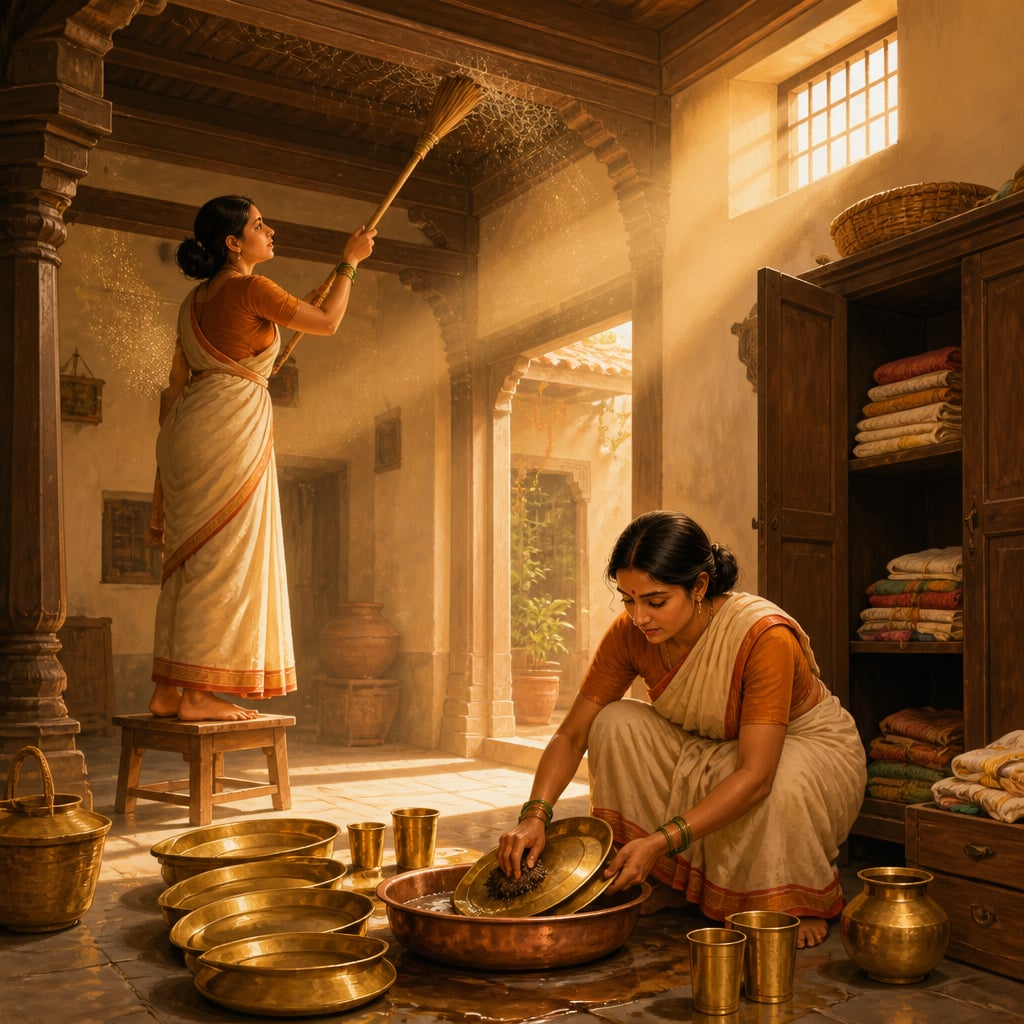
दिवाली से दो हफ्ते पहले, नागपुर के एक घर में
अक्टूबर के अंत में, 1990 के दशक की शुरुआत। एक नौ साल का लड़का नागपुर के एक दो मंजिला घर की सीढ़ी के नीचे की सीढ़ी पर बैठा है। ऊपर से निरंतर गतिविधि की आवाज आ रही है। उसकी दादी ऊपरी मंजिल के कमरे में एक छोटे लकड़ी के स्टूल पर खड़ी है। उसके हाथ में एक लंबी बांस की झाड़ू है जो पुराने कपड़े से बंधी है। वह छत और दीवार के कोने से मकड़ी के जाले साफ कर रही है। उसकी माँ उसी कमरे के फर्श पर है। हर अलमारी खुली है। हर साड़ी, हर स्टील की डिब्बी, उसकी हर पुरानी किताब उसके आस-पास ढेर में है। रसोई में रेडियो बज रहा है। प्रेशर कुकर चार बार सीटी बजा चुका है।
लड़का घर के हर बड़े-बुजुर्ग के रास्ते में है, इसलिए उसे सीढ़ी पर बैठने और न हिलने के लिए कहा गया है। वहां से वह रसोई की मेज पर पीतल की दीपक देख सकता है जो साल में सिर्फ एक बार निकाली जाती है। उसके बगल में कपूर का एक छोटा डिब्बा और नई कपास की बत्तियों का एक बंद पैकेट। सीढ़ी के नीचे उसका चाचा पुरानी टीन की पेटियां बाहर निकाल रहा है। "फेंक, फेंक," दादी ऊपर से बार-बार पुकार रही है। "लक्ष्मी नहीं आती गंदे घर में।" लक्ष्मी गंदे घर में नहीं आती। लड़का अपने बचपन के हर साल अक्टूबर से मध्य नवंबर तक यह वाक्य सुनेगा।
यह पाठ उस पखवाड़े के बारे में है। हिंदू घर तीन हजार साल से हर साल एक पूरे घर की गहरी सफाई करते आए हैं। यह एक धार्मिक कर्तव्य है। इसे लगभग चौदह दिनों में पूरा किया जाता है और धनतेरस को खत्म किया जाता है, जो दिवाली के पाँच दिवसीय क्रम का दूसरा दिन है। सफाई वैकल्पिक नहीं है। यह काम नहीं है। यह देवी के लिए पूर्वापेक्षा है। वही घर जो रोज सीमा को धोता है और भोर में आंगन को झाड़ता है, साल में एक बार पूरे घर को तोड़कर फिर से जोड़ता है। गहरी सफाई कैलेंडर में सबसे बड़ी शुद्धि है।
ज्यादातर आधुनिक दुनिया दिवाली को प्रकाश का त्योहार कहती है। लेकिन बहुत कम लोग जानते हैं कि दीये सिर्फ उस घर में जलाए जाते हैं जो पिछले पखवाड़े में अंदर से बाहर तक फिर से बनाया गया हो। मोमबत्तियां नतीजा हैं। सफाई प्रथा है। यह पाठ सफाई के बारे में है।
सारे भारत में यह प्रथा
दिवाली से पहले की गहरी सफाई के पास अलग-अलग क्षेत्रों में एक पहचानी जानी वाली आकृति है, लेकिन स्थानीय भिन्नताएं भी हैं।
महाराष्ट्र और कोंकण में, सफाई दिवाली से लगभग दो हफ्ते पहले शुरू होती है। यह अक्सर पितृ पक्ष के अंत और नवरात्रि की शुरुआत के साथ मेल खाती है। घर की दीवारों को सफेद रंग से पोता जाता है (पुराने गांव के घरों में) या कपड़े से पोंछा जाता है (आधुनिक अपार्टमेंटों में)। हर अलमारी खाली की जाती है। बिस्तर, कपड़े, रसोई के बर्तन, फोटो के फ्रेम और किताबें सब निकाली जाती हैं, छांटी जाती हैं और या तो धोई जाती हैं, चमकाई जाती हैं, दान दी जाती हैं या फेंक दी जाती हैं। पीतल और चांदी को इमली के पेस्ट और राख से चमकाया जाता है (या आधुनिक घरों में, पीतांबरी के साथ, जो भारतीय पॉलिश है)। धनतेरस पर, ताजी रंगोली हर दरवाजे पर बनाई जाती है। नए दीये सीमा पर रखे जाते हैं। प्रवेश द्वार को आम के पत्तों और गेंदे के फूलों की तोरण से सजाया जाता है। देवरा (घर की पूजा की जगह) को साल का पहला नया दीया मिलता है।
तमिलनाडु और आंध्र प्रदेश में, यह पखवाड़ा धनतेरस के बजाय नरक चतुर्दशी से जुड़ा हुआ है। सफाई अभ्यंग स्नान में समाप्त होती है। यह नरक चतुर्दशी की सुबह जल्दी किया जाने वाला तेल से नहाना है। यह सब एक घर में होता है जो पूरे हफ्ते झाड़ा, पोंछा और सजाया गया है। अरवनै पाड़ी (घर के सामने रंगोली का कालीन) रोज सात दिन तक बनाई जाती है। अनाज के डिब्बों को, चावल और दाल की पानी की बाल्टियों को खाली किया जाता है। पुरानी अनाज निकाली जाती है। नई फसल की अनाज डाली जाती है। डिब्बों को नीम के पानी से धोया जाता है और फिर भरा जाता है।
बंगाल में, जहां मुख्य दिवाली त्योहार काली पूजा है, सफाई कम लेकिन उतनी ही अच्छी होती है। यह ठाकुर दालान (घर की पूजा की जगह) और केंद्रीय आंगन पर केंद्रित होती है। पंजाब और हरियाणा में, सफाई करवा चौथ की तैयारी के साथ चलती है और मुख्य दिवाली की रात को घर के लक्ष्मी पूजन के साथ समाप्त होती है। गुजरात में, जहां दिवाली सप्ताह बेस्तु वरस के साथ खत्म होता है (कार्तिक शुक्ल प्रतिपदा पर गुजराती नव वर्ष), गहरी सफाई पुरानी वित्तीय वर्ष को बंद करने और नई खोलने जैसी है। व्यापारी अपनी पुरानी खाते की किताबें बंद करते हैं और चोपड़ा पूजन समारोह में नई खोलते हैं। घर पुरानी साल की बढ़त को बंद करता है और अगले साल के लिए एक साफ खाता खोलता है।
हर क्षेत्र में गहरी सफाई के अंदर तीन उप-प्रथाएं चलती हैं।
पहली है अनाज का रोटेशन। चावल, दाल, गेहूं और बाजरे की बाल्टियों को पूरी तरह खाली किया जाता है। बचा हुआ अनाज झाड़ा जाता है। बाल्टियों को धोया जाता है और धूप में सूखाया जाता है। नई फसल की अनाज (दिवाली ज्यादातर भारत में मानसून के बाद की खरीफ फसल के साथ मेल खाती है) डाली जाती है। जो पुरानी अनाज खपत नहीं हुई, वह दान के रूप में घर की सहायिका या मंदिर को दी जाती है। घर नई साल की शुरुआत ताजी स्टॉक और साफ अनाज के भंडार से करता है।
दूसरी है पीतल और चांदी की पॉलिशिंग। घर के हर पीतल और चांदी के बर्तन को, पूजा के बर्तन समेत, रोजमर्रा के रसोई के बर्तन, दीपक के स्टैंड और पारिवारिक विरासत की प्लेटों को दर्पण की तरह चमकाया जाता है। पूजा के बर्तनों को खास तरह से तैयार किया जाता है, लक्ष्मी पूजन की रात को देवी को प्राप्त करने के लिए।
तीसरी है वस्त्र की नई खरीदारी। नए कपड़े खरीदे जाते हैं, अक्सर धनतेरस पर (जो सोने या चांदी की खरीदारी का भी दिन है)। पुराने कपड़े जो अभी उपयोगी हैं दान दिए जाते हैं। जो अब नहीं हैं, फेंक दिए जाते हैं। बिस्तरों को धोया जाता है। पर्दों को उतारा जाता है, झाड़ा जाता है और फिर लगाया जाता है। ताजी रंगोली के रंग खरीदे जाते हैं। ताजी बत्तियां बनाई या खरीदी जाती हैं। दिवाली की रात, घर अपने सर्वश्रेष्ठ कपड़ों में होता है। सबसे साफ फर्श पर बैठा होता है। सबसे चमकीले कमरे में। नए दीये के साथ।

धर्मग्रंथ क्या कहते हैं
दिवाली की गहरी सफाई का धार्मिक आधार कई परतों में है। पद्म पुराण, स्कंद पुराण और भविष्य पुराण में सब में विस्तृत दिवाली के कथन हैं। स्कंद पुराण धनतेरस को धनवंतरि का दिन कहता है। धनवंतरि दिव्य चिकित्सक हैं। वे समुद्र मथन से निकले हैं। अमृत का कलश लेकर निकले हैं। उसी मथन से लक्ष्मी भी निकलीं। दिवाली अमावस्या को। घर सफाई करता है क्योंकि धन की देवी इस रात अपना घर चुन रही हैं।
गृहं स्वच्छं विधायाथ दीपान् प्रज्वालयेद् बहून्।
gṛhaṃ svacchaṃ vidhāyātha dīpān prajvālayed bahūn
घर को साफ करके फिर कई दीये जलाने चाहिए।
पद्म पुराण, उत्तर खंड, दिवाली व्रत कथा
श्लोक अपने क्रम में बिल्कुल सटीक है। सफाई पहले आती है। दीये बाद में। दीये सफाई का नतीजा हैं। गंदे घर में चमचमाते दीये नहीं होते। साफ घर में एक दीया ही काफी है। पद्म पुराण इसे दिवाली के कथन में कई जगह दोहराता है। सफाई को अधिकार कहता है। यानी योग्यता। घर को देवी के लिए योग्य बनाने वाली क्रिया।
भविष्य पुराण एक और सिद्धांत जोड़ता है। लक्ष्मी-अलक्ष्मी का सिद्धांत। लक्ष्मी भाग्य की देवी हैं। उनकी बहन हैं अलक्ष्मी। अलक्ष्मी दुर्भाग्य की देवी हैं। अलक्ष्मी गंदगी में रहती हैं। अव्यवस्था में। अलमारियों की अव्यवस्था में। उन कोनों में जहां झाड़ू नहीं लगती। लक्ष्मी उस घर में नहीं आएंगी जहां अलक्ष्मी रहती हैं। दिवाली से पहले की सफाई एक बहन को निकालने और दूसरे के लिए जगह बनाने जैसी है। नरक चतुर्दशी की रात को, कई परंपराओं में, अलक्ष्मी की मूर्ति को सुबह की झाड़ू से सांकेतिक रूप से घर से बाहर निकाला जाता है।
अथर्ववेद में पुरानी बातें हैं। अथर्ववेद 12.1, भूमि सूक्त, पृथ्वी को घर की जीवंत आधार कहता है। यह पूछता है कि उसकी सतह को साफ रखकर सम्मानित किया जाए। अथर्ववेद 7.115 एक झाड़ा हुआ और व्यवस्थित घर की सुरक्षात्मक शक्तियों का आह्वान करता है। बुरी किस्मत के खिलाफ। वैदिक तर्क पुरैणिक लक्ष्मी-अलक्ष्मी कथा से हजार साल पहले का है। गृहस्वामी घर साफ करता है क्योंकि घर ही एक पवित्र स्थान है। सिर्फ इसलिए नहीं कि लक्ष्मी आ रही हैं।
वराहमिहिर का बृहत् संहिता, छठी सदी का वैदिक इंजीनियरिंग का विश्वकोश, हर मौसम की शुरुआत में पूरे घर की सफाई की सलाह देता है। ऋतु शोधन कहते हैं। खास तौर पर किसी भी बड़े उत्सव से पहले। पाठ सामग्री को नाम देता है: फर्शों के लिए गाय की खाद का पेस्ट। दीवारों के लिए हल्दी का पानी। कोनों के लिए ताजी कुश घास। हवा के लिए सूखी जड़ी-बूटियों का धुआं। लोबान, गुग्गुल, धूप। हर सामग्री का नाम उसके प्रतीकात्मक और जीवाणुरोधी दोनों कारणों के लिए दिया गया है।
प्रतीकवाद
गहरी सफाई कई परतों का प्रतीकवाद रखती है।
सतह पर, यह देवी के लिए तैयारी है। घर वह शरीर है जिसमें लक्ष्मी अगले साल रहेंगी। साफ शरीर दिव्य निवास की पूर्वापेक्षा है। पीतल को इसलिए चमकाया जाता है क्योंकि देवी अपना प्रतिबिंब देखती हैं। फर्श को इसलिए धोया जाता है क्योंकि वह नंगे पैरों चलती हैं। सीमा को इसलिए सजाया जाता है क्योंकि वह उसे पार करती हैं।
एक परत और गहरी, सफाई निष्कासन है। अलक्ष्मी को नाम दिया जाता है। ढूंढा जाता है। निकाला जाता है। हिंदू घर दुर्भाग्य को सिर्फ रूपक नहीं मानता। इसे एक मौजूदगी माना जाता है जो गंदगी में, गड़बड़ी में, टूटे हुए बर्तनों में, जमा किए गए सामानों में रहती है। सालाना सफाई सालाना निष्कासन है। घर को बताया जाता है कि कौन स्वागत है और कौन नहीं।
एक परत और गहरी, सफाई कैलेंडर है। दिवाली कार्तिक अमावस्या को आती है। फसल के मौसम के अंत में। हिंदू साल का संरचनात्मक बिंदु। गहरी सफाई कैलेंडर को घर पर लिखना है। घर एक सालाना चक्र बंद करता है और दूसरा खोलता है। व्यापारी अपनी पुरानी खाते की किताब बंद करता है और नई खोलता है। अनाज की बाल्टी पिछले साल के स्टॉक से खाली की जाती है और इस साल की फसल से भरी जाती है। शरीर को नरक चतुर्दशी की सुबह नहाया जाता है जैसे उसी अंत को चिन्हित करने के लिए। सफाई कैलेंडर की वास्तुकला को भौतिक रूप में बनाती है।
सबसे गहरी परत शोधन है। संस्कृत सफाई, शुद्धिकरण और परिमार्जन को एक ऑपरेशन मानता है। शोधन शब्द घर की सफाई के लिए, शरीर की सफाई पंचकर्म में, धातुओं की शुद्धि आयुर्वेद और रसायन विज्ञान में, और ध्यान में मन के परिमार्जन के लिए एक जैसे इस्तेमाल होता है। दिवाली से पहले की गहरी सफाई परंपरा द्वारा हर स्तर पर चलाए जाने वाले ऑपरेशन का घर-स्तर का उदाहरण है। वही मन जो कमरे के कोने को साफ करता है, वही मन दिल के कोने को साफ करता है।
शरीर क्यों प्रतिक्रिया करता है
दिवाली की गहरी सफाई की आदत की संरचना असाधारण रूप से अच्छी तरह से इंजीनियर की गई है।
संकेत स्पष्ट है। त्योहार की तारीख चंद्र कैलेंडर द्वारा निर्धारित होती है। घर हर पड़ोसी, हर रिश्तेदार, हर दुकान और मंदिर से टूटे बिना इससे बाहर नहीं निकल सकता। दो हफ्ते की तैयारी सब लोगों द्वारा एक साथ दिखाई जाती है। बाजार नए बर्तनों से भर जाते हैं। रंगोली की दुकानें ताजे रंग निकालती हैं। मिठाई की दुकानें दिवाली की पेटियों का विज्ञापन करती हैं। रिश्तेदार पूछते हैं कि सफाई कब शुरू होगी। संकेत पर्यावरणीय, सामाजिक और समय के संदर्भ में एक साथ है। इसे मिस करना असंभव है।
रूटीन पखवाड़े के दौरान प्रबंधनीय रोजाना ब्लॉकों में विभाजित किया जाता है। रसोई के लिए एक दिन। बैठक के लिए एक दिन। हर कमरे के लिए एक दिन। पूजा की वेदी के लिए एक दिन। भंडारण के लिए एक दिन। घर पूरे काम का सामना एक बार में नहीं करता। हर दिन एक छोटा ब्लॉक। यह विभाजन वही सिद्धांत है जो बीजे फॉग टिनी हैबिट्स में बताते हैं। एक व्यवहार स्थायी होता है जब इसे सबसे छोटी इकाई में तोड़ा जाता है जो बिना प्रतिरोध के की जा सकती है।
पुरस्कार कई परतों में है। एक साफ कमरे का तुरंत संवेदी पुरस्कार है। त्योहार के दौरान आने वाले रिश्तेदारों से घर की चमक पर टिप्पणी करने का सामाजिक पुरस्कार है। दिवाली की रात को ताजी धुली वेदी पर नया दीया रखने का प्रतीकात्मक पुरस्कार है। नई साल को साफ खाते से शुरू करने का कैलेंडर पुरस्कार है। वेंडी वुड गुड हैबिट्स, बैड हैबिट्स में बताती हैं। वह गहरा मनोवैज्ञानिक पुरस्कार है जो पर्यावरणीय प्राइमिंग है। साफ किया गया वातावरण अगले कई हफ्तों तक सफाई करने वाले को पुरस्कृत करता रहता है। हर बार जब वह उससे गुजरता है।
प्रथा पहचान को एंकर करने पर भी बहुत मजबूत चलती है। चार्ल्स ड्युहिग द हैबिट में बताते हैं। पहचान आदत का सबसे टिकाऊ आधार है। एक व्यक्ति जो खुद को धार्मिक गृहस्वामी मानता है, हर साल गहरी सफाई करेगा। इसे न करना खुद की छवि का उल्लंघन होगा। सालाना प्रथा ही एंकर है। इसे एक बार छोड़ने से साल भर का कम-स्तरीय असहजता पैदा होती है। इसे करने से उस तरह के व्यक्ति की पुष्टि मिलती है जो कैलेंडर को रखता है। हिंदू घर ने दिवाली की गहरी सफाई में एक पहचान-जुड़ी, पर्यावरणीय रूप से संकेत दी गई, सामाजिक रूप से मजबूत, कैलेंडर-लॉक की गई, ब्लॉकों में विभाजित व्यवहार बनाया है। यह पीढ़ियों के बीच विश्वसनीयता से चलता है। कोई ऊपरी-नीचे की जबरदस्ती नहीं।
प्रयोगशालाओं ने क्या पाया
आधुनिक शोध साहित्य ने पिछले बीस सालों में कई कोणों से गहरी सफाई को सही साबित किया है।
सबसे ज्यादा हवाला दिया जाने वाला एक अध्ययन रोस्टर, फेरारी और जुर्कट 2016 है। यह व्यक्तित्व और सामाजिक मनोविज्ञान बुलेटिन में प्रकाशित हुआ। इसने घर में गंदगी और कोर्टिसोल के बीच संबंध को मापा। एक नमूने में गृहस्वामियों को लिया गया। अध्ययन में पाया कि घर में गंदगी महिला गृहस्वामियों में कोर्टिसोल को काफी बढ़ाती है। नियमित सफाई चक्र तनाव के संकेतों को कम करते हैं। एक और नियंत्रित वातावरण अध्ययन यूसीएलए में सैक्सबे और रिपेट्टी 2010 ने किया। व्यक्तित्व और सामाजिक मनोविज्ञान बुलेटिन में। रहने की जगह में कम वस्तु-घनत्व कम शाम के कोर्टिसोल से जुड़ा था। सालाना गहरी सफाई, इस साक्ष्य पर, एक प्रमाणित मनोवैज्ञानिक स्वच्छता हस्तक्षेप के रूप में काम करती है। सिर्फ एक प्रतीकात्मक प्रथा नहीं।
रोजर्स और हार्ट 2021 का अध्ययन इनडोर एयर में प्रकाशित हुआ। इसने नहीं धुली सतहों, जमी धूल और गंदगी को ऊंचे इनडोर मोल्ड-स्पोर और धूल-घुन की गिनती से जोड़ा। और इन्हें निवासियों में श्वसन लक्षणों से जोड़ा। सालाना गहरी सफाई इन गिनती में काफी कमी लाती है। फर्शों और बाल्टियों को धोने के लिए नीम के पानी का उपयोग (बृहत् संहिता में बताया गया है और दक्षिणी घरों में अब भी आम है) को सुबप्रिया और नागिनी 2005 में स्वतंत्र रोगाणुरोधी सत्यापन मिला। करंट मेडिसिनल केमिस्ट्री में। नीम की व्यापक-स्पेक्ट्रम जीवाणु-विरोधी और कवक-विरोधी गतिविधि को सूचीबद्ध किया गया।
सफाई की धुआं शुद्धिकरण परत जिसमें सूखी जड़ी-बूटियां जली जाती हैं को वही सत्यापन मिला। लोबान, गुग्गुल, संबरानी। नॉटियल एट अल 2007 ने जर्नल ऑफ एथनोफर्माकोलॉजी में हवन धुएं के लिए दस्तावेज किया। एक मापा सत्तानबे प्रतिशत कमी हवा में जीवाणु वर्तनी की गिनती में एक बंद कमरे में। कमी तीस दिनों तक बनी रही। दिवाली की गहरी सफाई ज्यादातर घरों में धूप जलाने के साथ समाप्त होती है। हर कमरे में। दीये जलाने से पहले अंतिम शुद्धिकरण के रूप में।
जैव घड़ी और ऋतु का तर्क कार्तिक अमावस्या पर गहरी सफाई को शेड्यूल करना, हिंदू साल का संरचनात्मक बिंदु। यह क्रोनोबायोलॉजी साहित्य के साथ मिलता है जिसने होल, रॉसबैश और यंग को 2017 का नोबल पुरस्कार जीता। मानव शरीर विज्ञान चंद्र और सौर चक्र पर चलता है। बड़े व्यावहारिक परिवर्तन सबसे प्रभावी होते हैं जब कैलेंडर बिंदुओं पर शेड्यूल किए जाते हैं जो शरीर की अपनी घड़ियां पहचानती हैं। गहरी सफाई घर के पैमाने पर एक जैव घड़ी हस्तक्षेप है।
दुनिया अब इसे क्या कहती है
2014 में, जापानी सलाहकार मारी कोंडो ने लाइफ-चेंजिंग मैजिक ऑफ टाइडिंग अप प्रकाशित किया। किताब एक वैश्विक घटना बन गई। 2019 तक इसके 13 मिलियन प्रतियां बिक चुकी थीं। नेटफ्लिक्स ने 2019 में एक मारी कोंडो शो जारी किया। कोंडो का ब्रांड, कॉन-मारी, लाइसेंस सलाह, किताबें और प्रमाणित-सलाहकार शुल्क में दसियों मिलियन डॉलर उत्पन्न करता है। कॉन-मारी विधि के मुख्य निर्देश हैं: हर अलमारी खाली करो। हर चीज पकड़ो। पूछो कि क्या यह खुशी देती है। जो नहीं करता उसे फेंक दो। बाकी को ताजी साफ जगह में रखो। फ्रेमिंग जापानी शिंतो शुद्धिकरण को आत्मिक आधार के रूप में संदर्भित करता है। किताब, शो और ब्रांड दिवाली, लक्ष्मी, पद्म पुराण या हिंदू घर में इसी ऑपरेशन की तीन हजार साल की निरंतर परंपरा का उल्लेख नहीं करते।
समानता संरचनात्मक है। कॉन-मारी की पूरे घर की जांच हिंदू गहरी सफाई है। कॉन-मारी की अप्रयुक्त वस्तुओं की रिहाई हिंदू दान है। पुरानी अनाज और पुराने वस्त्रों की। कॉन-मारी का व्यवस्था की बहाली ताजी चमकाई गई पीतल और सीमा पर नई रंगोली है। शिंतो संदर्भ जहां तक जाता है सच है। शिंतो सफाई प्रथाएं मौजूद हैं। लेकिन चूक यह है कि हिंदू घर समान प्रोटोकॉल सालाना चला रहा है। पुरैणिक आदेश द्वारा। कम से कम तीन हजार सालों के लिए। फसल के अंत में चंद्र अमावस्या पर कैलेंडर लॉक किया गया। एक देवी इस प्रथा के केंद्र में।
रसीदें और भी तीक्ष्ण हैं। वैश्विक पेशेवर डिक्लुटरिंग सेवाएं उद्योग का अनुमान 2023 तक सालाना एक अरब डॉलर से अधिक है। अपार्टमेंट थेरेपी, रियल सिंपल और आर्किटेक्चरल डाइजेस्ट शरद ऋतु की गहरी सफाई पर सालाना सुविधा चलाते हैं। लगभग हमेशा अक्टूबर या नवंबर में। लगभग हमेशा दिवाली का नाम दिए बिना। द होम एडिट, रीज विदरस्पून की सहायता के साथ संगठन ब्रांड, नेटफ्लिक्स शो चलाता है। प्रीमियम कीमतों पर सलाह बेचता है। घर की प्रथा जो भारतीय आंटी ने मुफ्त में हर अक्टूबर में रिकॉर्डेड इतिहास के दौरान की है, अब सलाहकार नेतृत्व वाली सेवा परत है।
कंटेनर स्टोर (एक अरब डॉलर से अधिक सालाना राजस्व), आईकेईए का भंडारण विभाग, पश्चिमी न्यूनतमवाद कल्याण आंदोलन। प्रत्येक एक समान अंतर्निहित आवेग के निचले हिस्से में है। घर ने जितना हो सकता था उससे अधिक जमा किया है। जमा होने ने व्यवस्था बिगाड़ी है। व्यवस्था महसूस की गई लागत बनाती है। समाधान के लिए वही सालाना ऑपरेशन की जरूरत है जो हिंदू घर सहस्राब्दियों से चला रहा है। जो उत्पाद हिंदू परंपरा ने पैकेज किया था कैलेंडर-लॉक के रूप में, देवी-जुड़ा, परिवार द्वारा निष्पादित, मुफ्त-लागत प्रथा। आधुनिक कल्याण संगठन उद्योग ने अनबंडल किया है। अब वापस बेच रहा है। एक सलाहकार सत्र एक बार में। एक स्टोरेज बिन एक बार में।
यह शिकायत नहीं है। रसीदें प्रथा की पुष्टि करती हैं। वह घर जो हमेशा दिवाली की गहरी सफाई करता आया है, 13 मिलियन प्रतियों या नेटफ्लिक्स शो से बदतर नहीं होता है। धार्मिक गृहस्वामी का काम छोटा और स्पष्ट है। प्रथा को करते रहो। मूल नाम का उपयोग करो।
अपने लिए इसे क्या कहें
अंग्रेजी मुहावरा दिवाली सफाई स्वीकार्य है। संस्कृत फ्रेम अधिक सटीक है। दिवाली शोधन। या, पूरे अनुष्ठान संदर्भ के साथ। लक्ष्मी-प्राप्ति शोधन। सफाई जो लक्ष्मी के आने के लिए घर को तैयार करती है। मराठी घर पखवाड़े को दिवाली-ची सफाई कहते हैं। तमिल घर नरक चतुर्दशी के नहाने की सुबह को नरक चतुर्दशी स्नानम कहते हैं। और सात दिनों पहले को सफाई की खिड़की मानते हैं। गुजराती व्यापारी किताबों को बंद करने को चोपड़ा पूजन कहते हैं। नई किताब खोलने को बेस्तु वरस कहते हैं।
जब बातचीत कॉन-मारी तक पहुंचे, तो जवाब एक शांत वाक्य है। "यह दिवाली शोधन है। पद्म पुराण इसे बताता है। हिंदू घर इसे तीन हजार सालों से चला रहा है।" पीतल का बर्तन। चमकाई गई वेदी। सीमा पर ताजी रंगोली। दरवाजे पर छोटा दीया। ये रसीदें हैं। किताब रसीद है। घर मूल है।

पखवाड़ा दीये के साथ बंद होता है
नागपुर के घर में, दिवाली की सुबह, लड़का सुबह चार बजे जागता है। पूरा घर जागा है। दादी रसोई में है। सब के लिए तिल के तेल से अभ्यंग स्नान करवा रही है। पीतल दर्पण की तरह चमकता है। सीमा की रंगोली ताजी है। मकड़ी के जाले गए हैं। अलमारियां संगठित हैं। अनाज की बाल्टियां नई फसल से भरी हैं। चांदी की पूजा की प्लेट वेदी पर है। चांदी की लक्ष्मी की मूर्ति बीच में। हर बिस्तर पर नए कपड़े। घर संरचनात्मक रूप से बिल्कुल अलग है। चौदह दिन पहले जिस घर में लड़का रहता था। उससे।
दादी घर की वेदी पर पहला दीया जलाती है। वह आंखें बंद करती है। एक वाक्य मराठी में बोलती है। "अता लक्ष्मी येऊ शक्ते।" अब लक्ष्मी आ सकती हैं।
जो पाठ घर सुबह लड़के को सिखाता है वह यह नहीं है कि सफाई सदगुण है। यह है कि कैलेंडर इसे चाहता है। धर्मग्रंथ इसे बताते हैं। देवी कारण है। शरीर इसमें प्रतिक्रिया करता है। और, तीन हजार साल और 13 मिलियन कॉन-मारी प्रतियां बाद में। भारतीय आंटी के पास रेसिपी थी इससे पहले कि कोई इसे बेचना शुरू करे। दिवाली की रात को दीये चमकते हैं क्योंकि घर को उन्हें प्राप्त करने के लिए पिछले पखवाड़े में फिर से बनाया गया था। सफाई प्रथा है। दीये नतीजा हैं।
हिंदू कैलेंडर अगले साल यह प्रोटोकॉल फिर से चलाएगा। दादी तब तक शायद लकड़ी के स्टूल पर बांस की झाड़ू के साथ नहीं होगी। प्रोटोकॉल उससे पुराना होगा। घर से। उस भाषा से जिसमें वह निर्देश देती है। लड़का तब वह होगा जो अपने बच्चों को बताएगा। कि लक्ष्मी गंदे घर में नहीं आती। पीतल को क्यों चमकाया जाता है। अनाज की बाल्टी को क्यों खाली किया जाता है। वंश शारीरिक रूप से चलता है। पखवाड़े दर पखवाड़े। दीया दर दीया। झाड़ू दर झाड़ू। हर कार्तिक अमावस्या। हर घर में जो अभी भी कैलेंडर रखता है।
Key figures
Varahamihira
c. 505-587 CE
Abu'l-Fazl ibn Mubarak
1551-1602 CE
Catherine A. Roster
Active 2000-present; principal clutter-and-stress work published 2010-2020
Case studies
मुगल दरबार में अकबर की दिवाली (अईन-ए-अकबरी, 16वीं सदी)
16वीं सदी के अंत में अबुल-फजल ने अईन-ए-अकबरी पूरा किया। अकबर के दरबार का दस्तावेज। दिवाली का जिक्र है। महल की सफाई। रोशनी। 40 हाथ ऊंचा दीया। केंद्रीय आंगन में। घर की तैयारी। दिवाली को नवरोज और ईद के साथ एक पंक्ति में रखा है। दिवाली सिर्फ व्यापारियों का पर्व नहीं है। यह मुगल साम्राज्य का राजकीय पर्व है।
The Diwali deep clean's institutional history is older and broader than the modern household scale alone suggests. The Ain-i-Akbari record places the practice in the Mughal imperial chronicle, with state-level resources committed to its execution. The cleaning was a public, ceremonial, calendar-locked operation that touched merchant households, common households, and the imperial palace alike. The modern KonMari book has a thirteen-million-copy print run and a Netflix show. The Diwali deep clean has a Mughal imperial chronicle, a Padma Purana citation, and an Atharva Veda anchor. The receipts are not contemporary.
The Ain-i-Akbari remains the principal sixteenth-century external chronicle of Mughal household and ceremonial practice, used by every modern historian of the period. The Diwali deep clean continued, after Akbar's reign, through the later Mughal period, the Maratha confederacy, the colonial era, and into post-independence India, transmitted by household custom rather than state mandate. The akash deepa tradition, the forty-cubit-pole-lamp Akbar installed at Fatehpur Sikri, is preserved in modified form in many western Indian households as the household pole-lamp lit on the first day of Diwali.
The dharmic household practice has chronicle history at the imperial scale. The framing of these rituals as folk custom, recovered or rediscovered by Western consultants, ignores the documented record of state-level institutional practice across centuries. The receipts for Diwali cleaning's institutional weight are in the sixteenth-century Mughal administrative manual, not in twenty-first-century wellness consulting.
Every modern claim that Diwali cleaning is a regional folk custom can be answered with one citation. The Mughal imperial chronicle had it documented in state-level detail four centuries ago. The Padma Purana had it specified a thousand years before that. The Atharva Veda's substrate is older still.
The Ain-i-Akbari (c. 1590 CE) documents Akbar's celebration of Diwali at the Mughal imperial court, including palace cleaning and illumination, the akash deepa on a forty-cubit pole, and full household preparations. The text was completed approximately four hundred and twenty years before Marie Kondo's first English-language book.
Marie Kondo's The Life-Changing Magic of Tidying Up (2014, 13M copies)
In 2014, the English-language edition of the Japanese consultant Marie Kondo's The Life-Changing Magic of Tidying Up was published. The book became a global phenomenon, selling over thirteen million copies by 2019. Netflix released the Marie Kondo show in 2019. The KonMari brand generated tens of millions of dollars in licensed consulting, books, and certified-consultant training fees. The KonMari method's prescribed annual home declutter parallels the Diwali deep clean in structure: empty every cupboard, hold every object, ask whether it sparks joy, discard what does not, return the rest to a freshly cleaned space. The book references Japanese Shinto purification as the spiritual basis. The book, the show, and the brand do not mention Diwali, Lakshmi, the Padma Purana, the Sri Sukta, the Brihat Samhita's rtu-shodhana, or the three-thousand-year continuous tradition of the same operation in the Hindu household. The global professional decluttering and home-organisation services industry, downstream of the KonMari wave, crossed an estimated one billion dollars annually by 2023.
The Marie Kondo book is the cleanest documented case in the modern record of an annual household reset ritual reaching mainstream Western shelves with the dharmic lineage surgically removed. The structure is intact: whole-home audit, release of unused items, restoration of order, calendar-anchored execution. The lineage is removed: no Diwali, no Lakshmi, no Padma Purana, no Sri Sukta, no Brihat Samhita. The KonMari method's Shinto reference is honest as far as it goes, but the omission of the larger and older Hindu tradition that has run the same protocol annually, by Puranic prescription, for three thousand years, is the receipt being filed. The dharmic household's job is small and clear: keep running the Diwali shodhana, and use the original name.
The KonMari brand and the Marie Kondo show normalised the annual home-reset practice for a Western audience that had largely lost it. The Indian household that has always done the Diwali deep clean was not made worse by the book; it was, indirectly, validated by the global appetite for the protocol. The professional decluttering industry, the storage products industry (The Container Store at over a billion dollars in annual revenue, IKEA's storage division, The Home Edit at premium consulting tiers), and the autumn deep-clean editorial cycle in Apartment Therapy, Real Simple, and Architectural Digest are each downstream of the same impulse. The receipts confirm the practice. The naming has been replaced.
The market rewards the rebrander, not the source. The dharmic household's job is not to sue Marie Kondo. The job is to use the original word. Diwali shodhana, not KonMari method. Lakshmi-prapti shodhana, not autumn deep clean. The naming is the lineage. The lineage is the receipt. The brass pot, the polished altar, the freshly drawn rangoli at the threshold, and the first lamp at the doorway, lit on Dhanteras evening, are the original. Talapatram's Sanatan Operating System course, in this lesson, is filing the receipt.
Use the original word in conversation. When the friend says she is going to KonMari her closet this weekend, you say you are running the Diwali shodhana. When the magazine cover says autumn deep clean, you say Lakshmi-prapti shodhana. The labs are catching up; the books are selling; the only thing that completes the loop is the name. Diwali shodhana, not KonMari method. The Padma Purana had the recipe before any consultant began charging for it.
Marie Kondo's The Life-Changing Magic of Tidying Up (2014) has sold over thirteen million copies. The Netflix show launched in 2019. The global professional decluttering and home-organisation services industry exceeds one billion dollars annually as of 2023. The Padma Purana's Diwali-vrata-katha specified the same protocol approximately one thousand five hundred years ago. The Padma Purana is mentioned on zero KonMari product labels.
Roster 2016 and Saxbe-Repetti 2010: The Cortisol Cost of Clutter
In 2010, Darby Saxbe and Rena Repetti published a landmark study in Personality and Social Psychology Bulletin titled 'No Place Like Home: Home Tours Correlate With Daily Patterns of Mood and Cortisol.' The study, conducted at UCLA, recorded saliva-cortisol levels in homeowners and matched them against guided audio descriptions the homeowners gave of their own homes. Homeowners who described their homes as cluttered or unfinished showed elevated evening cortisol; homeowners who described their homes as restful or restorative showed lower cortisol. In 2016, Catherine Roster, Joseph Ferrari, and Mark Jurkat published 'The Dark Side of Home: Assessing Possession Clutter on Subjective Well-Being' in Personality and Social Psychology Bulletin, establishing that household clutter measurably elevates baseline cortisol in female homeowners and reduces self-reported life satisfaction; regular clearing cycles reduced the baseline stress markers. A 2021 study by Rogers and Hart in Indoor Air tied unwashed surfaces and clutter to elevated indoor mould-spore and dust-mite counts, correlated with respiratory symptoms in residents. The full pharmacology of the deep clean: reduced cortisol (Saxbe-Repetti, Roster), reduced respiratory burden (Rogers-Hart), reduced airborne bacteria from the dhoop-smoke purification stage (Nautiyal et al, Journal of Ethnopharmacology 2007). Each layer of the Diwali deep clean has independent peer-reviewed vindication.
The Sri Sukta's doctrine that Alakshmi dwells in dirt and clutter, and that her eviction is the precondition for Lakshmi's arrival, is the dharmic frame for what the Roster and Saxbe-Repetti studies measured at the molecular level. The clutter was always producing the cortisol; the cortisol was always producing the felt-sense of misfortune the tradition named as Alakshmi; the eviction of clutter was always producing the felt-sense of arriving abundance the tradition named as Lakshmi. The research vindication is total: the Vedic and Puranic frame, instrumented and confirmed. The Bhavishya Purana specified the principle; Roster measured it.
Household clutter and cortisol is now a recognised research domain, with over fifty peer-reviewed studies in the decade since the Saxbe-Repetti paper. The professional decluttering industry's growth from negligible in 2010 to over one billion dollars annually in 2023 reflects, in part, the slow diffusion of these findings into popular consciousness. The Diwali deep clean achieves the same cortisol reduction as a paid decluttering consultant, in the same fortnight, with no consulting fee, anchored to a calendar that does not require the household to remember when to schedule the work. The recipe is intact; the lineage is missing from the consultant's invoice.
The case for the tradition does not need to wait for the lab. The lab, when it arrives, will confirm what the tradition recorded. The Sri Sukta named the Lakshmi-Alakshmi doctrine in the Vedic period. The Padma Purana specified the cleaning protocol approximately fifteen hundred years ago. The Brihat Samhita codified the materials in the sixth century. The Saxbe-Repetti paper measured the mechanism in 2010. The Roster paper documented the clinical effect in 2016. Three independent records, four hundred to three thousand years apart, point to the same fortnight before the Kartik Amavasya.
Three thousand years of practice, fifteen hundred years of Puranic recipe specification, and over fifty peer-reviewed studies all point to the same fortnight before Diwali. The grandmother does not need to read the papers. She has the protocol. The papers are the receipt.
Saxbe and Repetti (2010, Personality and Social Psychology Bulletin) established that home-clutter descriptions correlate with elevated evening cortisol. Roster, Ferrari, and Jurkat (2016, Personality and Social Psychology Bulletin) established that household clutter measurably elevates cortisol in female homeowners and reduces self-reported well-being. Rogers and Hart (2021, Indoor Air) tied clutter to elevated indoor mould-spore and dust-mite counts. The Sri Sukta named the same doctrine approximately three thousand years earlier.
Historical context
वैदिक घर की प्रथा (1500 ईसा पूर्व) से पुरैणिक दिवाली संहिता (4वीं-10वीं सदी), मुगल दरबार का दस्तावेज (16वीं सदी), और आधुनिक कल्याण उद्योग की खोज (2014 से आज)
दिवाली से पहले की गहरी सफाई भारतीय सभ्यता की सबसे स्थिर घरेलू संस्था है। तीन हजार सालों में, वैदिक, मौर्य, गुप्त, पाल, चोल, विजयनगर, मुगल, मराठा और औपनिवेशिक काल में। हर कार्तिक अमावस्या को घर अलमारियां खाली करता है। दीवारें धोता है। पीतल चमकाता है। अनाज घुमाता है। सीमा पर पहला दीया जलाता है। प्रथा सभी क्षेत्रों में, सभी लोगों में, सभी आर्थिक स्थितियों में चली। महिलाओं के द्वारा सौंपी गई। औपनिवेशिक काल में शहरों में टूटी लेकिन गांवों में बनी। 1990-2000 में अपार्टमेंटों में समय कम किया लेकिन प्रथा बनी। 2014-2024 में पश्चिम ने कॉन-मारी ब्रांड के नाम से यही की। 13 मिलियन किताबें। नेटफ्लिक्स शो। संस्कृत के नाम हटा दिए। देवी का उल्लेख नहीं। धार्मिक घर का काम सरल है। हर कार्तिक अमावस्या को प्रथा करो। सच्चा नाम इस्तेमाल करो।
Living traditions
The pre-Diwali deep clean is no longer a Hindu household secret. Marie Kondo's The Life-Changing Magic of Tidying Up, with its thirteen million copies and Netflix show, is its modern echo. The Container Store, IKEA storage, and The Home Edit are its retail echoes. The professional decluttering and home-organisation services industry, at over a billion dollars annually, is its consulting echo. Apartment Therapy, Real Simple, and Architectural Digest run the autumn deep-clean editorial cycle without naming Diwali. The dharmic tradition's job is small and clear. When the friend says she is going to KonMari her closet, you say you are running the Diwali shodhana. When the magazine cover says autumn deep clean, you say Lakshmi-prapti shodhana. When the consultant invoices for whole-home decluttering, you say the Padma Purana specified the protocol fifteen hundred years ago. The labs have arrived. The Saxbe-Repetti paper arrived in 2010. The Roster paper arrived in 2016. The Padma Purana had it specified before any of them. The grandmother is still winning the argument she never bothered to start. Use the names. The brass pot, the polished altar, the freshly drawn rangoli at the threshold, the new lamp on Dhanteras evening, are the receipts. Talapatram's Sanatan Operating System course, in the Griha chapter, is the manual for the household the brass pot belongs to. Every ritual, every receipt, every Kartik Amavasya.
- The Pre-Diwali Fortnight Deep Clean: The household tradition of running a complete two-week deep clean of every room in the house in the fortnight preceding Diwali, with the work decomposed into daily blocks: one day for the kitchen, one day for the living room, one day for each bedroom, one day for the puja altar, one day for the storage. Cupboards are emptied and re-sorted; walls are wiped or whitewashed; brass and silver are polished; cobwebs are swept; bedding and curtains are washed; old clothes and unused objects are donated or discarded. The work culminates on Dhanteras evening with the lighting of the first lamp at the freshly cleaned threshold.
- Annual Grain Bin Rotation and Naya Anaaj: The household tradition of emptying every grain bin (rice, dal, wheat, millet) entirely in the days before Diwali, sweeping out the residue, washing the bins with neem water, drying them in the sun, and refilling with the new harvest grain (Diwali aligns with the post-monsoon Kharif harvest in most of India). The old grain that has not been consumed is given as daana (charity) to the household helper or to the temple. The first cooking from the new harvest, often a kheer or a sweet rice preparation, is offered as naivedya at the home altar before the household consumes it. The grain bin is the household's physical food security; its annual reset is the calendar's largest material renewal.
- Brass and Silver Polish for Lakshmi Puja: The household tradition of polishing every brass and silver vessel in the house, with particular attention to the puja vessels (kalasha, panchpatra, aarti thali, lamps), in the days before Diwali. Traditional polishing uses tamarind paste, ash, and lemon juice; modern households use Pitambari powder, Brasso, or commercial polishes. The puja vessels especially are polished to abhishekam-quality mirror finish, ready to receive the goddess on Lakshmi Puja night. The kitchen brass (the kalachi, the dabba, the gilas) is polished for daily use; the family heirloom silver (the puja plate, the silver Lakshmi murti, the silver kalasha) is polished and dressed in silk or velvet wraps before being placed on the altar.
- Dhanvantari Temple, Thottuva, Kerala: One of the principal Dhanvantari temples in India, located on the banks of the Periyar river. The temple's main murti depicts Dhanvantari with four arms, holding the kalasha of amrita, a leech, the Atharva Veda, and a chakra, the iconographic specifications of the divine physician as recorded in the Markandeya Purana. The temple is at peak ritual intensity on Dhanteras (Dhanvantari Jayanti), when Vaidyas, Ayurvedic practitioners, and Diwali pilgrims from across Kerala and Tamil Nadu gather for the day's main puja. The temple is one of the few institutionalised Dhanvantari shrines and is the principal pilgrimage destination for the Diwali sequence's medical-divine framing.
- Mahalakshmi Temple, Kolhapur, Maharashtra: One of the eighteen Maha Shakti Peethas and the principal Mahalakshmi temple in western India. The temple's main murti, the Karaveera Mahalakshmi, is a four-armed standing form of the goddess holding the matulinga (citron), gada (mace), khetaka (shield), and panapatra (drinking vessel). The temple is at peak ritual intensity on Diwali Amavasya, when the household Lakshmi puja across Maharashtra is mirrored in the institutional puja at Kolhapur. The kiranotsava, the festival of the sun's rays striking the murti through the temple windows on three days each year (in Magha and Kartika), is one of the most precise architectural-astronomical alignments in any Indian temple. The Lakshmi Pancharatrika sequence at the temple, run across the five days of Diwali, is the most elaborate institutional reflection of the household pre-Diwali deep clean and Lakshmi Puja sequence.
- Pitambari Heritage Museum and Manufacturing Visit, Thane, Maharashtra: The headquarters and original manufacturing facility of Pitambari Products, the principal Indian household brass and copper polish brand, founded in 1946 by Vamanrao Prabhudesai. The Pitambari brand is the namesake polish of the dharmic household and is used across India and the diaspora as the standard pre-Diwali brass cleaner. The Thane manufacturing facility runs an annual heritage tour around Diwali (subject to advance booking), tracing the history of household brass-care from the traditional tamarind-paste-and-ash method documented in the Brihat Samhita through to the modern formulation. The visit is a contemporary institutional anchor for the brass-and-silver polish layer of the Diwali deep clean.
Reflection
- Of the three sub-rituals inside the Diwali deep clean (the cupboard-by-cupboard reset, the grain bin rotation, the brass and silver polish), which is closest to your current household practice, and which is most absent? What would change in your year if you reintroduced the missing one as a default before the next Kartik Amavasya?
- The Saxbe-Repetti paper measured in 2010 that household clutter elevates cortisol. The Sri Sukta named the same doctrine three thousand years ago as the elder sister Alakshmi who must be evicted. What does it mean that a tradition could specify the doctrine of clutter-as-misfortune three thousand years before the underlying biological mechanism could be measured?
- When the KonMari book sells thirteen million copies and the brand does not name Diwali, the recipe is preserved but the lineage is removed. Is the practice still the same? What is the relationship between a ritual and the goddess at its centre? Does the dharmic tradition require its own naming, and the deity it names, to remain itself?