The Thief Who Wept, Then Laughed
A condemned robber, at the very moment of his death, weeps and then laughs. What do the tears mean, and what the laughter?
A skilled robber is caught and sentenced to die. A merchant's daughter who had refused kings falls in love with him on sight and comes to die at his side, her father having offered his whole fortune to save him. On the stake, the thief weeps for a moment, then laughs a little, then dies. Why? You judge first, then the king does.
The Burning Ground
The corpse was in the tree again, and again the king climbed to fetch it. He had stopped being surprised by this. He cut it loose, bound it, swung it onto his shoulder, and set off once more across the cold grey ash. The Vetala settled behind his ear like an old companion and, in no hurry at all, began.
The Thief on the Stake
In the city of Ayodhya there was a merchant named Ratnadatta, first among the traders of the city, and he had a daughter named Ratnavati who was as lovely as her name, which means she who is jewelled. Kings and princes had asked for her hand, and she had refused them all.
In that same city, someone had been robbing the houses of the rich, night after night, and no guard could catch him. At last King Viraketu went out himself in the dark to hunt the thief down. He found him, fought him, and after a long struggle took him alive, for the man was a warrior as much as a robber. The king ordered that at dawn he be led out and bound upon the stake to die.
In the morning the thief was carried through the streets to the execution ground. And it was there, as he passed, that Ratnavati saw him. She had turned away kings, and now, looking at a condemned robber on his way to death, she felt her whole heart go out to him. She went to her father and said: this man, and no other, is the one I will marry. Ransom him.
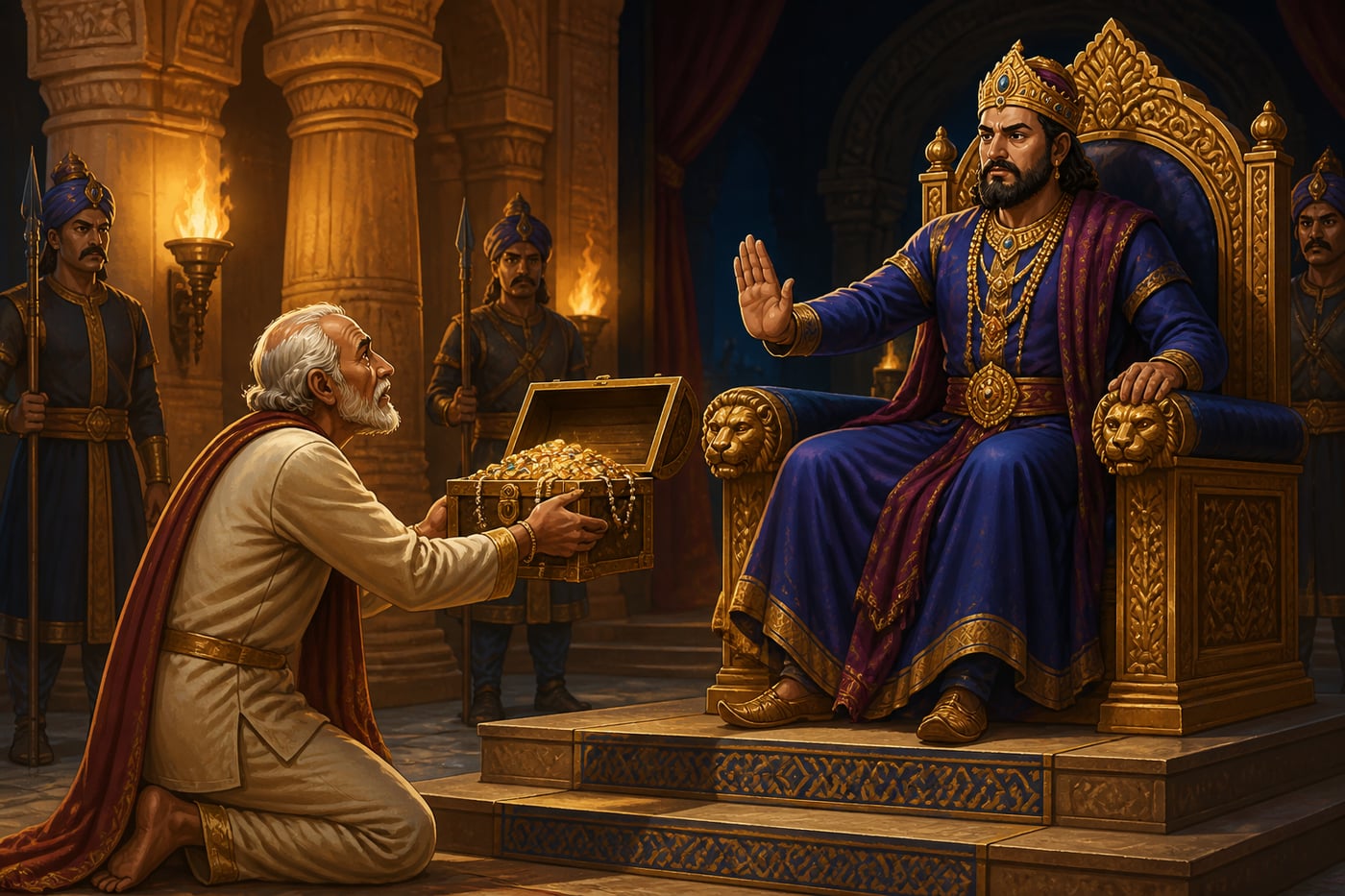
Ratnadatta was a merchant, and he did what a merchant could. He went to King Viraketu and offered his entire fortune for the thief's life. But the man had robbed on so vast a scale that the king would not sell his justice, and he refused.
So Ratnavati bathed, and dressed, and had herself carried in a palanquin to the very ground where the man she had chosen was dying, her old father walking beside her, resolved that if he must die she would follow him into the fire.

And the thief, lifted up on the stake, saw them come. He learned who she was, and what her father had offered, and what she now meant to do. And there, at the end of his life, he did a strange thing. He wept for a moment. Then he laughed a little. And then he died.
The Betaal's Riddle
"So, king," said the Vetala. "A robber, bound on the stake, with death already upon him. He sees the merchant's daughter coming to die at his side, and first he weeps, and then he laughs, and only then does he die. Tell me why. Why the tears, and why the laughter?
You know the rules. Answer, if you know."
You Be the Judge
Stop here, before the king speaks. A man at the very edge of death, who has every reason to grieve for nothing but himself. Instead he weeps, and then, in the same breath, he laughs.
What were the tears for? And what, at such a moment, could there possibly be to laugh about?
Vikram's Verdict
"The tears were for a debt," said Vikramaditya, walking on. "Here was a stranger, a merchant, who had offered his whole fortune to buy back the life of a thief he owed nothing to. Such kindness, given for nothing, asks to be repaid. And the thief knew that he was dying with the debt unpaid, that he would never have the chance to return so great a goodness. That is what he wept for: not his death, but a kindness he could not answer.
"And the laughter was wonder. Here was a woman who had turned away kings, choosing him, a condemned robber, and coming to die at his side. He could not fathom it. The heart makes choices that no reckoning explains, and a man may laugh, even on the stake, at how strange and unaccountable love can be. He wept for what he owed, and he laughed at what he was given. Both were the marks of a heart better than his crimes."
The Dharma
Notice what the king saw. Two opposite things, tears and laughter, in a dying criminal, and most people would have called it the raving of a broken mind. Vikramaditya read them instead as the two truest signs of a noble heart: gratitude for a kindness unearned, and wonder at a love undeserved.
That gratitude has a name, kritajnata, the knowing of what has been done for you. It is counted among the marks of a good person that even at the end, even in agony, their thought is for a debt of kindness rather than for themselves. And the love the maiden gave, and the fortune the merchant offered, were both a kind of grace, anugraha, favour that is not earned and cannot be bought.

And here is the turn the tale keeps for last. Because the thief's heart proved noble at the end, grace answered it. When Ratnavati would not leave his side, Shiva himself was moved, and gave the thief back his life. The robber rose whole, left his old ways, and the same king who had condemned him made him the commander of his army. A life is not sealed by its worst chapter. A single true response, gratitude, wonder, a turning of the heart, can open a door that justice alone had closed.
In Your World
Think of a kindness you can never fully repay: a parent's years, a teacher's patience, a friend who stood by you when it cost them something. You cannot clear a debt like that. What you can do is keep it in mind, and pass the same kindness on to someone else.
And at some point you will receive what you did not earn: forgiveness you had no right to, a second chance, a love that makes no sense on paper. Meet it the way the thief did. Do not treat it as owed to you, and do not sink into guilt about it either. Take it with surprise, and let it push you to become the kind of person who would have deserved it.
Reflection
- You judged the thief's tears and laughter before the king spoke. Did you read them as a broken man's raving, or as the signs of a heart better than his crimes?
- Whose kindness are you carrying that you have never repaid? What would it mean to carry that debt well, rather than to forget it?
- When have you received something you did not earn: forgiveness, a second chance, a love that made no sense on paper? Did you meet it with entitlement, with guilt, or with wonder?