Talapatram

Anangamanjari and Kamalakara

A wife, her beloved, and the husband she scorned all die of love in a single garden. Which of the three loved the most deeply? The answer is the one who was wronged.

Anangamanjari, unable to love the husband who adores her, falls for the brahman Kamalakara. When at last they meet, she dies of joy in his arms, he dies of grief beside her, and her returning husband Manivarman, finding her dead for another man, dies of sorrow rather than rage. Which of the three loved the most deeply? You judge first, then the king does.

The Burning Ground

For the last time that night, the king cut the corpse loose and carried it out onto the ash. The pattern no longer needs describing. The Vetala stirred and told its last tale of the night.

Three Hearts in Vishala

In the city of Vishala there lived a merchant named Arthadatta, whose daughter, Anangamanjari, was as lovely as a nymph of heaven. She was married to Manivarman, a merchant's son from a distant city, and her father kept the young couple in his own house. Manivarman adored his wife past all reason. But she could not love him; something in him she simply found distasteful, and no devotion of his could change it.

When the hot season came, Manivarman went home for a while to visit his parents. And in his absence, Anangamanjari, standing one day at her window, saw a young man pass in the street below. His name was Kamalakara, and he was the son of the king's own chaplain. In the space of a single look, each was lost to the other.

Her longing grew so fierce that she nearly took her own life, and it was her confidante Malatika who held her back, and who carried word gently between the two. Anangamanjari prayed to the goddess that if she could not have Kamalakara in this life, she might have him in the next. At last Malatika arranged for the two to meet in a garden, beneath a flowering mango bower.
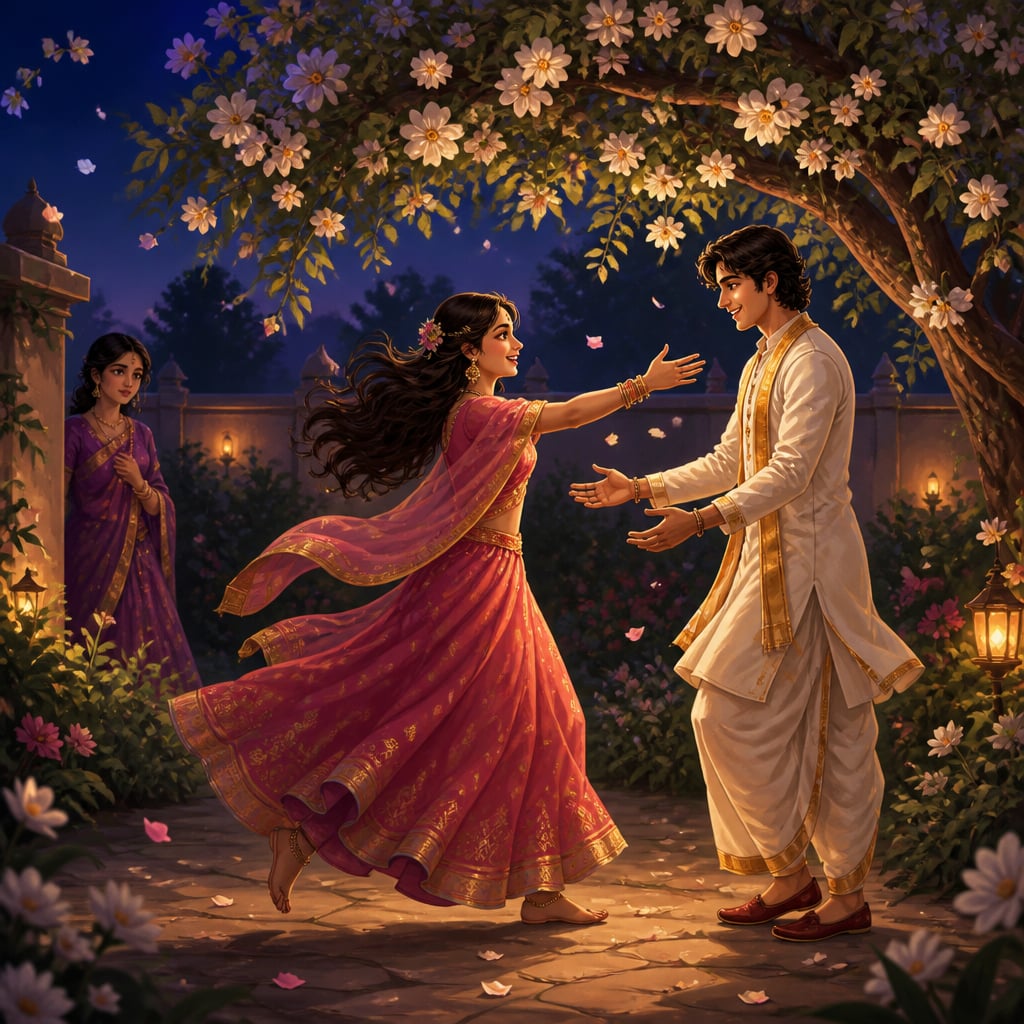
Anangamanjari running to Kamalakara in the garden

When the moment came, Anangamanjari ran to him with her arms open, crying, where are you going? I have caught you. And in that very instant, from the sheer force of her joy, her heart gave way, and she died. Kamalakara, seeing the woman he loved fall dead at the moment of their meeting, was so broken that his own heart burst, and he died beside her.

Manivarman grieving beside them in the garden

And then Manivarman came home. He walked into that garden and found his wife lying dead, and beside her a dead man he did not know, and he understood at once that she had died of love for another. He had every reason in the world for rage. Instead, only grief took him, and it was so heavy that his heart too gave way, and he died there among them.

The Betaal's Riddle

"So, king," said the Vetala. "Three people, all dead of love in a single garden. The woman died of joy at meeting her beloved. The beloved died of sorrow at losing her. And the husband, wronged and betrayed, with every right to fury, died only of grief. Of these three, blinded by love, which one loved the most deeply?

Answer, if you know. You know the rules."

You Be the Judge

Answer this one yourself, before the king does. The wife's love burned so hot it killed her at the first touch. The beloved's love could not outlast her death by a single breath. The husband loved a woman who did not want him, found her dead in another man's company, and mourned instead of raged. Whose love, would you say, ran the deepest?

Vikram's Verdict

"The husband, Manivarman," said Vikramaditya. "The other two are the easier to understand. The wife and her beloved had let their passion grow until it filled them completely, and a passion that full can kill with joy as easily as with grief; their deaths, wild as they were, follow from that. Their love, for all its fire, still wanted something. It wanted the other, and it broke in the same instant it got its wish.

"But look at the husband. He loved a woman who did not love him back, and never had. He came home to find her dead for the sake of another man, lying beside that man in a garden. Every law of the heart gave him leave to be angry, and a smaller love would have turned in that instant to hatred. His did not. He felt no anger at all, only a grief so deep that it stopped his heart. That is the deepest love of the three, because it was the only one with no self left in it. It asked nothing back, it was not even answered, and still it did not fail. That is the most complete love a person can carry."

The corpse was gone from his back, up into the branches again.

The Dharma

All three burned in the same fire. The tradition has a name for it: kama, desire, which the Gita calls an insatiable flame, the constant enemy that veils the mind. The fire was equal in all three, so it could not be what set them apart.

What set them apart was the self. The wife's love and the beloved's love, for all their intensity, were reaching for something: each wanted the other, and each died in the having or the losing of it. There was a self at the centre of that love, a self that wanted. Manivarman's love had none. He wanted nothing from her, expected nothing, was owed nothing, and even betrayal could not turn his love to anger. This is what the tradition calls prema, as against kama: love that seeks the good of the beloved and not its own, and asks for no return. That is why the king, weighing three deaths by one fire, called the husband's love the deepest. The measure of love is not how hot it burns, but how little it asks for itself.

And do not miss the warning the tale keeps underneath. Even this purest love killed the man who carried it, and the goddess, when she raised all three back to life, is said to have freed them from their passion as she did so. Love at its highest is the finest thing a heart can hold. Love that masters you, rather than one you learn to hold, can still burn your life to the ground. Both of these are true, and the wise carry both.

In Your World

We measure our love by how much we feel: the intensity, the ache, the fire. This tale measures it another way, by how little we ask in return.

Watch where your love keeps a ledger. So much given, so much owed back; you were there for me, so I will be there for you; I love you as long as you love me. That is real, and human, and most of our loving is made of it. But it has a self at its centre, and the self keeps count. The rarer and deeper love keeps no count at all: the parent who loves a child who gives nothing back for years, the friend who forgives before the apology arrives, the one who is wronged and answers with sorrow instead of spite. Your love has grown deep when it stops asking to be repaid. And it has grown wise, not just deep, when you can hold it without letting it consume you.

Reflection

  • You judged the three before the king spoke. Did you crown the hottest passion, or the love that asked for nothing back?
  • Where do you love with a ledger, quietly keeping count of what you give and what you get back? And where do you love freely, keeping no count at all?
  • Manivarman grieved where he could have raged. When you have been wronged in love or friendship, did you answer with anger or with sorrow, and what did that reveal about the love beneath it?

More in The Weight of the Heart

All lessons in The Weight of the Heart ยท Vikram & Betaal ebook course