Talapatram

Harisvamin's Misfortunes

A grieving brahman dies of poison that reached his food by pure accident. A kite, a dead snake, a kind couple: who is the murderer? The answer is no one.

Harisvamin loses his wife to a sky-faring sorcerer and wanders in grief. Starving, he is given a bowl of rice by a charitable brahman's wife. As he sits to eat beneath a tree, venom drips unseen from a dead snake carried by a passing kite, and he dies. The Betaal asks who is guilty of his death, and the king answers that not one of them is. You judge first, then the king does.

The Burning Ground

The corpse went back to the tree, and the king climbed and brought it down again. He tied it fast, lifted it to his shoulder, and stepped back into the ash. The Vetala settled itself and began.

Harisvamin's Long Sorrow

In Varanasi there lived a wealthy brahman named Harisvamin, the son of Devasvamin, and he had a wife of such rare beauty that people said the maker of the world must have shaped her only after long practice on the nymphs of heaven. Her name was Lavanyavati.

Madanavega carrying Lavanyavati through the night sky

One night, a sky-faring sorcerer, a Vidyadhara prince named Madanavega, was passing overhead and saw her sleeping. Seized by her beauty, he swooped down, gathered her up still asleep, and carried her away through the air. Harisvamin woke to an empty bed and searched everywhere and found nothing. Broken by the loss, he gave away all his wealth and set out on pilgrimage, wandering from one holy place to the next, half in the hope of finding some trace of her, half because a grief that great cannot sit still.

One day, worn thin by the sun and by hunger and by sorrow, he came to a village where a good brahman named Padmanabha was performing a sacrifice. Padmanabha's wife saw the starving traveller at their door and her heart went out to him. She filled a bowl with rice boiled in milk, sweetened with sugar and ghee, and gave it to him, and told him to go and eat in the cool by the lake.
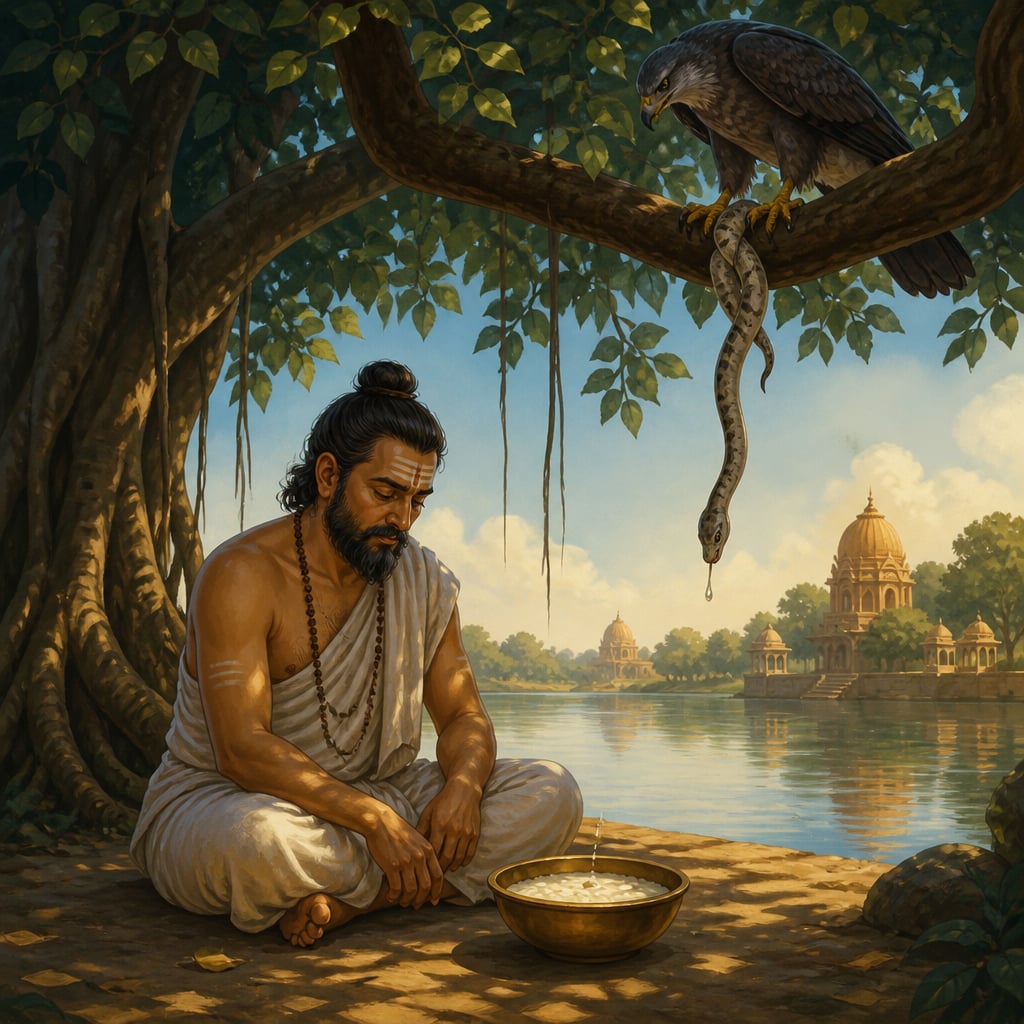
Harisvamin beneath the banyan as venom falls

Harisvamin carried the bowl to the shade of a banyan tree and set it down, grateful at last, and made ready to eat. He did not see what happened above him. A kite came flying with a black snake clutched dead in its claws, and settled on a branch of that same tree to eat its catch. And from the mouth of the dead snake a little venom dripped, and fell, unseen, into the bowl of rice. Harisvamin ate, and the poison took him, and he died there beneath the tree, saying only that when fate turns against a man, the whole world turns along with it.

The Betaal's Riddle

"So, king," said the Vetala. "A brahman lies dead of poison, and to kill a brahman is counted the heaviest of all crimes. But whose crime is it? The kite, who carried the snake? The snake, whose venom did the deed? Or the good couple, who gave the food that killed him? Name the murderer.

Answer, if you know. You know the rules."

You Be the Judge

Pause here, with the corpse still on the king's shoulder. A man is dead of poison, and everything in us says a death like this must have a doer. Three stand in the frame: a bird, a dead snake, a kind woman and her husband. Point, if you can, to the guilty one.

Vikram's Verdict

"There is no murderer here," said Vikramaditya. "Not one of them is guilty.

"Look at each in turn. The snake was already dead, carried helpless in the claws of the creature that was eating it. A thing that is prey in another's grip commits no crime; the venom it dripped, it did not choose to drip. The kite did nothing but what a kite does: it caught its natural food and carried it to a branch to eat, hungry as every living creature is. There is no fault in a bird feeding itself. And the couple were people wholly given to right living, and what they did was the purest act in the whole tale: they saw a starving stranger and they fed him. Charity freely given is not a crime, whatever happens to follow it.

"None of the three meant harm. None of them broke a duty. A death took place, but a death is not the same as a murder. And I will say more. The only person who could earn any guilt in this tale is the one foolish enough to lay the killing of a brahman upon any of these three. To manufacture a culprit where there is none is itself the sin."

The weight left his shoulder; the corpse hung in the tree once more.

The Dharma

Hold this verdict beside the one just before it. In the last tale, a death traced back along a whole chain to a single guilty man, the king who failed his duty. Here is a death with a chain just as long, and at the end of it, no one. Guilt was real in the one case and wholly absent in the other, and the difference between them is the thing to carry away.

The difference is intention. The king was bound to keep watch over his realm and did not; his failure was a real choice, a real neglect of a real duty. But the kite meant only to eat, the snake meant nothing at all, and the woman meant only kindness. Where there is no intention to harm and no duty betrayed, there is no guilt, however terrible the outcome. This is why the tradition weighs an act by its bhava, the intent within it, and not by its result alone. The Gita says it without flinching: the one who acts with no will to harm, though a death should follow from his hand, is no slayer, and is not bound.

What killed Harisvamin, then? The tale gives it a name of its own: daiva, fate, the working of things beyond any hand. His own last words were the whole teaching. When fate turns, the world turns with it. Some sorrows are nobody's crime. They are simply the hardest face of a world we do not command.

In Your World

When something terrible happens, the mind goes hunting for the one who did it, and it will not rest until it finds someone. If there is no real culprit, it will invent one. We blame the doctor for the illness that was always going to win, the friend who made the introduction that ended badly, the parent, the messenger, ourselves.

Learn the king's discipline. When you go looking for who is to blame, ask first whether there is any blame to assign at all. Was there real intent, or a real duty broken? If neither, then you are not facing a crime but a grief, and the honest thing, the harder thing, is to let it stay a grief. Do not punish a blameless person, yourself included, for a sorrow that no one chose.

Reflection

  • You judged the kite, the snake, and the couple. Did you feel the pull to pin the death on someone? Where did that pull want to land, and why there?
  • When has a good act of yours led, by accident, to a bad outcome? Did you, or others, treat you as guilty for it, and was that fair?
  • Where in your life do you demand a villain for every loss? What would change if you allowed that some losses have no villain at all?

More in The Weight of the Heart

All lessons in The Weight of the Heart ยท Vikram & Betaal ebook course